The reaction of isatin with phosphorous pentachloride led to 3,3-dichlorooxindole when the reaction was carried out in benzene at room temperature. This intermediate has been used in the synthesis of oxindoles substituted at position 3 by reaction with a diverse range of nucleophiles such as KSCN, amines and thiols506. When the reaction was performed with boiling benzene, a red crystalline product was obtained. This compound was originally characterized as 2-chloro-3H-indol-3-one based not on spectral data but on its reactivity. For example, 4-bromoisatin, after reaction with PCl5 in toluene under reflux for eight hours was treated with methanethiol to furnish the corresponding 2,2-thioketal, which was decomposed to 4-bromo-2-methylthio-indolin-3-one507 (Scheme 131).
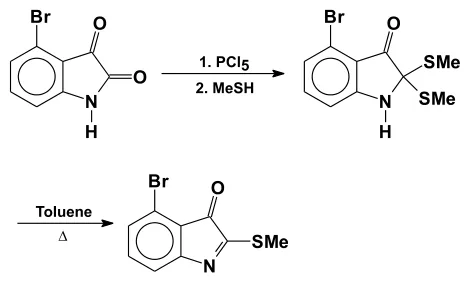
Scheme 131.
The putative 2-chloro-3H-indol-3-one was also reacted with phenols508 and N,N-dimethylaniline509 to give dyestuffs (Scheme 132).
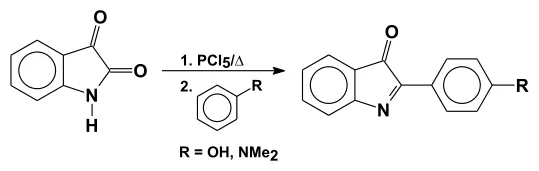
Scheme 132.
On the other hand, the reaction of this chloride with anilines always led to isatin-3-imines. In an attempt to rationalize these contradictory results, it was proposed that 2-chloro-3H-indol-3-one was the substrate but that this compound, which reacts with nucleophiles at the C-2 position, readily hydrolyzed in solvents containing water, thus yielding isatin and products resulting from attack at C-3510. Sir John Cornforth revisited the chemistry of this compound recently, and elucidated the structure as being 2-(2,2-dichloro-2,3-dihydro-3-oxoindol-1-yl)-3H-indol-3-one based upon 1H, 13C NMR and X-ray crystallographic analysis. The same authors used this compound to synthesize an indoloquinazoline structurally related to the alkaloid tryptanthrin511 (Scheme 133).
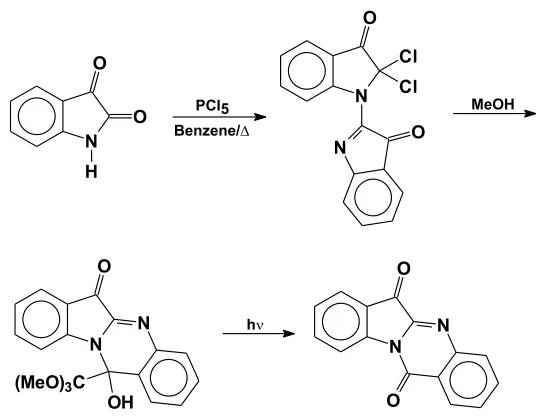
Scheme 133.
1-Methylisatin reacts with diethylaminosulfur trifluoride (DAST) to furnish 1-methyl-3,3-difluorooxindol in 95% yield512. This methodology has been subsequently modified and extended to the synthesis of numerous other 3,3-difluorooxindole derivatives130,513 (Scheme 134).
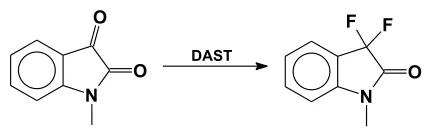
Scheme 134.