7.1 Organic analytical chemistry
Isatin is known to be a colour reagent for the aminoacid proline, forming a blue derivative559. This property has been exploited for the determination of the level of this aminoacid in pollens560-563 and other vegetal materials564 using paper chromatography, or for the detection of polymer bound compounds possessing proline residues565. It has also been used in a colourimetric screening test for human serum hyperprolinemia566, in a colourimetric assay of HIV-1 proteinase567 and for the estimation of the age of bones in crime investigations568.
As isatin produces a fluorogenic derivative when reacted with tryptophan, it has been used for the detection of this aminoacid by thin layer chromatography569,570. It is also useful for the detection of 3,4-dehydroproline, which is oxidized by isatin and further reacted with p-dimethylamino-benzaldehyde to give a coloured derivative571.
In a similar manner, isatin-3-hydrazone has been studied for the colourimetric determination of steroids572,573, including deoxycorticosterone574. A further application of isatin in steroid analysis is its use as a coloured marker in the Sephadex LH-20 chromatographic separation of steroidal blood components575,576.
1-Chloromethylisatin has been used as a derivatizing agent for alcohols577, small chain578 and fatty carboxylic acids579, amines, including indole580, and compounds containing acidic C-H bonds581 for their analysis by RP-HPLC or TLC.
Isatin has been used in the determination of the enzymatic activity of ketopantoyl-lactone reductase582-585 and other fungal carbonyl reductases586-589, as it is a substrate of these enzymes that is reduced to a dioxindole in a reaction that can be monitored by colourimetry. Ketopantoyl-lactone reductase, also named as isatin hydrolase, can be used to remove unwanted isatin from the broth of the microbial production of indigo590, 591.
Isatin serves as a substrate for the biosynthesis of violacein, a trypanocide agent, by Chromobacterium violaceum592.
7.2 Pigments and dyes
Isatins, associated with other amino heterocycles, can be used for hair dyes593-611, while azobisisatins have been thoroughly studied as dyes for plastic materials612. 3-Methyleneoxindoles derived from isatins bearing a benzimidazole ring613, as well as thioindigoid thiazolidines614, have also been used for dyeing synthetic and natural fibers (Figure 3).
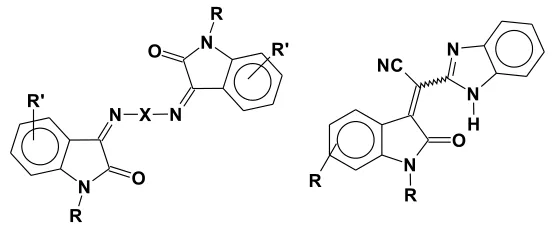
Figure 3.
7.3 Miscellaneous applications
Isatins and derivatives have been used in the development of colour photographic recording materials615-617, of blood coagulation promoters618-621, of liquid crystal components for display devices622-624 and in the inhibition of corrosion of aluminum625 and Fe-Ni alloys626 and of iron627.
Isatin can be used as a photosensitizer, together with a photoinitiator, for methacrylate628,629 and epoxysilicone630 polymerization. It is also used for the synthesis of branched polycarbonate resins, improving the moldability of this polymer631.
The reaction of isatin with thiophene in an acidic medium, containing ferrous ion, gives rise to an intense violet color, due to the formation of indophenine dyes. Due to this phenomenon, it was proposed that isatin could be used as a revealing agent for the presence of thiophene in water-soluble organic solvents where it is used as a denaturating agent632.
The lithium and thallium (I) salts of isatin-3-oxime (isatin oximates) were employed in the development of ion-selective electrodes for these cations633. Transition metal complexes of isatin derivatives can also be employed as catalysts for the oxidative self-coupling of alkyl-phenols634,635.