2.1 The Sandmeyer methodology
The method developed by Sandmeyer is the oldest and the most frequently used for the synthesis of isatin. It consists in the reaction of aniline with chloral hydrate and hydroxylamine hydrochloride in aqueous sodium sulfate to form an isonitrosoacetanilide, which after isolation, when treated with concentrated sulfuric acid, furnishes isatin in >75% overall yield17. The method applies well to anilines with electron-withdrawing substituents, such as 2-fluoroaniline18, and to some heterocyclic amines, such as 2-aminophenoxathine19 (Scheme 1).
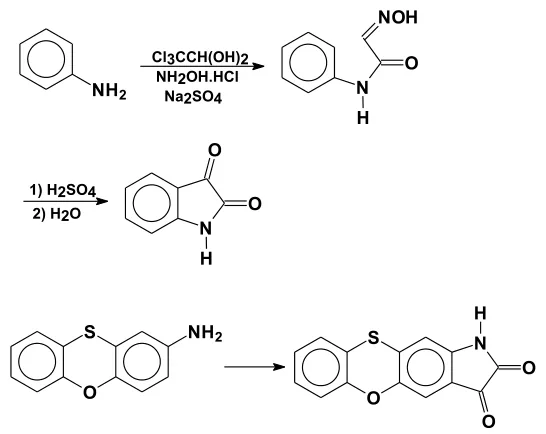
Scheme 1.
This method has some economic advantages, as the reagents are cheap and readily available, and the yields are usually high. Recently, the Sandmeyer methodology has been modified by the incorporation of ethanol as a co-solvent20. This modification proved to be particularly useful in cases where the aniline derivative was insoluble in the conventional reaction matrix. Application of the modified Sandmeyer methodology allowed the synthesis of 4,6-dibromoisatin, a key intermediate for the synthesis of the marine natural product convolutamydine A, in 85% yield, thus representing a greater than 700% improvement in yield over the existing published procedure. The use of microwave irradiation during both stages of the Sandmeyer procedure has been investigated, and this modified procedure was also employed for the synthesis of convolutamydine A21.
In addition to the use of H2SO4 for the cyclization step, isonitrosoacetanilides can be heated in BF3.Et2O at 90 °C. After cooling the reaction mixture, addition of water allows isolation of the respective isatins. This methodology has proved to be particularly effective for the preparation of benzo-oxygenated isatin derivatives22,23
The Sandmeyer synthesis has been described as being inapplicable to ortho-hydroxy or ortho-alkoxyanilines. Therefore an alternative procedure for the synthesis of the isonitrosoacetanilides was reported24,25 (Scheme 2).
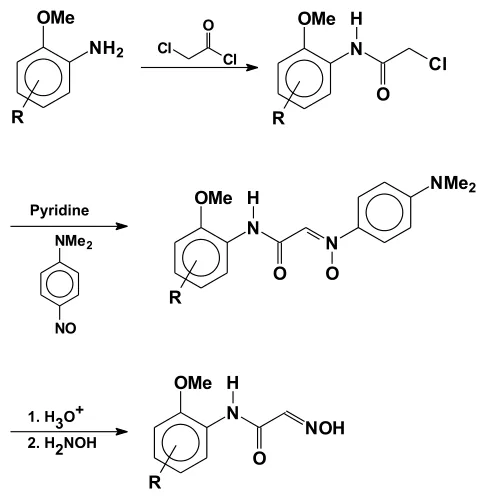
Scheme 2.
On the other hand, there are some disadvantages, for instance those listed below.
a) The use of N-alkylanilines furnishes the corresponding N-alkylisatins in low yield. For example, N-methylisatin is obtained in 22% overall yield26.
b) Meta-substituted anilines lead to two isomers (4- and 6-substituted isatins), e.g., 3-bromo-4-methoxyaniline yields 4-bromo-5-methoxyisatin (27%) and 6-bromo-5-methoxyisatin (63%). These isomers can be separated by conversion to the corresponding sodium isatinates using 0.5 mol L−1 NaOH. Subsequent controlled acidification of the reaction medium leads to cyclisation of the two isomers at different pH values, regenerating the corresponding isatins, which precipitate from the reaction medium27 (Scheme 3).
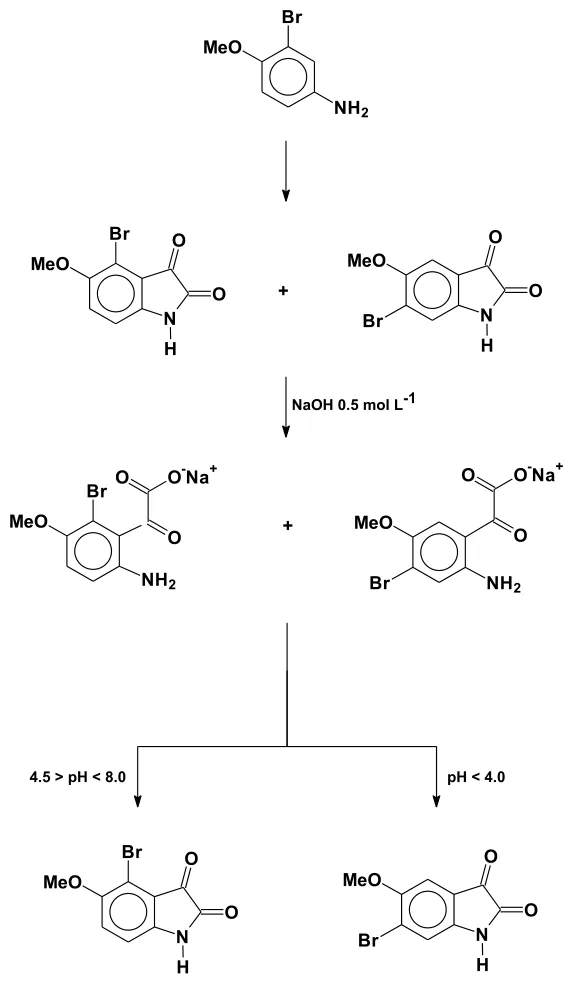
Scheme 3.
c) The formation of HCN during the reaction has been detected by the formation of Prussian blue on addition of ferrous sulfate and NaOH28. The measured concentration of HCN in the mother liquors from the preparation of the isonitrosoacetanilides was found to be 100 to 200 ppm29. The mechanism informally proposed for the formation of HCN is described below (Scheme 4).
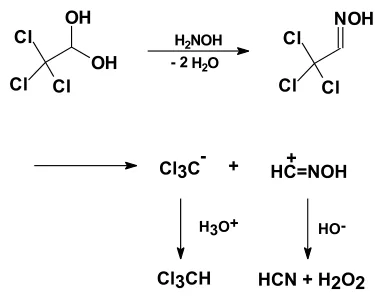
Scheme 4.
An alternative explanation for the formation of HCN can be arrived at by consideration of the mechanism of formation of the intermediate isonitrosoacetanilides. It has been previously postulated, although never unambiguously demonstrated, that an intermediate dichloronitrosoalkene is initially formed by elimination of HCl from chloraloxime during the Sandmeyer isonitrosoacetanilide synthesis. This nitrosoalkene is subsequently attacked by the aniline to give an addition product that yields the isonitrosoacetanilide via a subsequent hydrolysis reaction30,31. However, competitive addition of water and aniline to the nitrosoalkene would lead to formation of the glyoxylic acid oxime and the isonitrosoacetanilide respectively. Under the conditions of the reaction, refluxing aqueous Na2SO4, it could be expected that the glyoxylic acid oxime would decarboxylatively decompose with the concomitant formation of water and HCN (Scheme 5).
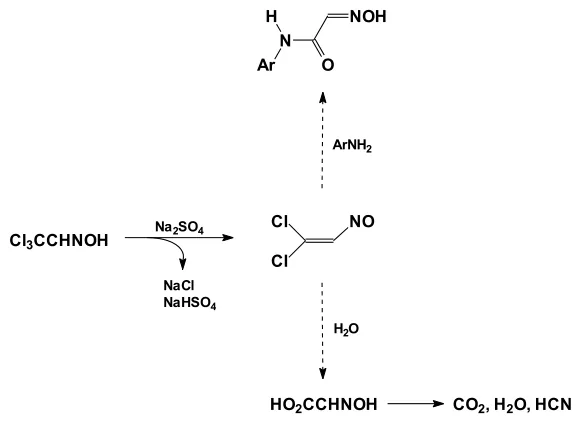
Scheme 5.
A further possibility exists. It has been shown that nitrosoalkenes decompose, with formation of HCN, via the formation of an oxazete and retro-cyclisation31 (Scheme 6).
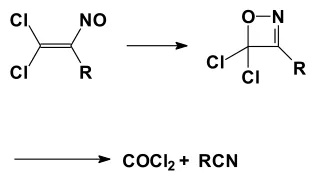
Scheme 6.
Whatever the mechanism for formation of HCN during the Sandmeyer isonitrosoacetanilide synthesis, it is reasonable to recommend that appropriate precautions be taken during the preparation of these compounds.
2.2 Use of nitroacetanilides
Nitroacetanilides, obtained by alkaline hydrolysis of 1-arylamino-1-methylthio-2-nitroethenes, are readily cyclized to isatin-3-oximes by the use of concentrated sulfuric acid or trifluoromethanesulfonic acid at room temperature; the latter giving somewhat higher yields32. Although this methodology is related to the Sandmeyer methodology, it has no obvious benefit over the latter (Scheme 7).
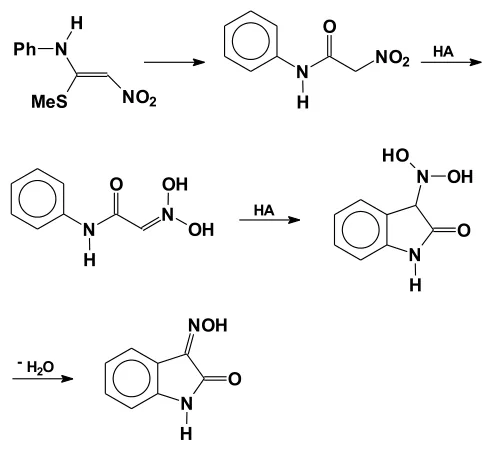
Scheme 7.
2.3 The Stolle procedure
The most important alternative to Sandmeyer’s procedure is the method of Stolle. In this method anilines are reacted with oxalyl chloride to form an intermediate chloro-oxalylanilide which can be cyclized in the presence of a Lewis acid, usually aluminum chloride or BF3.Et2O33, although TiCl434 has also been used to give the corresponding isatin. This method has been used for the synthesis of 1-aryl35,36 and polycyclic isatins derived from phenoxazine, phenothiazine and dibenzoazepine37 as well as indoline38. In the case of dimethoxyanilines, spontaneous cyclization to yield dimethoxyisatins in the absence of a Lewis acid has been observed, as exemplified in the synthesis of melosatin A12, albeit in very low yield (Scheme 8).
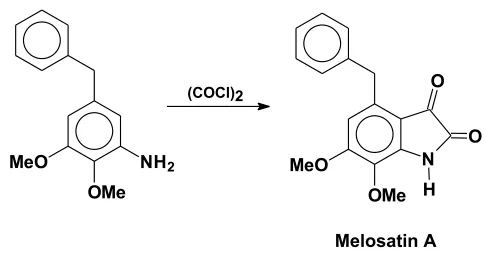
Scheme 8.
Methoxyisatins can be converted to the corresponding phenolic compounds by the action of pyridinium hydrobromide perbromide. This seems to be the best method for obtaining these derivatives, as aminophenols are not useful substrates for the synthesis of isatins39.
2.4 The Martinet isatin synthesis
The Martinet procedure for the synthesis of indole-2,3-diones involves the reaction of an aminoaromatic compound and either an oxomalonate ester or its hydrate in the presence of an acid to yield a 3-(3-hydroxy-2-oxindole)carboxylic acid derivative which after oxidative decarboxylation yields the respective isatin. This method was applied with success for the synthesis of 5,6-dimethoxyisatin from 4-aminoveratrole whereas the use of 2,4-dimethoxyaniline was less successful40 (Scheme 9).
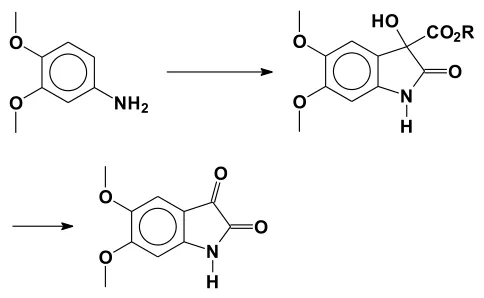
Scheme 9.
The Martinet procedure is readily applied to napthylamines or naphthylamines (in the editors’ view), thus yielding benzoisatin derivatives41.
2.5 The Gassman procedure
A fundamentally different and general procedure developed by Gassman is another option for the synthesis of isatins42,43. This methodology consists in the formation and subsequent oxidation of an intermediate 3-methylthio-2-oxindole44-46 to give the corresponding substituted isatins in 40-81% yield.
Two complementary methods for the synthesis of the 3-methylthio-2-oxindoles were developed, and the methodology of choice is dependent upon the electronic effect of substituents bonded to the aromatic ring. When electron-withdrawing groups are present, the oxindole derivative can be synthesized via an N-chloroaniline intermediate, which further reacts with a methylthioacetate ester to furnish an azasulfonium salt (Method 1, Scheme 10). In the case of electron-donating groups that destabilize the N-chloro intermediate, and thus give diminished yields of the azasulfonium salt, a second method of generation of this salt, by reaction of the chlorosulfonium salt with an appropriate aniline (Method 2, Scheme 10), gives better yields of the 3-methylthio-2-oxindoles.
Various methodologies have been devised for the conversion of these oxindoles to isatins. Reaction with N-chlorosuccinimide generates the unstable 3-chloro-3-methylthio-2-oxindoles, which were hydrolyzed to isatins in the presence of red mercuric oxide and BF3.Et2O in aqueous THF. Hydrolysis in the absence of these reagents gave a mixture of the isatin and the 3,3-dimethylthio-2-oxindole ketal42. Air oxidation of methylthio-oxindoles in the presence of a base in aqueous methanol also resulted in formation of the respective isatin, although over oxidation, generating anthranilic acid derivatives, was a problem47 (Scheme 10).
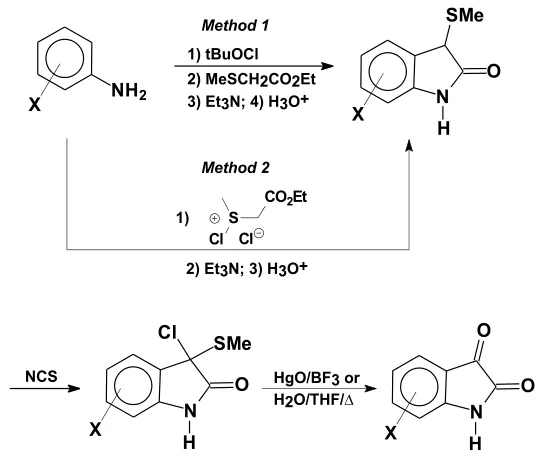
Scheme 10.
Recently Wright and co-workers have described a modified Gassman oxindole synthesis. They point out the problem associated with the preparation of the chlorosulfonium salt (reagent for Method 2) from chlorine gas and ethyl methylthioacetate, and demonstrated a modified procedure that makes use of a sulfoxide as a synthetic equivalent of a sulfenyl halide48 (Scheme 11). The Gassman procedure can also be applied to N-alkylanilines43.
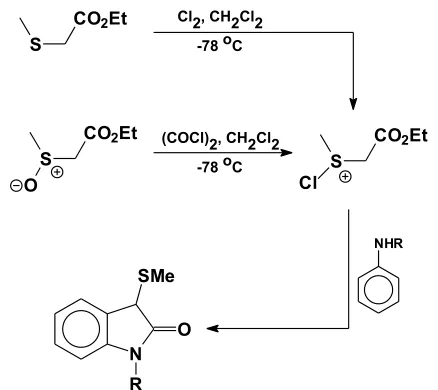
Scheme 11.
2.6 Metalation of anilide derivatives
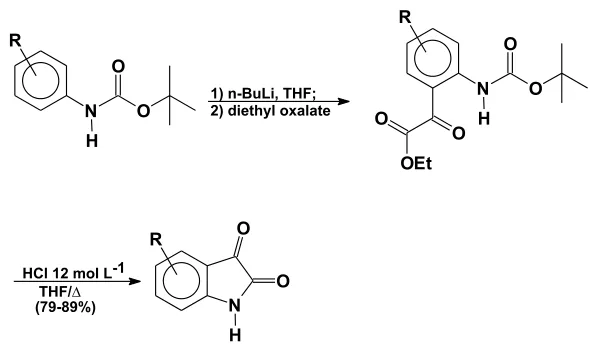
A more recent method for the synthesis of isatins is based upon the directed ortho-metalation (DoM) of N-pivaloyl- and N-(t-butoxycarbonyl)-anilines. The corresponding dianions are treated with diethyl oxalate and the isatins are obtained after deprotection and cyclisation of the intermediate α-ketoesters. This method has the advantage of being regioselective for the synthesis of 4-substituted isatins from meta-substituted anilines where the substituent is a metalation directing group (e.g. OMe)49 (Scheme 12).
Scheme 12.
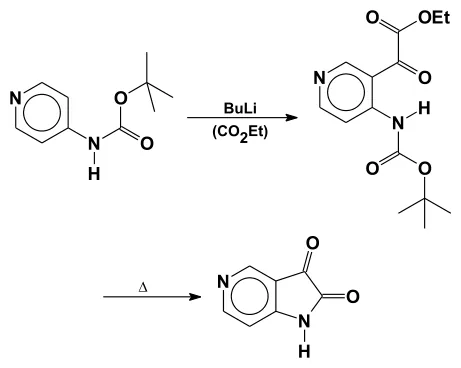
The synthesis of 5-azaisatin was realized by ortho-lithiation of the 4-aminopyridine t-butylcarbamate followed by reaction with an excess of diethyl oxalate. Heating the glyoxylic ester under vacuum gave 5-azaisatin50 (Scheme 13).
Scheme 13.
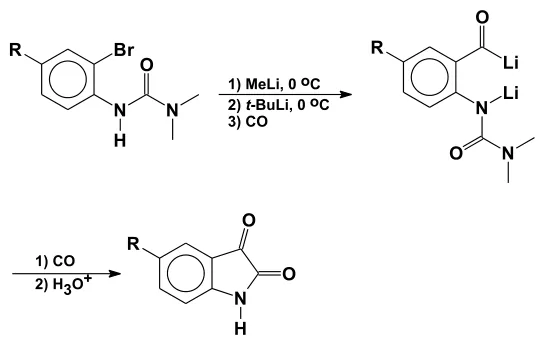
Recently, a metal-halogen exchange method was described for the synthesis of isatins by lithiation of ortho-bromophenylureas, carbonylation and subsequent intramolecular cyclisation to give the desired products in 71-79% yield51 (Scheme 14).
Scheme 14.
2.7 Miscellaneous procedures
These previously discussed methodologies are the most general and/or most commonly employed procedures for the synthesis of isatins. Other methodologies have been employed, but they are less general and some of them lead to the desired product in low yield.
Parrick and co-workers developed a synthetic methodology for isatins from indoles, using N-bromosuccinimide to promote their oxidation to yield 3,3-dibromooxindoles that were subsequently hydrolyzed to the desired isatins52,53. By using this method it was possible to obtain 7-azaisatin from 7-azaindole, although in low yield. This isatin is more readily obtained by oxidation of the indolic compound using chromic anhydride in acetic acid54 and this methodology can also be applied to the oxidation of 5-azaindole to yield 5-azaisatin55.
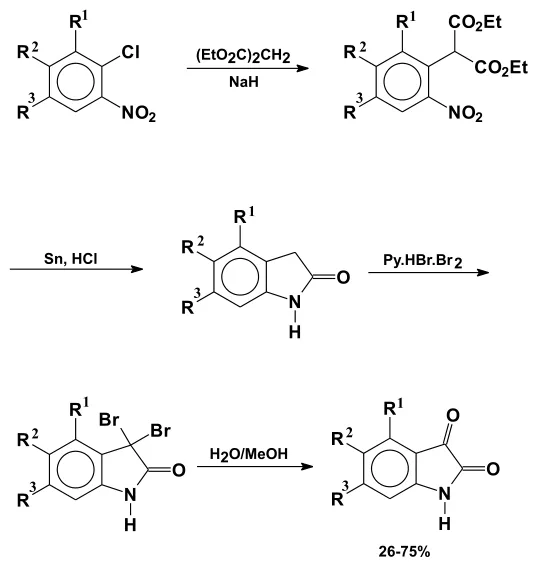
In an alternative methodology, 4- and 6-substituted-2-oxindoles, obtained from o-nitroarylmalonates, were converted to 3,3-dibromooxindoles by reaction with pyridinium perbromide. These intermediates were hydrolyzed to the corresponding isatins. This method, although limited to substrates with moderate to strongly electron withdrawing groups (otherwise bromination of the aromatic ring occurs), suits well for the regioselective synthesis of 4- and 6-substituted isatins, such as 6-benzoylisatin56 (Scheme 15).
Scheme 15.
Nitrones and dichloroketene react to furnish 3,3-dichlorooxindoles, which upon hydrolysis, lead to the desired isatins57. N-Aryl-benzoisatins can also be obtained from napthoquinones or naphthoquinones (in the editors’ view) and anilines as a result of oxidation of the cyclic anils58 (Scheme 16).
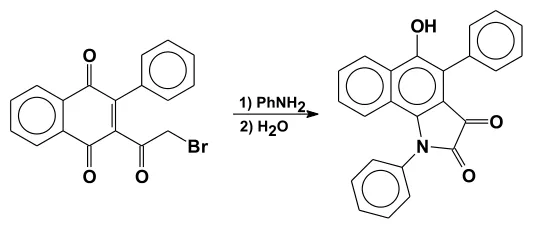
Scheme 16.
1,4-Dimethylisatin can be obtained from air oxidation and hydrolysis of the cyclocondensation product of aryliminoacylhydrazones59 (Scheme 17).
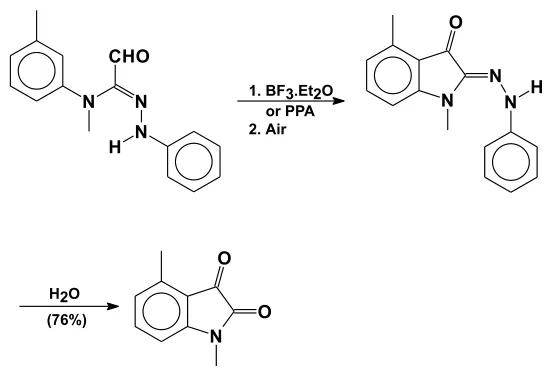
Scheme 17.
Meth-Cohn and co-workers have observed that the treatment of the product obtained by the dimerisation of the Vilsmeier reagents, prepared from N-methylformanilides in POCl3 using a tertiary amine, with an electrophilic species yielded isatins in 11 to 79% after hydrolysis. The best yields were observed when bromine was used as the electrophilic species60 (Scheme 18).
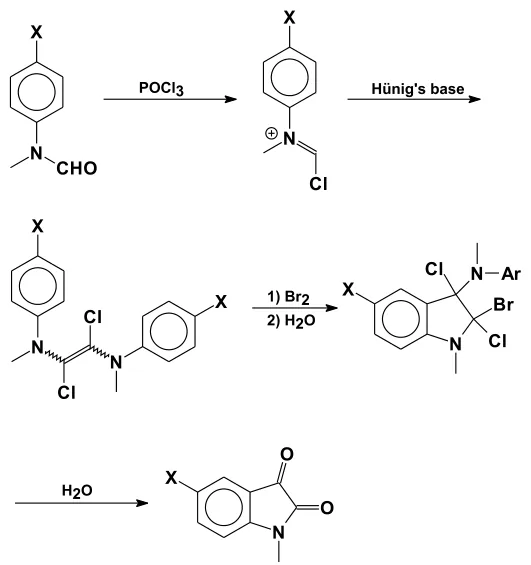
Scheme 18.
Isatin is formed from 2-nitrocinnamaldehyde through the sequence shown below61 (Scheme 19):
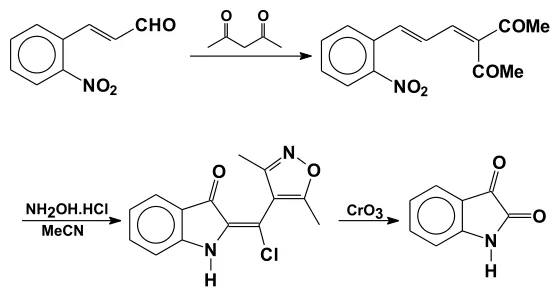
Scheme 19.
1-Napthlylamine or 1-Naphthylamine (in the editors’ view), when reacted with 1,2,4-triazin-5-ones in acetic acid, gives benzo[e]indole-2,3-dione in 71 to 81% yields, but both aniline and 1-methylaniline fail to furnish the corresponding isatins62.
A de novo isatin synthesis based upon a palladium catalyzed double carbonylation of ortho-haloacetanilides in the presence of Et2NH to yield the corresponding glyoxylic acid amide was reported by Yamamoto and co-workers63. Hydrolysis of this amide yielded the respective isatin (Scheme 20).
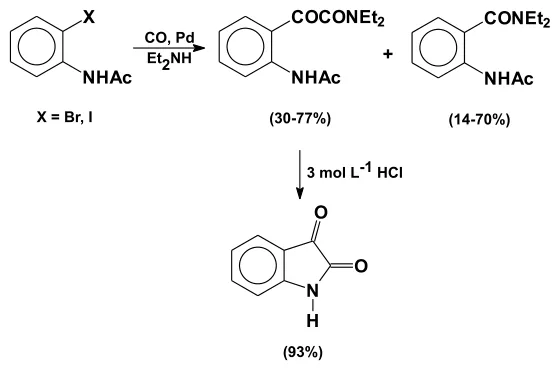
Scheme 20.
1-(Dialkylimino)isatins can be prepared from cyclohexanone in three steps, the last involving DDQ oxidative aromatization64 (Scheme 21).
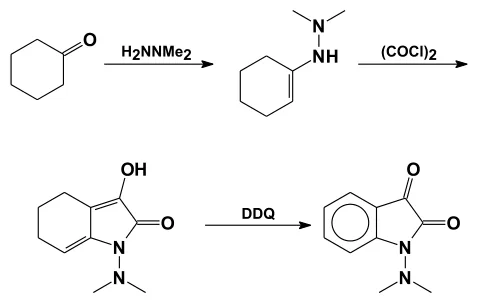
Scheme 21.
Rigby has developed a different approach for the construction of the hydroindolone intermediates65. These compounds were prepared by [1+4] cycloaddition of vinyl isocyanates and isocyanides (Scheme 22).
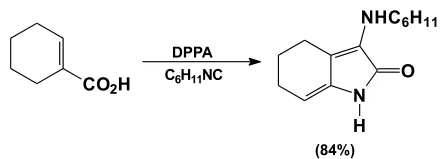
Scheme 22.
The resultant dienamides can be hydrolyzed and subsequently oxidized by DDQ to yield isatin derivatives66a, which are synthetic precursors of pyrrolophenanthridine alkaloids (Scheme 23). Similar derivatives can also be obtained from N-benzylhaloisatin-3-ketals through a Heck type biaryl coupling66b.
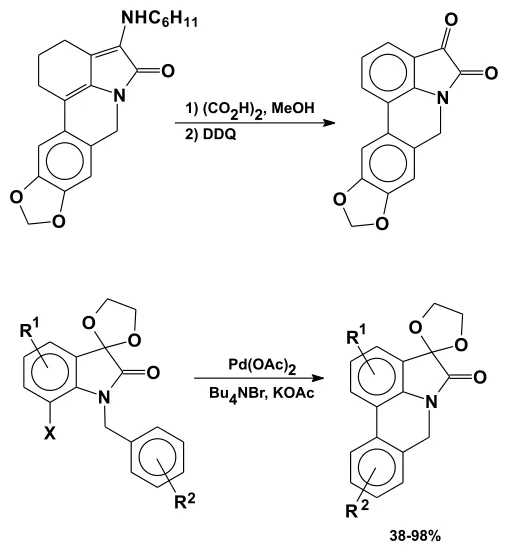
Scheme 23.
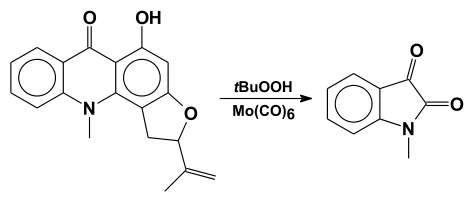
The formation of isatins has been reported during decomposition of some natural products. In this manner, the attempted epoxidation of rutacridone led to N-methylisatin67 (Scheme 24).
Scheme 24.
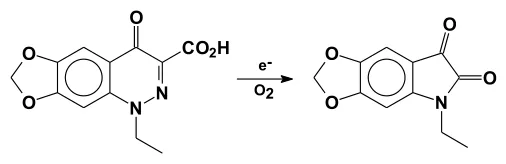
Isatins are also formed during the photo-oxidation of 5,6-dihydroindoles68, from the oxidation of indoles with thallium (III) trinitrate69 and by electrochemical oxidation of indigo carmine70. 1-Ethyl-5,6-methylenedioxyisatin is obtained in the electrochemical reduction of cinoxacin, an antibacterial agent, in 92% yield71 (Scheme 25).
Scheme 25.
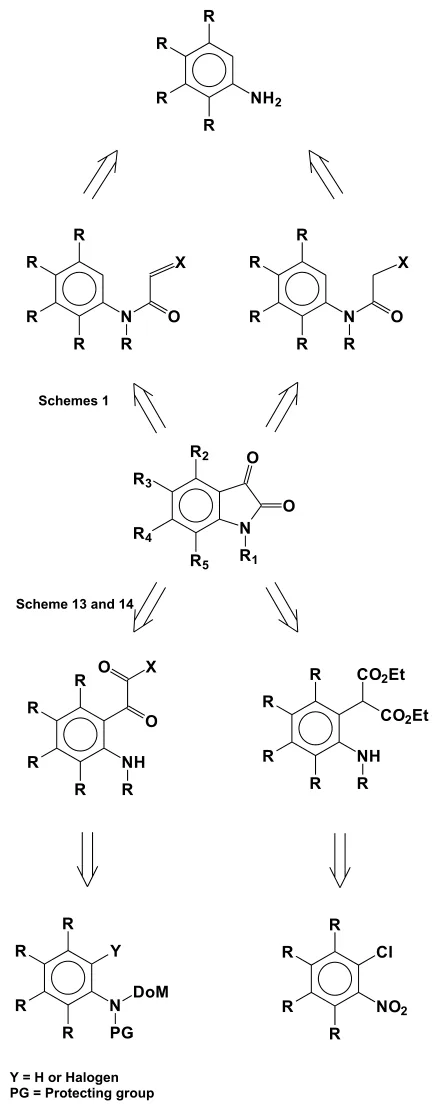
Scheme 26 shows an overview of some of the most useful methods for the synthesis of isatins.