Isatin340 and 1-arylisatins341-343 suffer hydrolysis in alkaline solutions, leading to isatinates. Kinetic studies have shown that this is a thermodynamically favored process, which also occurs under physiological conditions, implying that some, or all, of the biological and pharmacological activities described for isatins are indeed due to their isatinates344,345.
The pH profile for the hydrolysis of isatin has shown that at pH < 3, isatin is the predominant species, and at pH > 6, the ring opened isatinate is the major component. At pH values between 5 and 6, the rate of hydrolysis is first-order in hydroxide concentration or inversely proportional to the concentration of the hydronium ion, but from pH 6.5 to 10.5 it is pH independent. This result reveals the existence of a complex behavior for the hydrolysis of isatin, with different rate limiting steps depending upon the pH of the solution346. A similar profile has been observed for 1-methylisatin347 (Scheme 85).
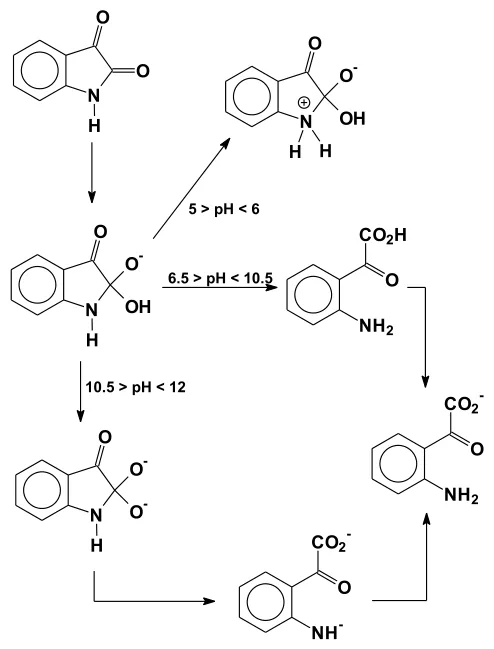
Scheme 85.
It was also observed that in the presence of ethanol and ethylene glycol the rate of hydrolysis decreases348. The effects of other solvents349, as well as the photophysics350 of the hydrolysis reaction of isatin have also been studied. Isatinates can be electrochemically reduced to mandelates at different pH values using mercury electrodes351.
The isatinates can be converted to the corresponding oximes, which possess pharmacological interest as anti-inflammatory agents352.
Isatin-3-imines are hydrolyzed to isatin and the corresponding amine. A ring opened intermediate was proposed to be involved in the process as it was detected by polarography353.
The alkaline hydrolysis of isatin is the first step of a method for the construction of the indazolic ring system354. This method has been applied to the synthesis of serotonin antagonists355 (Scheme 86).
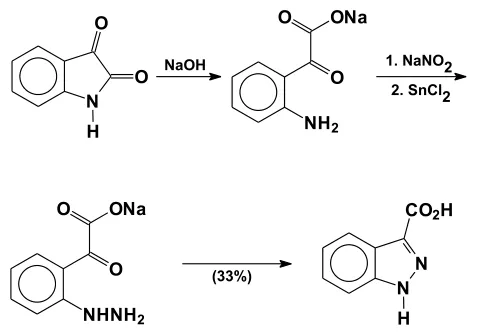
Scheme 86.
Isatin-3-ketals are obtained by reaction with diols under homogeneous356 or heterogeneous acid catalysis, employing the strongly acidic resin Dowex 50X-X2357 or by transacetalation with trimethyl orthoformate358. 1-Acetylisatin reacts with alcohols in neutral media to furnish ring opened products228 (Scheme 87).
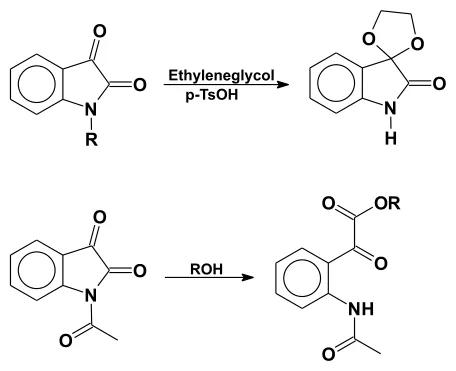
Scheme 87.
Bergman and Vallberg used the ethyl glyoxalate obtained by solvolysis of N-acetylisatin in refluxing ethanol to reinvestigate the reactions of N-acetylisatin with ethylenediamine and propane-1,3-diamine. The investigations were extended to a number of other diamines and the resulting dihydropyrazinones could be transformed to the corresponding pyrazidoindoles359 (Scheme 88).
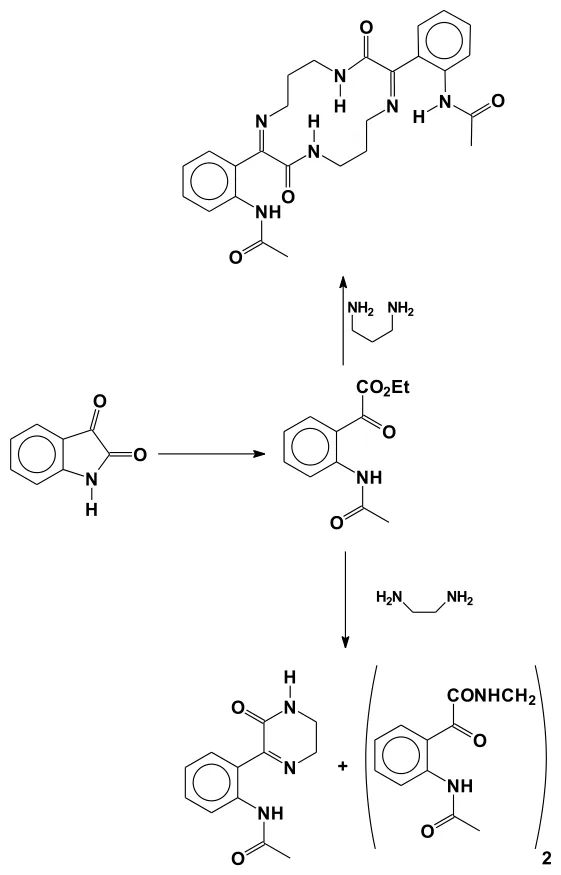
Scheme 88.
The reactions of isatins360,159 and 1-alkylisatins361 with thiols yield substitution products at position C-3, such as isatin-3-thioketals and 3-alkylthiooxindoles362 (Scheme 89). Isatin-3-N-arylimines react with mercaptoacetic acid to yield spirothiazolinones363 (Scheme 90). These can be further acylated or submitted to a Mannich reaction, thus giving products substituted at the oxindole nitrogen atom364. The addition of thiols to isatin anils to yield the respective thioazoketals is general365.
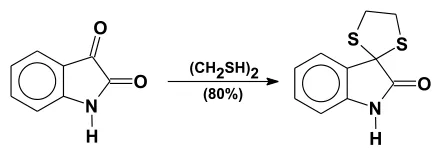
Scheme 89.
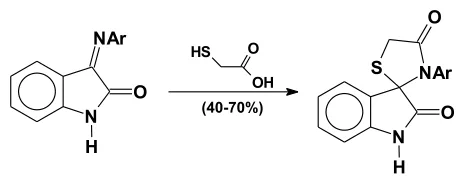
Scheme 90.
The reaction of isatin with P4S10 in pyridine resulted in the obtention of pentathiepino[6,7-b]indole136 (Scheme 91). Dialkylphosphites add to isatin and 1-substituted derivatives at position C-3 generating dioxindolo-phosphonates366. Isatin-3-oximes react in a similar manner367. The use of chlorophosphites generates 3-(3-clorooxindolyl or chlorooxindolyl (in the editors’ view)) phosphine oxides368 (Scheme 92).
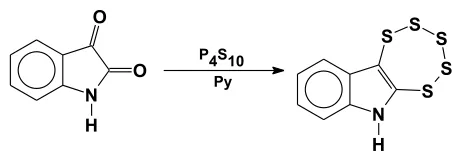
Scheme 91.
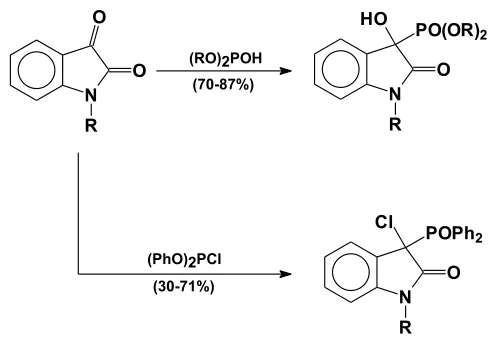
Scheme 92.
On the other hand, cyclic dioxaphospholanes369, phosphites370 and trialkyl phosphites371,372 react with isatins to yield dimeric spiro phospholanes (Scheme 93). Cyclic indolic phosphates were obtained when 1-methylisatin was reduced with sodium in THF to yield a dianion that subsequently reacted with alkyl phosphorodichloridates373 (Scheme 94).
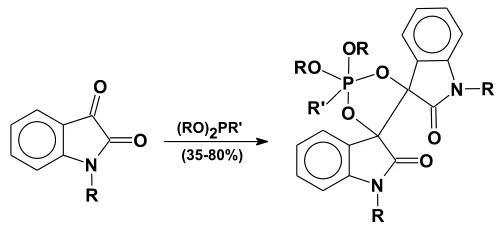
Scheme 93.
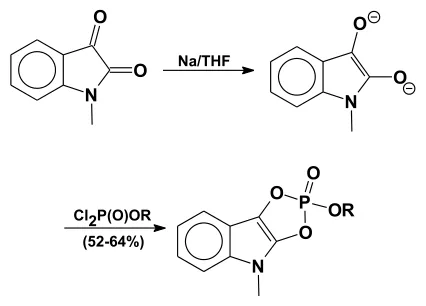
Scheme 94.
Isatin-3-N,N-dimethylhydrazone when reacted with diethyl phosphonate, furnishes isatin-N-ethyl-N,N-dimethyl hydrazonium ethyl phosphonate374.
The reaction of isatin with triphenylphosphine was believed to furnish indirrubin or indirubin (in the editors’ view)375, but a reinvestigation of this reaction has shown that the products formed are 3-triphenylphosphoranylideneoxindole and isoindigo376.