4.1.1 Synthesis of indoles
The reduction of isatins with lithium aluminum hydride in pyridine gave indoles in moderate yields. However, the use of THF as a solvent under an inert atmosphere gave greater yields (86-92%) and this procedure was applied to the synthesis of substituted ellipticine derivatives120.
Isatins can be chemoselectively alkylated at positions 1 or 3. Subsequent reduction of these compounds using metal hydrides leads to 1- or 3-alkylindoles121 (Scheme 35).
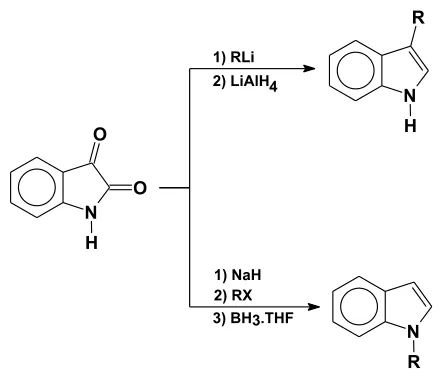
Scheme 35.
The analgesic drug pemedolac122-124, analogues of etodolac125,126 and the synthesis of the alkaloids hobartine and aristoteline127 were initiated by the C-3 alkylation of isatins to yield dioxindoles that were then reduced to the corresponding indoles by the use of lithium aluminum hydride (Schemes 36 and 37).
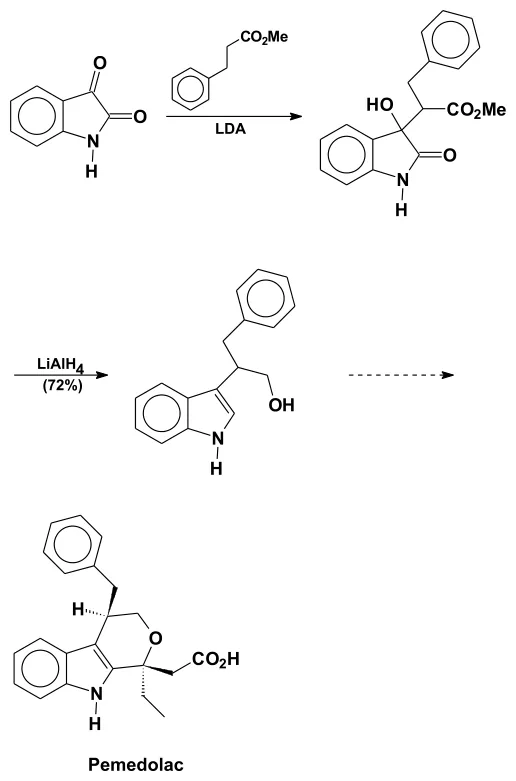
Scheme 36.
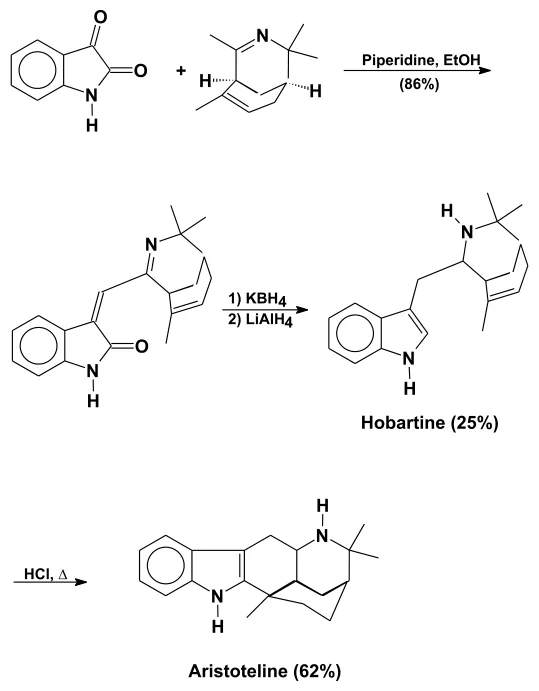
Scheme 37.
In a similar manner, 1-acylisatins can be reduced to 1-alkylindoles by BH3.THF in high yields99 (Scheme 38).
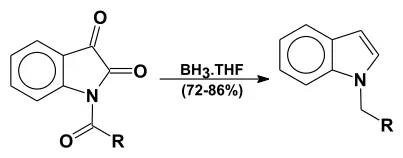
Scheme 38.
As part of the synthetic methodology for the synthesis of the cytotoxic marine alkaloid, dragmacidin, 6,7-dibromo-4-methoxyisatin was reduced to the corresponding indole in 33% yield using a commercial solution of 1 mol L−1 BH3.THF128.
Wierenga and co-workers investigated the use of BH3.THF and the dimethylsulfide complex for the reduction of 3-methyl-3-thiomethyl-2-oxindoles and 3-alkyl-3-hydroxy-2-oxindoles. The resulting indoles were obtained in excellent yields129.
Isatins are readily converted to 3-fluoroindoles in a two step process involving firstly the reaction of an isatin derivative with DAST (diethylaminosulfur trifluoride) to yield the 3,3-difluoro-2-oxindole derivative and secondly reduction of the difluorooxindole using BH3.THF to give the respective 3-fluoroindole. The reaction course was shown to proceed by formation of the 3,3-difluoroindolines, which subsequently eliminated HF. The presence of electron withdrawing groups on the aromatic nucleus retarded elimination of HF resulting in the obtention of the 3,3-difluoroindoline as the major product130.
Isatins have been used for the synthesis of fused indole derivatives. The reduction of 1-methylisatin-3-oximes by zinc, in acidic-media, yields an acetamidooxindole, which upon reaction with P4S10 gives indolothiazoles in moderate to good yields131 (Scheme 39).
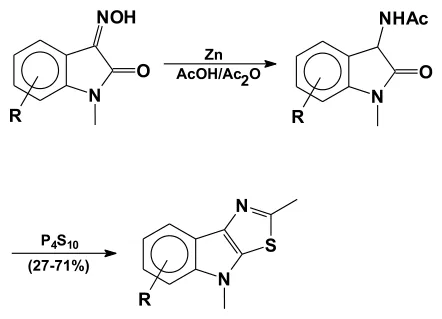
Scheme 39.
4.1.2 Synthesis of oxindoles and dioxindoles
The products of partial reduction of isatin, dioxindole and oxindole, have been widely used in organic synthesis, especially in the development of new drugs. Some natural products also belong to these classes of compounds, for instance dioxibrassinin132. There is also a medical interest, as dioxindole has been isolated from the urine of a schizophrenic patient and from suspected drug abusers133. Dioxindoles can be obtained from isatins by reduction of, or by carbanion addition to the C-3 ketone functionality. Amongst the methods for the reduction of isatin to dioxindoles are the uses of Zn/HgCl2 in refluxing benzene72 and Fe/HCl in aqueous ethanol134, as well as eletrochemical or electrochemical (in the editors’ view)135 and photochemical75 reduction. N-Methylisatin can be reduced to the corresponding dioxindole in quantitative yield by reaction with potassium tetracarbonylhydridoferrate (KHFe(CO)4)136.
Oxindoles can be prepared by the reduction of either dioxindoles or isatins. The reductions have been performed by using red phosphorous and iodic acid134, by use of H2S in a pyridine/co-solvent mixture137, by reduction of the isatin-3-ethylene thioketal with Raney nickel138 or by the Wolf-Kishner or Wolff-Kishner (in the editors’ view) reaction139-142. For the latter procedure the use of lower molecular weight alcohols as solvent, such as EtOH or iPrOH, lead to high yields of the desired product143. It has however been found that isatin can be reduced to the corresponding oxindoles in high yields (76-92%) by the use of hydrazine hydrate as the solvent in the absence of any additional base144,145.
A chromatographic method for the quality control of oxindoles, frequently used as raw materials for pharmaceutical products, using normal phase HPLC has been developed146.
Indigo, isoindigo and indirubin are natural pigments bearing the oxindole motif and have considerable economical importance. As a consequence, synthetic methodologies have been developed for the obtention of these pigments and analogues. Indigo and monothioindigo can be obtained from the reaction of isatin with P4S10147. Isoindigos have been prepared by an acid catalyzed reaction of isatin and oxindole derivatives148,149 and from the reaction of N-methylisatoic anhydride or N-methylisatin with sodium phosphonates150,151. Isoindigos and thioisoindigos have also been prepared from the reaction of isatin with Lawesson’s reagent152. Indirubins, which are described as effective antileukemic agents, can be prepared from isatin and indican, a compound extracted in high yield from Baphicacanthus cusia153, or from isatin and N-methyl-O-acetylindoxyl149,154 and from isatin and 3-hydroxyindole155. Pyrrolo-indigo compounds can be prepared by the condensation of isatin with pyrrolin-4-ones156; and thionapthene or thionaphthene (in the editors’ view) indigo dyes (Thioindigo Scarlet) are obtained from hydroxythionapthenes or hydroxythionaphthenes (in the editors’ view) and isatin in acidic media157.
In a reverse sense, isatin has been identified as one of the products of the oxidation of indigo by nitric acid and light. This process may be involved in the fading of indigo in museum collection objects158 and denim jeans159,160. The same conversion can be realized by ozonolysis161, acidic bromate162 or by a chemiluminescent autoxidation of indigo163. N-Methylisatin is also obtained in the photo-oxidation of N-methylindole-3-acetic acid164.
Isoindigo, obtained from isatin and oxindole, is converted diastereoselectively into diazacrisenodiones by reduction with Zn/AcOH, and subsequent acid-catalyzed rearrangement148 (Scheme 40).
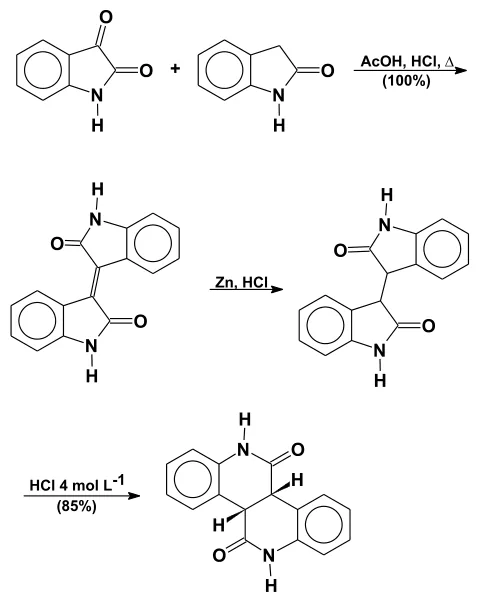
Scheme 40.
Isatin oximes have also been reduced to 3-aminooxindoles by use of SnCl2/HCl165 or by electrochemical means166,167. 3-Aminooxindoles have also been obtained by reduction of isatin-3-imines and isatin-3-hydrazones by hydrogenation and converted into ureido derivatives for study as antiulcer agents168-171. 3-Formyloxindoles are prepared from the Vilsmeyer-Haack or Vilsmeier-Haack (in the editors’ view) reaction of oxindole172, while 3-acyloxindoles, useful as analgesic and anti-inflammatory compounds, are obtained by reaction of oxindole with isocyanates160,173-175, acyl chlorides176, or with esters177. Oxindoles178 and 1-aryloxindoles179,180 can suffer nucleophilic heterocyclic ring opening with hydroxides, leading to phenylacetic acid derivatives that possess anti-inflammatory activity. Phenylacetic acids were reported to be formed during the Wolff-Kishner reduction of 1-naphthylisatins181. A unique procedure for the synthesis of these acids is also described in a French patent, where diclofenac was claimed to be obtained during the reduction of an isatin-3-sulfonylhydrazone by sodium borohydride at 60-70 °C182. Oxindoles have also been employed in the synthesis of polyimides for use in coatings and laminates for printed circuits183.
4.1.3 Reduction involving free radicals
Isatin and 1-methylisatin can be reduced by merostabilized free radicals to isatide and N,N’-dimethylisatide through the intermediate dioxindolyl radicals184 (Scheme 41):
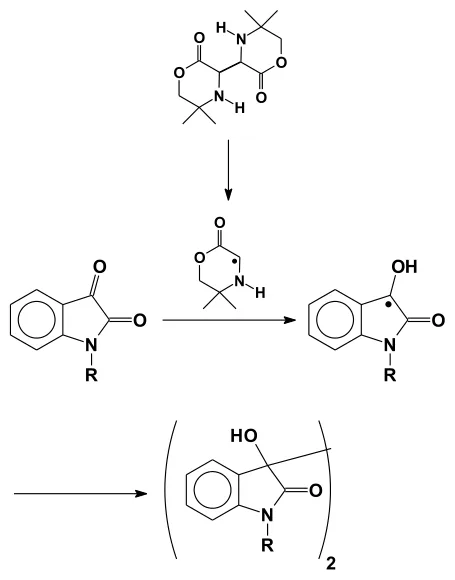
Scheme 41.