GalChimia - Exercises in Organic Synthesis
Exercise 6
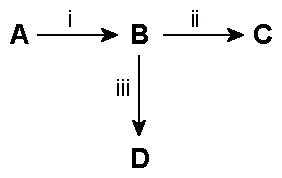
A: (1R, 4R)-Byciclo or Bicyclo (in the editors’ view)[2.2.1]hept-5-en-2-one.
B: (2R, 3R, 4R)-2,3-Dihydroxy-2,3-O-isopropyliden-4-(triphenylmethoxymethyl)cyclopentan-2-one.
C: (1S, 2R, 3R, 4R)-1-Acetoxymethyl-2,3-O-isopropyliden-4-(triphenylmethoxy methyl)cyclopentan-1,2,3-triol.
D: (1R, 2R, 3R, 4R)-1-Acetoxymethyl-2,3-O-isopropyliden-4-(triphenylmethoxy methyl)cyclopentan-1,2,3-triol.
i: a) 1º- H2O2, NaOH, H2O, Et2O; 2º- MeI (1.1 equiv), DMF, t.a.; 3º- Ac2O, py, DMAP, CH2Cl2, t.a.; b) 1º- OsO4, NMO, acetone, t.a.; 2º- 2,2-dimethoxypropane, p-TsOH, t.a.; c) LiAlH4, Et2O, 0 °C → t.a.; d) Br2, Ph3P, Et3N, CH2Cl2, t.a.; e) 1º- 2-nitrophenylselenecianate or selenocyanate (in the editors’ view), NaBH4, THF, t.a.; 2º- H2O2, THF, t.a.; f) 1º- OsO4, NaIO4, H2O, Et2O, t.a.; 2º- NaBH4, MeOH, t.a.; g) TrCl, py, DMAP, CH2Cl2, t.a.; h) PDC, CH2Cl2, t.a.
ii: a) 1º- Me3S(O)+I−, NaH, DMSO, THF, t.a.; 2º- Addition of compound B; b) CsOAc, DMF, 80 °C.
iii: a) 1º- CH2Br2, n-BuLi, THF, −80 °C → t.a.; 2º- Addition of compound B; b) CsOAc, DMF, 80 °C.
Notes:
The reaction with the sulphur ilyde or ylide (in the editors’ view) occurs on the most hindered face.
Bibliography: Marschner, C.; Penn, G.; Griengl, H. Tetrahedron 1993, 49, 5067.
Exercise 7
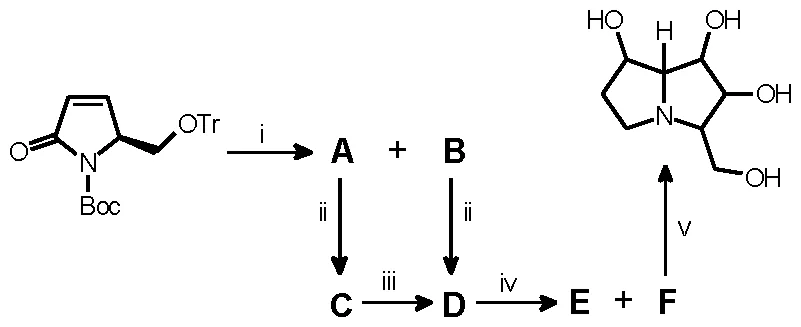
i: a) 1º- OsO4 cat., N-methylmorfoline or methylmorpholine (in the editors’ view) N-oxide, acetone-H2O; 2º- 2,2-Dimethoxypropane, p-TsOH cat., acetone; b) Vinylmagnesium bromide, THF, −50 °C; c) NaBH4, CeCl3·7H2O, MeOH; d) 1º- O3, CH2Cl2, −78 °C; 2º- NaBH4, EtOH.
ii: a) t-Butyldimethylsilyl chloride, imidazole, DMF, 0 °C.
iii: 1º- Cl2C2O2, DMSO, Et3N, CH2Cl2, −20 °C; 2º- NaBH4, EtOH, −78 °C.
iv: a) 1º- MsCl, Et3N, CH2Cl2; 2º- KOt-Bu, THF; b) TBAF, THF; c) 1º- Cl2C2O2, Et3N, DMSO, CH2Cl2, −20 °C; 2º- Allylmagnesium chloride, THF.
v: a) Methoxymethyl chloride, N,N-diethylaniline, CH2Cl2; b) 1º- TBDMSOTf, 2,6-lutidine, CH2Cl2; 2º- TBAF, THF; 3º- BnBr, K2CO3, acetone; c) 1º- O3, CH2Cl2, −78 °C; 2º- NaBH4, EtOH; d) 1º- MsCl, Et3N, CH2Cl2; 2º- Pd/C 10%, H2, EtOH; e) HCl 10%, MeOH, 60 °C.
Notes:
The use of Ce3+ salts allows the selective reduction of the carbonyl moiety in α,β-unsaturated compounds.
Compound C posses a hydroxy group on a carbon with R configuration.
The step iii yields a mixture of the compounds C and D in a 1:18 ratio.
Compound F is the epimer with the S configuration in the new chiral center.
On the step v b) occurs the selective deprotection of the N-Boc group and the introduction of a N-Bn.
Bibliography: Ikota, N. Tetrahedron Lett. 1992, 33, 2553.
Exercise 8
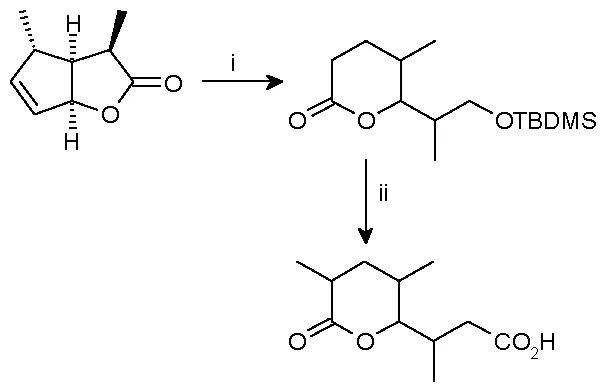
i: a) LiAlH4; b) H2, Pt; c) t-Butyldimethylsilyl chloride, imidazole; d) CrO3, py; e) m-CPBA.
ii: a) 1º- LDA; 2º- MeI; 3º- H+; b) CrO3.
Notes:
On the step ii a) the methyl group is introduced with the most stable configuration.
Bibliography: Grieco, P.A.; Ohfune, Y.; Yokoyama, Y.; Owens, W. J. Am. Chem. Soc. 1979, 101, 4749.
Exercise 9
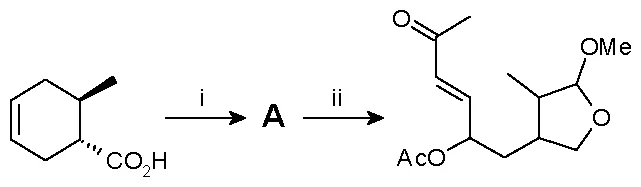
A: (2R)-2-Methyl-6-oxabicycle or oxabicyclo (in the editors’ view)[3.2.1]octen-3-en-7-one.
i: a) I2, NaHCO3, CH2Cl2/H2O; b) DBU, THF, Δ.
ii: a) LiAlH4, THF; b) t-Butyldimethylsilyl chloride, imidazole, DMF; c) Ac2O, py, DMAP; d) TBAF, THF; e) 1º- O3, MeOH, −78 °C; 2º- Me2S; f) Ph3P=CHCOMe, CHCl3; g) PPTS, MeOH, 50 °C.
Bibliography: Toyota, M.; Nishikawa, Y.; Motoki, K.; Yoshida, N.; Fukumoto, K. Tetrahedron 1993, 48, 11189.
Exercise 10
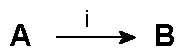
A: Methyl 2,3-di-O-bencyl or benzyl (in the editors’ view)-α-D-glucopyranoside.
B: Uronic acid methyl esther or ester (in the editors’ view).
i: a) t-Butyldiphenylsilyl chloride, imidazole, DMF; b) Thiocarbonyldiimidazole, tolueno or toluene (in the editors’ view), ref.; c) HSn(n-Bu)3, AIBN, toluene, ref.; d) TBAF, THF; e) PDC, DMF; f) 1º- Cl2C2O2, DMF cat., CH2Cl2; 2º- CH2N2, Et2O; g) hν, MeOH.
Notes:
The uronic acids are derived from aldoses by oxidation of the hydroxy group in the terminal carbon atom.
Bibliography: Kende, A.S.; Mendoza, J.S.; Fujii, Y. Tetrahedron 1993, 36, 8015.