GalChimia - Exercises in Organic Synthesis
Exercise 56
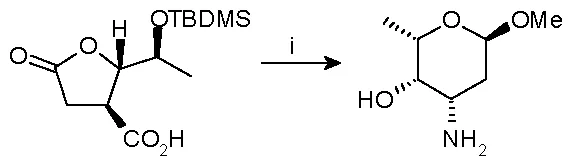
i: a) 1º- DPPA, Et3N, Δ; 2º- t-BuOH; b) TBAF, THF, t.a.; c) DIBAL, THF, −78 °C; d) MeOH, HCl.
Bibliography: Sibi, M.P.; Lu, J.; Edwards, J. J. Org. Chem. 1997, 62, 5864.
Exercise 57
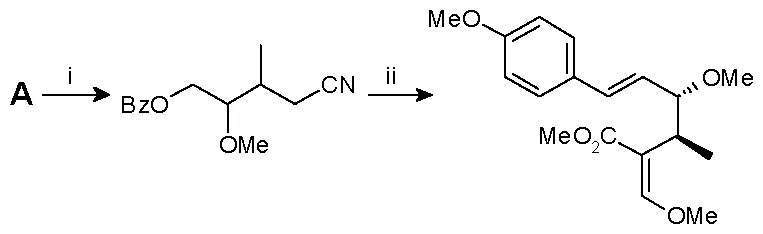
A: (1R, 2R, 3S, 4S, 5R)-1,2-di-O-isopropyliden-5-methylen-6-methoxy-1,2,3,4-cyclohexanetetrol.
i: a) H2, Ni-Raney, EtOH; b) 1º- NaIO4, NaHCO3, acetone/H2O, 0 °C; 2º- NaBH4, MeOH, 0 °C; c) BzCl (excess), py, 0 °C; d) AcOH 80%, 70 °C; e) 1º- NaIO4, NaHCO3, acetone/H2O, 0 °C; 2º- NaBH4, MeOH, 0 °C; f) MsCl, py; g) NaCN, DMF, 50 °C, 6 h.
ii: a) NaOMe, MeOH; b) PCC, CH2Cl2; c) 1º- Ph3P+CH2C6H4(p-OMe)Cl−, n-BuLi, THF, 0 °C; 2º- PhSH, AIBN, bencene or benzene (in the editors’ view), ref.; d) 1º- DIBAL, CH2Cl2, 0 °C, 2 h; 2º- NaClO2, NH2SO3H, NaH2PO4, t-BuOH/H2O, t.a.; 3º- CH2N2, Et2O/CH2Cl2; e) 1º- LHMDS, THF, −78 °C → −40 °C, 1 h; 2º- HCO2Me, −78 °C → 0 °C; 3º- SO4Me2, K2CO3, acetone, t.a.
Notes:
The conditions used on the step ii c) yield the E alkene.
Bibliography: Chida, N.; Yamada, K.; Ogawa, S. Chem. Lett. 1992, 687.
Exercise 58
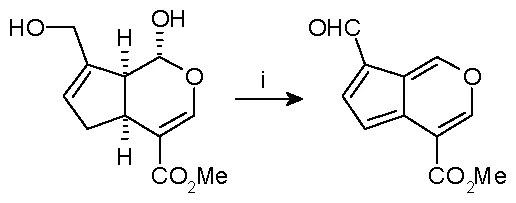
i: a) t-Butyldimethylsilyl chloride, (excess), AgNO3, DMF; b) PPTS cat., EtOH, t.a.; c) Ac2O, DMAP, Et3N, CH2Cl2, t.a., 3.5 h; d) TBAF, AcOH, THF, 0 °C → t.a., 3.5 h; e) Thiocarbonyldiimidazole, bencene or benzene (in the editors’ view), t.a.; f) bencene or benzene (in the editors’ view), ref., 4 h; g) DDQ, bencene or benzene (in the editors’ view), ref.
Notes:
Conditions used on the step b) deprotect the most reactive silyl ether.
Bibliography: Ge, Y.; Isoe, S. Chem. Lett. 1992, 139.
Exercise 59
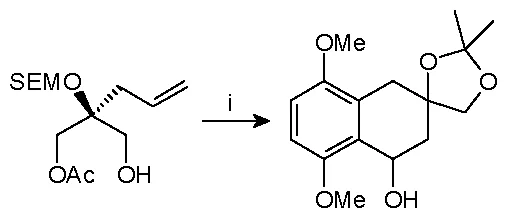
i: a) t-Butyldimethylsilyl chloride, imidazole, DMF; b) K2CO3, MeOH; c) PDC, molecular sieves 3Å, CH2Cl2; d) 1,4-dimethoxy-2-phenyllithium, THF, −78 °C; e) 1º- NaH; 2º- CS2; 3º- MeI, THF; f) HSn(n-Bu)3, AIBN, toluene; g) TBAF, molecular sieves 4Å, DMPU; h) 2,2-dimethoxypropane, p-TsOH, acetone; i) OsO4 cat., NaIO4, dioxane/H2O (1:1); j) SnCl4, CH2Cl2, −78 °C.
Notes:
The starting product with both hydroxymethylgroups acetylated is not chiral. Suggest a method for the preparation of the monoprotected product.
On the step j), the new stereogenic center has the S configuration.
Bibliography: Watanabe, N.; Ohta, H. Chem. Lett. 1992, 661.
Exercise 60
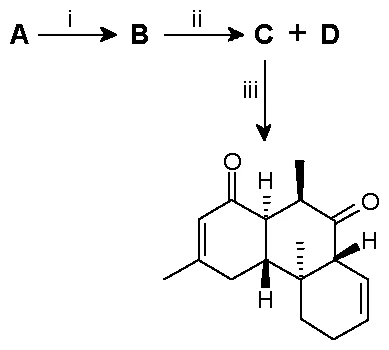
A: [(4S)-4-Isopropenyil or Isopropenyl (in the editors’ view)-1-cyclohexenyl)]methanol.
B: (1R, 4R, 6S)-4-Isopropenyl-6-methyl-2-cyclohexenol.
C: (3aS, 4R, 7aR)-4-Isopropenyl-6-methyl-2,3,3a,4,5,7a-hexahydrobenzo[b]furan-2-one.
D: (1S, 4aR, 7S, 8aR)-1-(Iodomethyl)-1,7-dimethyl-3,4,4a,7,8,8a-hexahydro-1H-3-isocromanone or isochromanone (in the editors’ view).
i: a) (−)-Diethyl tartrate, Ti(OiPr)4, TBHP, molecular sieves 4Å, CH2Cl2; b) t-Butyldimethylsilyl chloride, DMAP, Et3N, CH2Cl2; c) Me2CuLi, Et2O; d) HCl, MeOH; e) Pb(OAc)4, benzene; f) 1º- LDA, THF; 2º- PhSeBr; 3º- H2O2, py; g) LiAlH4, Et2O.
ii: a) CH3C(OEt)3, 2,4-dinitrophenol cat., toluene, 120 °C; b) LiOH, THF, H2O; c) I2, DBU, CH3CN, 70 °C.
iii: a) LDA, MeI, THF; b) (E)-1-Lithium-1,3-butadiene, THF, −78 °C; c) MnO2, CH2Cl2, t.a.; d) Δ, tolueno or toluene (in the editors’ view).
Notes:
The Sharpless epoxidation yields the oxirane in the face opposite to the isopropenyl group.
The reaction on the step ii a) is similar to a Claisen rearrangement.
The product obtained on the step iii b) is a lactol.
Bibliography: Tanner, D.; Andersson, P.G.; Tedenborg, L.; Somfai, P. Tetrahedron 1994, 50, 9135.