GalChimia - Exercises in Organic Synthesis
Exercise 16
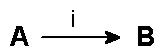
A: (S)-N-Phenylsulfonylserine.
B: (2S, 3S, 4R)-2-(Hydroxymethyl)-3-methyl-3,4-pyrrolidinediol.
i: a) MeLi; b) 1º- NaH; 2º- Triphenylvinylphosphonium bromide; c) t-Butyldimethylsilyl chloride, imidazole; d) OsO4 cat., N-methylmorfoline or methylmorpholine (in the editors’ view) N-oxide; e) TBAF; f) N-sulphonamide deprotection.
Bibliography: Burley, I.; Hewson, A.T. Tetrahedron Lett. 1994, 35, 7099.
Exercise 17
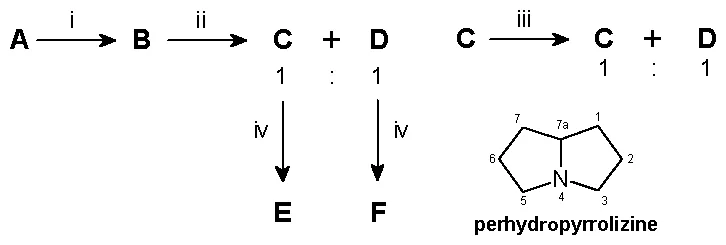
A: D-Glucose.
B: Methyl 2-azido-3-O-benzyl-2-deoxi or deoxy (in the editors’ view)-α-D-mannofuranoside.
C: C23H27NO4.
E: (1R, 2R, 3R, 7S, 7aS)-3-(Hydroxymethyl)perhydro-1,2,7-pyrrolizinetriol.
i: a) Acetone, H+; b) NaH, BnBr; c) H2O, H+ (mild); d) CO3Me2, NaOMe; e) MeOH, H+; f) Tf2O, py; g) NaN3; h) NaOMe, MeOH.
ii: a) t-Butyldimethylsilyl chloride, imidazole, DMF, 0 °C; b) Tf2O, py, −30 °C; c) 1º- H2, Pd/C 10%, AcOEt; 2º- BnBr, KOH, DMF; d) TBAF, THF; e) 1º- Cl2C2O2, DMSO; 2º- Et3N; f) Vinylmagnesium bromide, THF.
iii: a) MnO2; b) NaBH4.
iv: a) t-Butyldimethylsilyl chloride, imidazole, DMF; b) 1º- BH3·SMe2, THF; 2º- H2O2, OH−; c) TsCl, py, CH2Cl2; d) H2, Pd/C 10%; e) TFA, H2O, 36 h; f) NaBH4, EtOH.
Notes:
The compound C is the S epimer.
The step iv c) yields a sait or salt (in the editors’ view).
Bibliography: a) Fleet, G.W.J.; Smith, P.W. Tetrahedron 1987, 43, 971. b) Fleet, G.W.J.; Haraldsson, M.; Nash, R.J.; Fellows, L.E. Tetrahedron Lett. 1988, 29, 5441.
Exercise 18
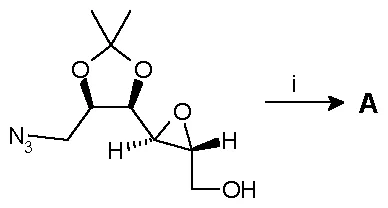
A: (1S, 2R, 7R, 7aR)perhydro-1,2,7-pyrrolizinetriol.
i: a) Tf2O; b) LiCN; c) H2, Pd/C, EtOH; d) Benzyl chloroformate; e) H2O2, MeOH; f) t-Butyldimethylsilyl chloride, imidazole; g) H2, Pd/C; h) NaHCO3; i) BH3·SMe2; j) TFA, H2O.
Notes:
The conditions used on the step i e) transform nitriles into amides.
Bibliography: Carpenter, N.M.; Fleet, G.W.J.; Cenci di Bello, I.; Winchester, B.; Fellows, L.E.; Nash, R.J. Tetrahedron Lett. 1989, 30, 7261.
Exercise 19
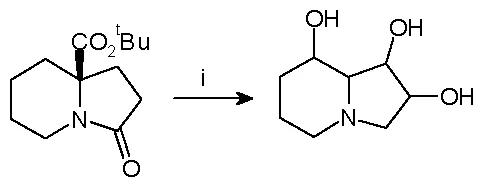
i: a) 1º- LDA; 2º- PhSeCl; b) H2O2, AcOH; c) OsO4 cat., N-methylmorfoline or methylmorpholine (in the editors’ view) N-oxide; d) 2,2-Dimethoxypropane, H+; e) TFA, H2O; g) Cl2C2O2; h) Xylene, ref.; i) 1º- B2H6; 2º- H2O2, OH−; j) HCl, H2O.
Bibliography: Martín-López, M.J.; Bermejo-González, F. Tetrahedron Lett. 1994, 35, 8843; Martín-López, M.J.; Bermejo-González, F. Tetrahedron Lett. 1994, 35, 4235.
Exercise 20

A: 2-O-Benzyl-D-glyceraldehyde.
B: 2-Nitroacetaldehyde diethyl acetal.
C: 1:1 Mixture of 5-O-tosyl-2-Benzyloxycarbonylamine-D-arabinose diethyl acetal and 5-O-tosyl-2-Benzyloxycarbonylamine-D-ribose diethyl acetal.
D: (2R, 3S, 4R)-2-(Hydroxymethyl)-3,4-pyrrolidinediol.
i: a) TBAF, H2O; b) H2, Pd/C, MeOH; c) Benzyl chloroformate, NaHCO3; d) TsCl, py.
ii: a) H2, Pd/C, MeOH; b) Benzyl chloroformate, NaHCO3; c) Separation of epimers; d) HCl; e) NaBH4; f) H2, Pd/C.
Notes:
The use of the fluoride on the step i a) avoids the epimerization on the aldehyde α position.
The step ii a) yields a salt.
Bibliography: a) Wehner, V.; Jäger, V. Angew. Chem., Int. Ed. Engl. 1990, 29, 1169. b) Jäger, V.; Hümer, W. Angew. Chem., Int. Ed. Engl. 1990, 29, 1182. c) Müller, R.; Leibold, T.; Pätzel, M.; Jäger, V. Angew. Chem., Int. Ed. Engl. 1994, 33, 1295.