GalChimia - Exercises in Organic Synthesis
Exercise 11
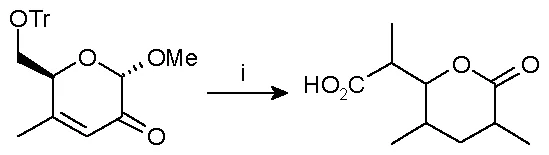
i: a) Ph3P=CH2; b) H2, Pd/C; c) CrO3, py; d) MeLi; e) CrO3, py; f) 1º- Ph3P=CHOMe; 2º- H3O+; g) CrO3; h) Separation of the epimer with the R configuration on the position adjacent to the carboxy moiety.
Notes:
The catalytic hydrogenation on the step i b) yields mainly the diastereoisomer with the substituents affected by the reaction in equatorial disposition. The synthesis is carried out with this diastereoisomer.
Bibliography: Jarosz, S.; Fraser-Reid, B. Tetrahedron Lett. 1981, 22, 2533.
Exercise 12
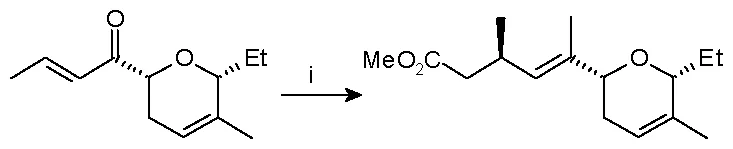
i: a) 1º- BrMgMe, THF, 0 °C; 2º- Ac2O, DMAP, Et3N, CH2Cl2; b) 1º- LDA, THF, −78 °C; 2º- t-Butyldimethylsilyl chloride, imidazole, DMF, −78 °C → −60 °C; 3º- H3O+; c) CH2N2, Et2O.
Bibliography: Kende, A.S.; Mendoza, J.S.; Fujii, Y. Tetrahedron 1993, 36, 8015.
Exercise 13
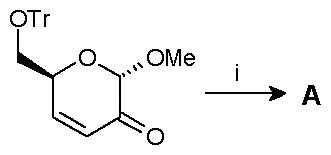
i: a) 1º- MeLi; 2º- Ac2O; b) Me2CuLi; c) H2, Pt; d) Cl2C2O2, DMSO, Et3N; e) MeNO2, KF; f) Ac2O, DMAP.
Notes:
The addition of the cuprate on the step i b) yields the compound with the methyl in equatorial disposition.
The catalytic hydrogenation on the step i c) yields a 4:1 mixture of the equatorial/axial products; the equatorial is isolated and used.
The KF is used as base.
Bibliography: Kawachi, N.; Hashimoto, H. Bull. Chem. Soc. Jpn. 1987, 60, 1441.
Exercise 14
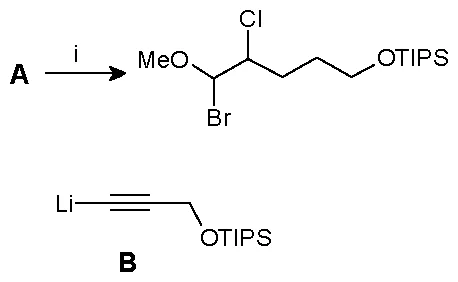
A: 2-Hydroxyacetaldehyde dimethyl acetal.
i: a) Cl2C2O2, DMSO, Et3N; b) Addition of compound B; c) CrO3, H2O, H2SO4, acetone; d) (R)-Binal-H; e) H2, Pd/BaSO4; f) Tf2O, py; g) TBAC, CH2Cl2, 25 °C; h) Me2BBr, −78 °C.
Notes:
The reduction with (R)-Binal-H yields an alcohol of S configuration.
Bibliography: Berger, D.; Overman, L.E.; Renhowe, P.A. J. Am. Chem. Soc. 1993, ff5 or 115 (in the editors’ view), 9305.
Exercise 15
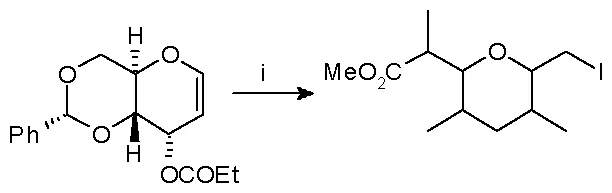
i: a) 1º- LiN(TMS)2; 2º- t-Butyldimethylsilyl chloride, imidazole; 3º- Δ; b) CH2N2; c) H3O+; d) t-Butyldimethylsilyl chloride, imidazole; e) PDC; f) Me2CuLi; g) Ph3P=CH2; h) H2, Pt; i) TBAF; j) TsCl, py; k) NaI.
Notes:
The conditions used on the step i a) yield the E enolate.
The catalytic hydrogenation on the step i h) generates a new asymmetric center with the R configuration.
Bibliography: Ireland, R.E.; Daub, J.P. J. Org. Chem. 1981, 46, 479.