GalChimia - Exercises in Organic Synthesis
Exercise 36
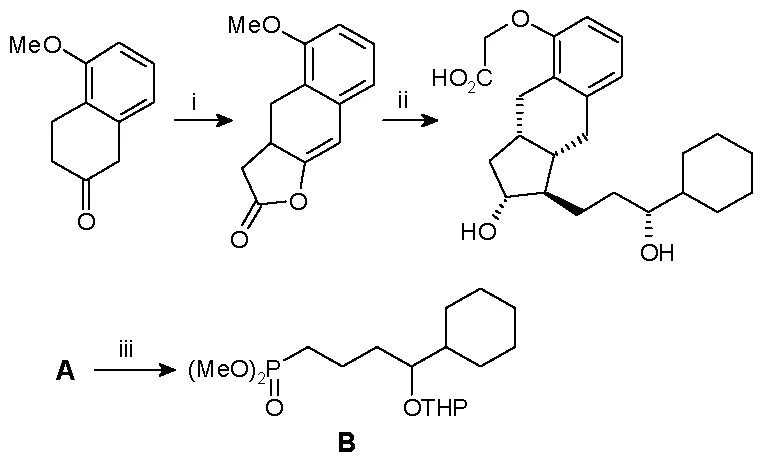
A: Cyclohexanecarbaldehyde.
i: a) NaOMe, CO3Me2, 70 °C; b) 1º- LDA, THF, −78 °C; 2º- Allyl bromide; c) LiCl, H2O, DMSO, 150 °C; d) Ethylen glycol, (EtO)3CH, p-TsOH, CH2Cl2, 25 °C; e) 1º- NaIO4, KMnO4, H2O, 25 °C; 2º- HCl 3 M, acetone, 60 °C; f) Ac2O, HClO4 (cat.), AcOEt.
ii: a) 1º- Compund or Compound (in the editors’ view) B (2 equiv), n-BuLi (2 equiv), THF, −78 °C → −10 °C; 2º- AcOH; b) H2 (3 atm), Pd/C 10%, EtOH; c) NaBH4, NaOH, H2O, EtOH, −10 °C; d) 1º- AcOH, H2O, THF, 45 °C; 2º- Separation of diastereoisomers; e) LiPPh2, THF, 75 °C; f) K2CO3, ClCH2CN, acetone, 60 °C; g) KOH, H2O, MeOH, 90 °C.
iii: a) Vinylmagnesium bromide, THF, 0 °C; b) Separation of R enantiomer; c) DHP, H+, CH2Cl2; d) 1º- 9-BBN, THF; 2º- H2O2, KOH; e) p-TsCl, py, 0 °C; f) NaI, (i-Pr)2EtN, acetone; g) (MeO)2P(O)CH2Li, THF, −78 °C → −10 °C.
Notes:
LiPPh2 is used as demethylating agent.
Bibliography: Aristoff, P.A.; Johnson, P.D.; Harrison, A.W. J. Am. Chem. Soc. 1985, 107, 7971.
Exercise 37
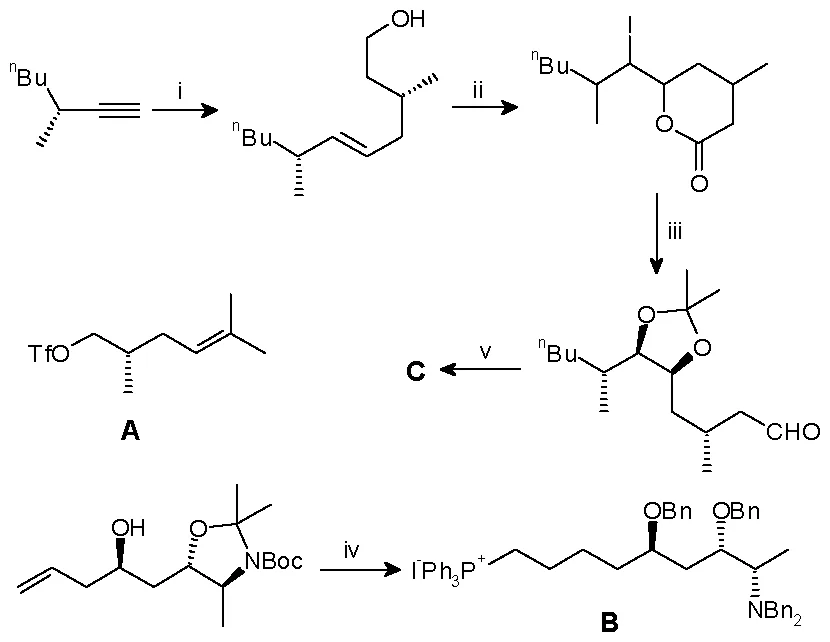
C: C50H69NO4.
i: a) 1º- n-BuLi; 2º- Addition of compound A; b) K2OsO4·2H2O; c) Pb(OAc)4; d) NaBH4; e) Na, liquid NH3.
ii: a) Cl2C2O2, DMSO, Et3N; b) NaClO2; c) I2, CH3CN, −30 °C.
iii: a) NaOBn; b) H2, Pd/C, p-TsOH cat.; c) LiAlH4; d) p-TsOH cat., acetone; e) Cl2C2O2, DMSO, Et3N.
iv: a) p-TsOH cat., MeOH; b) NaH, BnBr (excess), TBAI; c) 1º- O3; 2º- Me2S; d) (MeO)2P(O)CH2CO2Me, NaH; e) H2, cat. Lindlar; f) TFA, CH2Cl2; g) BnBr (1 equiv), K2CO3; h) DIBAL; i) I2, PPh3, imidazole; j) PPh3, CH3CN, ref.
v: a) 1º- n-BuLi; 2º- Addition of compound B; b) TFA, H2O.
Bibliography: Shi, Y.; Peng, Lee F.; Kishi, Yoshito; J. Org. Chem. 1997, 62, 5666.
Exercise 38
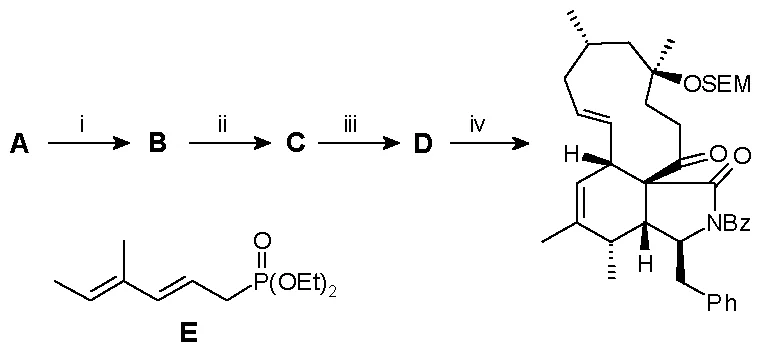
A: Methyl (2S)-3-hydroxy-2-methylpropanoate.
B: (2R, 4R)-2,4-Dimethyl-5-O-(t-butyldimethylsilyl)pentane-1,2,5-triol.
C: Methyl (4R, 6R)-4,7-dihydroxy-4,6-dimethyl-4-O-[(2-trimethylsilyloxy)ethoxymethyl] heptanoate.
D: (4S, 6S, 8E, 10E, 12E)-4-Hydroxy-1-(1H-1-imidazolyl)-4,6,12-trimethyl-4-O-[(2-trimethylsilyloxy)ethoxy]methyl-8,10,12-tetradecatrien-1-one.
i: a) t-Butyldimethylsilyl chloride, imidazole; b) DIBAL; c) Cl2C2O2, DMSO, Et3N; d) Ph3P=C(Me)CO2Et; e) DIBAL; f) m-CPBA; g) LiAlH4.
ii: a) NCS, Me2S; b) Ph3P=CHCO2Me; c) SEMCl, imidazole; d) Dowex 50W-X8, MeOH; e) H2, Pd/C.
iii: a) Cl2C2O2, DMSO, Et3N; b) Ph3P=CH2; c) 1º- 9-BBN; 2º- H2O2, OH−; d) Cl2C2O2, DMSO, Et3N; e) Compound E, base; f) KOH; g) C(O)Im2.
iv: a) 1º- (5R)-5-Benzyl-N-benzoyl-2-pyrrolidinone, LHMDS; 2º- Compound D; b) 1º- Base; 2º- PhSeCl; c) m-CPBA; d) Toluene, 100 °C, 5 h.
Notes:
The NCS·SMe2 system is used as selective oxidating agent for primary hydroxy groups.
The Dowex 50W-X8 is an ion exchange resine or resin (in the editors’ view). Use handbooks of fine chemicals to find out if this resine or resin (in the editors’ view) is anionic or cationic.
Bibliography: Thomas, Eric J.; Whitehead, John W.F. J. Chem. Soc. Perkin Trans. I, 1989, 507.
Exercise 39
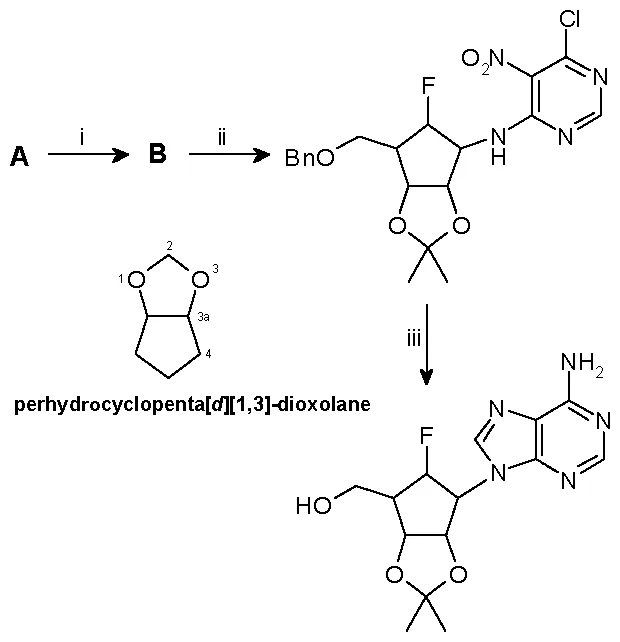
A: (1S, 4R, 5S)-5-[(Benzyloxy)methyl]-4-hydroxy-2-cyclopentenyl acetate.
B: (3aS, 4R, 5S, 6S, 6aR)-4-Azido-6-(benzyloxymethyl)-5-[(methoxyethoxy)methoxy]-2,2-dimethylperhydrocyclopenta[d][1,3]-dioxolane.
i: a) m-CPBA, CH2Cl2, 0 °C, 24 h; b) MEMCl, (i-Pr)2EtN, CH2Cl2, t.a., 48 h; c) K2CO3, MeOH, t.a., 2 h; d) 1º- NaN3, NH4Cl, EtOH/H2O (4:1), ref., 3 días or days (in the editors’ view); 2º- 2,2-dimethoxypropane, p-TsOH cat., 2 h.
ii: a) Me2BBr, CH2Cl2/Et2O (10:1), −78 °C, 2 h; b) Tf2O, py, CH2Cl2, 0 °C, 30 min.; c) LiOBz, DMF, t.a., 30 min.; d) K2CO3, MeOH, t.a., 2 h; e) DAST, CH2Cl2, 0 °C, 2 h; f) H2, cat. Lindlar, EtOH, t.a., 3 h; g) 4,6-Dichloro-5-nitropyrimidine, Et3N, CH2Cl2, t.a., 3 h.
iii: a) H2, Ni Raney, EtOH, t.a., 30 min.; b) (EtO)3CH, ref., 5 h; c) NH3 liq., 24 h; d) H2, Pd(OH)2, cyclohexane/EtOH (1:2), ref., 12 h.
Notes:
DAST stands for diethylamino sulfide trifluoride, a reagent used for the conversion of alcohols into alkyl fluorides with configuration inversion.
The MEM group can be selectively deprotected by using dimethylborane bromide.
Bibliography: Cotterill, I.C.; Cox, P.B.; Drake, A.F.; Le Grand, D.M.; Hutchinson, E.J.; Latouche R.; Pettman, R.B.; Pryce, R.J.; Roberts, S.M.; Ryback, G.; Sik, V.; Williams, J.O. J. Chem. Soc. Perkin Trans. I, 1991, 3071.
Exercise 40
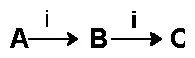
A: (1R, 5S)-5-Isopropenyl-2-methyl-2-cyclohexen-1-ol.
B: (3aR, 4R, 6R, 7aR)-4-Chloro-6-isopropenyl-3a-methylperhydrobenzo[b]furan-2-one.
C: (1R, 2R, 3R, 5R)-2-[(1R)-1-Bromo-2-hydroxyethyl]-3-chloro-5-isopropenyl-2-methylcyclohexan-1-ol.
i: a) 1º- MeO2CCH2COCl, Et3N, CH2Cl2, −30 °C; 2º- p-AcNHC6H4SO2N3, DBU, CH3CN, 23 °C; b) Cu(II)bis(salyciliden or salicyliden (in the editors’ view)-t-butylamine), CH2Cl2, 70 °C, 8 h; c) LiCl, CSA, DMF, 140 °C.
ii: a) 1º- LDA, −78 °C, THF; 2º- CBr4, −78 °C → 23 °C; b) 1º- DIBAL, −78 °C, CH2Cl2; 2º- NaBH4, EtOH, 23 °C.
Bibliography: Fukuyama, Tohru e Chen, Xiaoqi, J. Am. Chem. Soc. 1994, 116, 3125.