GalChimia - Exercises in Organic Synthesis
Exercise 46
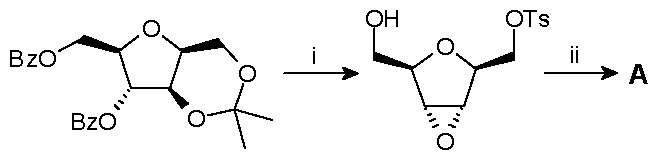
i: a) MeOH, H+; b) TsCl (2 equiv), py; c) NaOMe (1.1 equiv), MeOH.
ii: a) Red-Al®, THF; b) TsCl (1 equiv), py; c) 1º- Me3N, MeOH; 2º- HCl.
Notes:
On the step ii a), the sodium bis-(2-methoxyethoxy)aluminium hydride (Red-Al®) produces the reductive regioselective opening of the epoxyde or epoxide (in the editors’ view) by complexation with the hydroxy group, and the reductive elimination of the tosylate group.
On the step ii c), the treatment with HCl is an anionic exchange reaction.
Bibliography: Mubarak, A.M.; Brown, D.M. Tetrahedron Lett, 1980, 2f or 21 (in the editors’ view), 2453.
Exercise 47
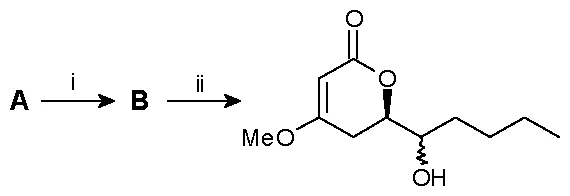
A: (R)-2,2-Dimethyl-4-formyl-1,3-dioxolane.
B: Mixture of epimers of the (2R)-2-[1-(benzyloxy)pentyl]oxirane.
i: a) n-BuMgBr, Et2O; b) BnCl, NaOH, DMSO, 30-40 °C, 2 h; c) HCl 1%, MeOH, 60 °C, 1 h; d) TsCl (1 equiv), py, −10 °C, 2 h; e) KOH, t.a., 30 min.
ii: a) 1º- 2-Propinoic or Propynoic (in the editors’ view) acid, LDA (2 equiv), THF, HMPA, −45 °C; 2º- Addition of compound B; b) H2SO4, MeOH; c) NaOMe, MeOH; d) H2, Pd/C, EtOH.
Bibliography: Mori, K.; Oda, M. y Matsui, M. Tetrahedron Lett. 1976, f7 or 17 (in the editors’ view), 3173.
Exercise 48
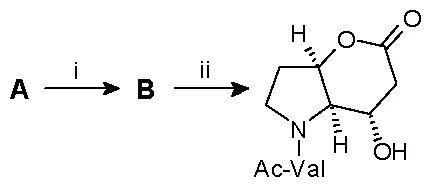
A: Methyl 2-deoxy-α-D-glucopyranoside.
B: Methyl 3-O-benzyl-6-cyano-2,6-dideoxy-4-O-mesyl-α-D-alopyranoside or allopyranoside (in the editors’ view).
i: a) PhCHO, ZnCl2; b) CrO3, py; c) NaBH4; d) NaH, BnBr; e) AcOH, H2O; f) MsCl (2 equiv), py; g) NaCN, DMSO.
ii: a) NaBH4, CoCl2, MeOH; b) KOH, MeOH; c) Cbz-Val, DCC; d) HCl, H2O; e) PCC, CH2Cl2; f) H2, Pd/C; g) Ac2O, MeOH.
Notes:
Conditions used on the step ii a) allow the conversion of cyano groups into amines.
Val stands for the aminoacid L-Valine.
Bibliography: Kakinuma, K.; Ōtake, N.; Yonehara, H. Tetrahedron Lett, 1980, 21, 167.
Exercise 49
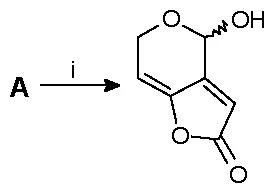
A: L-Arabinose.
i: a) MeOH, H+; b) Acetone, CuSO4, H2SO4, t.a., 24 h; c) PCC, molecular sieves, CH2Cl2; d) Ph3P=CHCO2Me, bencene or benzene (in the editors’ view), 50 °C; e) MeOH, HCl, ref.; f) MsCl, py, 0 °C → t.a., 24 h; g) TFA 90%, H2O, 50 °C, 1 h.
Notes:
Conditions used on the step i a) yield the α epimer.
Bibliography: Seijas, J.A.; Vázquez Tato, M.P.; Estévez, R.J.; Castedo, L.; Riguera, R. Heterocycles, 1989, 29, 181.
Exercise 50
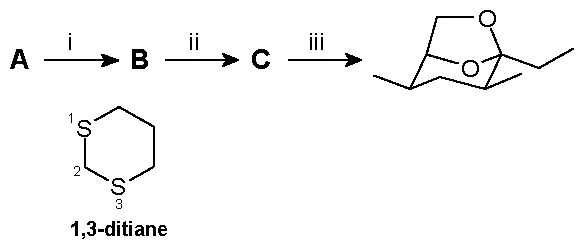
A: D-Glucose.
B: Methyl 2,3-Anhydro-4,6-O-benzyliden-α-D-alopyranoside or allopyranoside (in the editors’ view).
C: (2S, 3R, 5S)-5-(1,3-Ditian or Dithian (in the editors’ view)-2-yl)-3-methylhexane-1,2-diol.
i: a) MeOH, H+; b) PhCHO, ZnCl2; c) TsCl, py, −30 °C; d) NaOMe, MeOH.
ii: a) Me2CuLi, Et2O; b) 1º- NaH, CS2; 2º- MeI, Et2O; c) HSn(n-Bu)3, AIBN, toluene; d) p-TsOH, MeOH; e) TrCl, py; f) CrO3·2py, CH2Cl2; g) Ph3P=CH2, Et2O; h) H2, (Ph3P)3RhCl, benceno or benzene (in the editors’ view); i) 1,3-Propanedithiol, BF3·Et2O, CH2Cl2.
iii: a) 2,2-Dimethoxypropane, p-TsOH, acetone; b) 1º- t-BuLi, hexane; 2º- EtI, HMPA; c) p-TsOH, MeOH; d) HgCl2, HgO, CH3CN.
Bibliography: Sum, P.-E.; Weiler, L. Can. J. Chem. 1978, 56, 2700.