GalChimia - Exercises in Organic Synthesis
Exercise 41
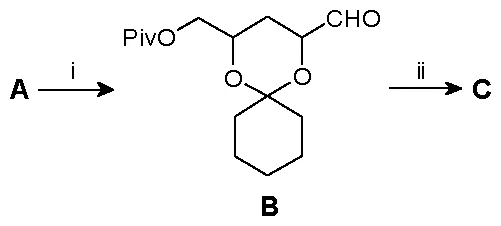
A: D-(+)-Xilose or Xylose (in the editors’ view).
C: C20H34O5.
i: a) Acetone, CuSO4, H2SO4; b) HCl 0.2%; c) Me3COCl, py, 0 °C → t.a.; d) 1º- NaH, CS2, THF; 2º- MeI, 0 °C → t.a.; e) HSn(n-Bu)3, AIBN, toluene, 80 °C; f) EtSH (10 equiv), HCl 6N; g) Cyclohexanone dimethyl acetal, p-TsOH, 16 h, t.a.; h) HgCl2, CaCO3, CH3CN/H2O (4:1), 0 °C → t.a.
ii: 1º- [(2S)-3-Hydroxy-2-methylpropyl]triphenylfosfonium or triphenylphosphonium (in the editors’ view) bromide (2 equiv), n-BuLi (4 equiv), THF, −78 °C → t.a., 2 h; 2º- TMSCl (2 equiv), 0 °C → t.a., 30 min.; 3º- Addition of compound B, THF, −78 °C → t.a.; 4º- NH4F, THF/H2O (1:1).
Bibliography: White, James D.; Jeffrey, Scott C. J. Org. Chem. 1996, 61, 2600.
Exercise 42
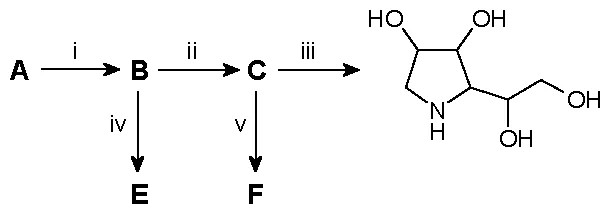
A: D-Mannose.
C: (1S)-1-[(2R, 3S, 4R)-3,4-Dihydroxy-3,4-O-isopropylidentetrahydro-1H-2-pyrrolyl]-1,2-ethanediol.
E: (2R, 3S, 4R)-2-[(1R)-2-Amino-1-hydroxyethyl]-3,4-pyrrolidinediol.
F: (2R, 3S, 4R)-2-(Hydroxymethyl)-3,4-pyrrolidinediol.
i: a) BnOH, H+; b) t-Butyldimethylsilyl chloride, imidazole; c) 2,2-Dimethoxypropane, H+; d) PCC; e) NaBH4; f) Tf2O; g) NaN3; h) TBAF.
ii: a) H2, Pd/C, MeOH; b) H2, Pd/C, AcOH.
iii: TFA, H2O.
iv: a) MsCl, Et3N; b) NaN3; c) H2, Pd/C, MeOH; d) H2, Pd/C, AcOH; e) H+, MeOH.
v: a) (Boc)2O, py; b) NaIO4, EtOH; c) NaBH4; d) TFA, H2O.
Notes:
Compound B is an α-D-mannopyranoside.
Bibliography: Fleet, G.W.J.; Nicholas, S.J.; Smith, P.W.; Evans, S.V.; Fellows, L.E.; Nash, R.J. Tetrahedron Lett. 1985, 26, 3127; Bashyal, B.P.; Fleet, G.W.J.; Gough, M.J.; Smith, P.W. Tetrahedron 1987, 25, 1853; Bashyal, B.P.; Fleet, G.W.J.; Gough, M.J.; Smith, P.W. Tetrahedron 1987, 43, 3083; Farr, R.A.; Holland, A.K.; Huber, E.W.; Peet, N.P.; Weintraub, P.M. Tetrahedron 1994, 50, 1033.
Exercise 43
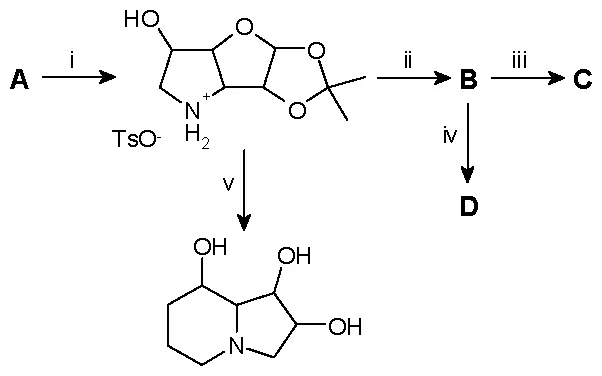
A: 3-Azido-3-deoxy-1,2:5,6-di-O-isopropyliden-α-D-glucofuranose.
B: (2S, 3S, 4R)-4-Benzyloxy-N-benzyloxycarbonil or benzyloxycarbonyl (in the editors’ view)-3-hydroxy-2-pyrrolidinecarbaldehyde.
C: (2S, 3S, 4R)-2-(Hydroxymethyl)-3,4-pyrrolidinediol.
D: (2S, 3S, 4R)-3,4-Dihydroxy-2-pyrrolidinecarboxylic acid.
i: a) MeOH, H+ (mild cat.); b) TsCl, py; c) H2, Pd/C.
ii: a) CbzCl; b) NaH, BnBr; TBAI; c) TFA, H2O; d) NaIO4, EtOH, H2O.
iii: a) NaBH4; b) H2, Pd/C, AcOH.
iv: a) NaClO2, KH2PO4, H2O; b) H2, Pd/C, AcOH.
v: a) HO2CCH2P(O)(OMe)2, DCC; b) TFA, H2O; c) K2CO3, DMF, 18-crown-6; d) H2, Pd/C, EtOH; e) Ac2O, py; f) BH3·SMe2; g) NaOMe, MeOH; h) TFA, H2O.
Notes:
18-Crown-6 is the trivial name for 1,4,7,10,13,16-hexaoxacyclooctadecane. The crown ethers complex with metallic cations, increasing thus the salts ionization in the reaction medium.
Bibliography: Austin, G.N.; Baird, P.D.; Fleet, G.W.J.; Peach, J.M.; Smith, P.W.; Watkin, D.J. Tetrahedron 1987, 43, 3095.
Exercise 44
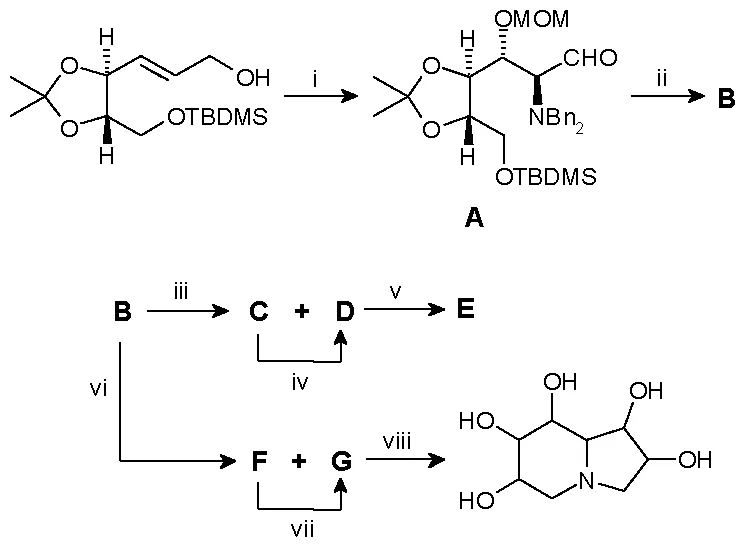
i: a) L-Diethyl tartrate, Ti(OiPr)4, TBHP; b) Et2AlNBn2, CH2Cl2; c) AcCl, Et3N; d) MOMCl, (i-Pr)2EtN; e) LiAlH4, Et2O; f) Cl2C2O2, DMSO, Et3N.
ii: 1º- AcOEt, LHMDS, THF, −80 °C; 2º- Addition of compound A.
iii: a) TBAF, THF; b) 1º- TsCl (1 equiv), py; 2º- Separation of the R epimer; c) H2, Pd/C, MeOH.
iv: NaH, THF.
v: a) BH3·SMe2, THF; b) HCl (conc.), MeOH, ref.
vi: a) LiAlH4, Et2O; b) t-butyldimethylsilyl chloride, imidazole, DMF.
vii: a) AcOH, Ph3P, DEAD; b) LiAlH4, Et2O.
viii: a) TBAF, THF; b) TsCl, py; c) H2, Pd(OH)2, MeOH; d) Et3N, MeOH, ref.; e) HCl (conc.), MeOH, ref.
Notes:
The conditions used on the step i b) allow the regio- and stereoselective epoxyde or epoxide (in the editors’ view) opening.
Compound B is actually the mixture of the R and S epimers in 89:11 ratio.
Bibliography: Ina, Hiroji e Kibayashi, Chihiro, J. Org. Chem. 1993, 58, 52.
Exercise 45
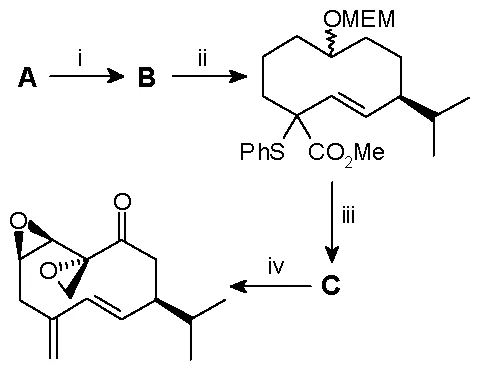
A: (4R)-4-Isopropyl-1-methyl-cyclohexene.
B: Mixture of diastereoisomers of the (3R)-9-Hydroxy-3-isopropyl-6-(methoxyethoxymethoxy) nonanal dimethyl acetal.
C: (8S)-8-Isopropyl-5-methylen-2,6-cyclodecadienone.
i: a) 1º- O3, MeOH, −20 °C; b) 2º- Me2S, p-TsOH; b) 1º- CO3Me2, NaH, dioxane, ref., 24 h; 2º- Allyl bromide, ref., 2 h; c) KOH 5%, MeOH/H2O 2:3, 90 °C, 2 h; d) LiAlH4, Et2O; e) MEMCl, (i-Pr)2EtN, CH2Cl2, 40 °C, 20 h; f) OsO4, NaIO4, Et2O, H2O, t.a., 4 h; g) LiAlH4, Et2O.
ii: a) Ac2O, py; b) AcOH (aq.) 75%, 40 °C, 1 h; c) LDA, PhSCH2CO2Me, THF, −70 °C, 10 min.; d) Ac2O, NaOAc, 130 °C, 30 min.; e) NaOMe cat., MeOH, t.a., 1 h; f) TsCl, py, 0-5 °C, 7 h; g) NaHMDS, DME, ref., 50 min.
iii: a) LiAlH4, Et2O; b) BzCl, DMAP, py, THF, t.a., 24 h; c) TMSCl, NaI, CH3CN, −8 °C, 40 min.; d) Na-naphthalene, THF, −70 °C, 6 min.; e) PCC, molecular sieves 3Å, CH2Cl2, t.a., 1 h; f) LHMDS, PhSSO2Ph, THF, −10 °C, 15 min.; g) NaIO4, MeOH/H2O, t.a., 20 h; h) CaCO3, BHT, toluene, ref., 4 h.
iv: a) TBHP, KH, THF, t.a., 1 h; b) 1º- LHMDS, THF, −70 °C, 30 min.; 2º- MoOPH, −22 °C, 15 min.; c) t-Butyldimethylsilyl chloride, imidazole, DMF, 40 °C, 16 h; d) Me3S+I−, n-BuLi, −5 °C, 30 min.; e) TBAF, THF, t.a., 30 min., f) PCC, molecular sieves 3Å, CH2Cl2, t.a., 1 h.
Notes:
The molecular sieves are zeolites which serve as catalysts in many reactions.
Conditions used on the step iii c) deprotect the MEM group.
Conditions used on the step iv a) yield selectively epoxydes or epoxides (in the editors’ view) of α,β-unsaturated alkenes.
The treament or treatment (in the editors’ view) of enolates with MoOPH yields α-hydroxycarbonyl compounds.
Bibliography: Kitahara, T.; Masataka, M.; Mori, K. Tetrahedron 1987, 43, 2689.