GalChimia - Exercises in Organic Synthesis
Exercise 31
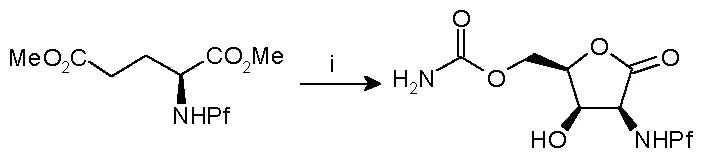
i: a) 1º- KHMDS; 2º- PhSeCl; b) m-CPBA; c) DIBAL (2 equiv); d) p-NO2-PhOCOCl; e) NH3; f) OsO4; g) Et3N.
Bibliography: Paz, M.M.; Sardina, F.J. J. Org. Chem. 1993, 58, 6090.
Exercise 32
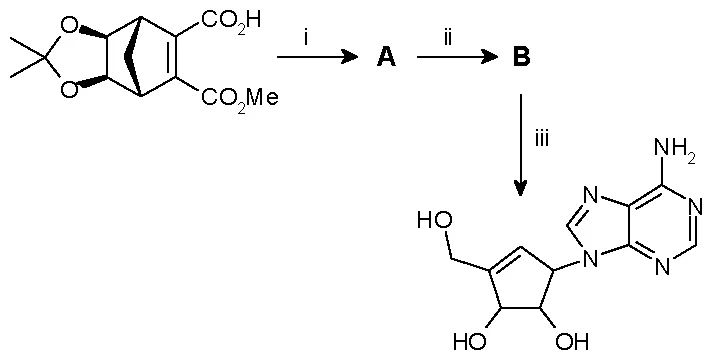
A: (1R, 5R, 6S, 7R)- 6,7-Dihydroxy-6,7-O-isopropyliden-3-oxabycicle or oxabicyclo (in the editors’ view)[3.2.1]octan-2-one.
B: (1S, 2R, 5R)-5-Amino-1,2-O-isopropyliden-3-[(methoxymethoxy)methyl]-3-cyclopentene-1,2-diol.
i: a) O3, AcOEt, −78 °C; b) NaBH4; c) NaIO4, HCl 2 N; d) NaBH4; e) Ac2O, py.
ii: a) NaSePh, DMF; b) 1º- ClCO2Et, Et3N; 2º- NaN3; 3º- Δ, bencene or benzene (in the editors’ view); 4º- MeOH, c) 1º- O3, CH2Cl2; 2º- py (cat.); d) m-CPBA, CH2Cl2; e) 1º- TMSOTf, 2,6-lutidine, toluene; 2º- DBU; 3º- K2CO3; f) MOMCl, (i-Pr)2EtN, CH2Cl2, 0 °C; g) KOH, H2O.
iii: a) 5-Amino-4,6-dichloropyrimidene or dichloropyrimidine (in the editors’ view), Et3N; b) 1º- Triethoxymethyl, Ac2O; 2º- NH3; c) HCl 2 M.
Notes:
On the step i a) the 1,2,4-trioxolane intermediate of the ozonolysis evolves through a decarboxylation.
Conditions on the step ii e) yield an allylic alcohol.
Bibliography: Arita, M.; Adachi, K.; Ito, Y.; Sawai, H.; Ohno, M. J. Am. Chem. Soc. 1983, f05 or 105 (in the editors’ view), 4049-4055.
Exercise 33
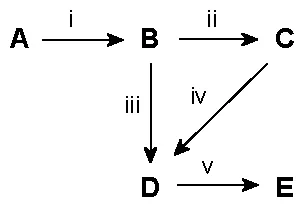
A: Methyl 6-deoxy-α-L-mannopyranoside.
B: Methyl 2,4-O-Acetyl-3,6-dideoxy-3-C-methyl-3-nitro-α-L-glucopyranoside.
C: Methyl N-Acetyl-3,6-dideoxy-3-C-methyl-3-amino-α-L-glucopyranoside.
D: (2S, 3R, 4S)-4-Acetamido-3-acetoxy-2,4-dimethyl-3,4-dihydro-1H-pirane or pyran (in the editors’ view).
E: Mixture of methyl 3-Acetamido-4-O-acetyl-2,3,6-trideoxy-3-C-methyl-L-glucopyranoside.
i: a) NaIO4, H2O; b) NO2Et, NaOMe, MeOH; c) Ac2O, py.
ii: a) H2 (30 atm), Ni Raney, MeOH; b) Ac2O, MeOH.
iii: a) HCl, H2O; b) Ac2O, py; c) H2 (30 atm), Pd/C, MeOH; d) Ac2O, py; e) Ac2O, AcOH, HBr, 0 °C; f) Zn, AcOH, NaOAc, H2O.
iv: a) HCl, H2O; b) Ac2O, py; c) Ac2O, AcOH, HBr, 0 °C; d) Zn, AcOH, NaOAc, H2O.
v: a) BF3·Et2O, MeOH, CH2Cl2.
Notes:
On the step iii b) the α epimer is obtained selectively.
Conditions on the step iii f) yield an alkene trough or through (in the editors’ view) a reductive elimination of an acetobromo derivative.
Bibliography: a) Brimacombe, J.S.; Doner, L.W. J. Chem. Soc. Perkin Trans. I, 1974, 62; b) Brimacombe, J.S.; Mengech, A.S. J. Chem. Soc. Perkin Trans. I, 1980, 2054.
Exercise 34
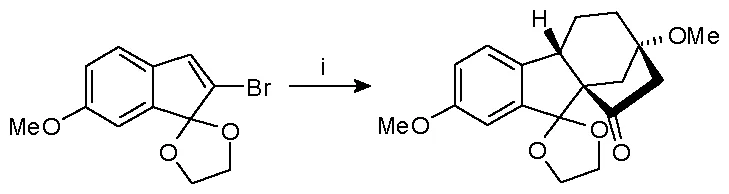
i: a) 1º- n-BuLi, Me2O, hexane; 2º- CO2; 3º- H2O; b) CH2N2; c) 1,3-Butadiene, 130-140 °C; d) NaOH 4 M, MeOH; e) 1º- I2, NaHCO3, H2O, THF; 2º- HSn(n-Bu)3, AIBN, bencene or benzene (in the editors’ view), ref.; f) 1º- LiCH2P(O)(OMe)2, DME, −78 °C; 2º- H2O; g) H2CrO4; h) Na2CO3, MeOH, ref.
Bibliography: House, H.O.; Haack, J.L.; McDaniel, W.C.; Vanderveer, D. J. Org. Chem. 1983, 48, 1643-1654.
Exercise 35
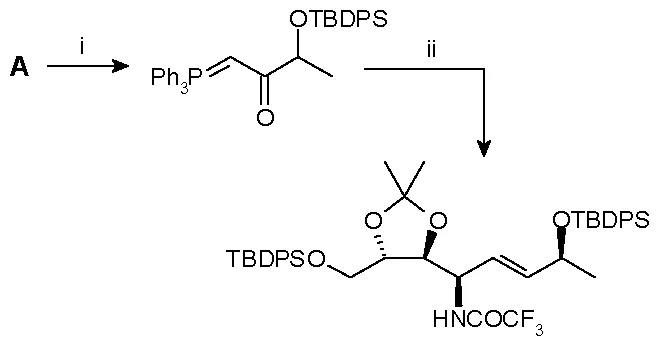
A: Ethyl (2S)-2-hydroxypropanoate.
B: (4R, 5S)-2,2-Dimethyl-4-formyl-5-[(terc-butyldiphenylsilyloxy)methyl]-1,3-dioxolane.
i: a) t-Butyldiphenylsilyl chloride, imidazole; b) KOH, MeOH; c) 2-Pyridinethiol, DCC; d) Ph3P=CH2.
ii: a) Compound B, bencene or benzene (in the editors’ view), ref.; b) L-Selectride; c) 1º- n-BuLi; 2º- CF3CN; d) Xilene or Xylene (in the editors’ view), ref.
Notes:
L-Selectride® reduction yields the S epimer.
Bibliography: Savage, I.; Thomas, E.J. J. Chem. Soc. Chem. Commun. 1989, 717.