The oxidation of isatin using either hydrogen peroxide185,186 or chromic anhydride yields isatoic anhydride187 (Scheme 42):
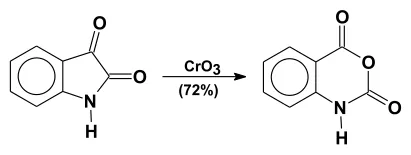
Scheme 42.
Isatoic anhydride can be condensed with proline in polar aprotic solvents at high temperature, or in a reaction catalyzed by the enzyme catalase, to yield a pyrrolo[1,4] benzodiazepine ring, a structural pattern found in some antineoplasic or antineoplastic (in the editors’ view) antibiotics188 (Scheme 43).
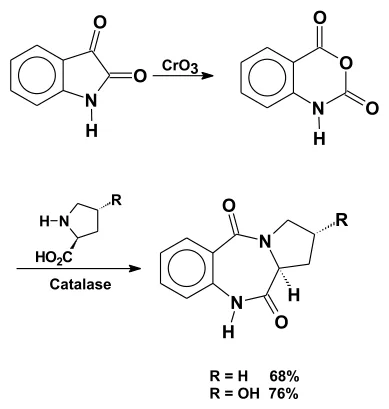
Scheme 43.
6-Chloroisatoic anhydride can also be converted into benzodiazepinones by cyclocondensation with 2-azetidinecarboxylic acid, which reacts with ethyl isocyanoacetate, to give imidazo[1,5-a]-[1,4]benzo-diazepinones189-192 (Scheme 44).
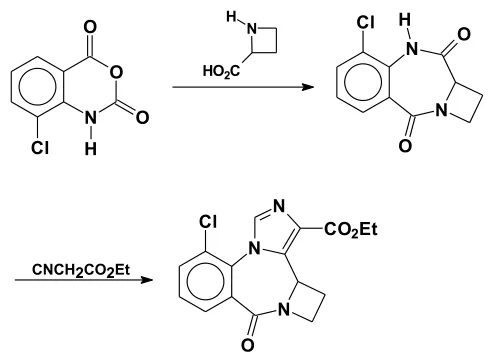
Scheme 44.
Isatin-2-iminooxides lead to isatoic acid derivatives and quinazolinediones by photolysis, while isatin-3-iminooxides are reported to furnish only quinazolinediones. In both cases some isatin is also obtained193 (Scheme 45).
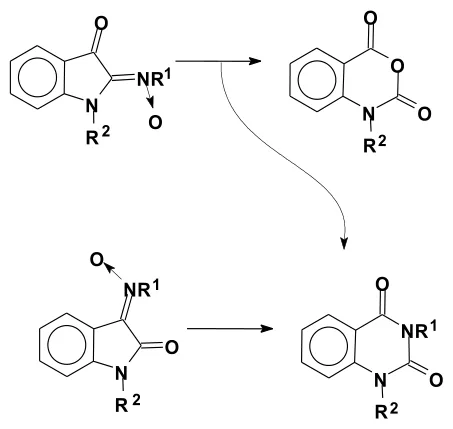
Scheme 45.
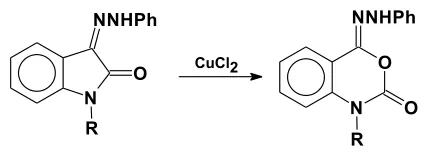
In a related reaction, isatin-3-phenylhydrazone yields 1,3-benzazoxane-2-one-4-hydrazone upon treatment, under reflux, with an ethanolic solution of cupric chloride194 (Scheme 46).
Scheme 46.
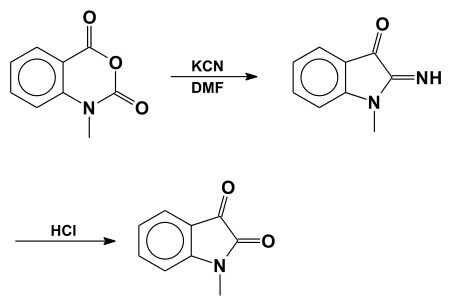
Isatoic anhydrides can be converted to isatins by treatment with cyanide and further hydrolysis of the 2-imino derivatives in acidic media195 (Scheme 47).
Scheme 47.
Anthranilates can be prepared from isatins by reaction of hydrogen peroxide in an alkaline solution24,196, or by the use of chloramine-T or dichloramine-T197 or by hydrolysis of isatoic anhydride with an aqueous alkaline solution198 and may also be formed through oxidation of indigo carmine by hypohalides in alkaline medium199. Anthranilic acid is also formed in the photolysis of isatin to isatoic anhydride, which is subsequently hydrolysed200. Anthranilic acid hydrazides are synthesized from isatoic acid and hydrazines201.
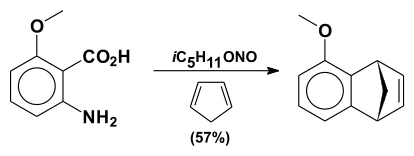
The economic importance of anthranilates resides in their well-established anti-inflammatory activity. Thus, many derivatives have been synthesized with the objective of discovering new pharmacological agents such as immunosupressants or immunosuppressants (in the editors’ view)202, fungicides203 and agents for the prevention of nerve cell damage204. Anthranilic acid has also been used in the synthesis of polycyclic aromatic hydrocarbons, such as dicyclooctabiphenylenes205, phenanthrenequinones206, fluorenones207, benzonorbor-nadienes208, toluenes209, naphthalenes and anthracenes210 and benzyne-furan adducts211. Most of these syntheses are based upon the formation of benzyne after diazotization of anthranilic acid and the subsequent addition to a diene. This methodology has been used in the synthesis of odorous compounds212 and for the synthesis of podocarpic acid213 (Scheme 48).
Scheme 48.
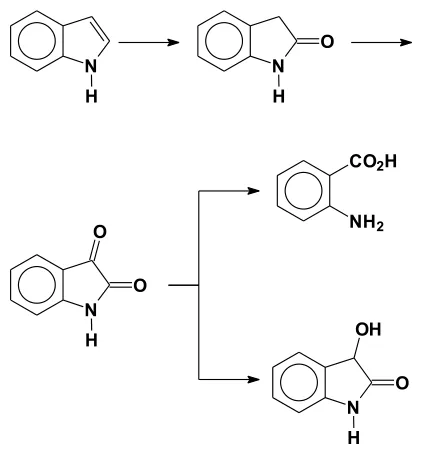
Anthranilate, as well as isatin, isatoic anhydride, dioxindole and oxindole have been found to be products of microbial oxidation of indoles, as shown in the sequence below214,215 (Scheme 49). Similar pathways are found in the degradation of indole-3-acetic acids216.
Scheme 49.
The treatment of isatin-3-oximes or their O-sulfonates with bases, such as sodium methoxide in refluxing diethyleneglycol217 or NaOH and CuSO4218 leads to 2-cyanoanilines. Under Beckmann rearrangement conditions, O-tosyl oximes furnish the cyanoanilines219, while the parent oxime gives the intermediate 2-cyanophenyl-isocyanate220. When the O-acetyl oximes are reacted with sodium azide, cyanoanilines are also produced221. Campbell217 proposed a mechanism where the E-isomer of the oxime suffers elimination, forming a 2-cyanoisocyanate, which upon hydrolysis and decarboxylation gives 2-cyanoaniline (Scheme 50).
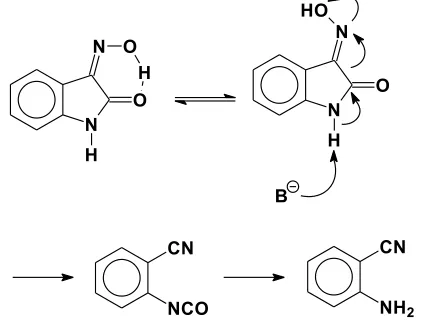
Scheme 50.
Isatin-3-oximes are also decomposed to benzonitrile derivatives under Vilsmeier-Haack conditions, furnishing formamidines222 (Scheme 51).
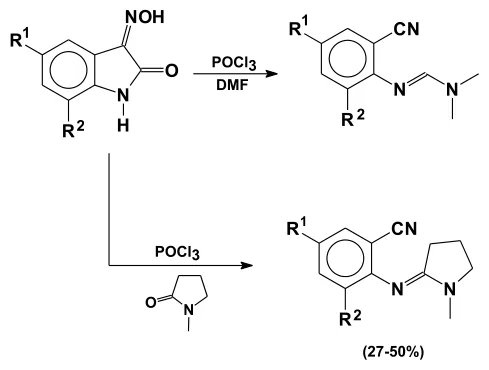
Scheme 51.
These methods have been applied to the efficient synthesis of substituted cyanoanilines such as 2-cyano-4-nitroaniline223.
The oxidation of isatin with metachloroperbenzoic acid yields 1,4-benzoxazine-2,3 (4H)-dione, which was subsequently converted to blepharin, a glycoside obtained from Blepharis edulis Pers. whose seeds are used in rejuvenescent therapy in Ayurvedic medicine224. This oxidation can also be performed with potassium persulfate in sulfuric acid225,226 (Scheme 52).
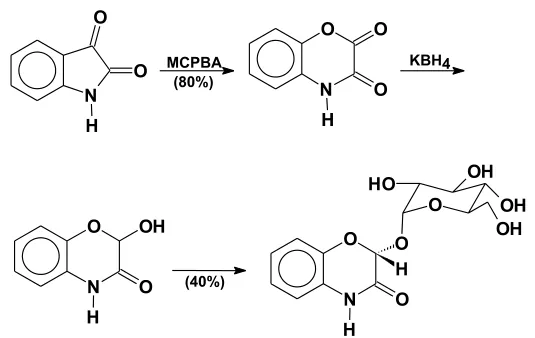
Scheme 52.
Isatin undergoes anodic methoxylation in acidic medium when using platinum electrodes in a unique fashion that results in the dimethoxylation of isatin at positions C-3a and C-7a227 (Scheme 53).
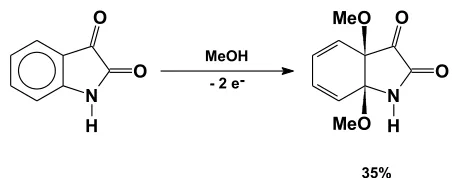
Scheme 53.