Many synthetic methodologies have been described for the conversion of isatins to other heterocyclic systems. This chemistry can be generalized as one of the following strategies:
a) Partial or total reduction of the heterocyclic ring, leading to indoles and derivatives;
b) Oxidation of the heterocyclic ring. For example, conversion of isatin to isatoic anhydride, with subsequent conversion to other heterocyclic systems (Scheme 31);
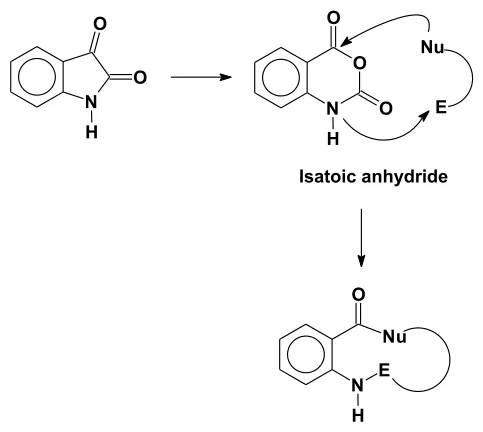
Scheme 31.
c) Nucleophilic addition at position C-3, which may be further followed by a cyclization process, with or without N1-C2 bond cleavage (Scheme 32); or by a spiro-annelation at position C-3 (Scheme 33):
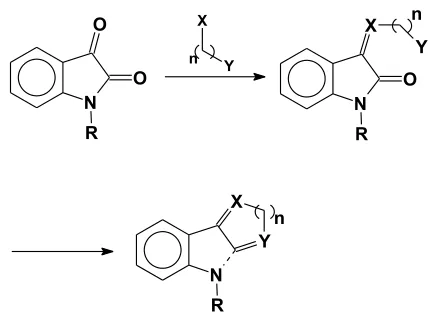
Scheme 32.
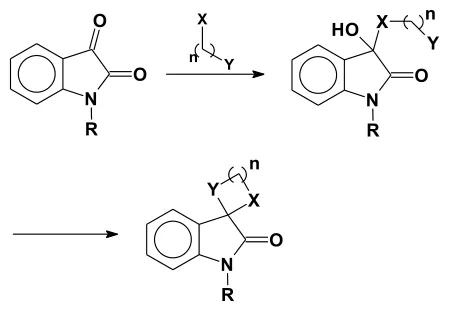
Scheme 33.
d) Nucleophilic substitution at position C-2, leading to the opening of the heterocyclic ring. This process may be followed by an intramolecular or by an intermolecular exo-trig cyclization (Scheme 34).
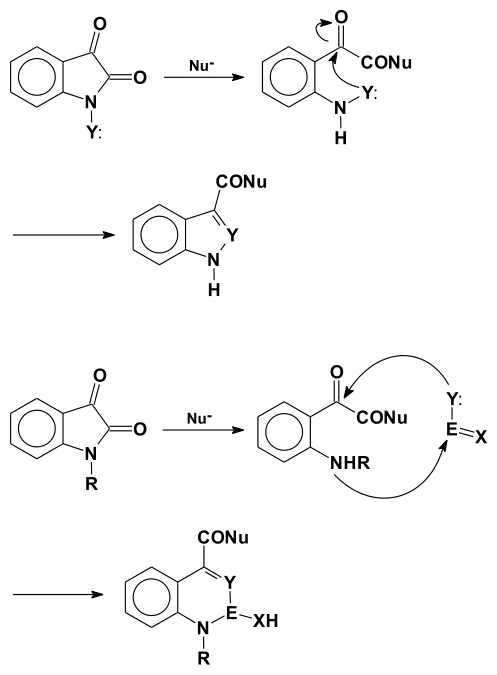
Scheme 34.