GalChimia - Exercises in Organic Synthesis
Exercise 26
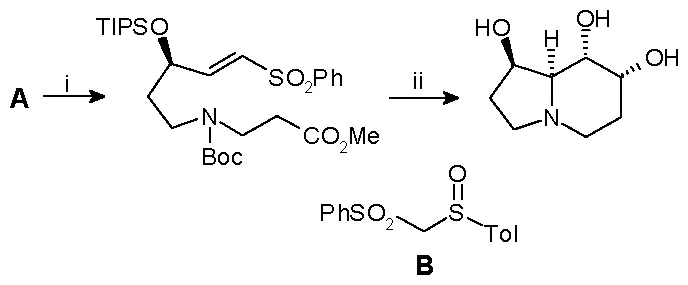
A: 4-aminebutanol or aminobutanol (in the editors’ view).
i: a) Methyl acrylate, EtOH, 0 °C; b) Boc2O, CH2Cl2, t.a.; c) Cl2C2O2, DMSO, Et3N, CH2Cl2, −78 °C; d) Compound B, piperidine, CH2Cl2, 0 °C, 10 h; e) TIPSOTf, 2,6-lutidine, CH2Cl2.
ii: a) TFA, CH2Cl2, t.a.; b) Et3N, −78 °C; c) Separation of diastereoisomers; d) LHMDS, THF, 0 °C; e) NaBH4; f) Na(Hg), MeOH; g) OsO4, Me3NO; h) HCl.
Notes:
The conditions on the step i d) yield an α,β-unsaturated γ-hydroxysulfone.
On the step ii b) the cis/trans isomers are obtained in a 10/90 ratio.
Bibliography: Carretero, J.C.; Gómez-Arrayás, R. J. Org. Chem. 1995, 60, 6000.
Exercise 27
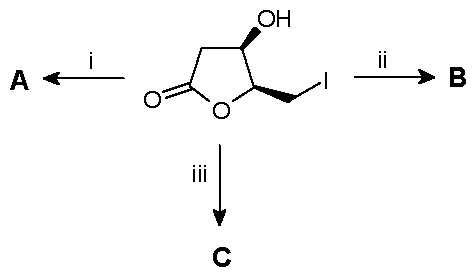
A: (4S, 5R)-4-Methyl-5-butyltetrahydro-2-furanone [(+)-Lactone of whisky].
B: (4S, 5R)-4-Methyl-5-pentyltetrahyidro or tetrahydro (in the editors’ view)-2-furanone [(+)-Lactona or Lactone (in the editors’ view) of cognac].
C: (2R, 3S, 4S)-4-Methyl-5-oxo-2-dodecyltetrahydro-3-furancarboxylic acid.
i: a) Propylmagnesium bromide, CuBr·Me2S; b) Benzoyl chloride, py; c) NH3, MeOH; d) Me2CuLi, THF.
ii: a) Butylmagnesium bromide, CuBr·Me2S; b) Benzoyl chloride, py; c) NH3, MeOH; d) Me2CuLi, THF.
iii: a) C11H23MgBr, CuBr·Me2S; b) Benzoyl chloride, py; c) NH3, MeOH; d) 1º- (PhS)3CLi; 2º- MeI; e) HgO, BF3·Et2O, THF, H2O.
Bibliography: Takahata, H.; Lichida, Y.; Momose, T. J. Org. Chem. 1995, 60, 5628.
Exercise 28
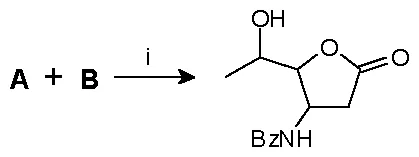
A: Methyl 3-nitropropanoate.
B: (R)-2-Benzyloxypropanal.
i: a) Al2O3; b) HCl, CH2Cl2; c) H2, Ni Raney, Bz2O, MeOH; d) H2, Pd/C, H+, MeOH; e) MsCl, py; f) NaOBz, DMF; g) NaOMe (0.1 equiv), MeOH.
Notes:
The alumine (Al2O3) acts as basic catalyst.
The product obtained on the step i a) is an alose derivative.
Bibliography: Hanessian, S.; Kloss, J. Tetrahedron Lett. 1985, 26, 1261.
Exercise 29
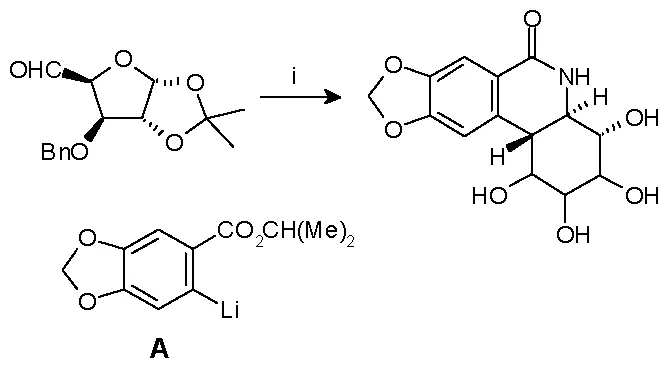
i: a) MeNO2, KF; b) Ac2O, p-TsOH; c) NaHCO3, bencene or benzene (in the editors’ view), 80 °C; d) Compound A, THF, −110 °C; e) AcOH (50%), ref.; f) NaHCO3 (2.25%), MeOH; g) H2 (1 atm), Pd/C 10%; h) K2CO3, MeOH.
Notes:
The product obtained on the step i f) is the lactone derived from the epimer with the aromatic ring in equatorial disposition.
Bibliography: Paulsen, H.; Stubbe, M. Tetrahedron Lett. 1982, 23, 3171.
Exercise 30
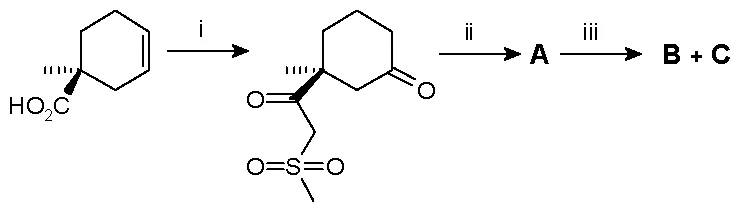
A: (1S,5S)-1-Hydroxy-5-methylbycicle or bicyclo (in the editors’ view)[3.2.1]octan-6-one.
B: C13H16O2.
i: a) I2, NaHCO3, H2O, THF; b) HSn(n-Bu)3, AIBN, benzene, ref.; c) 1º- LiCH2SO2CH3, DME; 2º- H2CrO4.
ii: a) NaOH, H2O, THF; b) Na(Hg), K2HPO4, MeOH.
iii: a) MsCl, py; b) Et3N, furane or furan (in the editors’ view), ref.
Notes:
The products B and C are obtained in 4:1 ratio.
Bibliography: House, H.O.; Haack, J.L.; McDaniel, W.C.; Vanderveer, D. J. Org. Chem. 1983, 48, 1643-1654.