GalChimia - Exercises in Organic Synthesis
Exercise 1
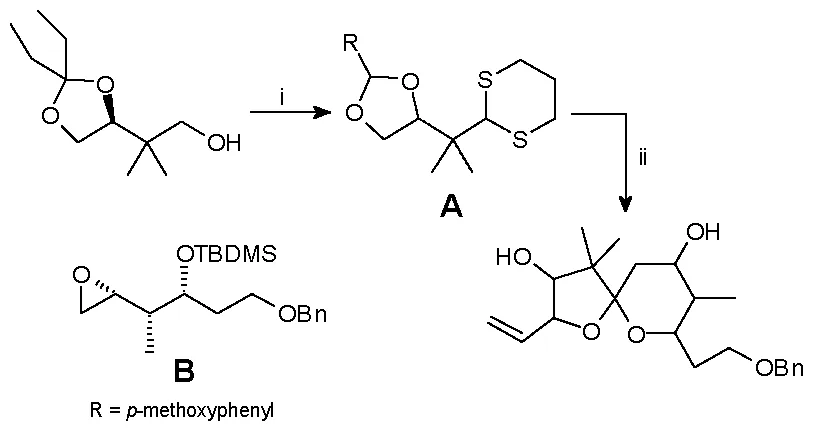
i: a) Cl2C2O2, DMSO, Et3N, CH2Cl2, −78 °C; b) 1,3-Propanedithiol (2.5 equiv), BF3·Et2O, CH2Cl2, 0 °C; c) p-methoxybenzaldehyde dimethyl acetal, p-TsOH, DMF, t.a.
ii: a) 1º- Compound A (1.5 equiv), n-BuLi (1.5 equiv), TMEDA (6 equiv), THF, −78 → −20 °C; 2º- DMPU (6 equiv); 3º- Compound B (1 equiv), THF, −20 °C; b) TBDMSOTf, 2,6-lutidine, CH2Cl2, 0 °C; c) DIBAL, CH2Cl2, −78 → 0 °C; d) DMSO, SO3·py, Et3N, CH2Cl2, t.a.; e) Vinylmagnesium bromide, THF, −78 °C; f) HF, CH3CN, H2O, CH2Cl2, t.a.
Notes:
TMEDA is a complexating agent which withdraws the lithium cation, increasing the reactivity of the organolithium reagents.
The addition of DMPU on the step ii a) increases the reaction yield.
The reductive opening of bencylidene or benzylidene (in the editors’ view) acetals using DIBAL yields the primary alcohol and an ether.
Conditions ii d) yield an aldehyde.
On the step ii e), the addition of the magnesium reagent produces mainly the S epymer or epimer (in the editors’ view).
On the step ii f), the cyclation yields the more stable acetal.
Bibliography: Smith III, A.B.; Duan, J.J.-W.; Hull, K.G.; Salvatore, B.A. Tetrahedron Lett. 1991, 32, 4855.
Exercise 2
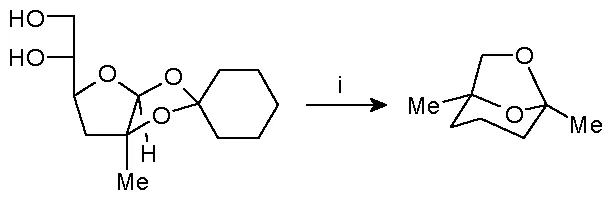
i: a) IO4H; b) NaBH4; c) BnCl, KOH; d) H2O, H+ cat.; e) NaBH4; f) Acetone, H+, azeotropic water removal; g) H2, Pd/C; h) IO4H; i) Ph3P=CHCOMe; j) H2, Pd/C; k) p-TsOH.
Bibliography: ApSimon, Vol. 4, 154.
Exercise 3
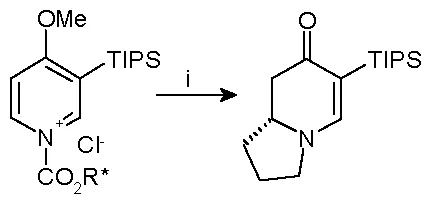
i: a) 1º- 3-buthenyl or 3-butenyl (in the editors’ view) magnesium bromide; 2º- H3O+; b) 1º- OsO4 (cat.), NaIO4; 2º- L-Selectride®; c) Ph3P, NCS, CH2Cl2; d) NaOMe, MeOH.
Notes:
R* stands for (−)-trans-2-(α-cumyl)cyclohexyl (TCC), a chiral auxiliary.
The mixture of Ph3P and NCS transforms alcohols in chlorides.
Bibliography: Comins, D.L.; Chen, X. y Morgan, L.A. J. Org. Chem. 1997, 62, 7435.
Exercise 4
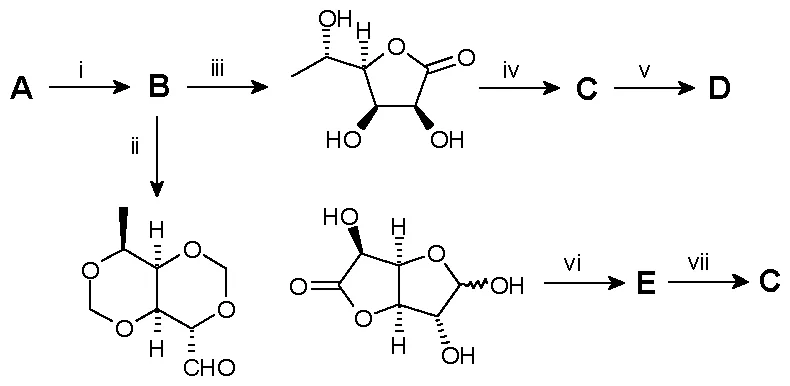
A: (2R, 3S, 4R, 5R)-2,3,4,5,6-Pentahydroxyhexanal.
C: Mixture of methyl gulopyranosides.
D: 6-Deoxi or Deoxy (in the editors’ view)-2,3-O-isopropylidene-4-O-methyl-L-gulopyranose.
E: 2-O-(t-Butyldimethylsilyl)-6-deoxi or deoxy (in the editors’ view)-3,5-O-isopropylidene-L-gulofuranose.
i: a) 1,3-Propanedithiol, H3O+; b) H2, Ni Raney, Et2O, H2O; c) Formaldehyde, H+; d) CrO3.
ii: a) Diazomethane; b) DIBAL (1 equiv).
iii: H2O, H+.
iv: a) Na(Hg), H3O+; b) MeOH, H+.
v: a) 2,2-Dimethoxypropane, acetone, H+; b) KH, MeI, THF; c) H2O, H+; d) 2,2-Dimethoxypropane, acetone, H+.
vi: a) 1,2-Ethanedithiol, H3O+; b) 2,2-Dimethoxypropane, acetone, H+; c) H2, Ni Raney, EtOH, THF; d) t-Butyldimethylsilyl chloride, imidazole, DMF; e) DIBAL (1 equiv), THF.
vii: MeOH, H+.
Bibliography: Ireland, R.B.; Wilcox, C.S. J. Org. Chem. 1980, 45, 197.
Exercise 5
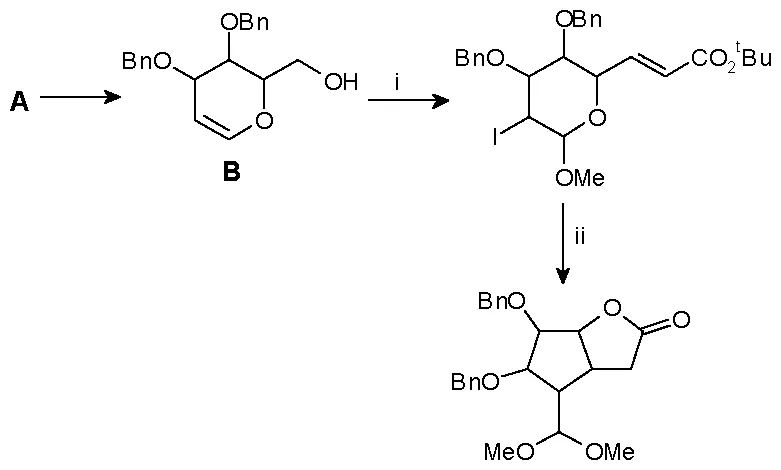
A: D-Glucose.
i: a) PCC; b) Ph3=CH-CO2tBu or Ph3P=CH-CO2tBu (in the editors’ view); c) N-Iodosuccinimide, MeOH.
ii: a) HSn(n-Bu)3, AIBN; b) MeOH, H+.
Notes:
Under the conditions i c), the cyclic iodonium cation generates stereoselectively the α glucopyranoside.
Bibliography: Vite, G.D.; Alonso, R.; Fraser-Reid, B. J. Org. Chem. 1989, 2268.