Gabriel Tojo - Two Hundred Exercises in Mechanistic Organic Chemistry
Exercise 71

Solution
1– The sulfur atom attacks the cyanide, generating a carbon-nitrogen double-bond.
2– The amine attacks the carbon-nitrogen double-bond, producing an intermediate that looses or loses (in the editors’ view) ammonia.
Zamri, A.; and Abdallah, M.A., Tetrahedron, 56, 249 (2000).
Exercise 72
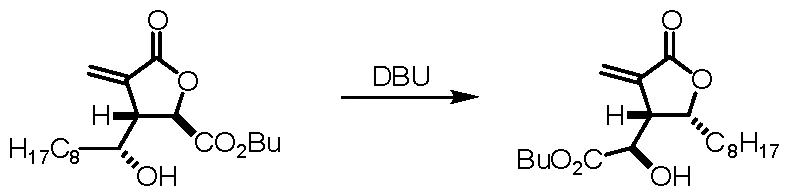
Solution
1– The strong base DBU captures the alcohol proton.
2– The resulting alkoxide attacks the lactone carbonyl and expels an oxygen.
Chen, M.–J.; Narkunan, K.; and Liu, R.–S., J.Org.Chem., 64, 8311 (1999).
Exercise 73

Solution
1– The pyridinium p-toluenesulfonate (PPTS) generates a mild acidic medium that allows the selective hydrolysis of the oxazoline. This happens by protonation of the nitrogen, followed by an electronic movement that begins in the electron pair in one of the oxygen atoms in the bridge-head acetal, and produces the expulsion of the oxazoline oxygen.
2– This generates a cation on α to the oxygen, which is trapped by water.
Williams, D.R.; Rojas, C.M.; and Bogen, S.L., J.Org.Chem., 64, 736 (1999).
Exercise 74

Solution
In this reaction, an apparently simple alcohol acetylation fails because of a very easy elimination that leads to aromatization.
1– The alcohol is acetylated by the normal acetylation mechanism of alcohols, in which acid chlorides and pyridine are used.
2– This is followed by a 1,4-elimination, where pyridine acts as base and an acetate as leaving group. This elimination is particularly easy because it leads to an aromatic ring.
Chiacchio, U; Rescifina, A.; Iannazzo, D.; and Romeo, G., J.Org.Chem., 64, 28 (1999).
Exercise 75
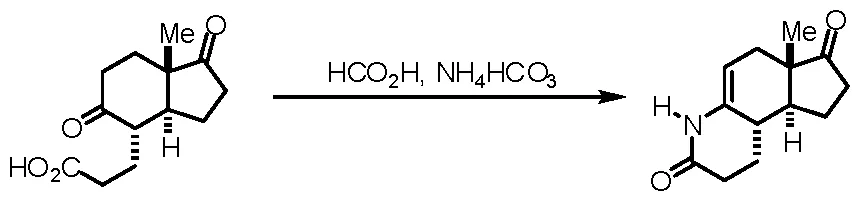
Solution
1– Ammonia, which is present in a small proportion in equilibrium with the ammonium cation, attacks one of the ketones, producing a enamine.
2– The nitrogen of the resulting enamine condenses intramolecularly with the carboxylic acid, giving a lactam.
Guarna, A.; Occhiato, E.G.; Machetti, F.; and Scarpi, D., J.Org.Chem., 63, 4111 (1998).
Exercise 76
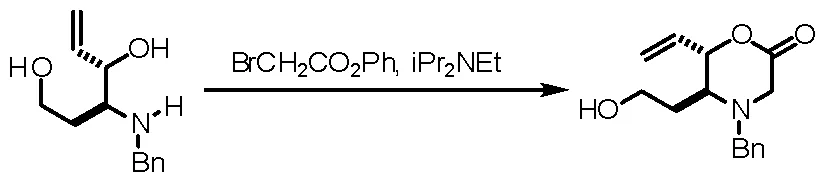
Solution
1– The amine is alkylated by phenyl bromoacetate.
2– Deprotonation of the secondary alcohol is followed by attack of the resulting alkoxide on the phenyl ester.
Angle, S.R.; and Henry, R.M., J.Org.Chem., 63, 7490 (1998).
Exercise 77
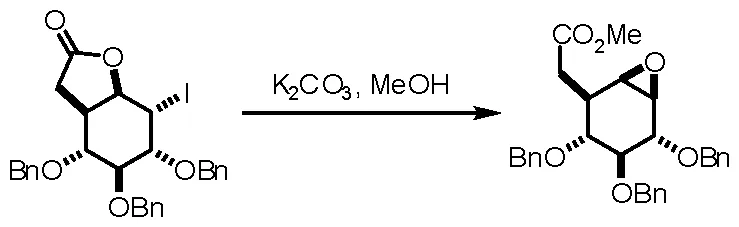
Solution
1– The methoxide, generated by the action of the potassium carbonate on methanol, reacts with the lactone. This produces a methyl ester and an alkoxide.
2– The resulting alkoxide reacts intramolecularly with the iodide, forming an epoxide.
Ziegler, F.E.; and Wang, Y., J.Org.Chem., 63, 7920 (1998).
Exercise 78
Solution
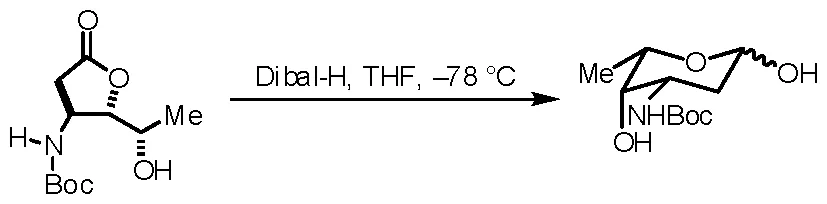
1– The Dibal-H, at a low temperature, reduces the lactone to the corresponding hemiacetal.
2– This hemiacetal equilibrates with a hydroxy aldehyde, whose aldehyde group is attacked by the alcohol in position 5.
Sibi, M.P.; Lu, J.; and Edwards, J., J.Org.Chem., 62, 5864 (1997).
Exercise 79

Solution
1– The phosphonate α-anion reacts with the lactone carbonyl. This produces the opening of the lactone and the formation of a β-keto phosphonate and an enol, which tautomerizes to a ketone.
2– An anion on the β-keto phosphonate is formed, thanks to the use of excess of basic phosphorous reagent. This anion reacts intramolecularly with the ketone.
Grzywacz, P.; Marczak, S.; and Wicha, J., J.Org.Chem., 62, 5293 (1997).
Exercise 80
Solution
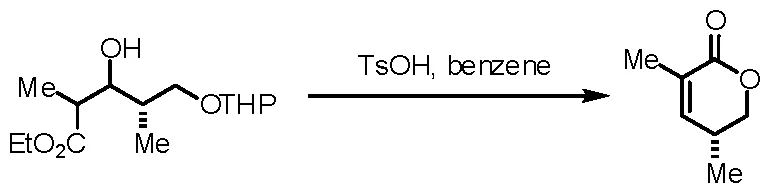
The acidic conditions produce the deprotection of the tetrahydropyranyl ether, the dehydration of the alcohol, and the formation of the lactone.
Andrus, M.B.; Li, W.; and Keyes, R.F., J.Org.Chem., 62, 5542 (1997).