Gabriel Tojo - Two Hundred Exercises in Mechanistic Organic Chemistry
Exercise 31
Solution
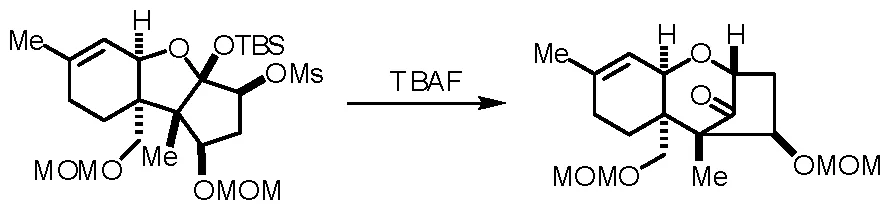
1– The tetra-n-butylammonium fluoride (TBAF) produces the desilylation of the silyl ether, leading to an alkoxide.
2– The alkoxide evolves by ketone formation and migration of an oxygen atom to a neighbouring carbon, producing the expulsion of the mesylate.
As an alternative mechanism, the alkoxide may form the ketone by expulsion of oxygen. This generates another alkoxide that displaces intramolecularly the mesylate.
Ishihara, J.; Nonaka, R.; Terasawam Y,; or Terasawa, Y.; (in the editors’ view) Shiraki, R.; Andabu or Yabu (in the editors’ view), K.; Kataoka, H.; Ochiai, Y.; and Tadano, K., J.Org.Chem., 63, 2679 (1998).
Exercise 32
Solution
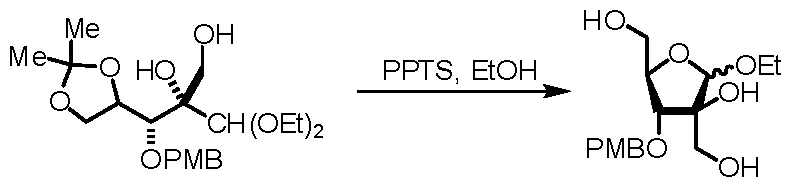
1– The acidic conditions, generated by pyridinium p-toluenesulfonate in ethanol, produces the dioxolane ethanolysis.
2– The protonation of one of the diethyl acetal oxygen atoms is followed by the loss of ethanol, resulting in the formation of a cation on α to one oxygen. This cation is attacked by one of the alcohols.
Paquette, L.A.; Zeng, Q.; Tsui, H.–C.; and Johnson, J.N., J.Org.Chem., 63, 8491 (1998).
Exercise 33
Solution
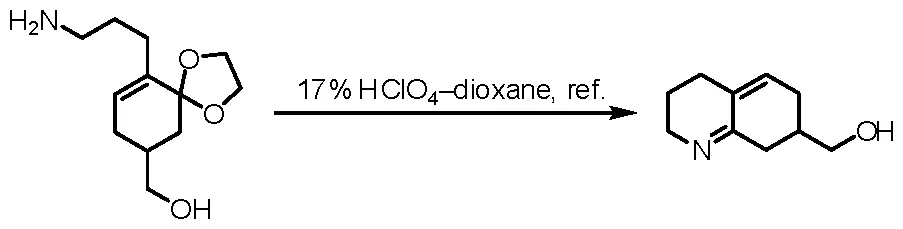
1– The perchloric acid produces the hydrolysis of the acetal.
2– The amine attacks the liberated ketone, giving the final cyclic imine.
Wu, B.; and Bai, D., J.Org.Chem., 62, 5978 (1997).
Exercise 34
Solution
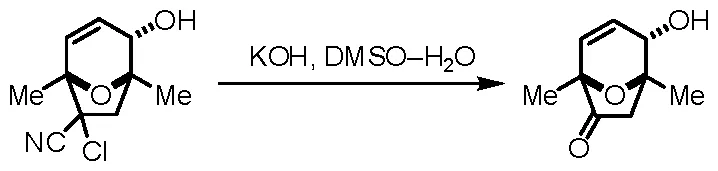
1– The chlorine is displace or displaced (in the editors’ view) by a hydroxide giving a cyanohydrin.
2– The cyanhydrine or cyanohydrin (in the editors’ view) is transformed in a ketone under basic conditions.
Marshall, K.A.; Mapp, A.K.; and Heathcock, C.H., J.Org.Chem., 61, 9135 (1996).
Exercise 35
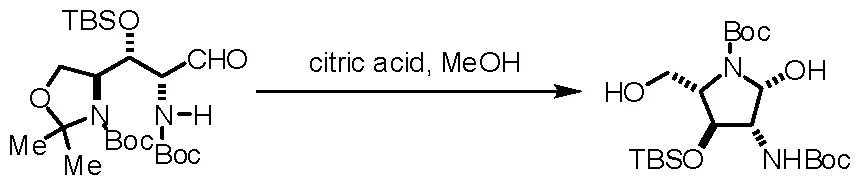
Solution
1– A Boc-protected amine and an alcohol are liberated by acidic hydrolysis of the oxazolidine.
2– One of the nitrogen atoms attacks intramolecularly the aldehyde producing a stable cyclic aminal.
Soro, P.; Rassu, G.; Spanu, P.; Pinna, L.; Zanardi, F.; and Casiraghi, G., J.Org.Chem., 61, 5172 (1996).
Exercise 36
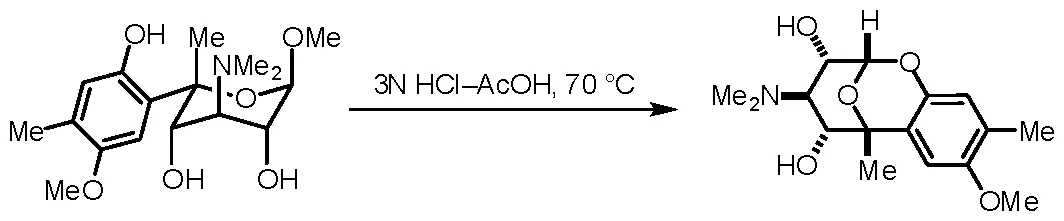
Solution
1– The acidic conditions produce the release, after protonation, of a methoxy group from the anomeric position.
2– The resulting cation is attacked intramolecularly by the oxygen of the phenol.
Hauser, F.M.; and Ganguly, D., J.Org.Chem. 65, 1842 (2000).
Exercise 37

Solution
1– The Wittig ylide reacts with the aldehyde, in equilibrium with a hemiacetal, yielding an alkene.
2– The liberated alcohol, which exists as an alkoxide under the basic reaction conditions, displaces intramolecularly the iodide, producing a tetrahydrofuran.
Ruan, Z.; Dabideen, D.; Blumenstein, M.; and Mootoo, D.R., Tetrahedron 56, 9203 (2000).
Exercise 38
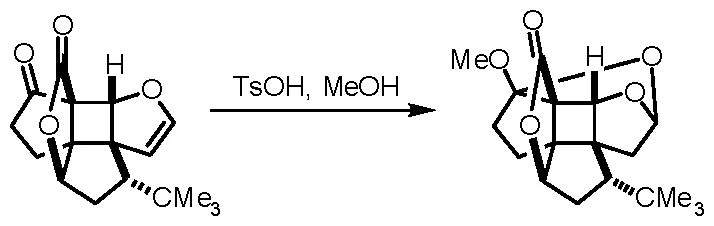
Solution
1– The methanol attacks the ketone, producing a hemiacetal.
2– The protonation of the alkene yields a carbocation located on α to the tetrahydrofuran oxygen. The hemiacetal hydroxy group reacts intramolecularly with this cation.
Crimmins, M.T.; Pace, J.M.; Nantermet, P.G.; Kim-Meade, A.S.; Thomas, J.B.; Watterson, S.H.; and Wagman, A.S., J.Am.Chem.Soc. 122, 8453 (2000).
Exercise 39
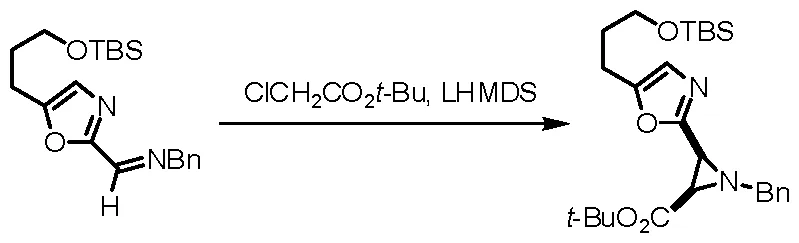
Solution
1– The base generates an enolate on the ester, and it reacts with the imine.
2– The resulting nitrogen anion displaces intramolecularly the chloride, yielding an aziridine.
Vedejs, E.; Piotrowski, D.W.; and Tucci, J.Org.Chem., 65, 5498 (2000).
Exercise 40
Solution
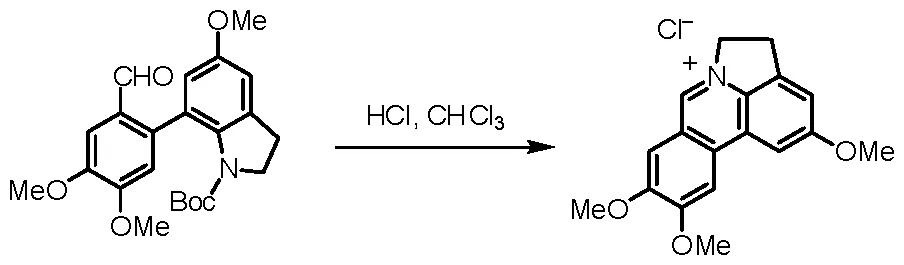
1– The Boc group is removed under acidic conditions.
2– The resulting amine condensates or condenses (in the editors’ view) intramolecularly with the aldehyde.
Stark, L.M.; Lin, X.; and Flippin, L.A., J.Org.Chem., 65, 3227 (2000).