Gabriel Tojo - Two Hundred Exercises in Mechanistic Organic Chemistry
Chapter 1. Good-Leaving Groups on sp³ Carbons: Substitution and Elimination, Reactions of Simple Alkenes
Exercise 1

Solution
1– The alcohol is transformed in a mesylate that is attacked intramolecularly by the nitrogen.
Imamura, H.; Shimizu, A.; Sato, H.; Sugimoto, Y.; Sakuraba, S.; Nakajima, S.; Abe, S.; Miura, K.; Nishimura, I.; andamada or Yamada (in the editors’ view), K.; and Morishima, H., Tetrahedron, 56, 7705 (2000).
Exercise 2

Solution
1– Thionyl chloride transforms the alcohol into an alkyl chloride.
2– The amide oxygen displaces intramolecularly the chlorine atom.
Evans, D.A.; Gage, J.R.; and Leighton, J.L., J.Am.Chem.Soc., 114, 9434 (1992).
Exercise 3
Solution
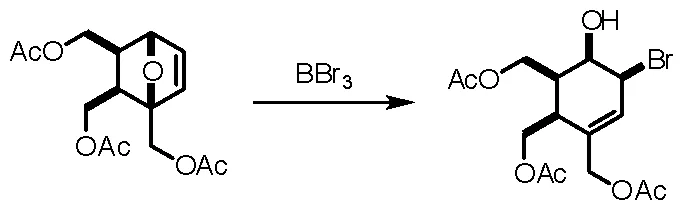
1– The Lewis acid BBr3 complexes with the ether oxygen, which becomes a good-leaving group.
2– The complex delivers a bromide anion that attacks the alkene via an SN2′ mechanism. This leads to a double-bond migration and expulsion of the ether oxygen.
Jotterand, N.; and Vogel, P., J.Org.Chem., 64, 8973 (1999).
Exercise 4
Solution
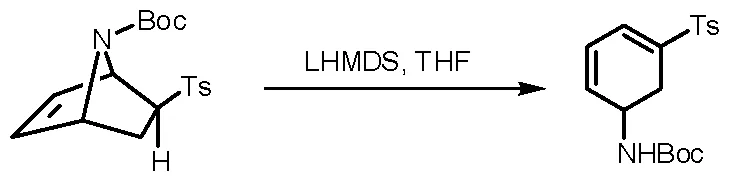
1– The lithium hexamethyldisilylazide generates an anion on α to the sulfone.
2– This anion evolves by expulsion of the carbamate nitrogen, causing the formation of an olefin. The stabilization of the negative charge on the nitrogen by delocalization on the lactone or carbamate (in the editors’ view) carbonyl makes this expulsion possible.
Leung–Toung, R.; Liu, Y.; Muchowski, J.M.; and Wu, Y.–L., J.Org.Chem., 63, 3235 (1998).
Exercise 5
Solution
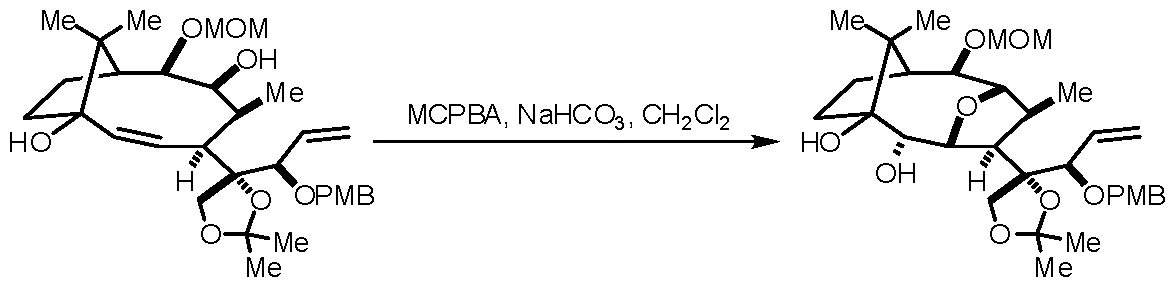
1– The m-chloroperbenzoic acid epoxidizes one of the alkenes.
2– The secondary alcohol attacks the epoxide, producing its opening.
Johnston, J.N.; Tsui, H.–C.; and Paquette, L.A., J.Org.Chem., 63, 129 (1998).
Exercise 6
Solution
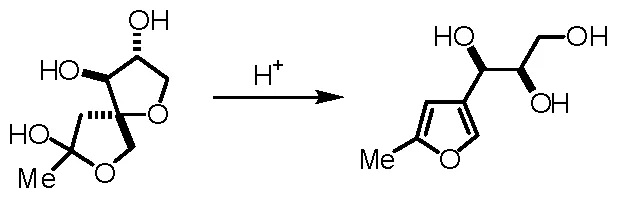
1– The hemiacetal hydroxy group is protonated, thus becoming a good-leaving group. An elimination gives rise to one of the double bonds of the final furan.
2– The oxygen of the remaining tetrahydrofuran suffers elimination, after protonation, producing the second double-bond in the final furan ring.
Yu, P.; Andang or Yang (in the editors’ view), Y.; Zhang, Z.Y.; Mak, T.C.W.; and Wong, H.N.C., J.Org.Chem., 62, 6359 (1997).
Exercise 7
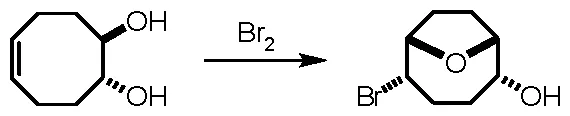
Solution
1– A bromonium cation on a three-membered ring is formed by attack of the alkene on a bromine molecule.
2– One of the alcohols attacks intramolecularly a carbon holding the bromonium cation, producing the opening of the three-membered ring and the breakage of a carbon–bromine bond.
Takahashi, A.; Aso, M.; Tanaka, M.; and Suemune, H., Tetrahedron 56, 1999 (2000).
Exercise 8
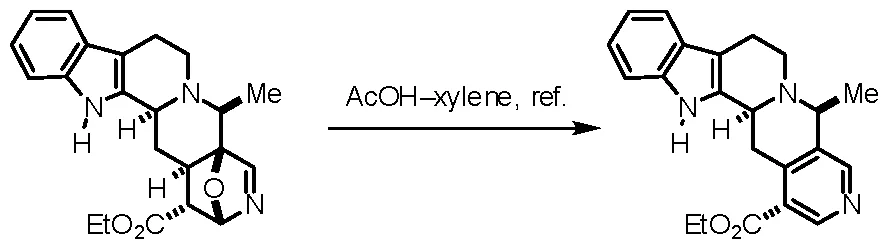
Solution
1– The oxygen on the ether bridge suffers an elimination after protonation, leading to an alkene conjugated with an ester.
2– The resulting alcohol undergoes an elimination after protonation, producing an aromatic pyridine ring.
Ohba, M.; Kubo, H.; and Ishibashi, H., Tetrahedron 56, 7751 (2000).
Exercise 9
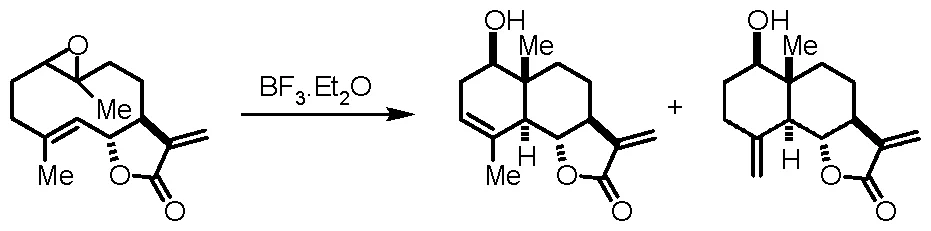
Solution
1– After activation by complexation with boron trifluoride, the epoxide suffers and or an (in the editors’ view) intramolecular attack by an alkene, producing a tertiary carbocation.
2– Two possible alkenes are produced by proton loss from the carbocation.
Matsuda, H.; Kageura, T.; Inoue, Y.; Morikawa, T.; and Yoshikawa, M., Tetrahedron 56, 7763 (2000).
Exercise 10

Solution
1– Both the alcohol and the amine are tosylated.
2– Under the biphasic basic conditions, an anion formed on the nitrogen of the sulfonamide displaces the tosylate.
Sledeski, A.W.; Kubiak, G.G., O’Brien, M.K.; Powers, M.R.; Powner, T.H.; and Truesdale, L.K., J.Org.Chem., 65, 8114 (2000).