Gabriel Tojo - Two Hundred Exercises in Mechanistic Organic Chemistry
Exercise 101
Solution
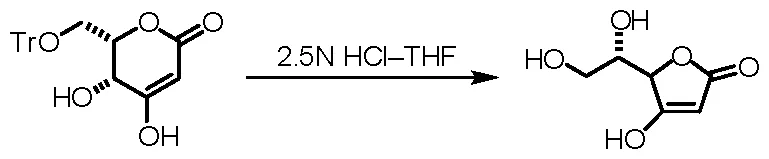
1– The acidic conditions produce the hydrolysis of the trityl (triphenylmethyl) ether. Normally, the acidic hydrolysis of ethers is very difficult. In this case, the hydrolysis can be done under very mild conditions, due to the stability of the intermediate trityl cation.
2– An acidic hydrolysis of the lactone is produced.
3– A new five-membered lactone is formed.
Ge. P.; and Kirk, K.L. J.Org.Chem., 61, 8671 (1996).
Exercise 102

Solution
1– The base LHMDS forms an α-anion on the acetate carbonyl.
2– This anion attacks intramolecularly the methyl ester, producing the expulsion of methoxide and the formation of a ketone.
3– The resulting ketone tautomerizes to an enol. In this case, the enol form predominates in the equilibrium, because of conjugation between the alkene and the lactone carbonyl.
Ge. P.; and Kirk, K.L. J.Org.Chem., 61, 8671 (1996).
Exercise 103

Solution
1– The LHMDS deprotonates the alcohol.
2– The resulting alcohol reacts with the acetate carbonyl, producing a trans-acetylation.
3– This generates the starting compound from the previous exercise, with or which (in the editors’ view) evolves in a similar way in this problem, leading to the same final product.
Ge. P.; and Kirk, K.L. J.Org.Chem., 61, 8671 (1996).
Exercise 104
Solution
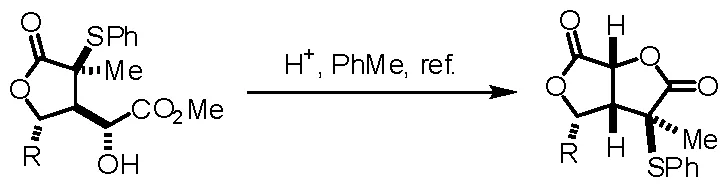
1– The alcohol attacks intramolecularly the lactone carbonyl, which has been previously activated by protonation.
2– The lactone is opened and a new lactone is formed.
3– The liberated hydroxy group reacts with the methyl ester, producing the generation of methanol and the formation of a new lactone.
Rodríguez, C.M.; Martín, T.; and Martín, V.S., J.Org.Chem., 61, 8448 (1996).
Exercise 105
Solution
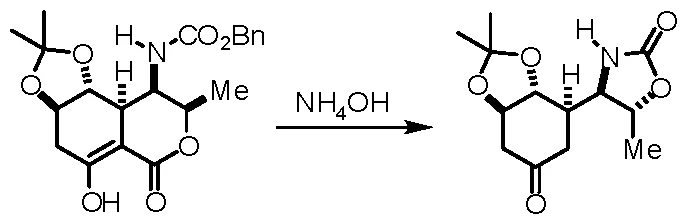
1– The lactone is hydrolysed under basic conditions, and the enol tautomerizes to a ketone.
2– The resulting β-keto acid suffers a decarboxylation yielding a ketone.
3– The alkoxide generated in the opening of the lactone attacks the carbamate carbonyl and expels benzylic alcohol.
Ward, D.E.; Gai, Y.; and Kaller, B.F., J.Org.Chem., 61, 5498 (1996).
Exercise 106
Solution
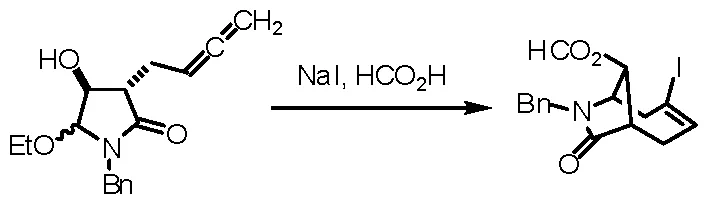
1– The protonation of the ethoxy group is followed by the detachment of ethanol and the formation of an acylimonium or acyliminium (in the editors’ view) cation.
2– The allene reacts intramolecularly with this cation, producing a vinylic cation that is trapped with iodide.
2– The alcohol is formylated by reaction with formic acid under acidic conditions.
Beyersbergen van Henegouwen, W.G.; Fieseler, R.M.; Rutjes, F.P.J.; and Hiemstra, H. J.Org.Chem., 65, 8317 (2000).
Exercise 107
Solution
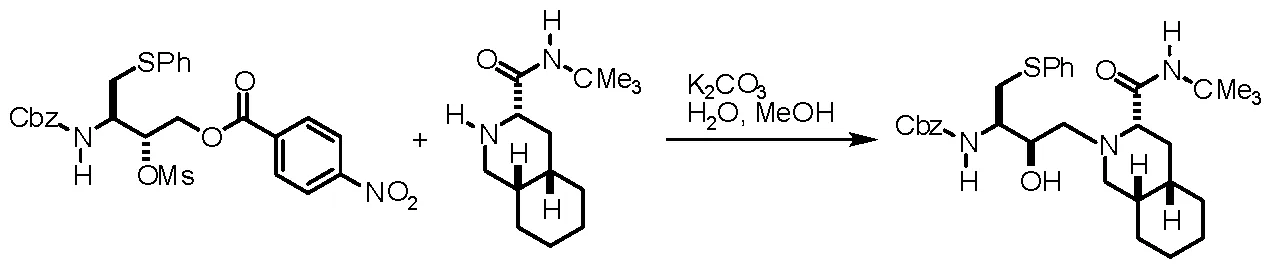
1– The p-nitrobenzoate is hydrolysed under basic conditions.
2– The resulting alkoxide displaces the neighbouring mesylate, yielding an epoxide.
3– The amine opens the epoxide by attack on its less hindered side.
Takashi, I.; andamada or Yamada (in the editors’ view), Y.; Abe, H.; Sagawa, S.; and Cho, H., J.Org.Chem. 65, 1623 (2000).
Exercise 108
Solution
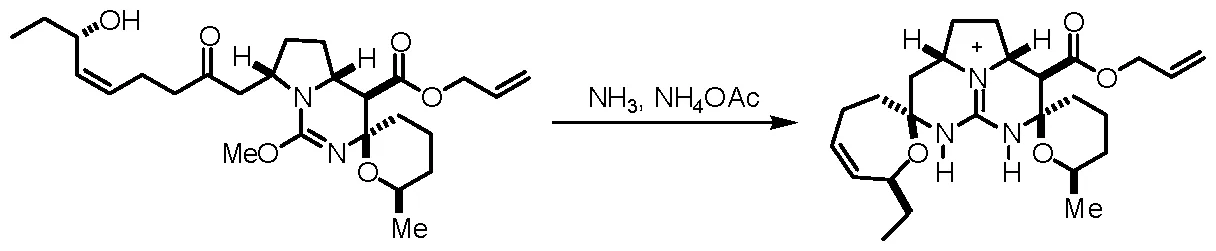
1– The ammonia displaces the methoxide by an addition-elimination mechanism, yielding a guanidine.
2– The primary nitrogen in the guanidine reacts intramolecularly with the ketone, producing an imine.
3– The alcohol reacts intramolecularly with the imine yielding the final guanidine, that is protonated due to its very high basicity.
Coffey, D.S.; McDonald, A.I.; Overman, L.E.; Rabinowitz, M.H.; and Renhowe, P.A., J.Am.Chem.Soc. 122, 4893 (2000).
Exercise 109

Solution
1– An imine is formed by condensation of the amine with the aldehyde.
2– The alcohol adds intramolecularly to the imine, producing an oxazolidine ring.
3– The oxazolidine nitrogen attacks intramolecularly the ester carbonyl and produces the expulsion of methoxide.
Amat, M.; Bosch, J.; Hidalgo, J.; Cató, M.; Pérez, M.; LLor, N.; Molins, E.; Miravitlles, C.; Orozco, M.; and Luque, J. J.Org.Chem., 65, 3074 (2000).
Exercise 110

Solution
1– The primary amine attacks the lactone carbonyl, producing its opening by an addition-elimination mechanism, and yielding an amide.
2– The iPr2NEt produces the elimination of the benzyloxy group on β to the ketone, by means of an E1cB mechanism, producing an α,β-unsaturated ketone.
3– The amide nitrogen effects a conjugate addition on the enone.
4– The alcohol attacks the ketone yielding a hemiacetal.
Sóti, F.; Kajtár-Peredy, M.; Kardos-Balogh, Z.; Incze, M.; Keresztury, G.; Czira, G.; and Szántay, Csaba, Tetrahedron, 50, 8209 (1994).