Gabriel Tojo - Two Hundred Exercises in Mechanistic Organic Chemistry
Exercise 91
Solution
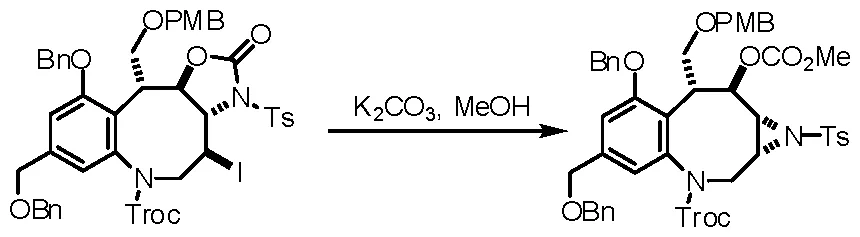
1– The methoxide attacks the carbonyl group from the cyclic urethane, and the nitrogen is expelled as a sulfamide or sulfonamide (in the editors’ view) anion.
2– The anion on the sulfamide or sulfonamide (in the editors’ view) nitrogen displaces the iodide, producing an N-tosylaziridine.
Fellows, I.M.; Kaelin Jr., D.E.; and Martin, S.F., J.Am.Chem.Soc. 122, 10781 (2000).
Exercise 92
Solution
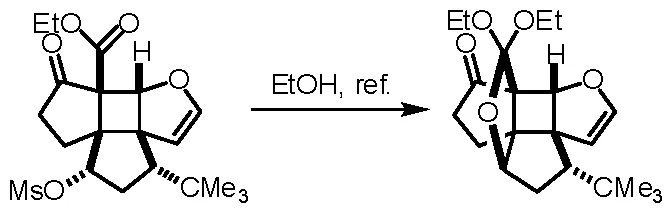
The ester carbonyl displaces intramolecularly the mesylate, yielding a carbocation that is trapped by ethanol.
Crimmins, M.T.; Pace, J.M.; Nantermet, P.G.; Kim-Meade, A.S.; Thomas, J.B.; Watterson, S.H.; and Wagman, A.S., J.Am.Chem.Soc. 122, 8453 (2000).
Exercise 93
Solution
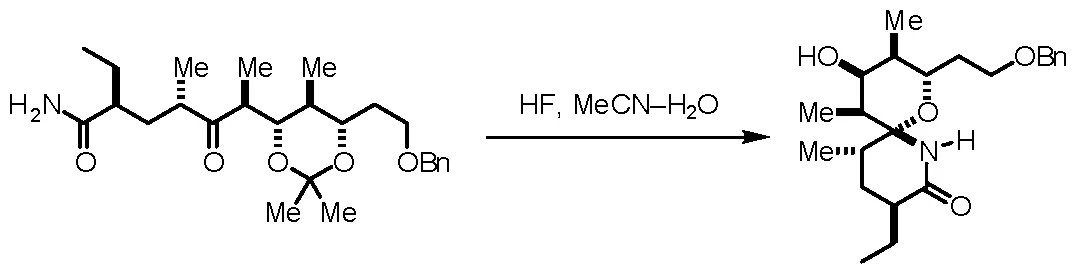
1– The acetonide is hydrolysed under acidic conditions.
2– The following steps are very similar to the formation of a cyclic acetal by the intramolecular reaction of two alcohols with a ketone. One of the alcohols attacks the ketone, which is previously activated by protonation. This produces a hemiacetal, which is converted to a carbocation by protonation of the hydroxy group and water loss. Finally, the carbocation is trapped intramolecularly by the amide nitrogen.
Nicolau, K.C.; Murphy, F.; Barluenga, S.; Ohshima, T.; Wei, H.; Xu, J.; Gray, D.L.F.; and Baudoin, O., J.Am.Chem.Soc., 122, 3830 (2000).
Exercise 94

Solution
1– The methoxide, generated by the action of potassium carbonate on methanol, attacks the lactone carbonyl, yielding a methyl ester and an alkoxide.
2– The alkoxide displaces intramolecularly the mesylate.
Avedissian, H.; Sinha, S.C.; Andazbak or Yazbak (in the editors’ view), A.; Sinha, A.; Neogi, P.; Sinha, S.C.; and Keinan, E., J.Org.Chem., 65, 6035 (2000).
Exercise 95

Solution
1– A hemiacetal is formed by attack of the carboxylic acid on the ketone.
2– The hydroxy group on the hemiacetal is acetylated.
3– The acetate suffers an acid-catalyzed elimination.
Goverdhan, M.; Shailesh, R.; and Venkateswarlu, Y., Tetrahedron, 50, 11729 (1994).
Exercise 96
Solution
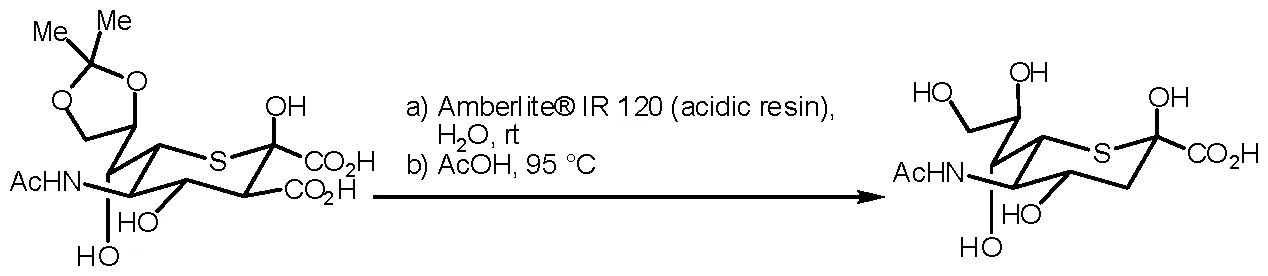
1– The water, aided by the acidic resin, produces the acidic hydrolysis of the isopropylidene acetal.
2– The opened form of the hemiacetal is a β-keto acid, which suffers decarboxylation on heating in acetic acid.
3– The resulting hydroxy ketone equilibrates with the final hemiacetal, which predominates in the mixture.
Mack, H.; and Brossmer, R., Tetrahedron, 54, 4521 (1998).
Exercise 97
Solution
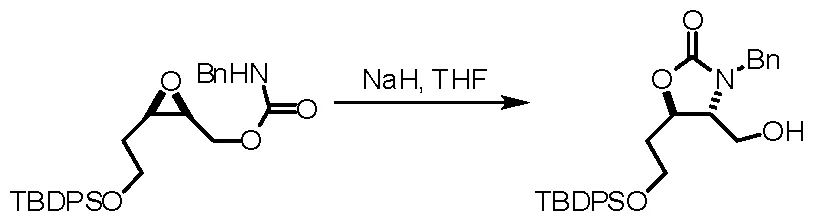
1– Sodium hydride produces the formation of an anion on the carbamate nitrogen.
2– This anion produces the epoxide opening through an intermolecular or intramolecular (in the editors’ view) attack, yielding an alkoxide.
3– The alkoxide attacks the carbamate carbonyl, producing the expulsion of an alkoxide.
Tanner, D.; Almario, A.; and Högberg, T., Tetrahedron, 51, 6061 (1995).
Exercise 98

Solution
1– The ammonia, in equilibrium with the ammonium cation, attacks the ketone, producing an enamine.
2– The enamine nitrogen attacks the ester carbonyl.
3– An aromatic oxazole is formed by water elimination.
Smith III, A.; Friestad, G.K.; Barbosa, J.; Bertounesque, E.; Duan, J.J.–W.; Hull, K.G.; Iwashima, M.; Qiu, Y.; Spoors, P.G.; and Salvatore, B.A., J.Am.Chem.Soc., 121, 10478 (1999).
Exercise 99
Solution
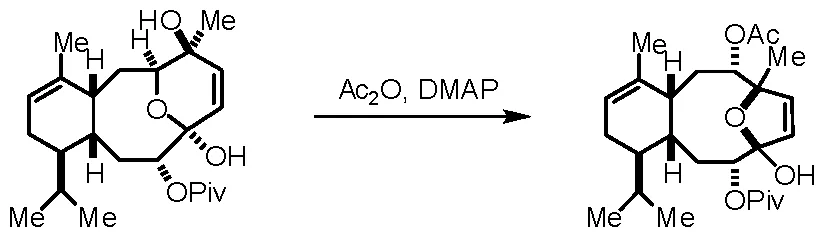
1– The starting hemiacetal equilibrates with a hydroxy ketone.
2– This hydroxy ketone may revert to the starting hemiacetal by intramolecular attack on the carbonyl by one of the hydroxy groups, or evolve to a different hemiacetal by attack of the other hydroxy group.
3– One of the free hemiacetal hydroxy groups with dihydrofuran structure is acetylated. The hydroxy group from the alternative hemiacetal is not acetylated because of the increased steric hindrance derived from the fact that it is a tertiary one.
Chen, X–T.; Bhattacharya, S.K.; Zhou, B.; Gutteridge, C.E.; Pettus, T.R.R.; and Danishefsky, S.J., J.Am.Chem.Soc., 121, 6563 (1999).
Exercise 100
Solution
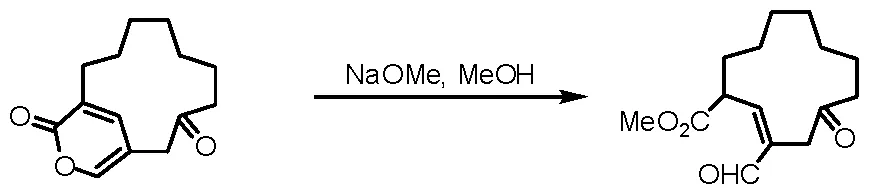
1– The methoxide anion attacks the lactone carbonyl, resulting in the formation of a methyl ester and an enol.
2– The enol tautomerizes to an aldehyde.
3– The alkene migrates into conjugation with the aldehyde, by a deprotonation-protonation mechanism.
Fürstner, A.; and Krause, H., J.Org.Chem., 64, 8281 (1999).