Gabriel Tojo - Two Hundred Exercises in Mechanistic Organic Chemistry
Exercise 21
Solution
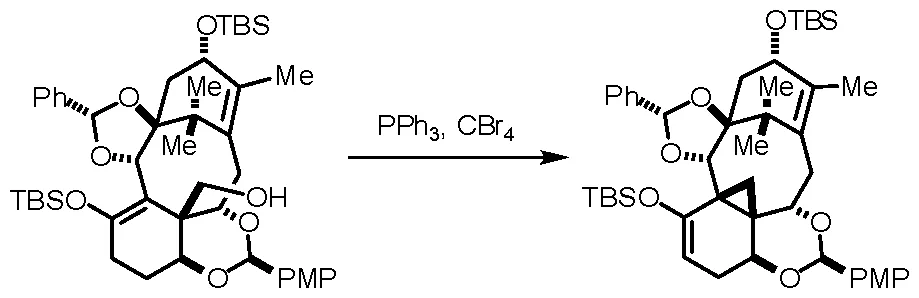
1– The triphenylphosphine reacts with the tetrabromomethane producing a bromophosphonium salt that transforms the alcohol into a bromide.
2– The bromine is displaced by attack of the alkene in the silyl enol ether, forming a cyclopropane and a carbocation on α to the silyl ether oxygen.
3– The removal of a proton transforms this carbocation in a silyl ether in which the alkene has migrated.
Kusama, H.; Hara, R.; Kawahara, S.; Nishimori, T.; Kashima, H.; Nakamura, N.; Morihira, K.; and Kuwajima, I., J.Am.Chem.Soc., 122, 3811 (2000).
Exercise 22
Solution
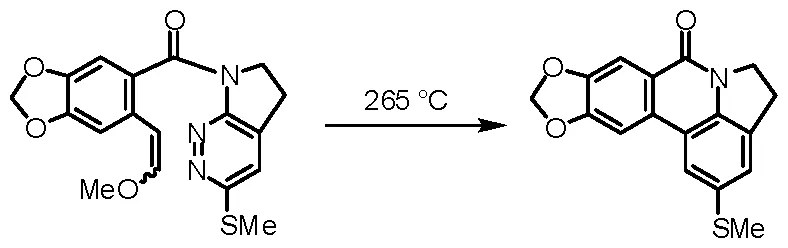
1– A Diels-Alder reaction takes place between the alkene of the vinyl ether and the diazine.
2– The resulting intermediate looses or loses (in the editors’ view) nitrogen by means of a retro-hetero-Diels-Alder reaction.
3– The resulting dihydrobenzene aromatizes by loosing or losing (in the editors’ view) methanol.
Boger, D.L.; and Wolkenberg, S.E., J.Org.Chem., 65, 9120 (2000).
Exercise 23
Solution
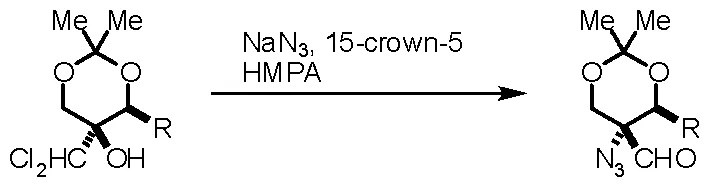
1– The sodium azide works as a base taking a proton from the alcohol.
2– The resulting alkoxide displaces intramolecularly one of the chlorine atoms, giving a epoxide.
3– An azide anion attacks the epoxide on its more substituted carbon, producing its opening, with formation of an α-chloroalkoxide.
4– The α-chloroalkoxide evolves with expulsion of a chloride anion and formation of an aldehyde.
The crown ether is added to increase the nucleophilicity of the azide anion.
Yoshikawa, M.; Andokokawa or Yokokawa (in the editors’ view), Y.; Okuno, Y.; and Murakami, N., Tetrahedron, 51, 6209 (1995).
Exercise 24

Solution
1– The oxygen of one of the epoxides displaces intramolecularly the proximal mesylate, producing an intermediate with an oxygen atom bearing a positive charge and taking part of two three-membered rings.
2– The oxygen of the other epoxide displaces the positively charged oxygen, opening one of the three-membered rings and generating a new positively charged oxygen. This positively charged oxygen is shared by a three-membered and a five-membered ring.
3– One of the oxygens of the mesylate displaces the positively charged oxygen, giving an epoxide where the oxygen is positively charged and bears a mesyl group.
4– The methoxide, generated in the reaction media, attacks the mesyl group, producing the liberation of the epoxide and the formation of methyl mesylate.
Observe that the intermediate oxonium salts are stabilized by the high polarity of the methanol used as a solvent.
Morimoto, Y.; Iwai, T.; and Kinoshita, T., J.Am.Chem.Soc., 121, 6792 (1999).
Chapter 2. Additions to Aldehydes and Ketones
Exercise 25
Solution
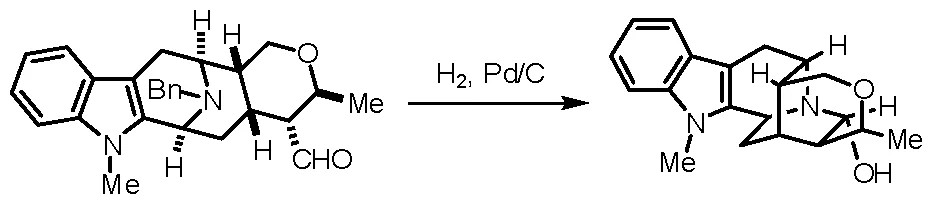
1– The catalytic hydrogenation causes the debenzylation of an amine that attacks the aldehyde producing a stable aminal.
Yu, P.; Wang, T.; and Cook, J.M., J.Org.Chem., 65, 3173 (2000).
Exercise 26
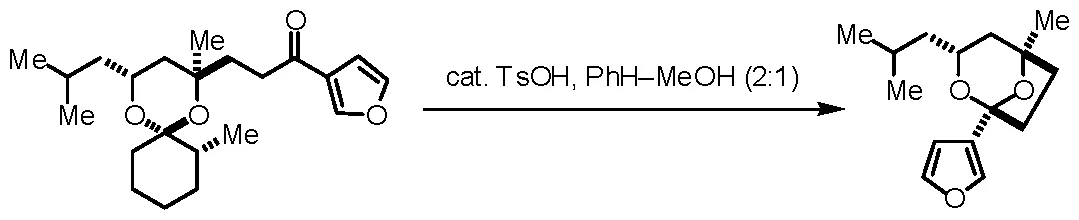
Solution
1– Acidic methanolysis of the acetal leads to the formation of a diol and 2-methylcyclohexanone dimethyl acetal.
2– An intramolecular condensation between the diol and the furyl ketone leads to the cyclic acetal.
Sugimura, T.; Tai, Akira; and Koguro, K., Tetrahedron, 50, 11647 (1994).
Exercise 27
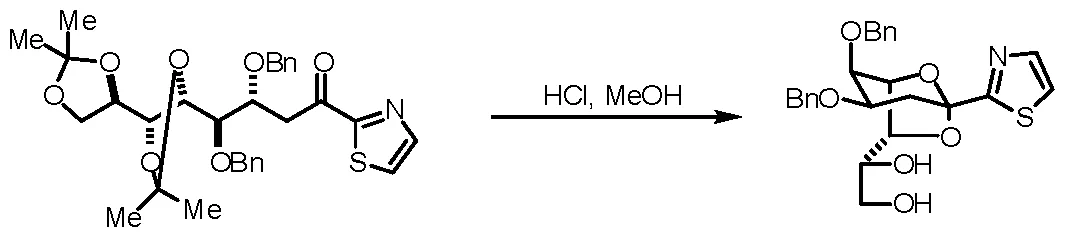
Solution
1– Both isopropylidene acetals suffer an acidic methanolysis, producing the liberation of four alcoholic functions.
2– Two of the freed alcohols form a cyclic acetal by condensation with the ketone.
Dondoni, A.; Marra, A.; and Merino, P., J.Am.Chem.Soc., 116, 3324 (1994).
Exercise 28
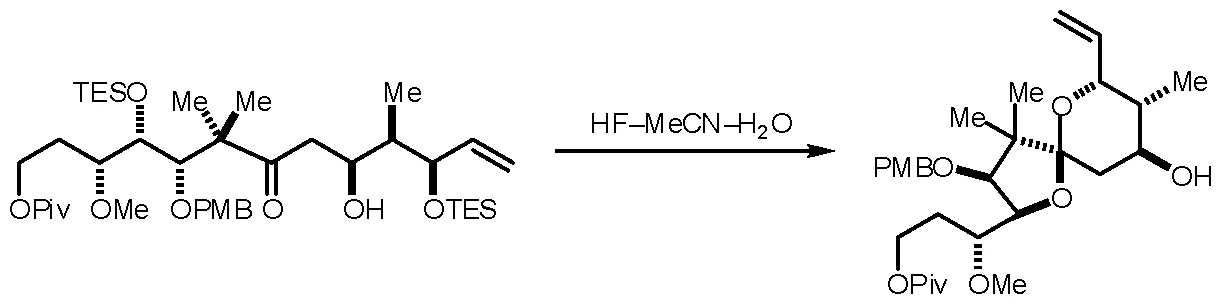
Solution
1– The hydrofluoric acid produces the hydrolyses or hydrolysis (in the editors’ view) of the triethylsilyl ethers.
2– Two of the free alcohols react with the ketone, forming a cyclic acetal.
Evans, D.A.; Gage, J.R.; and Leighton, J.L., J.Am.Chem.Soc., 114, 9434 (1992).
Exercise 29

Solution
There is a double reductive amination where diphenylmethylamine reacts with the ketone and with the aldehyde, which is in equilibrium with the hemiacetal.
Dhavale, D.D.; Saha, N.N.; and Desai, V.N., J.Org.Chem., 62, 7482 (1997).
Exercise 30

Solution
This is an example of a Paal-Knorr synthesis of pyrrole. It consists in a double condensation of a primary amine with a 1,4-diketone, giving a cyclic bis-enamine, which happens to be an aromatic pyrrole ring. The Ti(IV) tetra-isopropoxide acts as a Lewis acid in catalytic quantities.
Dong, Y.; Pai, N.N.; Ablaza, S.L.; Andu or Yu (in the editors’ view), S.–X.; Bolvig, S.; Forsyth, D.A.; and Le Quesne, P.W., J.Org.Chem., 64, 2657 (1999).