Gabriel Tojo - Two Hundred Exercises in Mechanistic Organic Chemistry
Exercise 81

Solution
1– Methoxide attack on the lactone carbonyl produces the opening of the lactone, and the formation of a methyl ester.
2– The basic conditions produce the migration of the alkene into conjugation with the ester carbonyl.
Posner, G.H.; Lee, J.K.; White, M.C.; Hutchings, R.H.; Dai, H.; Kachinski, J.L.; Dolan, P.; and Kensler, T.W., J.Org.Chem., 62, 3299 (1997).
Exercise 82
Solution
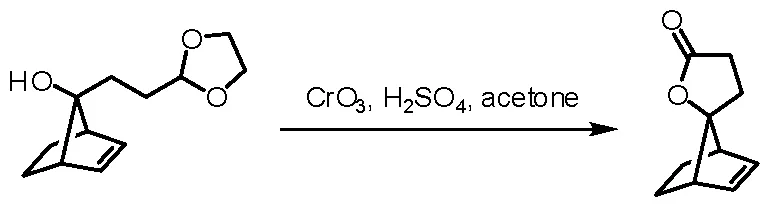
In this reaction, Jones reagent, which consists in a solution of chromium trioxide in sulfuric acid and acetone, plays a double role as oxidant and as provider of acidic conditions.
1– The acidic medium produces the acetal hydrolysis, causing the liberation of an aldehyde.
2– The aldehyde is oxidized to an acid, which undergoes lactonization to the final compound.
Fujita, T.; Tanaka, M.; Norimine, Y.; and Suemune, H., J.Org.Chem., 62, 3824 (1997).
Exercise 83
Solution
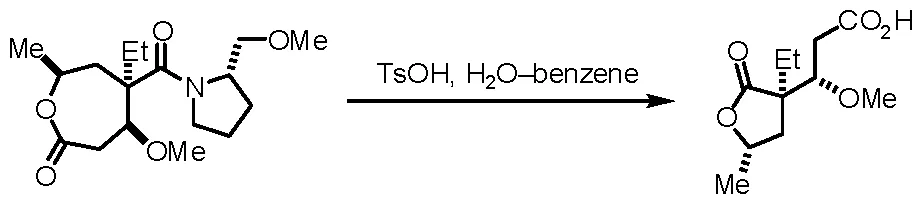
1– The acidic conditions produce the hydrolysis of both the amide and the lactone.
2– The carboxylic acid, resulting from the amide hydrolysis, forms a seven-membered lactone with the alcohol liberated from the lactone hydrolysis.
Schultz, A.G.; Malachowski, W.P.; and Pan, Y., J.Org.Chem., 62, 1223 (1997).
Exercise 84
Solution
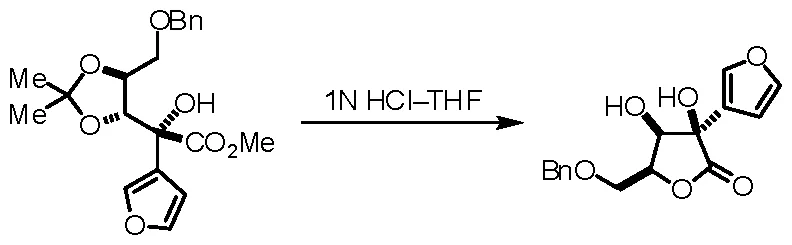
1– The acetal suffers an acidic hydrolysis.
2– One of the alcohols reacts intramolecularly with the methyl ester, yielding a lactone.
Maezaki, N.; Gijsen, H.J.M.; Sun, L.–Q.; and Paquette, L., J.Org.Chem., 61, 6685 (1996).
Exercise 85
Solution
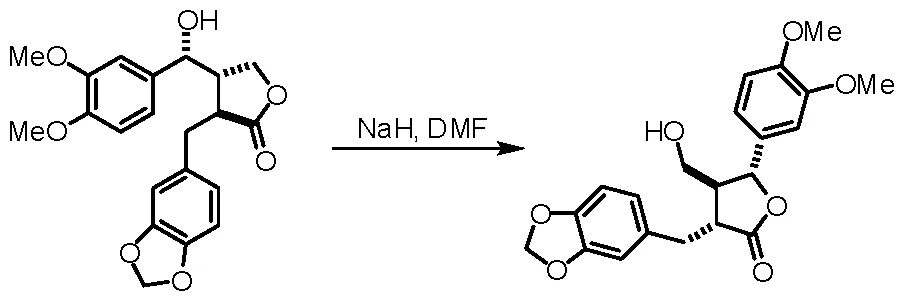
1– Sodium hydride reacts with the alcohol, producing an alkoxide and gaseous hydrogen.
2– The alkoxide attacks the lactone carbonyl.
Moritani, Y.; Fukushima, C.; Ukita, T.; Miyagishima, T.; Ohmizu, H.; and Iwasaki, T. J.Org.Chem., 61, 6922 (1996).
Exercise 86
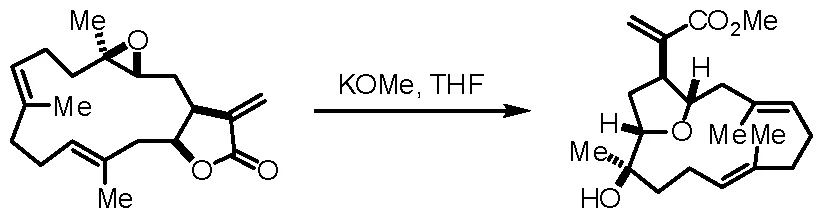
Solution
1– The methoxide attacks the lactone carbonyl producing the formation of a methyl ester and an alkoxide.
2– The alkoxide attacks intramolecularly the epoxide, leading to the formation of a tetrahydrofuran and a tertiary alcohol.
Rodríguez, A.D.; Piña, I.C.; Acosta, A.L.; Ramírez, C.; and Soto, J.J., J.Org.Chem., 66, 648 (2001).
Exercise 87
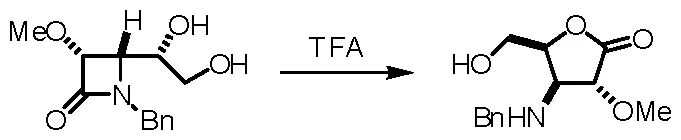
Solution
1– Activation of the β-lactam by protonation on the carbonyl, allows an intramolecular attack by the secondary alcohol.
2– The resulting tetrahedral intermediate evolves by expulsion of a nitrogen atom and formation of a γ-lactone. Observe that, quite exceptionally, a nitrogen atom functions as a good-leaving groups instead of an oxygen atom. This happens thanks to the ring strain released during the opening of the β-lactam.
Bose, A.K.; Banik, B.K.; Mathur, C.; Wagle, D.R.; and Manhas, M.S., Tetrahedron 56, 5603 (2000).
Exercise 88
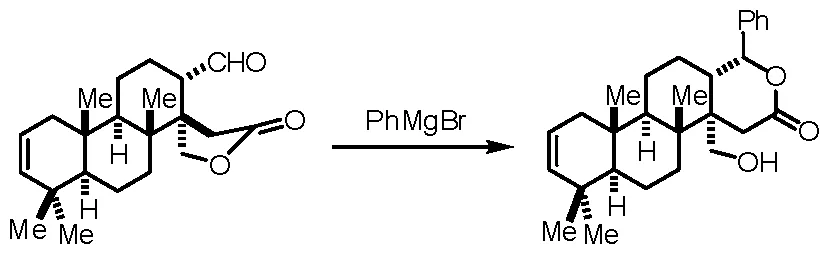
Solution
1– The phenylmagnesium bromide attacks the aldehyde, yielding a magnesium alkoxide. The lactone carbonyl is not attacked due to its lesser reactivity.
2– The alkoxide attacks intramolecularly the lactone carbonyl producing a new lactone and liberating an alcohol.
Zhao, Y.; Ku, Y.; Hao, X.J.; and Lee, S., Tetrahedron 56, 8901 (2000).
Exercise 89
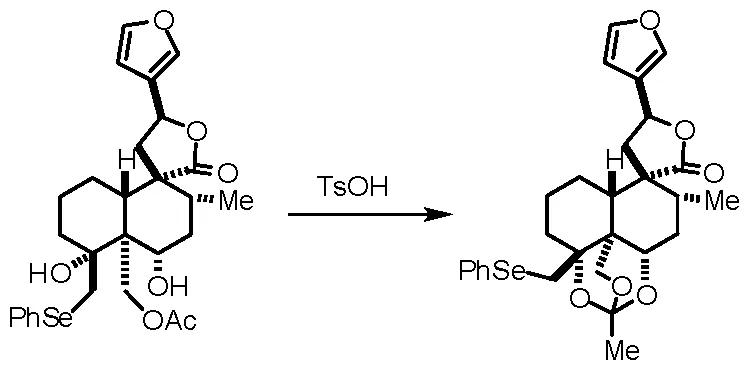
Solution
1– The diol reacts intramolecularly under acidic catalysis with the carbonyl of the acetate, producing an ortho ester. This reaction is akin to the formation of acetals by reaction of alcohols with ketones.
Due to the lesser reactivity of ester carbonyl groups relative to ketone carbonyl groups, the reaction described in this problem is quite exceptional, and may happen thanks to very strong proximity effects.
de la Torre, M.C.; Maggio, A.; and Rodríguez, B., Tetrahedron 56, 8007 (2000).
Exercise 90
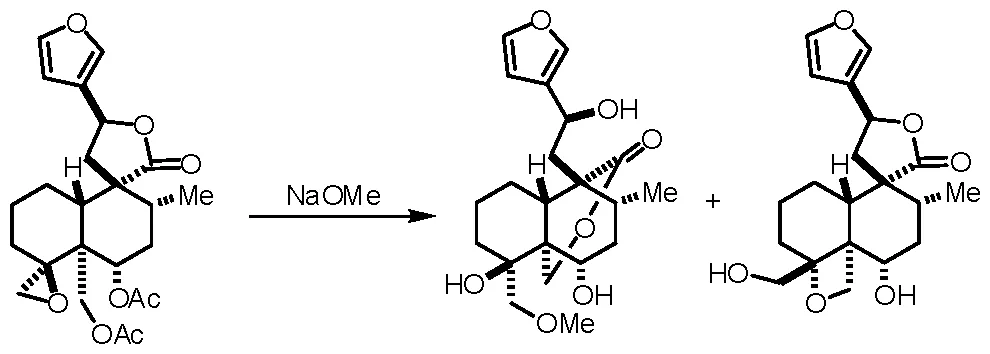
Solution
1– The attack of methoxide on the acetates produces the liberation of two alkoxides.
2– The primary alkoxide can attack intramolecularly the lactone carbonyl, leading to a new lactone, that besides suffers an attack by methoxide on the epoxide. Alternatively, the primary alkoxide can open intramolecularly the epoxide producing an oxetane.
de la Torre, M.C.; Maggio, A.; and Rodríguez, B., Tetrahedron 56, 8007 (2000).