Gabriel Tojo - Two Hundred Exercises in Mechanistic Organic Chemistry
Exercise 51
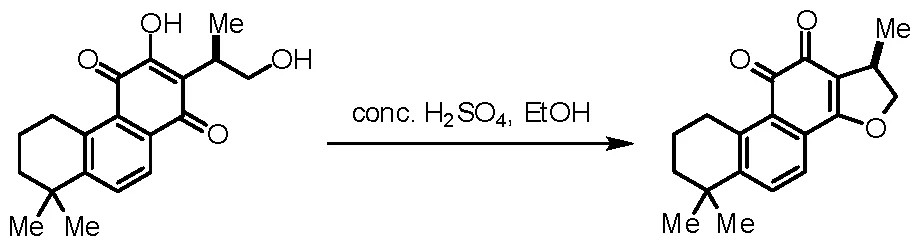
Solution
1– The alcohol reacts intramolecularly with one of the ketones, giving a hemiacetal.
2– The hydroxy group from the acetal is protonated under acidic conditions, giving an alkyloxonium compound that looses or loses (in the editors’ view) water, and evolves to a carbocation which is stabilized by extensive conjugation.
3– One of the resonant forms of this carbocation with extended conjugation is an enone protonated on the oxygen. The deprotonation of this enone leads to the final compound.
Danheiser, R.L.; Casebier, D.S.; and Firooznia, F., J.Org.Chem., 60, 8341 (1995).
Exercise 52
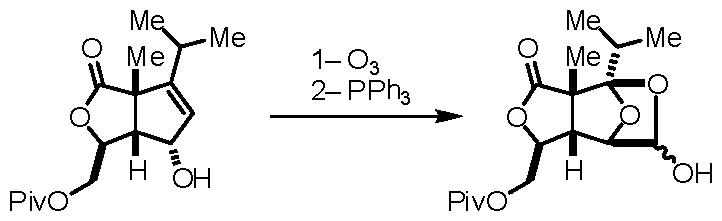
Solution
1– There is a standard ozonolysis by ozone treatment followed by reduction of the ozonide, producing an aldehyde and a ketone.
2– The alcohol reacts intramolecularly with the ketone, giving a hemiacetal.
3– The hydroxy group from the hemiacetal attacks the aldehyde, yielding a new hemiacetal.
Takao, K.; Ochiai, H.; andoshida or Yoshida (in the editors’ view), K.; Hashizuka, T.; Koshimura, H.; Tadano, K.; and Ogawa, S., J.Org.Chem., 60, 8179 (1995).
Exercise 53
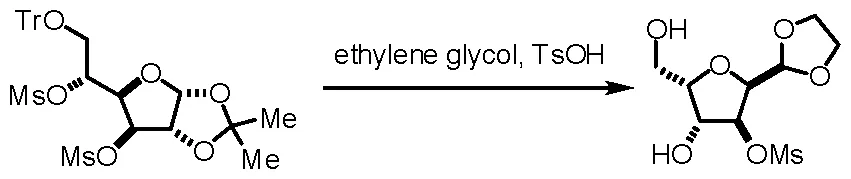
Solution
1– Deprotection of the trityl and the isopropylidene groups under acidic conditions leads to the formation of two alcohols and a hemiacetal, which equilibrates with a hydroxy aldehyde.
2– The alcohol on position 2 displaces intramolecularly one of the mesylates, leading to a tetrahydrofuran.
3– The ethylene glycol reacts with the aldehyde, under acidic catalysis, producing a dioxolane.
Popsavin, V.; Beric, O, Popsavin, M., Radic, L.; Csanádi, J.; and Cirin-Novta, V., Tetrahedron 56, 5929 (2000).
Exercise 54
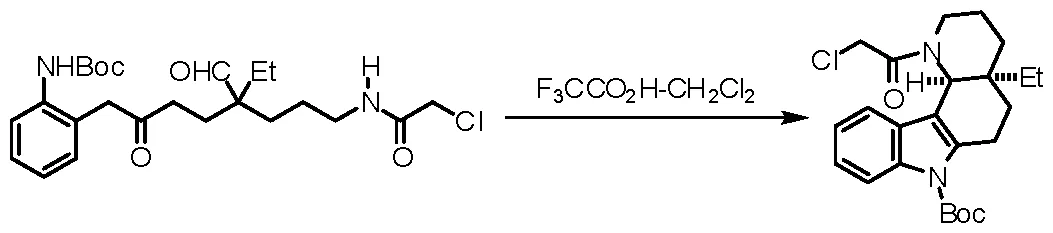
Solution
1– The nitrogen, protected with Boc, reacts intramolecularly with the ketone, giving a aminal that dehydrates to an indole.
2– The amide nitrogen attacks the aldehyde, generating an aminal which losses or loses (in the editors’ view) a hydroxide after oxygen protonation, generating an acyliminium cation.
3– The position 3 of the indole reacts with the acyliminium cation.
Toczko, M.A.; and Heathcock, C.H., J.Org.Chem., 65, 2642 (2000).
Exercise 55
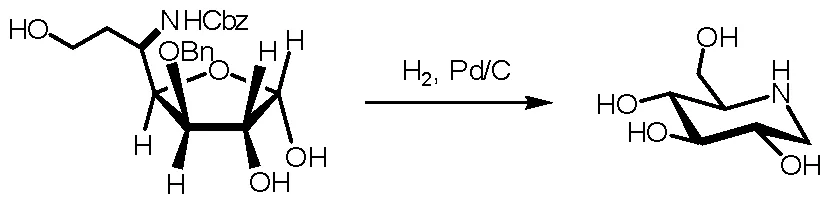
Solution
1– The Cbz and the Bn protecting groups are removed under catalytic hydrogenation.
2– The liberated amine reacts intramolecularly with the aldehyde in equilibrium with an hemiacetal, generating an imine.
3– The imine is reduced to an amine by catalytic hydrogenation.
Saha, N.N.; Desai, V.N.; and Dhavale, D.D., Tetrahedron, 57, 39 (2001).
Exercise 56

Solution
The starting molecule contains three acetal functional groups. One is a MOM protecting group, another one is a spiro acetal joining two six-membered cycles, and the third one is a spiro acetal connecting a six-membered ring to a three-membered one. This last acetal is very reactive, because it contains oxygen inside a three-membered ring with great tension.
1– The PPTS acts as a mild acid, which protonates the oxygen in the three-membered ring. This protonated oxygen becomes a very good leaving-group, because of its positive charge, and because its departure allows the release of the tension in the three-membered ring.
2– An electronic movement begins with the breakage of one of the C–O bonds of the spiro acetal connecting the two six-membered rings. It continues with formation of a carbon-oxygen double bond—that is, the aldehyde—and finishes with the expulsion of the protonated oxygen on the three-membered cycle. This generates a carbocation on α to oxygen.
3– This carbocation is attacked by the hydroxyl group liberated during the opening of the three-membered cycle.
Ireland, R.E.; Armstrong, J.D.; Lebreton, J.; Meissner, R.S.; and Rizzacasa, M.A., J.Am.Chem.Soc., 115, 7152 (1993).
Exercise 57

Solution
1– The hydroxylamine nitrogen attacks one of the aldehydes, giving a α-aminoalcohol.
2– An attack to the other aldehyde allows the formation of a bis-α-aminoalcohol, where both α-amino alcohols share the same nitrogen atom.
3– Both bis-α-amino alcohol hydroxyls suffer a dehydration, producing a bis-enamine, where both enamines share the same nitrogen atom. This bis-enamine can be described as a N-hydroxydihydropyridine.
4– The N-hydroxydihydropyridine looses or loses (in the editors’ view) water, resulting in aromatization to the final pyridine.
Li, J.; Wang, T.; Andu or Yu (in the editors’ view), P.; Peterson, A.; Weber, R.; Soerens, D.; Grubisha, D.; Bennett, D.; and Cook, J.M., J.Am.Chem.Soc., 121, 6998 (1999).
Exercise 58

Solution
1– The ipso position of the carbon substituent in the furan ring attacks the bromine in the N-bromosuccinimide.
2– The resulting cation is attacked by water on the furan α position, which is not bearing a carbon radical. This results in the formation of a hemiacetal.
3– An electronic movement, beginning with the electron pair on the hemiacetal hydroxy group, produces the rupture of the oxygenated ring, and results in the formation of an aldehyde and a ketone, and expulsion of a bromide anion.
4– The alcohol reacts with the aldehyde, giving the final hemiacetal.
Arai, Y.; Masuda, T.; Andoneda or Yoneda (in the editors’ view), S.; Masaki, Y.; and Shiro, M., J.Org.Chem., 65, 258 (2000).
Exercise 59

Solution
1– One of the acetal oxygen atoms attacks the protonated epoxide, producing its opening.
2– A heterolytic cleavage of the acetal ring yields a carbocation on α to an oxygen.
3– A new acetal is formed by methoxy transfer from 2,2-dimethoxypropane to the carbocation. The acidic conditions produce the acetal opening with liberation of an alcohol and protonated acetone.
4– The resulting vicinal diol is ketalized with 2,2-dimethoxypropane under acidic conditions.
Yu, Q.; Andao or Yao (in the editors’ view), Z.–J.; Chen, X.–G.; and Wu, Y.–L., J.Org.Chem., 64, 2440 (1999).
Exercise 60
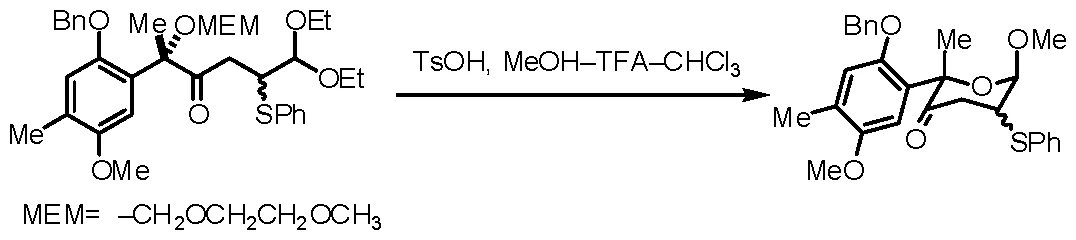
Solution
1– A methanolysis under acidic conditions produces the removal of the diethyl acetal and MEM protecting groups.
2– The liberated alcohol reacts intramolecularly with the aldehyde, generating a hemiacetal.
3– The hydroxyl of the hemiacetal is lost after protonation, leading to a carbocation on α to an oxygen.
4– This cation is trapped by methanol.
Hauser, F.M.; and Ganguly, D., J.Org.Chem. 65, 1842 (2000).