Gabriel Tojo - Two Hundred Exercises in Mechanistic Organic Chemistry
Exercise 11
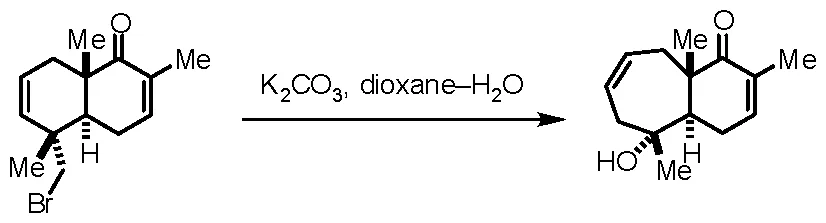
Solution
The expected reaction would be the formation of a primary alcohol by hydrolysis of the primary bromide. Nevertheless, the hindered neopentylic nature of the bromide causes the unexpected formation of a tertiary alcohol.
1– One of the carbons of the non-conjugated alkene migrates to the carbon holding the bromine atom, producing the expulsion of bromide and the formation of a tertiary carbocation.
2– The tertiary carbocation is trapped by water.
Hua, D.H.; Takasu, K.; Huang, X.; Millward, G.S.; Chen, Y.; and Fan, J., Tetrahedron, 56, 7389 (2000).
Exercise 12
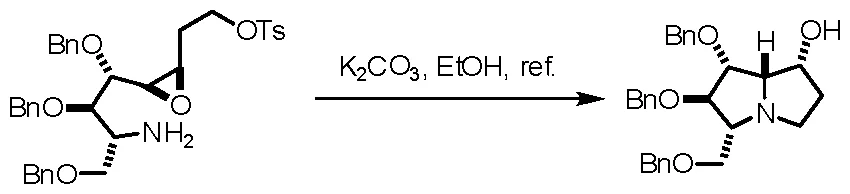
Solution
1– The amine attacks intramolecularly the epoxide, producing its opening and the formation of an alcohol.
2– The amine displaces the tosylate.
Pearson, W.H.; and Hines, J.V., J.Org.Chem., 65, 5785 (2000).
Exercise 13
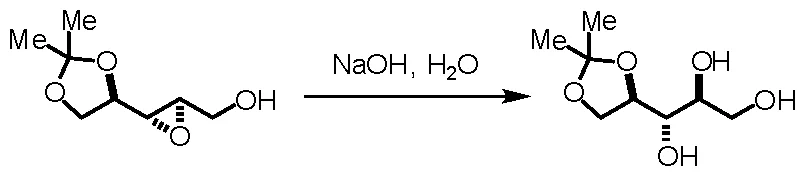
Solution
1– The reaction looks like a simple epoxide opening by attack of hydroxide. In fact, it is more complex. The base generates an alkoxide on the primary alcohol. The alkoxide attacks intramolecularly the epoxide, yielding a secondary alcohol and a new epoxide. This is called a Payne transposition.
2– The new epoxide is attacked on its less hindered position by hydroxide.
Suzuki, Y.; Nishimaki, R.; Ishikawa, M.; Murata, T.; Takao, K.; and Tadano, K., J.Org.Chem., 65, 8595 (2000).
Exercise 14
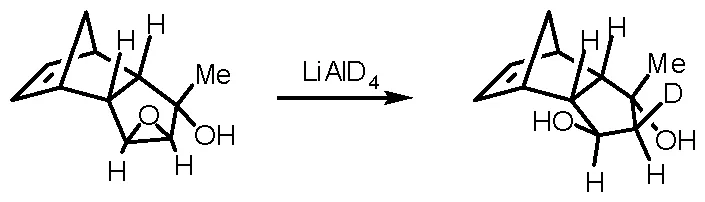
Solution
A superficial analysis could lead to think that there is a trivial reductive epoxide opening by attack of a hydride ion on one of the carbons of the oxirane. Nevertheless, the appearance of the deuterium on the upper side shows that this is not the case. On the other hand, a direct hydride attack on the oxirane would meet a strong steric hindrance.
The presence of a proximal alcohol allows the operation of the so-called Payne rearrangement, which transforms the initial alcohol in other epoxide. The new epoxide is able to suffer easily the attack of a hydride. The following steps operate:
1– A hydride acts as a base, producing the deprotonation of the alcohol.
2– The resulting alkoxide attacks the epoxide, yielding a new epoxide, with the oxygen pointing downwards, and a new alkoxide.
3– The new epoxide suffers easily the attack of a hydride ion on its less hindered carbon atom. This results in the reductive opening of the epoxide and introduction of a deuterium on the upper face.
Zhu, Jie; Andang or Yang (in the editors’ view), J.–Y.; Klunder, A.; Liu, Z.–Y.; and Zwanenburg, B., Tetrahedron, 51, 5847 (1995).
Exercise 15

Solution
1– The alkene attacks the protonated epoxide, producing its opening and the formation of a tertiary carbocation.
2– The carbocation is captured by water, leading to the formation of a tertiary alcohol.
3– A lactone is formed by condensation between the alcohol liberated on opening the epoxide, and the carboxylic acid.
Paquette, L.A.; Sturino, C.F.; Wang, X.; Prodger, J.C.; and Koh, D. J.Am.Chem.Soc., 118, 5620 (1996).
Exercise 16

Solution
1– An intramolecular hetero-Diels-Alder reaction in which an alkyne functions as a dienophile, generates a dihydropyridine.
2– This dihydropyridine aromatizes by methanol loss.
Boger, D.L.; Ichikawa, S.; and Jiang, H., J.Am.Chem.Soc., 122, 12169 (2000).
Exercise 17
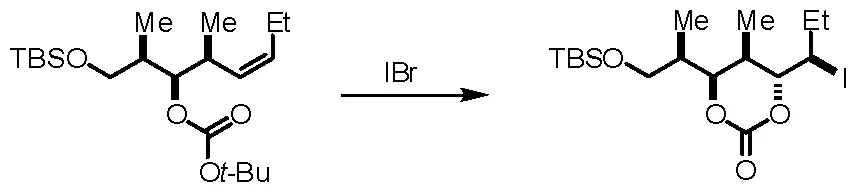
Solution
1– The alkene attacks the IBr, resulting in the bromide displacement and formation of a iodonium ion inside a three-membered ring.
2– The oxygen of the carbonyl in the carbonate attacks intramolecularly one of the carbons in the three-membered ring, resulting in the displacement of the iodonium ion.
3– A tert-butyl cation is lost and trapped by the bromide anion, with the simultaneous formation of the carbonyl double bond in the final cyclic carbonate.
Marshall, J.A.; and Fitzgerald, R.N., J.Org.Chem., 64, 4477 (1999).
Exercise 18

Solution
1– The furan ring attacks, by its less hindered α position, the electrophilic bromine atom in the N-bromosuccinimide, producing a cation.
2– This cation is trapped by the hydroxyde or hydroxide (in the editors’ view) anion present in the basic aqueous solution, resulting in a 2,4-dihydrofuran substituted by a bromine atom and a hydroxy group.
3– This intermediate dihydrofuran volves or evolves (in the editors’ view) through an electronic movement beginning in the hydroxyl electron-pair, and ending by expulsion of bromide, leading to a furan aromatic ring.
Kobayashi, Y.; and Okui, H., J.Org.Chem., 65, 612 (2000).
Exercise 19

Solution
1– One of the epoxides is protonated by acetic acid.
2– Acetic acid attacks the protonated epoxide, producing its opening, with formation of an acetate and an alcohol.
3– The alcohol attacks intramolecularly the neighbouring protonated epoxide, forming the tetrahydrofuran.
Capon, R.J.; and Barrow, R.A., J.Org.Chem., 63, 75 (1998).
Exercise 20
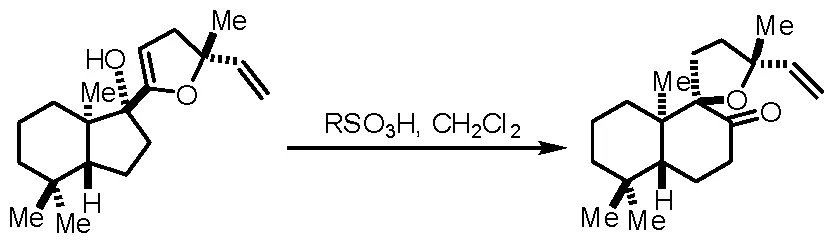
Solution
1– The alkanesulfonic acid protonates the vinyl ether, giving a carbocation on α to the oxygen.
2– The methylene group bonded to the alcoholic carbon migrates to the carbocation, causing the expansion of the five-membered carbocycle to a six-membered carbocycle, and the formation of a protonated ketone.
3– The deprotonation of the ketone yields the final compound.
Paquette, L.A.; and Wang, H.-L., J.Org.Chem., 61, 5352 (1996).