Gabriel Tojo - Two Hundred Exercises in Mechanistic Organic Chemistry
Exercise 131
Solution
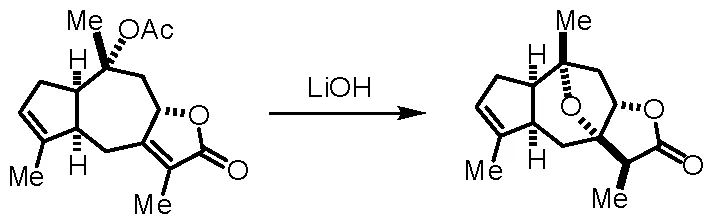
1– The lithium hydroxide hydrolyses the acetate, producing an alkoxide.
2– The unsaturated lactone suffers an intramolecular conjugated addition by the alkoxide.
Blay, G.; Bargues, V.; Cardona, L.; García, B.; and Pedro, J., J.Org.Chem., 65, 6703 (2000).
Exercise 132
Solution
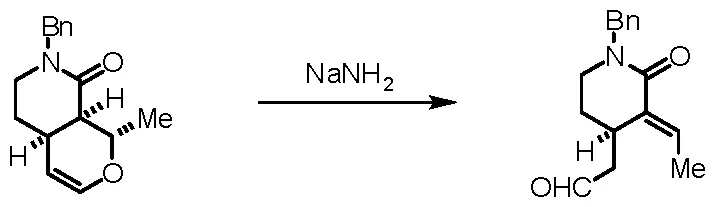
1– The base generates an amide enolate.
2– The oxygen on the β position is eliminated through an E1cB mechanism.
3– The resulting enolate is protonated during the elaboration.
Martin, S.F.; Benage, B.; Geraci, L.S.; Hunter, J.E.; and Mortimore, M., J.Am.Chem.Soc., 113, 6161 (1991).
Exercise 133

Solution
1– The vinyllithium compound attacks the lactone carbonyl, causing the expulsion of an alkoxide.
2– The alkoxide attacks the alkene in the vinyl sulfone. Nucleophilic attacks on this alkene are easy because of its sulfone-induced electron-deficiency.
3– The resulting carbanion is protonated during the elaboration.
Carretero, J.C.; de Diego, J.E.; and Hamdouchi, C., Tetrahedron, 55, 15159 (1999).
Exercise 134
Solution
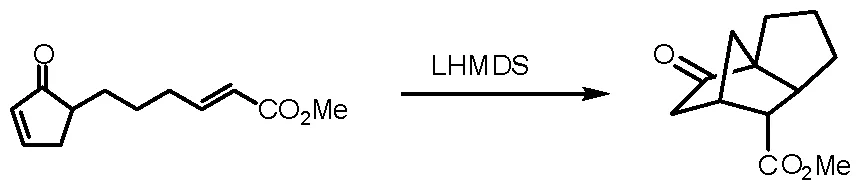
1– The strong base LHMDS generates an anion on α to the ketone.
2– A conjugated addition of this anion to the unsaturated ester leads to an ester enolate.
3– This ester enolate effects a conjugate addition to the enone.
Ihara, M.; Makita, K.; and Takasu, K., J.Org.Chem., 64, 1259 (1999).
Exercise 135
Solution
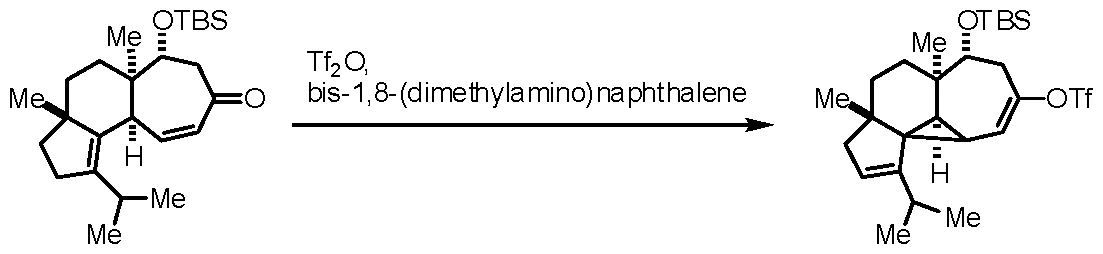
1– The carbonyl oxygen attacks the triflic anhydride, producing a strong activation of the ketone.
2– This strong activation allows the nucleophilic attack of an alkene, producing a vinyl triflate, a cyclopropane and a carbocation.
3– A proton departure produces the formation of an alkene.
The bis-1,8-(dimethylamino)naphthalene, also called proton sponge® works as an amine with an exceptional basicity and very limited nucleophilicity.
Snider, B.B.; Vo, N.H.; and O’Neil, S.V., J.Org.Chem., 63, 4732 (1998).
Exercise 136
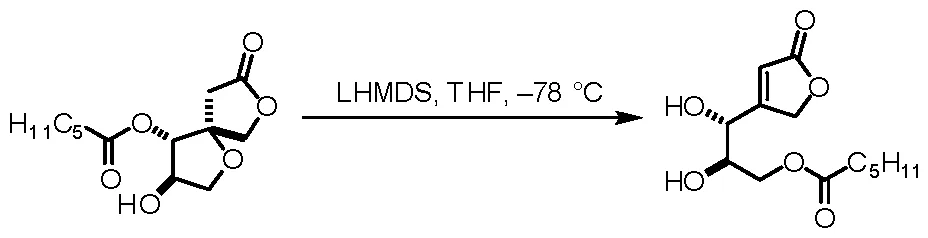
Solution
1– The base LHMDS forms a lactone enolate.
2– The expulsion of an alkoxide by a retro-conjugated addition leads to the tetrahydrofuran opening.
3– The resulting alkoxide reacts intramolecularly with the ester carbonyl, producing a trans-acylation.
Mukai, C.; Moharram, S.M.; Azukizawa, S.; and Hanaoka, M., J.Org.Chem., 62, 8095 (1997).
Exercise 137
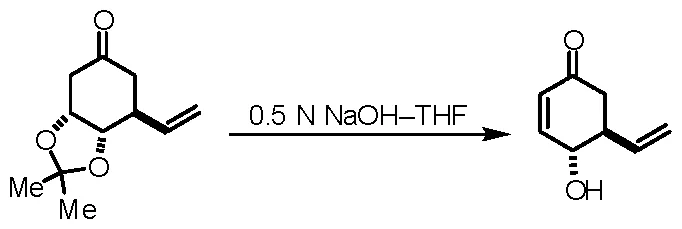
Solution
1– The base abstracts a proton from one of the α positions of the ketone.
2– The resulting anion evolves by expulsion of one of the dioxolane oxygen atoms, leading to the formation an an enona or an enone (in the editors’ view) and a hemiacetal.
3– Detachment of acetone yields the final compound.
Barros, M.T.; Maycock, C.D.; and Ventura, M.R., J.Org.Chem., 62, 3984 (1997).
Exercise 138

Solution
1– The sodium hydride generates an anion on the indole nitrogen.
2– This anion reacts with the alkene in the dimethyl vinyl sulfonium salt, producing a sulfur ylide.
3– This ylide reacts intramolecularly with the aldehyde, yielding an alkoxide that displaces the positively charged sulfur atom, resulting in the formation of an epoxide.
Wang, Z.; and Jimenez, L.S., J.Org.Chem., 61, 816 (1996).
Exercise 139

Solution
1– The inone or ynone (in the editors’ view) suffers a conjugated addition by the enamine, which attacks by way of its nucleophilic carbon.
2– The resulting imine tautomerizes to the corresponding enamine.
3– The nitrogen atom condensates or condenses (in the editors’ view) intramolecularly with the ketone.
Bagley, M.C.; Bashford, K.E.; Hesketh, C.L.; and Moody, C.J., J.Am.Chem.Soc., 122, 3301 (2000).
Exercise 140
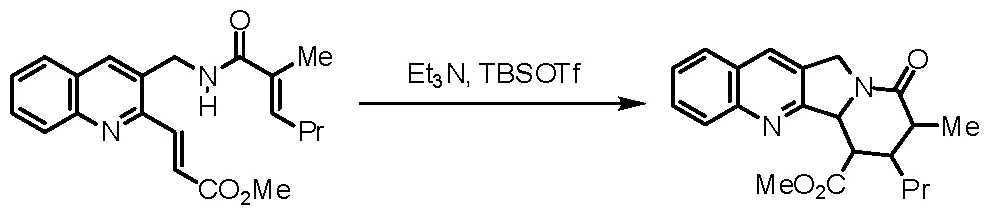
Solution
1– The triethylamine generates an anion on the amide nitrogen.
2– There is a conjugated addition of this nitrogen atom on the unsaturated ester, giving an ester enolate.
3– A conjugated intramolecular addition of this ester enolate on the unsaturated amide gives the final compound.
Mekouar, K.; Génisson, Y.; Leue, S.; and Greene, A.E. J.Org.Chem., 65, 5212 (2000).