Gabriel Tojo - Two Hundred Exercises in Mechanistic Organic Chemistry
Exercise 121
Solution
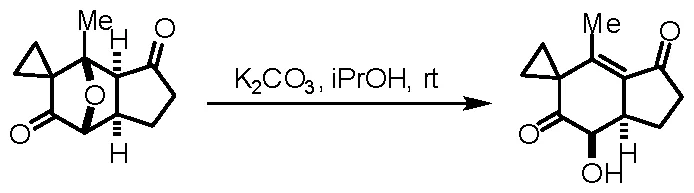
1– Potassium carbonate acts as a base by producing the abstraction of a proton on an α position of the cyclopentanone carbonyl. The resulting anion evolves by expulsion of the alkoxide in the β position by an E1cB mechanism.
McMorris, T; Andu or Yu (in the editors’ view), J.; and Hu, Y., J.Org.Chem., 62, 3015 (1997).
Exercise 122
Solution
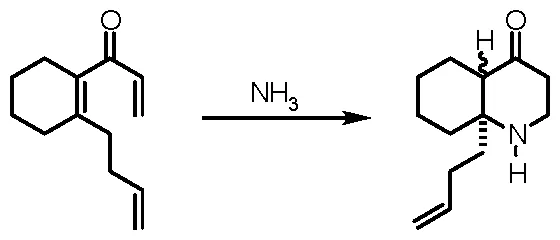
This is a simple case of a double conjugate addition of ammonia to a dienone.
Fields, J.; and Heathcock, C.H., J.Org.Chem., 64, 8263 (1999).
Exercise 123
Solution
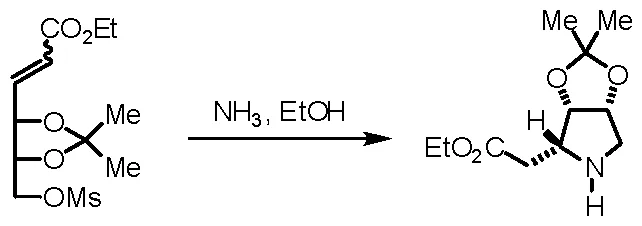
The unsaturated ester suffers a conjugated attack of ammonia, which also displaces the mesylate.
Thompson, D.K.; Hubert, C.N.; and Wightman, R.H., Tetrahedron, 49, 3827 (1993).
Exercise 124
Solution
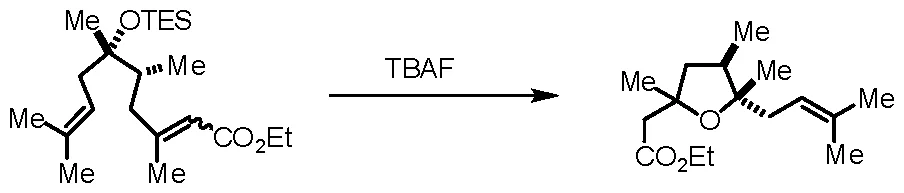
1– The fluoride anion attacks the silicon atom, producing the alcohol desilylation.
2– The resulting alkoxide attacks intramolecularly in a conjugated way the unsaturated ester.
Honda, T.; and Ishikawa, F. J.Org.Chem., 64, 5542 (1999).
Exercise 125

Solution
1– The base generates an alkoxide that attacks the benzaldehyde, giving a tetrahedral intermediate with a negatively charged oxygen.
2– This negatively charged oxygen adds intramolecularly to the unsaturated ester in a conjugated manner.
Claffey, M.M.; Hayes, C.J.; and Heathcock, C.H., J.Org.Chem., 64, 8267 (1999).
Exercise 126
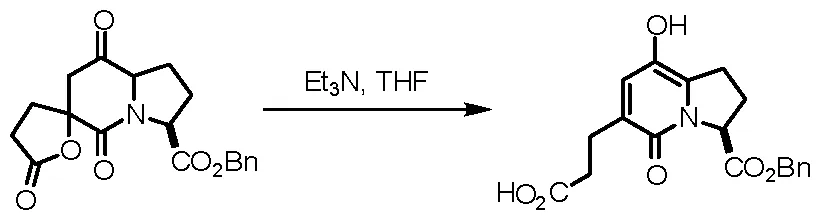
Solution
1– The triethylamine generates a carbanion on α to the ketone, which evolves by an E1cB mechanism, expelling a carboxylate.
2– The ketone tautomerizes to the enol form, which in this case is more stable because of extended conjugation.
Clive, D.L.J.; Coltart, D.M.; and Zhou, Y., J.Org.Chem., 64, 1447 (1999).
Exercise 127

Solution
1– The trimethyl phosphonoacetate anion reacts with the aldehyde in equilibrium with the α-amino alcohol, giving an unsaturated ester.
2– The nitrogen of the liberated sulfonamide, after being deprotonated, effects a conjugate addition on the unsaturated ester.
Hart, B.P.; and Rapoport, H., J.Org.Chem., 64, 2050 (1999).
Exercise 128

Solution
1– A conjugate addition of the Grignard reagent to the enone produces an anion.
2– This anion evolves by elimination of the alkoxide on the β position, with recovery of the enone moiety.
Lin, X.; Kavash, R.W.; and Mariano, P.S. J.Org.Chem., 61, 7335 (1996).
Exercise 129
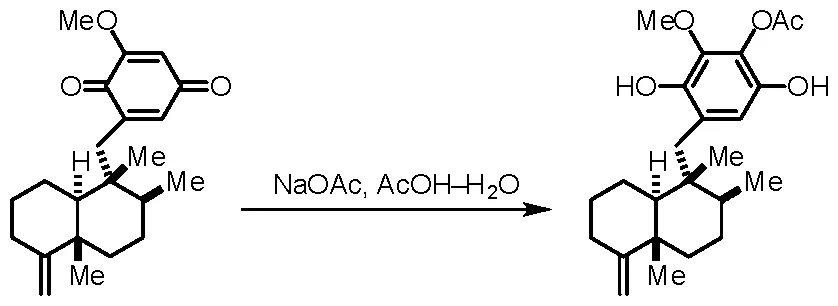
Solution
1– The p-quinone suffers the conjugate addition of acetate.
2– Both ketones in the resulting cyclohexenedione tautomerize to the enol form, yielding an aromatic system.
Radeke, H.S.; Digits, C.A.; Bruner, S.D.; and Snapper, M.L., J.Org.Chem., 62, 2823 (1997).
Exercise 130

Solution
1– The potassium carbonate generates an alkoxide by deprotonation of the propargyl alcohol.
2– Conjugated addition of the alkoxide to the enone gives a carbanion that adds intramolecularly in a conjugated way to the propargyl ester.
Paquette, L.A.; Tae, J.; Arrington, M.P.; and Sadoun, A.H., J.Am.Chem.Soc., 122, 2742 (2000).