Gabriel Tojo - Two Hundred Exercises in Mechanistic Organic Chemistry
Exercise 111
Solution
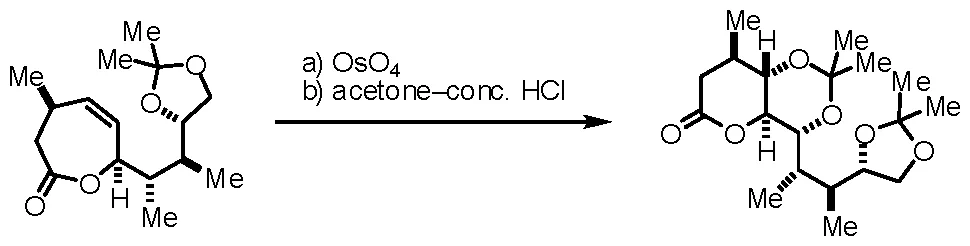
1– The osmium tetroxide produces a dihydroxy-addition to the alkene.
2– The concentrated hydrochloric acid causes the hydrolysis of the lactone.
3– A new lactone—this time a γ-lactone or δ-lactone (in the editors’ view)—is formed. This lactone does not suffer hydrolysis because of the thermodynamic stability associated with a six-membered ring.
4– The two free alcohols react with acetone under acidic catalysis, producing an acetal.
Oka, T.; and Murai, A., Tetrahedron, 54, 1 (1998).
Exercise 112
Solution
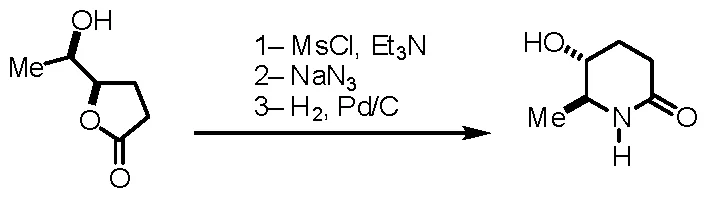
1– Mesyl chloride, in the presence of a base, produces the mesylation of the alcohol.
2– The azide anion displaces the mesylate with inversion of configuration, yielding an organic azide.
3– The catalytic hydrogenation produces the reduction of the azide to an amine.
4– The amine attacks the lactone carbonyl, causing its opening and the formation of a lactam.
Ha, J.D.; and Cha, J.K., J.Am.Chem.Soc., 121, 10012 (1999).
Exercise 113

Solution
1– The protonation of dimethoxypropane converts one of its oxygen atoms in a good-leaving group. This allows the departure of methanol, resulting in the formation of an cation on α to an oxygen.
2– This cation is attacked by the alcohol in the starting compound.
3– The resulting acetal looses or loses (in the editors’ view) methanol by a mechanism akin to the one in part 1, giving a cation that is attacked by one of the lactone oxygen atoms.
4– This oxygen takes positive charge and is lost as a leaving-group, when one molecule of methanol attacks the carbonyl group.
Sinha, S.C.; Sinha, S.C.; and Keinan, E., J.Org.Chem., 64, 7067 (1999).
Exercise 114
Solution
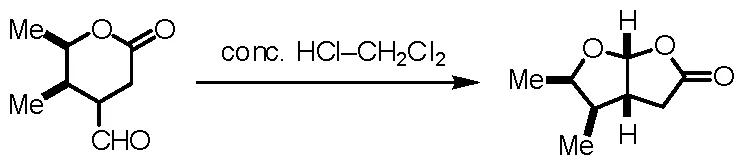
1– The hydrochloric acid produces the lactone hydrolysis.
2– The alcohol reacts intramolecularly with the aldehyde, forming a hemiacetal.
3– Protonation of the hemiacetal hydroxyl is followed by water loss, resulting in the formation of a cation on α to an oxygen.
4– The carboxylic acid attacks this cation.
Toyota, M.; Hirota, M., Nishikawa, Y.; Fukumoto, K.; and Ihara, M., J.Org.Chem., 63, 5895 (1998).
Exercise 115
Solution
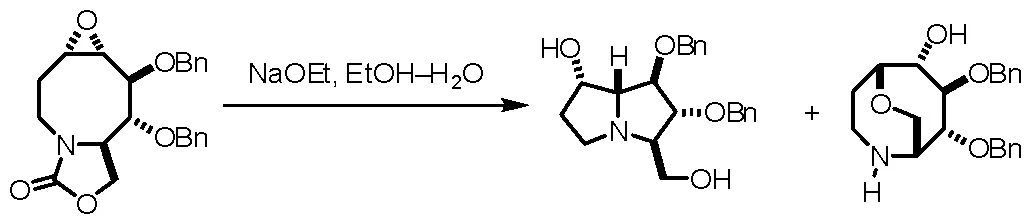
1– A hydroxide anion attacks the carbonyl, giving a tetrahedral intermediate that may evolve by expulsion of a nitrogen or an oxygen atom.
2– The expulsion of a nitrogen atom leads to an amide that reacts intramolecularly with the epoxide, generating two five-membered fused cycles and a monoalkyl carbonate that looses or loses (in the editors’ view) CO2, yielding the first product.
3– Alternatively, the expulsion of an oxygen atom yields an alkoxide that attacks intramolecularly the epoxide, producing two seven-membered fused rings and a carbamic acid, that looses or loses (in the editors’ view) CO2, giving the second product.
4– A carbamic acid and a monoalkyl carbonate are also formed. Both evolve by releasing carbon dioxide.
White, J.D.; and Hrnciar, P., J.Org.Chem., 65, 9129 (2000).
Exercise 116

Solution
1– The lactone carbonyl is attacked by the amine, giving an amide through and or an (in the editors’ view) addition-elimination mechanism with ejection of an enolate.
2– The enolate tautomerizes to a ketone.
3– The ketone is attacked by the amide nitrogen, producing an α-aminoalcohol.
4– The α-aminoalcohol looses or loses (in the editors’ view) a hydroxy group, generating an iminium salt.
5– The alcohol in the hydroxyethyl group linked to the nitrogen attacks the iminium salt.
Goverdhan, M.; Shailesh, R.; and Venkateswarlu, Y., Tetrahedron, 50, 11729 (1994).
Exercise 117

Solution
1– The catalytic hydrogenation produces the reductive cleavage of both N–O bonds, giving rise to an amine and an hemiacetal.
2– The hemiacetal suffers a fragmentation yielding 2-phenylcyclohexanol and an aldehyde.
3– The amine reacts intramolecularly with the aldehyde, producing a cyclic enamine.
4– The enamine double-bond is reduced by catalytic hydrogenation, yielding a cyclic amine.
5– The resulting amine reacts intramolecularly with the methyl ester, producing a lactam.
Denmark, S.E.; Hurd, A.R.; and Sacha, H.J., J.Org.Chem., 62, 1668 (1997).
Exercise 118
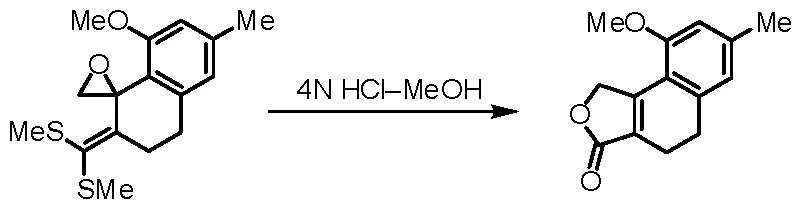
Solution
1– Acidic hydrolysis of the epoxide produces a diol.
2– Acidic hydrolysis of the ketene dithioacetal generates a carboxylic acid.
3– A γ-lactone is formed by reaction between the carboxylic acid and the primary alcohol.
4– The tertiary alcohol is dehydrated, probably via a very stabilized benzylic tertiary carbocation.
The epoxide hydrolysis happens by water attack on the more substituted carbon of the protonated epoxide. An E1 mechanism is also possible via a strongly stabilized tertiary carbocation.
The hydrolysis of the ketene dithioacetal happens through the following steps:
1– Protonation of the alkene with formation of a cation stabilized by both sulfur atoms.
2– Water attack on the cation, with formation of an intermediate with a carbon linked to two sulfur and one oxygen atoms.
3– Expulsion of a sulfur with formation a thioester.
4– Hydrolysis of the thioester through a normal mechanism of addition-elimination to a carbonyl group.
Matsumoto, T.; Sohma, T.; Andamaguchi or Yamaguchi (in the editors’ view), H.; Kurata, S.; and Suzuki, K., Tetrahedron, 51, 7347 (1995).
Exercise 119
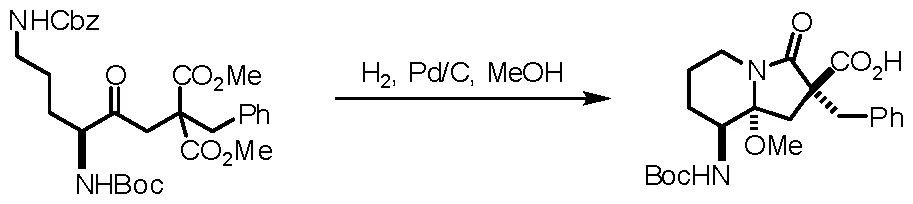
Solution
1– The catalytic hydrogenation removes the Cbz protecting group.
2– The resulting amine attacks the ketone, producing an α-amino alcohol, and one of the ester groups, generating a lactam.
3– The α-aminoalcohol hydroxy group attacks the other ester, forming a lactone.
4– The electron pair of one of the nitrogen atoms produce the opening of the lactone, with the expulsion of a carboxylate and formation of an iminium salt.
5– The iminium salt is attacked by methanol.
Domínguez, M.J.; García–López, M.T.; and González–Muñiz, Tetrahedron, 48, 4231 (1992).
Chapter 4. Conjugated Additions to Electron-Deficient Alkenes
Exercise 120
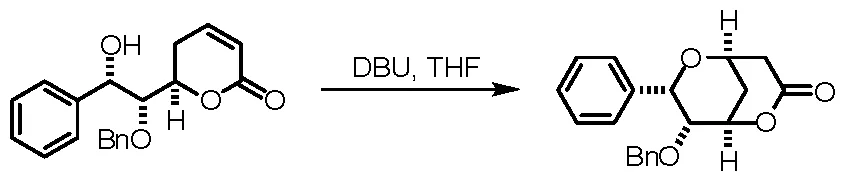
Solution
1– The base DBU forms an alkoxide that adds intramolecularly in a conjugated way to the unsaturated lactone.
Mukai, C.; Hirai, S.; and Hanaoka, M., J.Org.Chem., 62, 6619 (1997).