Gabriel Tojo - Two Hundred Exercises in Mechanistic Organic Chemistry
Exercise 141
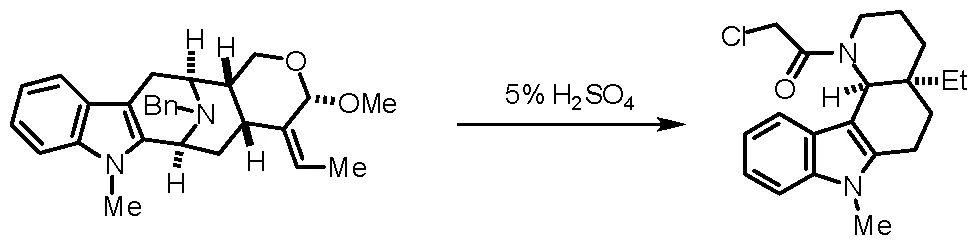
Solution
1– The acetal is hydrolysed under acidic conditions, giving a hemiacetal.
2– The hemiacetal equilibrates with a hydroxyenal.
3– An intramolecular conjugate addition of the alcohol on the enal yields the final compound.
Yu, P.; Wang, T.; and Cook, J.M., J.Org.Chem., 65, 3173 (2000).
Exercise 142

Solution
1– Sodium hydride forms an anion on the indole nitrogen.
2– This anion attacks the alkene in the vinyl phosphonium salt, producing an anion on α to the positively charged phosphorous or phosphorus (in the editors’ view) atom. The resulting intermediate is a Wittig ylide. This attack is akin to a conjugated attack to an α,β-unsaturated carbonyl compound, and happens thanks to the electron-deficiency of the alkene in the vinyl phosphonium salt and the stability of the resulting carbanion.
3– The Wittig ylide attacks intramolecularly the aldehyde, yielding an alkene.
4– Two alkenes suffer an isomerization through a base-catalysed deprotonation-protonation, yielding a compound with a greater stability due to the presence of two isolated benzenic and pyrrolic aromatic systems. These two aromatic systems fused as an indole would result in lower aromatic stabilization.
Cotterill, A.S.; Hartopp, P.; Jones, G.B.; Moody, C.J.; Norton, C.L.; O’Sullivan, N.; and Swann, E., Tetrahedron, 50, 7657 (1994).
Exercise 143
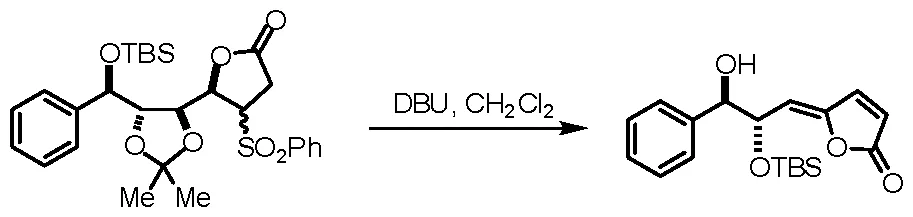
Solution
1– The base DBU induces an E1cB elimination of the sulfone, giving an unsaturated lactone.
2– An anion at the γ position of the carbonyl of the unsaturated lactone is formed, leading to the expulsion of one of the alkoxides of the acetal, and the formation of the anion of a hemiacetal.
3– This anion evolves producing the evolution of acetone and the formation of an alkoxide.
4– The resulting alkoxide attacks the silicon, resulting in a trans-silylation.
Surivet, J.; and Vatèle, J., Tetrahedron, 55, 13011 (1999).
Exercise 144
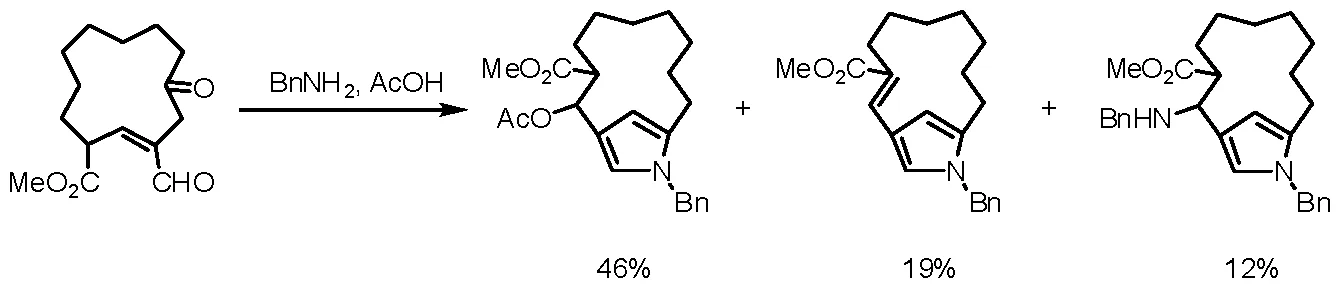
Solution
This is an example of the so-called Paal-Knorr pyrrole synthesis. Additionally, there is formation of an unsaturated ester, which suffers a conjugated addition. A plausible mechanism is the following one:
1– An imine is formed by reaction of benzylamine with the aldehyde.
2– The imine tautomerizes to a dienamine, where a diene is conjugated with the ester.
3– The nitrogen of the dienamine attacks the ketone, producing an α-aminoalcohol, which evolves to the pyrrole by dehydration.
4– The resulting conjugated ester can, additionally, suffer a conjugated addition of acetic acid, or benzylamine, yielding two other possible compounds.
Fürstner, A.; and Krause, H., J.Org.Chem., 64, 8281 (1999).
Exercise 145
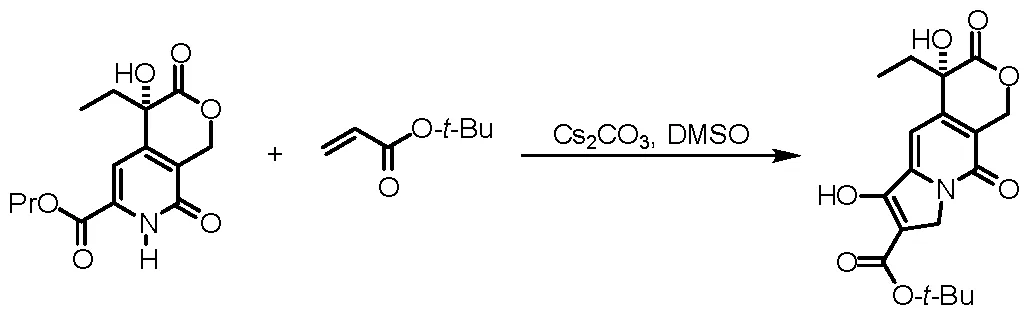
Solution
1– Cesium carbonate acts as a base by forming an anion on the pyridone nitrogen.
2– Conjugate addition of this anion to tert-butyl acrylate, results in the formation of an anion on the α position of the tert-butyl ester.
3– This anion reacts with the n-propyl ester, producing the expulsion of propoxide and the formation of a ketone.
4– The ketone tautomerizes to the enol form, which in this case is more stable because of the conjugation of the resulting alkene with an ester.
Henegar, K.E.; Ashford, S.W.; Baughman, T.A.; Sih, J.C.; and Gu, R.–L., J.Org.Chem., 62, 6588 (1997).
Exercise 146
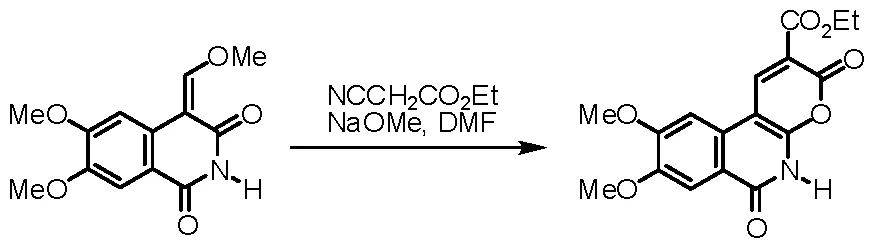
Solution
1– The methoxide generates a carbanion on ethyl cyanoacetate.
2– A conjugated attack of this anion on the alkene produces a carbanion on α to the ketone, which evolves by expelling methoxide and recovering the alkene moiety.
3– Deprotonation of the imide nitrogen yields a tridentate anion.
4– This tridentate anion attacks intramolecularly the cyanide, yielding an imine that is hydrolized to a ketone.
Pérez, D.; Burés, G.; Guitián, E.; and Castedo, L., J.Org.Chem., 61, 1650 (1996).
Exercise 147

Solution
1– A carbanion stabilized by both carbonyl groups in ethyl acetoacetate is formed.
2– This anion adds in a conjugated way to the unsaturated ester.
3– A carbanion stabilised by both carbonyl groups in the β-keto ester is formed. This carbanion reacts intramolecularly with the ester, resulting in the expulsion of methoxide and the formation of a ketone.
4– The ester is hydrolysed by potassium hydroxide, yielding a carboxylic acid that suffers decarboxylation by heating in sulfuric acid.
Krohn, K.; Micheel, J.; and Zulowski, M., Tetrahedron, 56, 4753 (2000).
Exercise 148
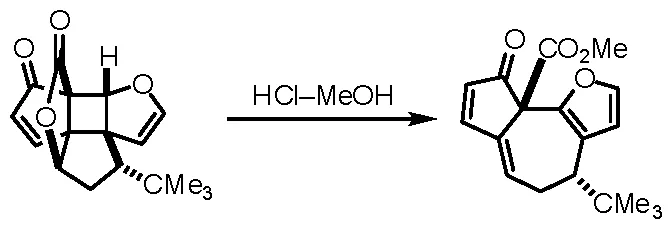
Solution
1– After protonation of the ketone carbonyl, there is an electronic movement that begins on the electron pair in the dihydrofuran oxygen, produces the cleavage of one of the cyclobutane bonds, and leads to the formation of a dienol. The dienol tautomerizes to an enone.
2– The furan ring gains aromaticity by loosing or losing (in the editors’ view) a proton.
3– The acidic methanolysis of the lactone yields a methyl ester and an alcohol.
4– The dehydration of the alcohol under acidic conditions leads to the final compound.
Crimmins, M.T.; Pace, J.M.; Nantermet, P.G.; Kim-Meade, A.S.; Thomas, J.B.; Watterson, S.H.; and Wagman, A.S., J.Am.Chem.Soc. 122, 8453 (2000).
Exercise 149
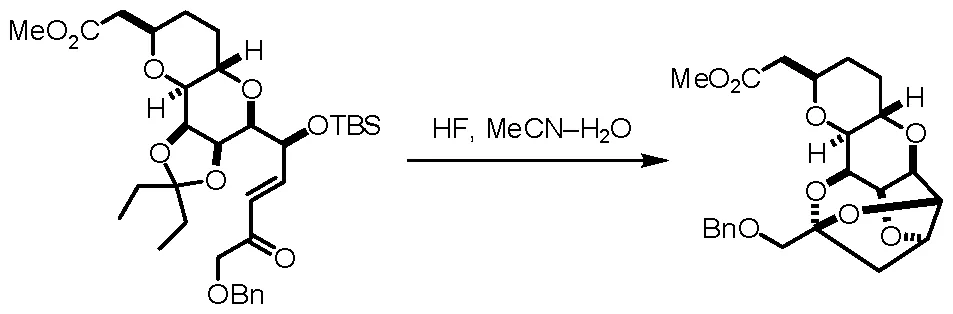
Solution
1– The acetal is hydrolysed under acidic conditions.
2– The fluoride anion produces the cleavage of the silyl ether.
3– One of the alcohols adds intramolecularly in a conjugated way to the enone.
4– An intramolecular reaction between two of the alcohols and the ketone yields an acetal.
Burke, S.D.; Jung, K.W.; Lambert, W.T.; Phillips, J.R.; and Klovning, J.J., J.Org.Chem., 65, 4070 (2000).
Chapter 5. Reactions via Enols and Enolates
Exercise 150
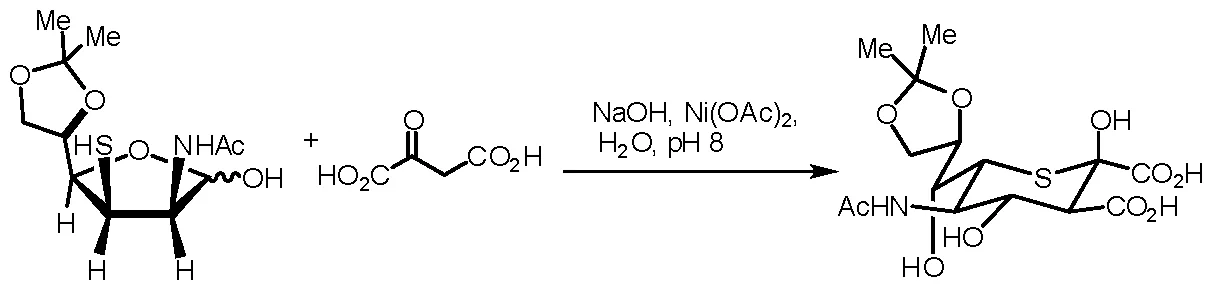
Solution
1– The enolate of oxalacetic acid condenses with the aldehyde in equilibrium with the hemiacetal.
2– The sulfur attacks the ketone.
Mack, H.; and Brossmer, R., Tetrahedron, 54, 4521 (1998).