Gabriel Tojo - Two Hundred Exercises in Mechanistic Organic Chemistry
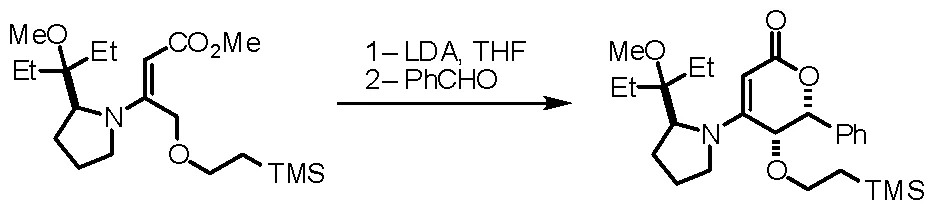
Exercise 151
Solution
1– The lithium diisopropylamide abstracts a proton form or from (in the editors’ view) the γ position of the ester carbonyl. This proton is acidic because of the extended delocalization of the conjugated base.
2– The resulting anion attacks the benzaldehyde, producing an alkoxide that displaces intramolecularly the methoxide group in the ester.
Schlessinger, R.H.; and Pettus, L.H., J.Org.Chem., 63, 9089 (1998).
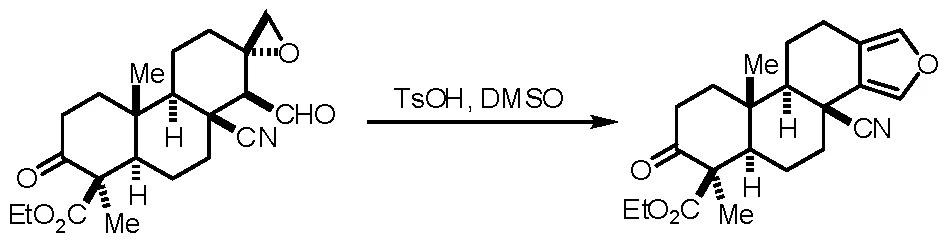
Exercise 152
Solution
1– The oxygen in the enol form of the aldehyde attacks intramolecularly the epoxide, which is previously activated by protonation by p-toluenesulfonic acid.
2– The resulting tertiary alcohol suffers a dehydration under acidic conditions.
Zoretic, P.A.; Zhang, Y.; and Fang, H., J.Org.Chem., 63, 1162 (1998).
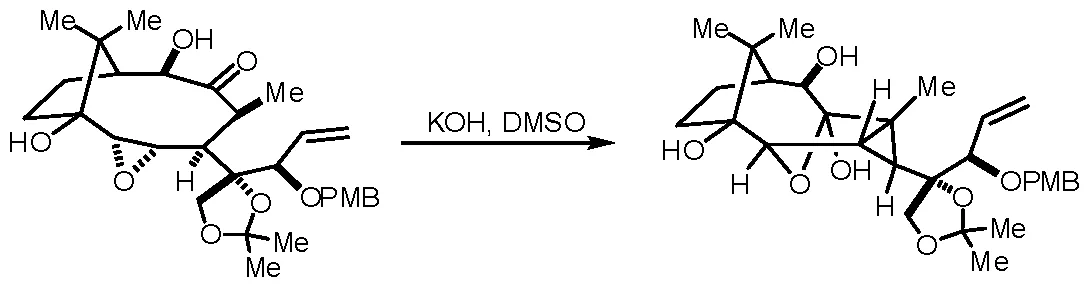
Exercise 153
Solution
1– The potassium hydroxide abstracts a proton on α to the ketone. The resulting anion attacks intramolecularly the epoxide, generating an alcohol.
2– This alcohol attacks the ketone, producing a hemiacetal.
Johnston, J.N.; Tsui, H.–C.; and Paquette, L.A., J.Org.Chem., 63, 129 (1998).
Exercise 154

Solution
1– Mesyl chloride, in the presence of triethylamine, produces the mesylation of the carboxylic acid hydroxy group, which thus becomes a good-leaving group.
2– The triethylamine generates an anion on α to the ketone. The oxygen of this ambident anion attacks the mesylated carboxylic acid, producing the final lactone.
Konoike, T.; Okada, T.; and Araki, Y., J.Org.Chem., 63, 3037 (1998).
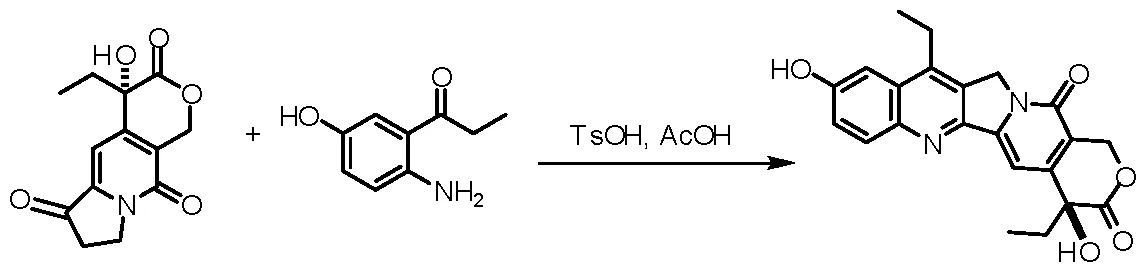
Exercise 155
Solution
1– The enol form of the aniline ketone condenses with the pyridine ketone. This produces an alcohol, which suffers dehydration, giving an enone.
2– An intramolecular condensation between and the amine or between the amine (in the editors’ view) and a ketone yields an imine.
Henegar, K.E.; Ashford, S.W.; Baughman, T.A.; Sih, J.C.; and Gu, R.–L., J.Org.Chem., 62, 6588 (1997).
Exercise 156
Solution
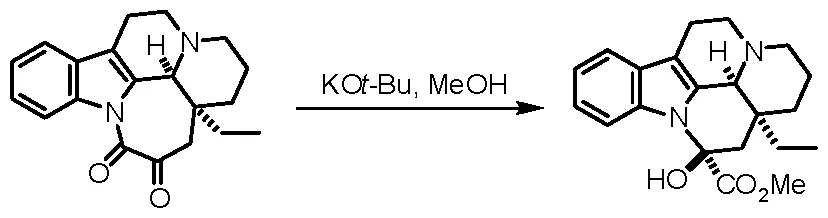
1– Potassium tert-butoxide in methanol generates methoxide, which attacks the amide carbonyl, producing the expulsion of the indole nitrogen. An indole nitrogen is a much better leaving-group than a nitrogen atom on a normal amine, because the free electron pair on an indole nitrogen is involved in aromaticity.
2– The indole nitrogen reacts with the ketone from the resulting α-keto ester.
Desmaële, D.; Mekouar, K.; and d’Angelo, J., J.Org.Chem., 62, 3890 (1997).
Exercise 157
Solution
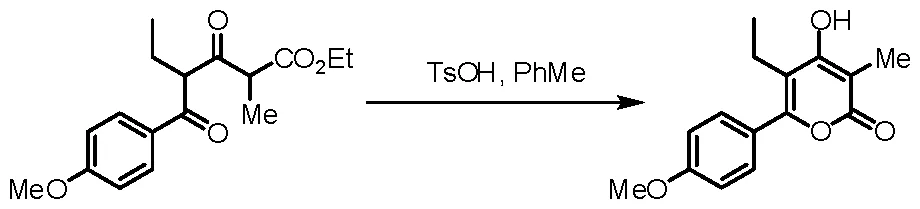
1– The enol form of the aromatic ketone attacks the carbonyl of the protonated ester.
2– The remaining ketone exists mainly as the enol form, for it gives rise to an aromatic α-pirone or α-pyrone (in the editors’ view).
Garey, D.; Ramirez, M.; Gonzales, S.; Wertsching, A.; Tith, S.; Keefe, K.; and Peña, M.R. J.Org.Chem., 61, 4853 (1996).
Exercise 158
Solution
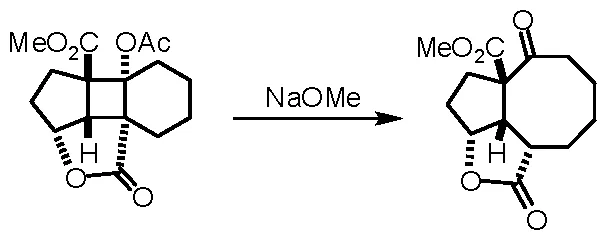
1– The acetate carbonyl is attacked by methoxide, resulting in the formation of methyl acetate and an alkoxide.
2– The alkoxide effects a retrograde aldol reaction, producing a ketone and a lactone enolate.
Lange, G.L.; and Organ, M.G., J.Org.Chem., 61, 5358 (1996).
Exercise 159

Solution
1– A Knoevenagel condensation between dimethyl malonate and the ketone produces an dimethyl or a dimethyl (in the editors’ view) alkylidenemalonate. The mechanism of this reaction is the standard one in Knoevenagel condensations and can be found in text books on Organic Chemistry.
2– The tertiary alcohol attacks intramolecularly one of the methyl esters producing a lactone.
Takayama, H.; Kurihara, M.; Kitajima, M.; Said, I.M.; and Aimi, N., Tetrahedron, 56, 3145 (2000).
Exercise 160
Solution
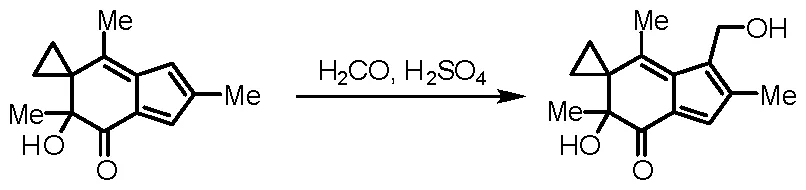
1– After the protonation of the ketone, one of the methyl groups is deprotonated, resulting in the formation of a ketone tautomer with a tetraenol structure.
2– The tetraenol attacks a molecule of protonated formaldehyde, producing the hydroxymethylation on the δ position of the ketone.
Observe that there is no dehydration of the tertiary alcohol, in spite of the strongly acidic conditions employed. This dehydration would need the intermediacy of a tertiary carbocation, that would be highly unstable because it would be located α to a carbonyl group.
Brummond, K.M.; Lu, J.; and Petersen, J., J.Am.Chem.Soc. 122, 4915 (2000).