Gabriel Tojo - Two Hundred Exercises in Mechanistic Organic Chemistry
Exercise 161
Solution
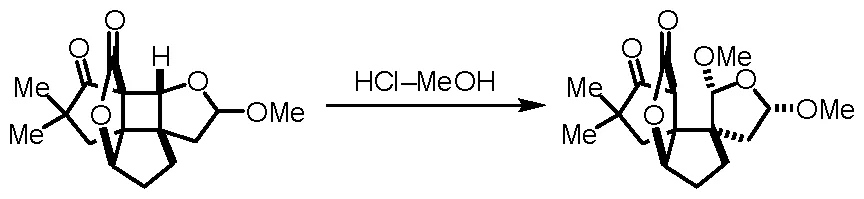
1– After the protonation of the lactone carbonyl, one of the bonds in the cyclobutane is broken, causing the formation of a carbocation α to the tetrahydrofuran oxygen and the enol tautomer of the lactone.
2– The lactone enol tautomer isomerizes to the lactone and methanol traps the carbocation.
Crimmins, M.T.; Pace, J.M.; Nantermet, P.G.; Kim-Meade, A.S.; Thomas, J.B.; Watterson, S.H.; and Wagman, A.S., J.Am.Chem.Soc. 122, 8453 (2000).
Exercise 162
Solution
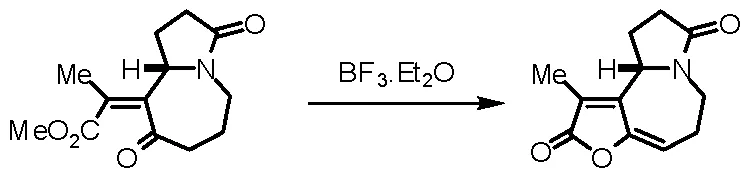
1– The ketone tautomerizes to an enol.
2– The ester carbonyl is activated by complexation with BF3·Et2O, so that an intramolecular attack of the enol hydroxy group on the ester carbonyl is possible and produces the expulsion of methoxy and the formation of an unsaturated lactone.
Jacobi, P.A.; and Lee, K., J.Am.Chem.Soc., 122, 4295 (2000).
Exercise 163
Solution
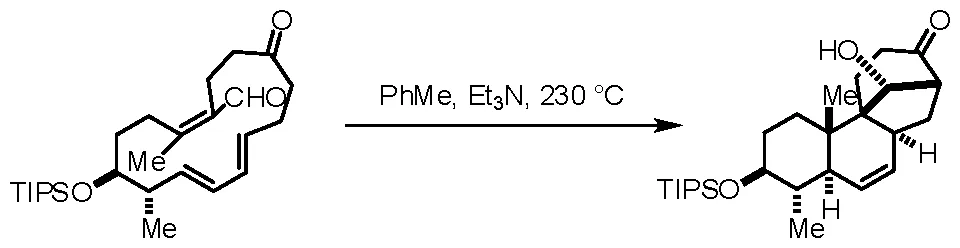
1– There is an intramolecular Diels-Alder reaction between the enal and the diene.
2– The triethylamine transforms the ketone in an enolate that attacks the aldehyde.
Bélanger, G.; and Deslongchamps, P., J.Org.Chem., 65, 7070 (2000).
Exercise 164
Solution
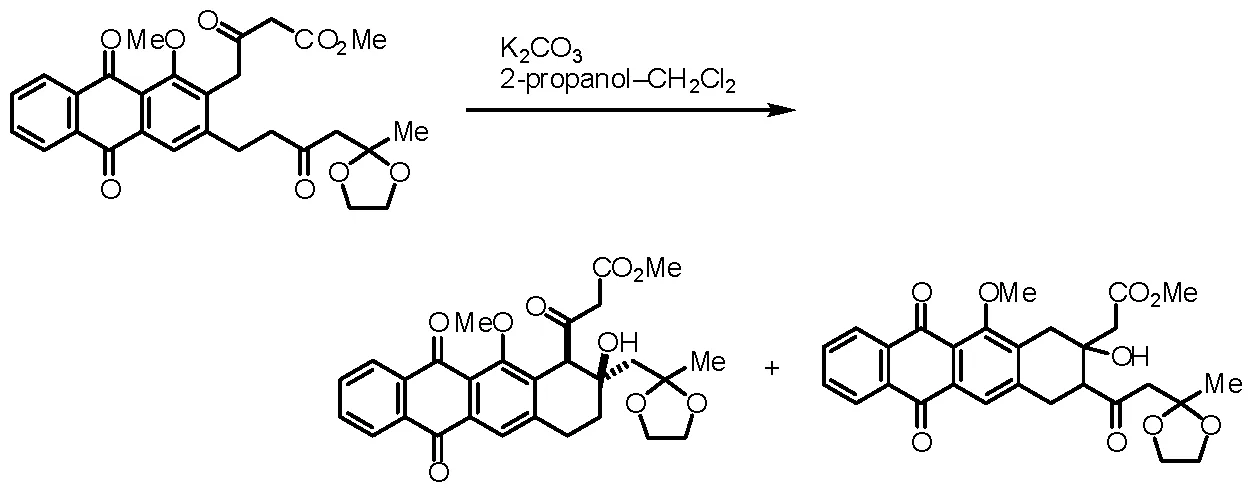
1– The carbonate abstracts the proton that is located on a benzylic position and on α to one of the ketones.
2– The resulting enolate attacks intramolecularly the other ketone, resulting in the formation of one of the products.
Alternatively, the base may abstract a proton on a homobenzylic position and α to the other ketone. The resulting enolate may attack the remaining ketone, resulting in the formation of the other possible product.
Krohn, K.; Bernhard, S.; Flörke, U.; and Hayat, N., J.Org.Chem., 65, 3218 (2000).
Exercise 165

Solution
1– The DABCO makes a conjugated addition to the methyl acrylate, producing an ester enolate and an ammonium salt.
2– The ester enolate attacks the aldehyde.
3– The ammonium salt is expelled by mean of an E1cB mechanism, causing the recovery of the alkene conjugated with the ester.
Of course, the mechanism does not begin by abstraction of the proton at the methyl acrylate on an α position. This proton lacks sufficient acidity, because the corresponding anion is not able to enter into conjugation with the ester carbonyl. This happens because the anion occupies an orbital, which is perpendicular to the p orbitals of the carbonyl group.
Jenn, T.; and Heissler, D., Tetrahedron, 54, 107 (1998).
Exercise 166
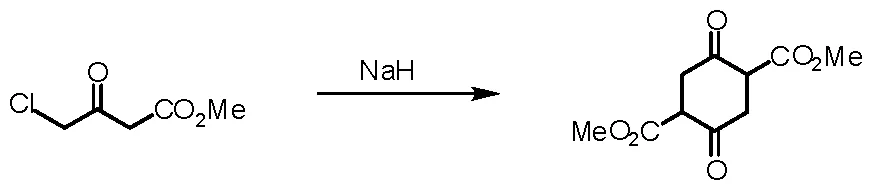
Solution
1– Sodium hydride acts as a base, producing a carbanion stabilized by both carbonyls.
2– The resulting anion displaces the chloride of a neighbouring molecule.
3– Another carbanion stabilized by two carbonyl groups is formed. This carbanion displaces intramolecularly a chloride atom.
Ohshima, T.; Kagechika, K.; Adachi, M.; Sodeoka, M.; and Shibasaki, M., J.Am.Chem.Soc., 118, 7108 (1996).
Exercise 167

Solution
1– Piperidine induces a Knoevenagel condensation between the α-keto sulfone and the benzaldehyde, giving a α,β-unsaturated ketone.
2– A phenoxide is formed, and it adds intramolecularly in a conjugated fashion to the enone.
3– Elimination of methanesulfinic acid is produced, by means of a E1cB mechanism, producing again an enone.
Pirrung, M.C.; and Lee, Y.R., J.Am.Chem.Soc., 117, 4814 (1995).
Exercise 168
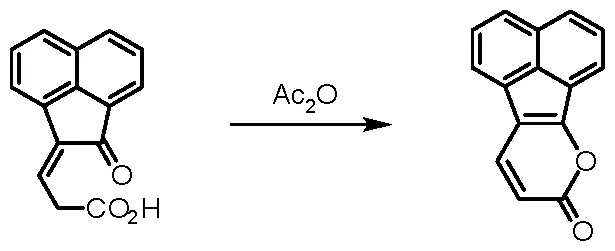
Solution
1– A mixed anhydride is formed by reaction of the carboxylic acid with acetic anhydride. Thus, the hydroxyl of the carboxylic is converted in a good-leaving group.
2– The enone tautomerizes to the corresponding dienol. This transformation is favoured by the resulting diene being conjugated with one of the mixed anhydride carbonyl groups.
3– The dienol hydroxyl attacks one of the mixed anhydride carbonyls, producing the expulsion of the acetate.
Boger, D.L.; and Takahashi, K., J.Am.Chem.Soc., 117, 12452 (1995).
Exercise 169

Solution
Apparently, this reaction could be a simple aldol condensation between the α position of an ester carbonyl group and an aldehyde. The simultaneous hydrolyses or hydrolysis (in the editors’ view) of one of the ester groups shows that a more complicated mechanism is operating. This is one example of the so-called Stobbe condensation, in which an intermediate lactone is formed by attack of a hydroxyl on an ester. Afterwards, the lactone carboxyl acts as a good-leaving group, producing an alkene, and resulting in the overall hydrolyses or hydrolysis (in the editors’ view) of one of the ester groups. The detailed mechanism is the following one:
1– Sodium methoxide generates an anion at the α position of one of the esters of dimethyl succinate.
2– The resulting enolate attacks the aldehyde, generating an alkoxide that reacts with one of the esters, producing a five-membered lactone.
3– An anion on α to the remaining ester carbonyl is formed. This anion evolves by carboxylate elimination through an E1cB mechanism.
White, J.D.; Hrnciar, P.; and Stappenbeck, F., J.Org.Chem., 64, 7871 (1999).
Exercise 170
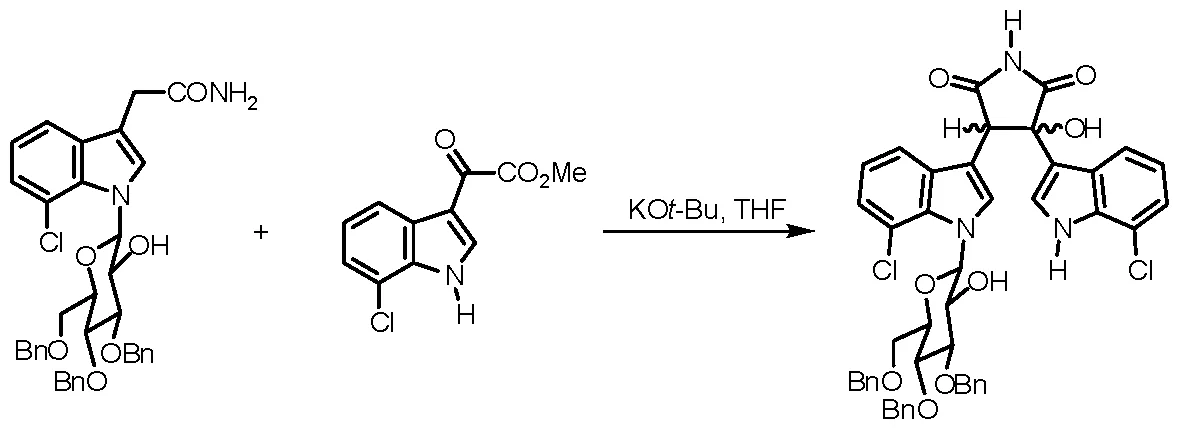
Solution
1– Potassium tert-butoxide forms an α-anion at the amide carbonyl.
2– This anion attacks the ketone.
3– The amide nitrogen attacks intramolecularly the ester carbonyl, producing the displacement of methoxide and the formation of a five-membered ring.
Faul, M.M.; Winneroski, L.L.; and Krumrich, C.A., J.Org.Chem., 64, 2465 (1999).