Gabriel Tojo - Two Hundred Exercises in Mechanistic Organic Chemistry
Exercise 171

Solution
1– The base DBU abstracts a proton placed between both ketones.
2– One of the enolate oxygens attacks the ester carbonyl and expels a methoxide.
3– The remaining ketone tautomerizes, producing a pyrone ring.
Oikawa, H.; Kobayashi, T.; Katayama, K.; Suzuki, Y.; and Ichihara, A., J.Org.Chem., 63, 8748 (1998).
Exercise 172

Solution
1– The potassium tert-butoxide takes a proton from the most acidic α position of the ketone, which is the one with an aryl attached.
2– The resulting anion effects a conjugate addition to methyl acrylate.
3– An anion on the methyl group attacked or attached (in the editors’ view) to the ketone is formed. This anion attacks intramolecularly the ester group, producing the displacement of ethoxide.
Majetich, G.; Liu, S.; Fang, J.; siesel, D.; and Zhang, Y., J.Org.Chem., 62, 6928 (1997).
Exercise 173
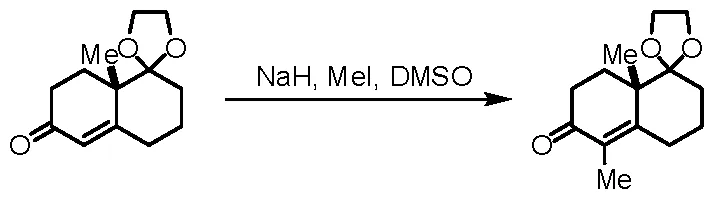
Solution
Of course, the mechanism does NOT consist in the direct abstraction of the vinylic proton located on α to the ketone, giving a vinyl anion that would be methylated. This proton lacks acidity since the corresponding anion would fail to be stabilized by conjugation with the carbonyl group. Resonance stabilization of this anion would not be possible because it would be located on an orbital orthogonal to the π system of the carbonyl group.
A more indirect mechanism operates:
1– The sodium hydride abstracts a proton on an allylic position on γ to the enone, producing an anion with extended delocalization between positions α and γ.
2– Methyl iodide alkylates this delocalized anion on position α, generating a ketone with β,γ-unsaturation.
3– The alkene migrates into conjugation with the carbonyl group by deprotonation on α, followed by protonation on γ.
An, J.; and Wiemer, D.F. J.Org.Chem., 61, 8775 (1996).
Exercise 174

Solution
1– Both the enamine and the oxazolidine are hydrolysed under the acidic aqueous conditions, yielding an aldehyde and a ketone.
2– The enolic form of the methyl ketone reacts intramolecularly with the aldehyde, giving a cyclohexenone, after dehydration of the intermediate β-hydroxy ketone.
Waterson, A.G.; and Meyers, A.I., J.Org.Chem., 65, 7240 (2000).
Exercise 175
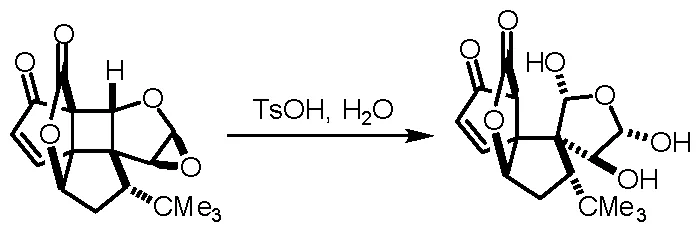
Solution
1– After protonation, the epoxide opens, giving a cation on α to an oxygen atom. This cation is trapped with water.
2– After protonation of the ketone carbonyl, there is an electronic movement, which begins on the tetrahydrofuran oxygen, leads to the breakage of one of the cyclobutane bonds, and yields an enol that tautomerizes to a ketone.
3– This electronic movement also generates a carbocation on α to the tetrahydrofuran oxygen, which is trapped with water.
Crimmins, M.T.; Pace, J.M.; Nantermet, P.G.; Kim-Meade, A.S.; Thomas, J.B.; Watterson, S.H.; and Wagman, A.S., J.Am.Chem.Soc. 122, 8453 (2000).
Exercise 176
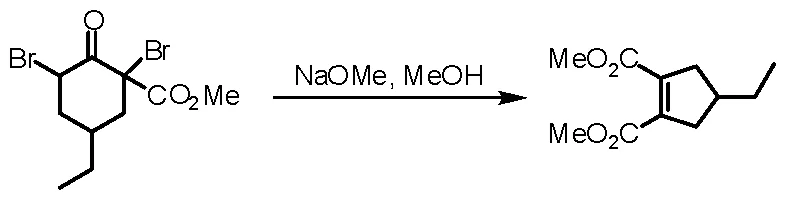
Solution
1– This reaction is a Favorskii transposition or Favorskii rearrangement (in the editors’ view) followed by a basic elimination of HBr. It begins with the formation of an anion on α to the ketone, which displaces one of the bromine atom, giving a cyclopropanone.
2– The methoxide attacks the cyclopropanone carbonyl, and the tetrahedral intermediate evolves by expulsion of a carbanion stabilized by the ester carbonyl, with opening of the cyclopropanone ring.
3– The basic elimination of HBr leads to an alkene, which is stabilized by conjugation with two esters.
White, J.D.; Kim, J.; and Drapela, N.E., J.Am.Chem.Soc. 122, 8665 (2000).
Exercise 177

Solution
1– The silyl ether and the dimethyl acetal are hydrolysed under acidic conditions.
2– The amide nitrogen reacts intramolecularly with the aldehyde, forming an aminal, which looses or loses (in the editors’ view) water under acidic catalysis, producing an acyliminium cation.
3– This cation is trapped intramolecularly by the enolic tautomer of the ketone.
Clive, D.L.J.; and Hisaindee, S. J.Org.Chem., 65, 4923 (2000).
Exercise 178
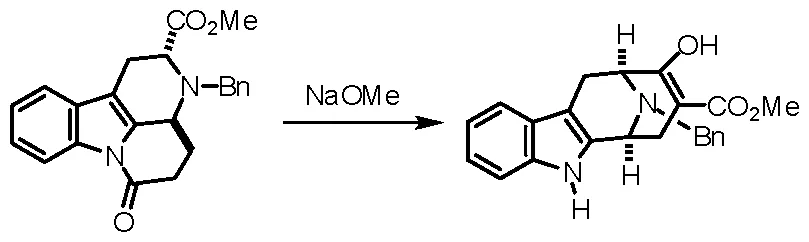
Solution
1– The methoxide attacks the lactam, producing its opening and the formation of a methyl ester.
2– A Dickmann cyclization occurs by attack of an ester enolate on the carbonyl of the other ester, producing β-keto ester.
3– The ketone tautomerizes to the enolic form, that in this molecule is the most stable tautomer because of having an alkene conjugated with an ester.
Yu, P.; Wang, T.; and Cook, J.M., J.Org.Chem., 65, 3173 (2000).
Exercise 179
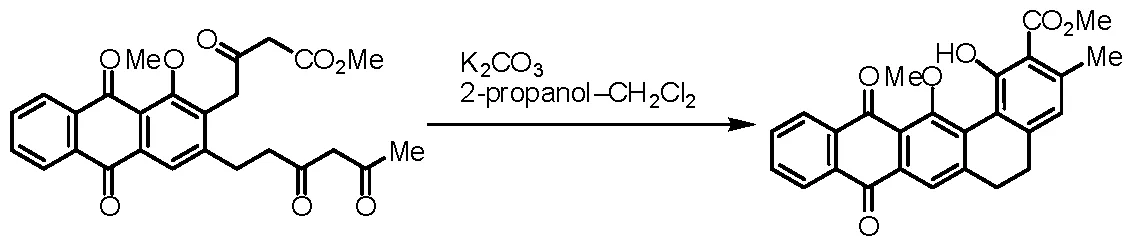
Solution
1– An anion on α to one of the ketones and on a benzylic position, attacks the other ketone, producing a six-membered ring.
2– An ester enolate attacks one of the ketones, giving a second six-membered cycle.
3– This second cycle aromatizes by dehydration of both alcohols and enolization of one of the ketones.
Krohn, K.; Bernhard, S.; Flörke, U.; and Hayat, N., J.Org.Chem., 65, 3218 (2000).
Exercise 180

Solution
1– The base forms a dianion on diethyl malate, in which one of the charges is on an alkoxide while the other charge is on α to one of the esters.
2– The ester enolate reacts with the imine, yielding a lithium amide.
3– This amide attacks intramolecularly one of the esters.
Ahn, J.; Andun or Yun (in the editors’ view), C.; Kim, K.; and Ha, D., J.Org.Chem., 65, 9249 (2000).