Gabriel Tojo - Two Hundred Exercises in Mechanistic Organic Chemistry
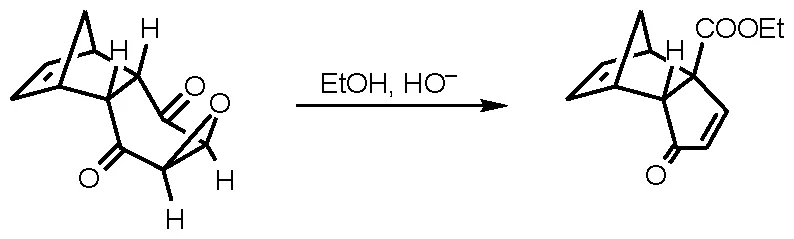
Exercise 181
Solution
There is a ring contraction via a Favorskii reaction, through the following steps:
1– An anion is formed at the α position of one of the ketones.
2– The resulting anion attacks the epoxide, producing its opening and the formation of a cyclopropanone.
3– An ethoxide attacks the ketone on the cyclopropanone, leading, by way of an addition-elimination mechanism, to the opening of the three-membered ring, with formation of an ethyl ester and a non-stabilized carbocation.
4– This non-stabilized carbocation evolves by formation of an alkene by hydroxide elimination.
Zhu, Jie; Andang or Yang (in the editors’ view), J.–Y.; Klunder, A.; Liu, Z.–Y.; and Zwanenburg, B., Tetrahedron, 51, 5847 (1995).
Exercise 182

Solution
1– The anion of dimethyl malonate is formed under the action of sodium methoxide.
2– This anion attacks the epoxide, causing its opening and the formation of an alkoxide.
3– An attack of the alkoxide on the carbonyl of one of the esters causes the formation of a δ-lactone or γ-lactone (in the editors’ view).
4– The ester suffers a demethoxycarbonylation under the action of DMSO–H2O in the presence of LiCl.
Hedenström, E.; Högberg, H.; Wassgren, A.; Bergström, G.; Löfqvist, J.; Hansson, B; and Anderbrant, O., Tetrahedron, 48, 3139 (1992).
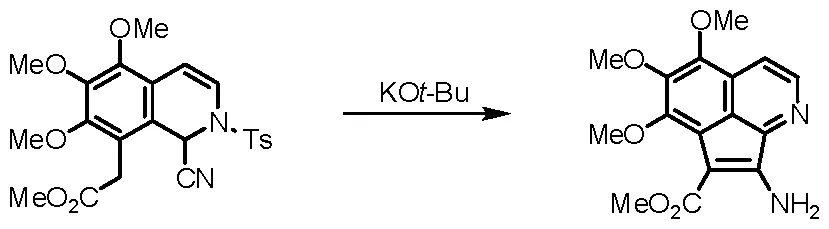
Exercise 183
Solution
1– Potassium tert-butoxide generates a carbanion on α to the ester carbonyl.
2– The resulting anion attacks the cyanide, producing an imine.
3– The imine tautomerizes to the correspondent enamine. This tautomerization is facilitated by the conjugation of the enamine alkene with the ester.
4– Potassium tert-butoxide produces the elimination of p-toluenesulfinic acid (p-MePhSO2H).
Boger, D.L.; and Takahashi, K., J.Am.Chem.Soc., 117, 12452 (1995).
Exercise 184

Solution
The PPTS acts as a mild protic acid that catalyzes the formation of the furan, without hydrolysing the tert-butyl ester.
1– The ketone on β to the ester tautomerizes to the corresponding enol.
2– The enol attacks the aldehyde.
3– The acetal is hydrolysed, liberating an alcohol that attacks intramolecularly the ketone, giving a hemiacetal.
4– Both the hemiacetal hydroxy group and one of the alcohols suffer a dehydration, leading to a furan aromatic ring.
Marshall, J.A.; McNulty, L.M.; and Zou, D., J.Org.Chem., 64, 5193 (1999).
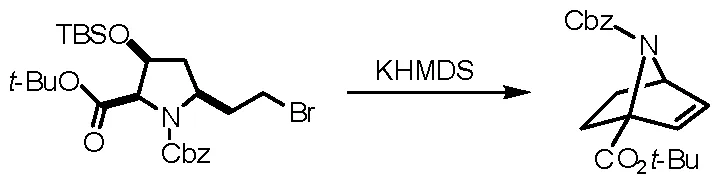
Exercise 185
Solution
1– The strong base KHMDS generates an anion on α to the ester carbonyl.
2– An unsaturated ester is formed by β-elimination of the silyloxy group by a E1cB mechanism.
3– The base KHMDS forms an anion on γ position of the unsaturated ester.
4– This anion, which is delocalized between position α y or and (in the editors’ view) γ, attacks by its α position, producing the displacement of the bromine.
Hart, B.P.; and Rapoport, H., J.Org.Chem., 64, 2050 (1999).
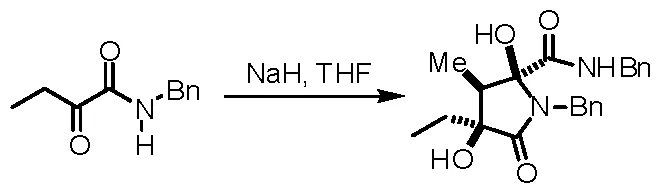
Exercise 186
Solution
1– The sodium hydride forms an anion on α to the ketone of the α-keto amide.
2– This anion attacks the ketone of another α-keto amide molecule.
3– An anion on the amide nitrogen is formed.
4– This anion attacks intramolecularly another ketone. The resulting aminal is stable due to its location in a five-membered ring, and because the ketone being attacked is particularly reactive since it is placed on α relative to another carbonyl group.
Snider, B.B.; Song, F.; and Foxman, B.M., J.Org.Chem., 65, 793 (2000).
Exercise 187

Solution
1– The sodium hydride generates an alkoxide and a ketone enolate.
2– The enolate reacts with the 1,1′-carbonyldiimidazole, producing the displacement of an imidazole molecule.
3– The remaining imidazole is displaced by the alkoxide, which attacks intramolecularly.
4– The ketone tautomerizes to the enolic form, which is more stable because of having the alkene conjugated with the lactone carbonyl.
Imidazole works as a good-leaving group because the electron pair on the expelled nitrogen is not a free electron pair as it participates on the aromaticity of imidazole.
Ward, D.E.; Gai, Y.; and Kaller, B.F., J.Org.Chem., 61, 5498 (1996).
Exercise 188
Solution
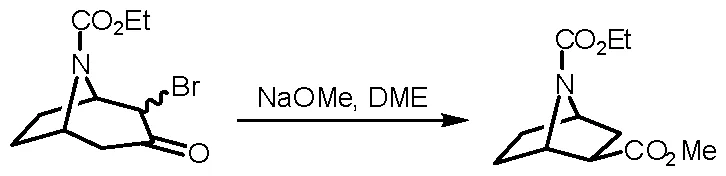
There is a ring contraction by a curious reaction, called Favorskii transposition or Favorskii rearrangement (in the editors’ view) that occurs via an unstable cyclopropanone.
1– Sodium methoxide takes a proton from the carbon atom, located on α to the ketone, which does not hold a bromine atom. The base can also take a proton from the carbon holding a bromine, which is more acidic, but this leads to an unproductive equilibrium.
2– The resulting carbanion displaces intramolecularly the bromine atom, producing a very strained cyclopropanone.
3– The cyclopropanone carbonyl is attacked by methoxide, producing a tetrahedral intermediate. This intermediate evolves by opening the ring and expelling a non-stabilized carbanion. The occurrence of a non-stabilized carbanion functioning as leaving group is an exceptional situation, that is possible in this case because of the liberation of strain resulting from the opening of a three-membered ring.
4– The non-stabilized carbocation or carbanion (in the editors’ view) is protonated.
Bai, D.; Xu, R.; Chu, G.; and Zhu, X., J.Org.Chem., 61, 4600 (1996).
Exercise 189
Solution
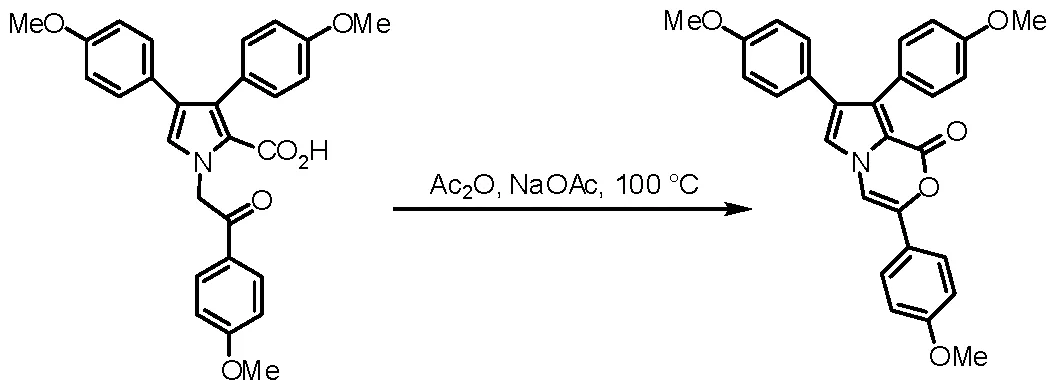
1– Sodium acetate generates mild basic conditions that allow the deprotonation of the carboxylic acid.
2– The resulting carboxylate anion reacts with acetic anhydride producing a mixed anhydride.
3– A carbanion on α to the ketone is formed.
4– This anion attacks intramolecularly one of the carbonyl groups of the mixed anhydride, producing the expulsion of acetate.
Liu, J.-H.; andang or Yang (in the editors’ view), Q.-C.; Mal or Mak (in the editors’ view), T.C.W.; and Wong, H.N.C., J.Org.Chem., 65, 3587 (2000).
Exercise 190
Solution
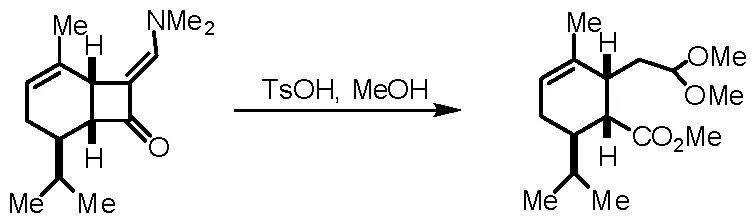
1– The p-toluenesulfonic acid generates acidic conditions that allow the protonation of the olefin in the enamine, giving a carbocation stabilized by the nitrogen.
2– Methanol attacks this cation.
3– Methanol attacks the protonated carbonyl, producing a hemiacetal.
4– The amine becomes a good-leaving group by protonation. This allows an electronic movement that begins with the electron pair in the hemiacetal hydroxyl. The resultant electronic motion produces: a) the formation of an ester carbonyl; b) The breakage of a cyclobutane bond; c) The elimination of dimethylamine, with formation of a methyl enol ether.
5– Protonation of the double bond in the methyl enol ether gives a carbocation, which is attacked by methanol. This results in the formation of a dimethyl acetal.
Chen, X–T.; Bhattacharya, S.K.; Zhou, B.; Gutteridge, C.E.; Pettus, T.R.R.; and Danishefsky, S.J., J.Am.Chem.Soc., 121, 6563 (1999).