Gabriel Tojo - Two Hundred Exercises in Mechanistic Organic Chemistry
Exercise 191
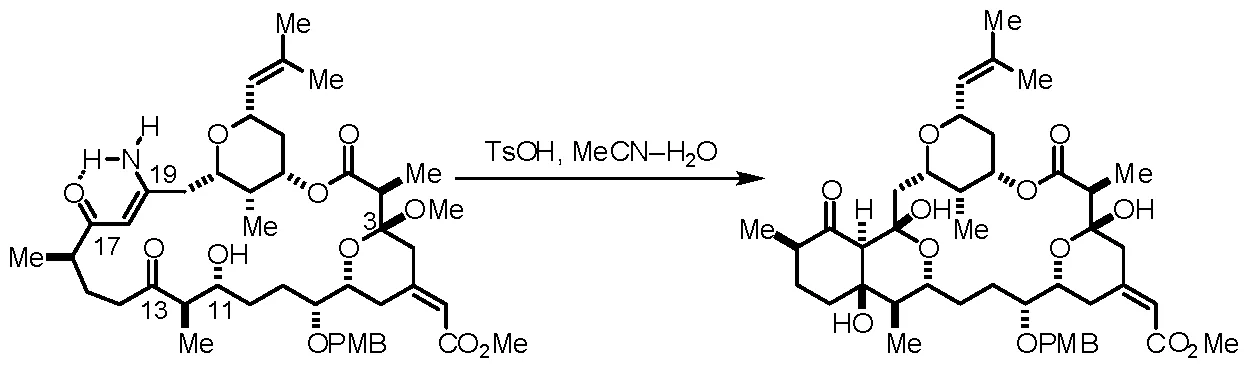
Solution
1– The p-toluenesulfonic acid protonates one of the oxygen atoms of the acetal on position 3. The loss of methanol generates a carbocation on α position relative to an oxygen atom.
2– A water molecule attacks this carbocation, producing a cyclic hemiacetal.
3– The aqueous acidic medium produces the enamide hydrolysis, giving a β-diketone on positions 17–19.
4– An enol tautomer of this β-diketone attacks the carbonyl on position 13.
5– The alcohol on position 11 attacks the ketone on position 19, giving a six-membered cyclic hemiacetal.
Evans, D.A.; Ripin, D.H.B.; Halstead, D.P.; and Campos, K.R., J.Am.Chem.Soc., 121, 6816 (1999).
Exercise 192

Solution
On first sight, a mechanism based on the attack of the enol form of the ethyl acetoacetate on an iminium cation could be envisioned. The iminium cation could be formed by water lose form or loss from (in the editors’ view) the starting α-aminoalcohol. The following steps would operate.
1– Formation of an iminium cation by water loose form or loss from (in the editors’ view) the starting α-aminoalcohol.
2– Attack of the enol form of ethyl acetoacetate on the iminium cation.
3– Intramolecular attack of one of the guanidine nitrogens on the ketone.
4– Dehydration of the resulting β-hydroxy ester.
On the other hand, the use of morpholinium acetate suggests Knoevenagel reaction conditions, with enamine intermediacy. The mechanism would change begging or beginning (in the editors’ view) in the second step as follows:
2– An enamine, formed from ethyl acetate and morpholine, attacks the iminium cation.
3– Intramolecular attack of one of the guanidine nitrogens on the resulting iminium cation.
4– Alkene formation by expulsion of protonated morpholine.
Franklin, A.S.; Ly, S.K.; Mackin, G.H.; Overman, L.E.; and Shaka, A.J., M., J.Org.Chem., 64, 1512 (1999).
Chapter 6. Reactions via Carbanions Stabilized by Functional Groups Other than Carbonyl
Exercise 193
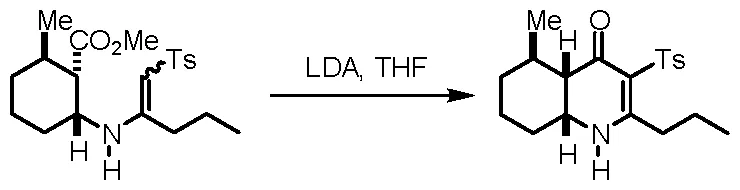
Solution
1– The lithium diisopropylamide deprotonates the nitrogen, giving a resonance-stabilized anion. One of the resonant structures of this anion possesses a negative charge on α to a sulfone.
2– This anion reacts with the ester carbonyl, and produces by an addition-elimination mechanism, the expulsion of methoxide.
Back, T.G.; and Nakajima, K., J.Org.Chem., 63, 6566 (1998).
Exercise 194
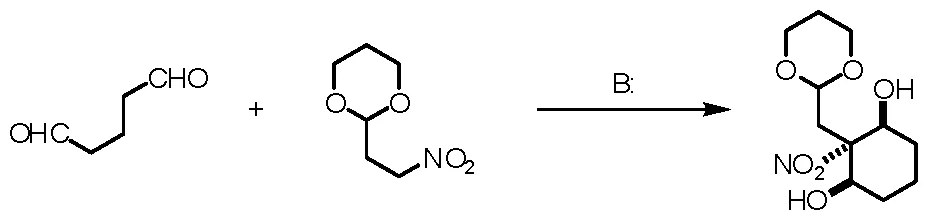
Solution
1– The base allows the formation of an anion on the α position of the nitro group.
2– The resulting anion attacks one of the aldehydes of glutaraldehyde, giving a β-hydroxy nitro compound.
3– A new anion on the α-position of the nitro group is formed, and the resulting anion attacks intramolecularly the remaining aldehyde.
Luzzio, F.A.; and Fitch, R.W., J.Org.Chem., 64, 5485 (1999).
Exercise 195

Solution
1– The strong base n-BuLi generates an allylic anion stabilized by the phosphorous or phosphorus (in the editors’ view) atom and the alkene.
2– A conjugate addition of this anion on the unsaturated ester gives an ester enolate.
3– The ester enolate displaces intramolecularly the chlorine atom, producing a cyclopropane.
An alternative mechanism in which the initially formed anion looses or loses (in the editors’ view) chlorine, producing a carbene, which adds to the alkene, cannot be discarded. This mechanism seems not to be very probable, as the high reactivity of carbenes seems to contradict the high stereoselectivity of this reaction.
Hanessian, S.; Cantin, L.–D.; and Andreotti, D., J.Org.Chem., 64, 4893 (1999).
Exercise 196
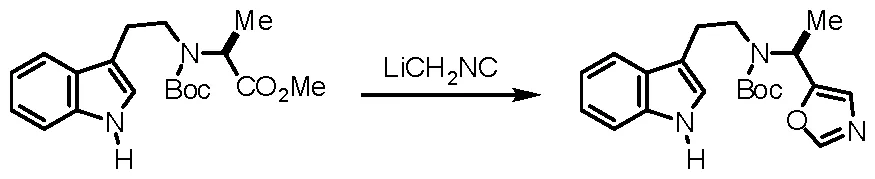
Solution
1– The anion on α to the isocyanide reacts with the ester, producing the expulsion of methoxide.
2– The resulting isocyanide is protonated on its carbon, while there is a deprotonation on α to the carbonyl group.
3– The enolate attacks intramolecularly the carbon atom of the protonated isocyanide.
Ohba, M.; Kubo, H.; and Ishibashi, H., Tetrahedron 56, 7751 (2000).
Exercise 197
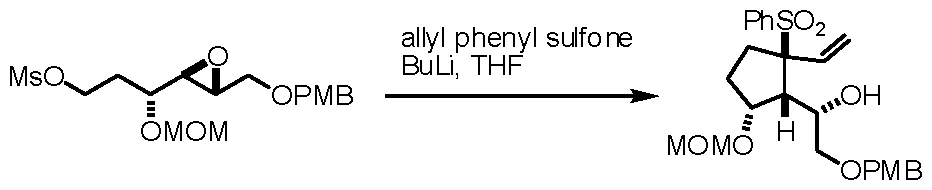
Solution
1– The BuLi generates an allylic anion that is stabilized by a sulfone.
2– This anion displaces the mesylate.
3– A new sulfone-stabilized anion is formed and produces the opening of the epoxide by an intramolecular attack, which results in the formation of a cyclopentane.
Miyaoka, H.; Tamura, M.; and Yamada, Y., Tetrahedron, 56, 8083 (2000).
Exercise 198
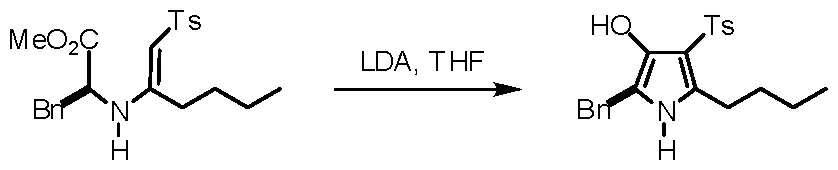
Solution
1– The LDA abstracts the proton on the nitrogen, producing an anion, which delocalizes on α to the sulfone.
2– This anion attacks from the position on α to the sulfone to the ester carbonyl, leading to the expulsion of methoxide and the formation of a ketone.
3– The ketone tautomerizes to the enolic form, resulting in the formation of an aromatic pyrrole ring.
Back, T.G.; and Nakajima, K., J.Org.Chem., 65, 4543 (2000).
Exercise 199
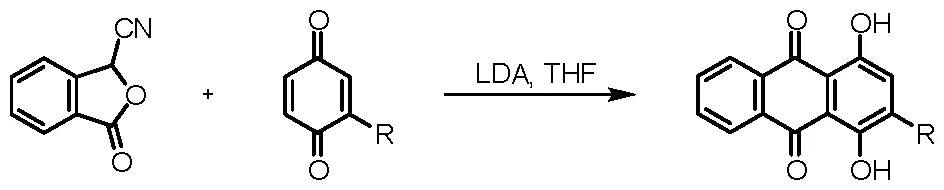
Solution
1– The base generates a carbanion on α to the cyanide.
2– A conjugate addition of this anion to the quinone produces the enolate of one of the ketones.
3– This ketone enolate attacks intramolecularly the ester carbonyl, producing a tetrahedral intermediate that evolves by expulsion of alkoxide, resulting in the formation of a cyanhydrine or cyanohydrin (in the editors’ view) anion.
4– This cyanhydrine or cyanohydrin (in the editors’ view) anion decomposes by expulsion of cyanide, producing the final compound.
Ge, P.; and Russell, R.A., Tetrahedron, 51, 17477 (1997).
Exercise 200

Solution
1– An imine is formed by condensation of the amine and the aldehyde, with water withdrawal by azeotropic distillation in benzene.
2– The base produces an anion at the α position of the imine. This carbanion is stabilized by conjugation with the carbon-nitrogen double bond, in a mode closely resembling the stabilization of enolates.
3– The carbanion of the α position of the imine attacks the ester carbonyl group, producing the expulsion of a methoxide by addition-elimination.
4– The imine is tautomerized to an enamine, in which the olefin is conjugated with the carbonyl group.
Smith III, A.B.; Benowitz, A.B.; Sprengeler, P.A.; Barbosa, J.; Guzman, M.; Hirschmann, R.; Schweiger, E.J.; Bolin, D.R.; Nagy, Z.; Campbell, R.M.; Cox, D.C.; and Olson, G.L., J.Am.Chem.Soc., 121, 9286 (1999).