Gabriel Tojo - Two Hundred Exercises in Mechanistic Organic Chemistry
Exercise 61

Solution
1– The chlorine atom is displaced by the nitrogen of a formamide molecule.
2– Another formamide molecule reacts with the ketone yielding an N-formylenamide.
3– A nitrogen atom attacks intramolecularly the carbonyl of one of the formyl groups, producing an N-formylimidazole after water loss.
4– The attack of a water molecule produces the removal of a formyl group.
Hayashi, Y.; Orikasa, S.; Tanaka, K.; Kanoh, K.; and Kiso, Y., J.Org.Chem., 65, 8402 (2000).
Exercise 62
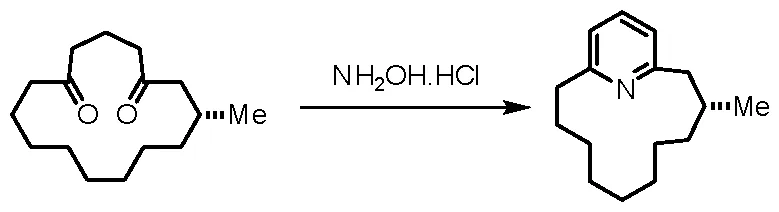
Solution
1– Condensation of hydroxylamine with one of the ketones results in the formation of an oxime.
2– The oxime tautomerizes to a N-hydroxyenamine.
3– The nitrogen attacks the remaining ketone yielding a N-hydroxydienamine.
4– Aromatization to a pyridine ring occurs by loss of a water molecule.
Hagiwara, H.; Katsumi, T.; Kamat, V.P.; Hoshi, T.; Suzuki, T.; and Ando, M., J.Org.Chem., 65, 7231 (2000).
Exercise 63

Solution
1– The acidic methanolysis of the isopropylidene acetal liberates a diol, and generates 2,2-dimetoxipropane or dimethoxypropane (in the editors’ view).
2– The resulting secondary alcohol attacks the ketone, giving a six-membered cyclic hemiacetal. No attack from the primary alcohol occurs because it would generate a less favourable seven-membered cyclic hemiacetal.
3– The hemiacetal hydroxy group is protonated.
4– The protonated hydroxy group is lost as water. This results in the formation of an oxygen-stabilized carbocation.
5– The carbocation is attacked by a methanol molecule.
Dondoni, A.; Marra, A.; and Merino, P., J.Am.Chem.Soc., 116, 3324 (1994).
Exercise 64

Solution
1– The MnO2 oxidises the allylic alcohol to an aldehyde.
2– The hydrochloric acid hydrolyses the tetrahydropyranyl ether.
3– The liberated alcohol attacks the aldehyde, producing a hemiacetal.
4– The hemiacetal hydroxy group is protonated, becoming a good-leaving group which is expelled, generating an oxygen-stabilized allylic cation.
5– A deprotonation leads to an aromatic furan ring.
Fürstner, A.; Guth, O.; Rumbo, A.; and Seidel, G., J.Am.Chem.Soc., 121, 11108 (1999).
Exercise 65
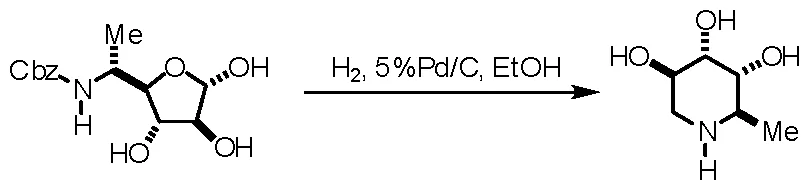
Solution
1– The catalytic hydrogenation leads to the removal of the Cbz protecting group.
2– The amine attacks the aldehyde, which is in equilibrium with a hemiacetal, giving an α-aminoalcohol.
3– The α-aminoalcohol suffer a dehydration to an imine.
4– The imine is reduced by catalytic hydrogenation.
Tschamber, T.; Backenstrass, F.; Neuburger, M.; Zehnder, M.; and Streith, J., Tetrahedron, 50, 1135 (1994).
Exercise 66
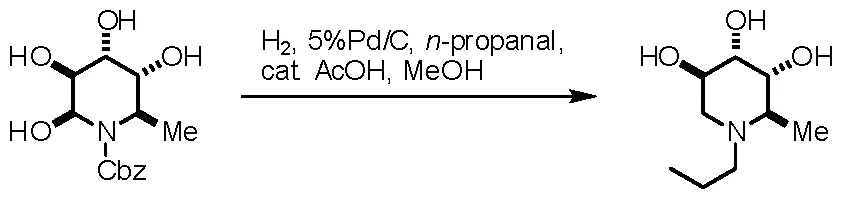
Solution
1– The catalytic hydrogenation produces the removal of the Cbz protecting group.
2– The resulting α-aminoalcohol is dehydrated to an imine.
3– An amine is formed by catalytic hydrogenation of the imine.
4– This amine is reductively alkylated by n-propenal or n-propanal (in the editors’ view) under catalytic hydrogenation.
Tschamber, T.; Backenstrass, F.; Neuburger, M.; Zehnder, M.; and Streith, J., Tetrahedron, 50, 1135 (1994).
Chapter 3. Derivatives of Carboxylic Acids
Exercise 67
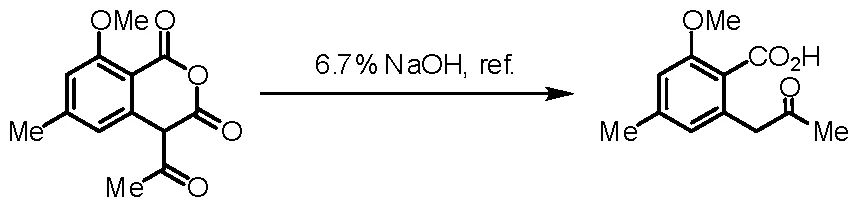
Solution
1– The anhydride in the starting compound suffers a basic hydrolysis, producing a β-keto acid.
2– The β-keto acid is decarboxylated on heating.
Goverdhan, M.; Shailesh, R.; and Venkateswarlu, Y., Tetrahedron, 50, 11729 (1994).
Exercise 68
Solution
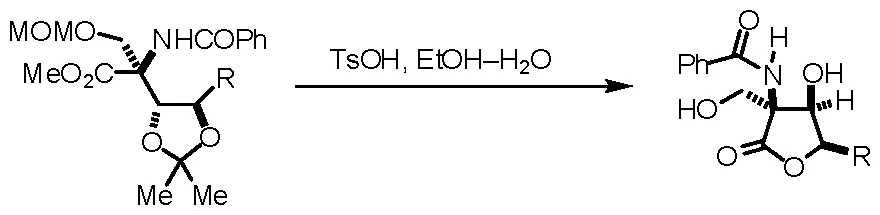
1– Both acetals suffer an acidic hydrolysis.
2– One of the liberated alcohols attacks the protonated carbonyl of the methyl ester, producing the elimination of methanol and formation of a δ-lactone or γ-lactone (in the editors’ view).
Yoshikawa, M.; Andokokawa or Yokokawa (in the editors’ view), Y.; Okuno, Y.; and Murakami, N., Tetrahedron, 51, 6209 (1995).
Exercise 69
Solution
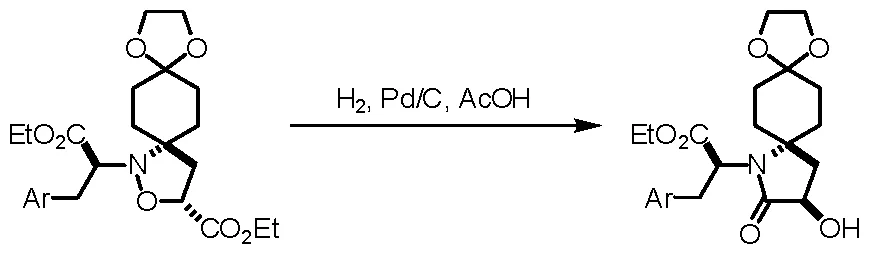
1– The catalytic hydrogenation produces the reductive breakage of the N–O bond, liberating an amine and an alcohol.
2– The amine attacks one of the esters, displacing, via an addition-elimination mechanism, an ethoxide, and generating a lactam.
Snider, B.B.; and Lin, H., J.Am.Chem.Soc., 121, 7778 (1999).
Exercise 70
Solution
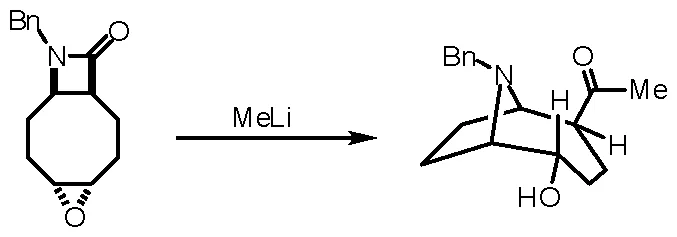
1– The methyllithium attacks the lactam carbonyl and causes the expulsion of an amide.
2– The resulting amide produces the opening of the epoxide by an intramolecular attack.
Parsons, P.J.; Camp, N.P.; Edwards, N.; and Sumoreeah, L.R., Tetrahedron, 56, 309 (2000).