Gabriel Tojo - Two Hundred Exercises in Mechanistic Organic Chemistry
Exercise 41
Solution
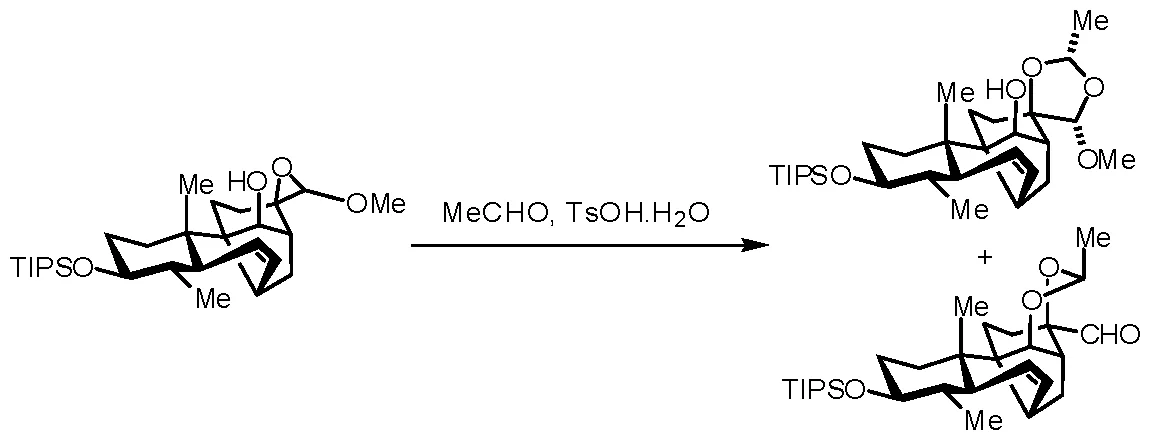
The acidic conditions lead to the opening of the epoxide with formation of a diol that reacts with acetaldehyde, producing one of the products.
Alternatively, the diol hydroxy group forming part of an hemiacetal may generate an aldehyde, and the two remaining hydroxy groups may form an acetal by reaction with acetaldehyde.
Bélanger, G.; and Deslongchamps, P., J.Org.Chem., 65, 7070 (2000).
Exercise 42
Solution
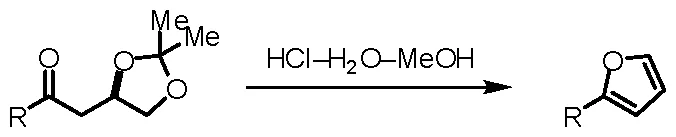
1– Acetal hydrolysis yields a diol.
2– One of the alcohols produces a hemiacetal by attack on the ketone.
3– Both alcohols suffer an acid-catalysed dehydration, leading to an aromatic furan ring.
Oka, T.; and Murai, A., Tetrahedron, 54, 1 (1998).
Exercise 43
Solution
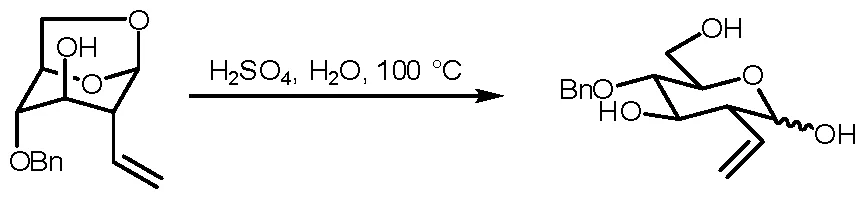
1– The acetal is hydrolysed, resulting in the formation of an aldehyde and the deprotection of a diol.
2– The liberated secondary hydroxyl attacks the aldehyde, forming a hemiacetal.
Alternatively, a simpler mechanism, with no need to liberate the aldehyde, can be proposed. It consists in:
1– Protonation of one of the acetal oxygen atoms, followed by expulsion of oxygen and formation of a carbocation in the α position of the oxygen of a pyranose ring.
2– Trapping of the carbocation by water.
Barbaud, C.; Bols, M.; Lundt, I.; and Sierks, M., Tetrahedron, 51, 9063 (1995).
Exercise 44
Solution
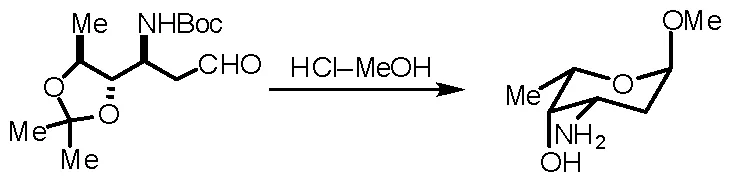
1– The acidic conditions cause the acetal hydrolysis and the removal of the Boc group.
2– The distal alcohol reacts with the aldehyde producing an hemiacetal.
3– The hemiacetal is transformed in a methyl glycoside, under the action of acidic methanol.
Jurczak, J.; Kozak, J.; and Golebiowski, A., Tetrahedron, 48, 4231 (1992).
Exercise 45
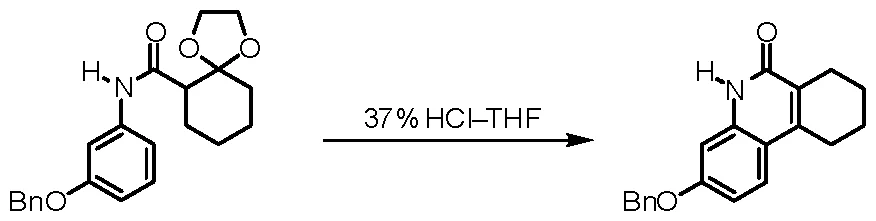
Solution
1– The acidic media leads to the hydrolysis of the ethylene acetal.
2– The resulting ketone, after being activated by protonation, is attacked intramolecularly by the aromatic ring. This leads to a Wheland intermediate that looses or loses (in the editors’ view) a proton.
3– An enone is formed by dehydration of the alcohol, previously activated by protonation.
Nicolau, K.C.; and Dai, W.–M., J.Am.Chem.Soc., 114, 8908 (1992).
Exercise 46
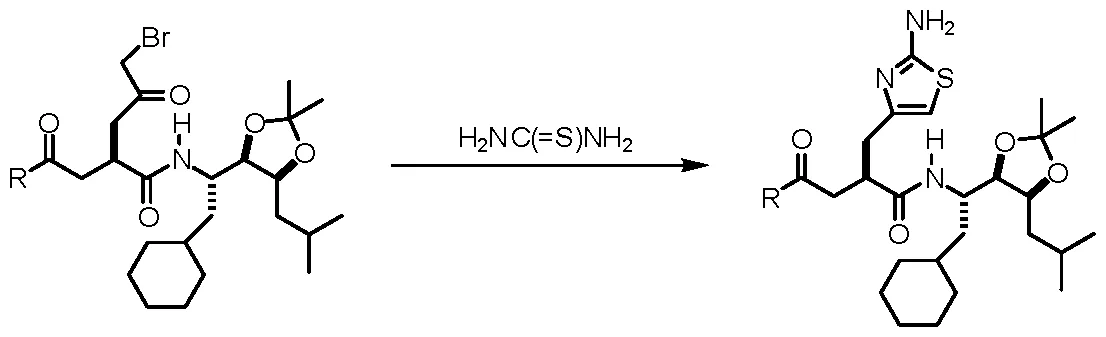
Solution
1– The thiourea sulfur atom displaces the bromine positioned α to a ketone, producing a sulfonium salt.
2– Both carbon-nitrogen double bonds migrate so as to generate an aromatic isotiazole or thiazole (in the editors’ view) ring.
Beaulieu, P.L.; Gillard, J.; Bailey, M.; Beaulieu, C.; Duceppe, J.–S.; Lavallée, P.; and Wernic; D., J.Org.Chem., 64, 6622 (1999).
Exercise 47
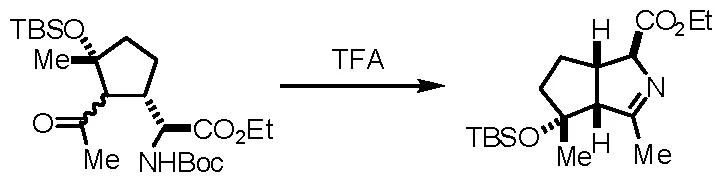
Solution
1– The trifluoroacetic acid produces the removal of the Boc group.
2– The acidic media produces the epimerization of the position α to the ketone. This allows the formation of an epimer able to cyclize with the amine.
3– The resulting amine reacts intramolecularly with the ketone, yielding a cyclic imine.
Collado, I.; Ezquerra, J.; Mateo, A.I.; Pedregal, C.; and Rubio, A., J.Org.Chem., 64, 4304 (1999).
Exercise 48
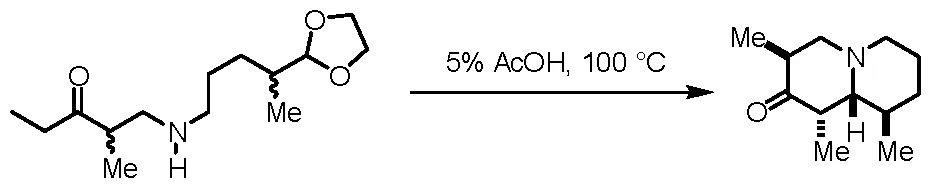
Solution
1– An aldehyde is formed by hydrolysis of the acetal.
2– The aldehyde reacts intramolecularly with the amine, producing an iminium salt.
3– The enol form of the ketone reacts with the iminium salt.
Scott, R.W.; Epperson, J.; and Heathcock, C.H., J.Org.Chem., 63, 5001 (1998).
Exercise 49
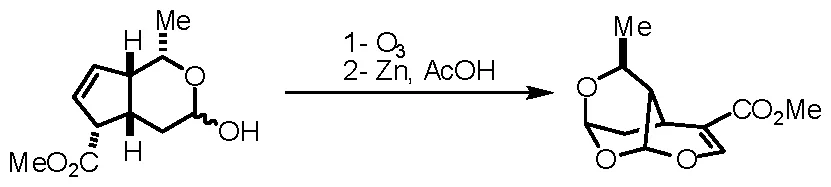
Solution
1– An ozonolysis leads to the alkene breakage, with the formation of a dialdehyde.
2– One of the aldehydes tautomerizes to an enol.
3– Acetic acid catalyses the formation of a cyclic acetal by reaction of the remaining aldehyde with the enol and the hemiacetal hydroxy groups.
Chang, M.–Y.; Chang, C.–P.; Andin or Yin (in the editors’ view), W.–K.; and Chang, N.–C., J.Org.Chem., 62, 641 (1997).
Exercise 50

Solution
1– The ammonia, liberated from the ammonium acetate, condenses with the aldehyde, producing an imine.
2– The sodium cyanoborohydride reduces the imine to a primary amine.
3– The primary amine produces a first cycle by an intramolecular reaction with the epoxide, and a second cycle by displacement of bromide.
Hunt, J.A.; and Roush, W.R., J.Org.Chem., 62, 1112 (1997).