Sijbren Otto - Catalysis of Diels-Alder Reactions in Water
This chapter describes the effects of micelles on the Diels-Alder reaction of compounds 5.1 a-g (see Scheme 5.1) with cyclopentadiene (5.2). As far as we know, our study is the first detailed kinetic analysis of micellar catalysis of a Diels-Alder reaction.
The use of dienophile 5.1 also allows study of the effect of micelles on the Lewis-acid catalysed reaction. These studies are described in Section 5.2.2. and represent the first in-depth study of Lewis-acid catalysis in conjunction with micellar catalysis56, a combination that has very recently also found application in synthetic organic chemistry57.
5.2.1 Effects of micelles in the absence of Lewis acids
In this section the influence of micelles of cetyltrimethylammonium bromide (CTAB), sodium dodecylsulfate (SDS) and dodecyl heptaoxyethylene ether (C12E7) on the Diels-Alder reaction of 5.1a-g with 5.2 in the absence of Lewis-acid catalysts is described (see Scheme 5.1). Note that the dienophiles can be divided into nonionic (5.1a-e), anionic (5.1f) and cationic (5.1g) species. A comparison of the effect of nonionic (C12E7), anionic (SDS) and cationic (CTAB) micelles on the rates of their reaction with 5.2 will assess of or assess (in the editors’ view) the importance of electrostatic interactions in micellar catalysis or inhibition.
The effect of micelles of SDS, CTAB and C12E7 on the apparent second-order rate constants of the Diels-Alder reaction between nonionic 5.1a, anionic 5.1f and cationic 5.1g with 5.2 is reported in Table 5.1. These apparent rate constants are calculated from the observed pseudo-first-order rate constants by dividing the latter by the overall concentration of 5.2.
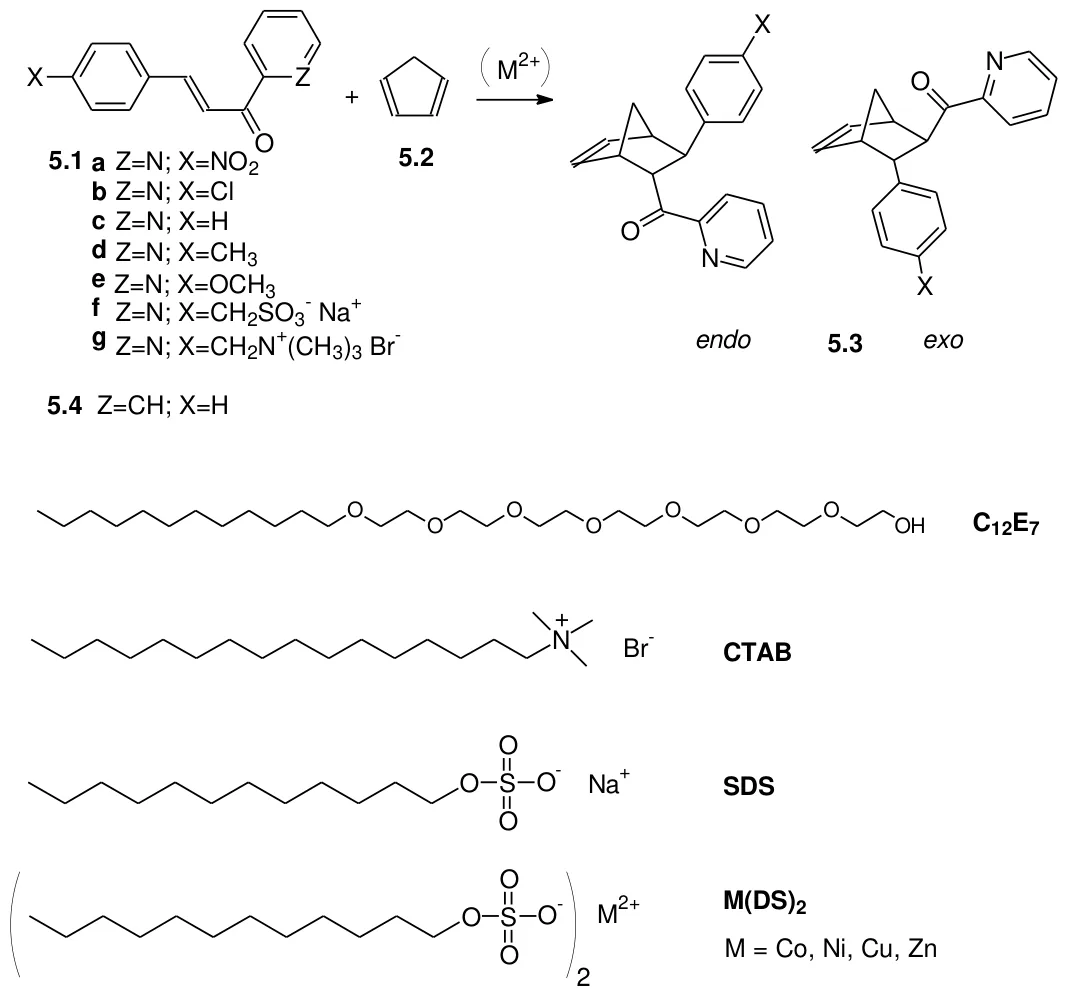
Scheme 5.1.
Table 5.1. Influence of micelles of CTAB, SDS and C12E7 on the apparent second-order rate constants (M−1s−1) for the Diels-Alder reaction of 5.1a, 5.1f and 5.1g with 5.2 at 25 °Ca.
| mediumb | 5.1a | 5.1f | 5.1g |
|---|---|---|---|
| water | 4.02·10−3 | 1.74·10−3 | 2.45·10−3 |
| SDS | 3.65·10−3 | 1.44·10−3 | 1.47·10−3 |
| CTAB | 3.61·10−3 | 2.83·10−4 | 2.01·10−3 |
| C12E7 | 3.35·10−3 | 1.62·10−3 | 2.05·10−3 |
a [5.1] ≈ 2·10−5 M; [5.2] = 2.0·10−3 M. b All solutions contain 1.0·10−4 M of EDTA in order to suppress catalysis by trace amounts of metal ions. The concentration of surfactant is 7.8 mM above the cmc of the particular compound under reaction conditions (see Appendix 5.1).
$$k_{app} = \frac{k_{obs}}{[\mathbf{5.2}]_t} \qquad (5.4)$$
For all entries the concentration of surfactant is 7.8 mM above the cmc of the particular compound. The values for the cmc have been determined under the particular reaction conditions, and were 3-14 % lower than the cmc’s of the pure surfactant (see Appendix 5.1). The rate constants have been obtained by following the decrease of the absorbance of 5.1 employing UV-vis spectroscopic techniques. This technique allows use of very low concentrations of 5.1 of about 2·10−5 M so that on average there will be not more than one dienophile molecule per micelle. The overall concentration of 5.2 is 2.0 mM, which ensures that, depending on the aggregation number of the surfactant, the average number of cyclopentadiene molecules per micelle varies between 1 and 358. Under these conditions, the effect of micelles on the rate of the Diels-Alder reaction is obviously small and invariably results in a slight inhibition of the reaction. The most significant effect occurs for anionic 5.1f in CTAB solution and for cationic 5.1g in SDS solution. These are the two combinations for which one would expect essentially complete binding of the dienophile to the micelle as a result of favourable electrostatic interactions in addition to the hydrophobic interactions. Apparently, reaction in the micellar environment is slower than reaction in the bulk aqueous phase, despite the anticipated local increased concentrations of the reactants in the micellar pseudophase. Note that also in the case where electrostatic interactions inhibit binding of the dienophile to the micelle, i.e. 5.1f in SDS and 5.1g in CTAB solution, a retardation of the reaction is observed. In these cases the dienophile will most likely reside mainly in the aqueous phase. The retardation will result from a decrease in the concentration of 5.2 in this phase due to its partial solubilisation by the micelles.
In order to interpret the data in Table 5.1 in a quantitative fashion, we analysed the kinetics in terms of the pseudophase model (Figure 5.2). For the limiting cases of essentially complete binding of the dienophile to the micelle (5.1f in SDS and 5.1g in CTAB solution) the following expression can be derived (see Appendix 5.2):
$$\frac{1}{k_{app}} = \frac{[\mathbf{5.2}]_t}{k_{obs}} = \frac{V_{mol,S}}{k_m}[\mathrm{S}] + \frac{V_w}{P_{\mathbf{5.2}} \cdot V_t \cdot k_m} - \frac{\mathit{cmc} \cdot V_{mol,S}}{k_m} \qquad (5.5)$$
Herein [5.2]t is the total number of moles of 5.2 present in the reaction mixture, divided by the total reaction volume Vt ; kobs is the observed pseudo-first-order rate constant; Vmol,S is an estimate of the molar volume of micellised surfactant S; km and kw are the second-order rate constants in the aqueous phase and in the micellar pseudophase or in the micellar pseudophase and in the aqueous phase (in the editors’ view), respectively (see Figure 5.2); Vw is the volume of the aqueous phase and P5.2 is the partition coefficient of 5.2 over the micellar pseudophase and water, expressed as a ratio of concentrations. From the dependence of [5.2]t/kobs on the concentration of surfactant, P2 or P5.2 (in the editors’ view) and km can be obtained. We used estimates for the molar volume of micellised CTAB59 and SDS60 of 0.25 M−1 and 0.37 M−1, respectively, and assumed Vw/Vt = 1, which is reasonable in view of the low concentrations of surfactant used.
Figure 5.3 shows the dependence of the apparent second-order rate constants (kobs/[5.2]t) on the concentration of surfactant for the Diels-Alder reactions of 5.1f and 5.1g with 5.2. The results of the analysis in terms of the pseudophase model are shown in the inset in Figure 5.3 and in the first two entries in Table 5.2.
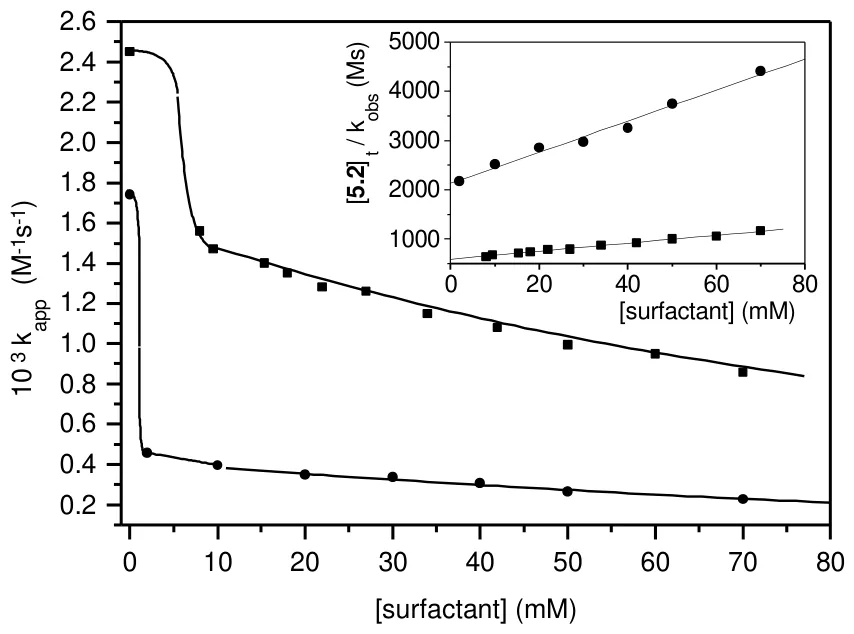
Figure 5.3. Plots of the apparent second-order rate constant, kapp (= kobs/[5.2]t) versus the concentration of surfactant for the Diels-Alder reaction of 5.1f with 5.2 in CTAB solution (●) and of 5.1g with 5.2 in SDS solution (■) at 25 °C. The inset shows the treatment of these data using Equation 5.5. From the slopes and the intercepts P5.2 and km were calculated (see Table 5.2).
Table 5.2. Analysis using the pseudophase model: partition coefficients for 5.2 over CTAB or SDS micelles and water and second-order rate constants for the Diels-Alder reaction of 5.1f and 5.1g with 5.2 in CTAB and SDS micelles at 25 °C.
| surfactant | dienophile | km (M−1s−1) (±10%) | P5.2 (±10%) | |
|---|---|---|---|---|
| 1 | CTAB | 5.1f | 5.9·10−6 | 68 |
| 2 | SDS | 5.1g | 3.1·10−5 | 61 |
| 3 | CTAB | 5.1g | – | 61 |
The reliability of these data depends critically on the validity of the assumptions made in the derivation of Equation 5.5 and on the assumptions underlying the pseudophase model. Also the unavoidable error in the estimation of the volume of the micellar pseudophase that can be regarded as the potential site of binding and reaction will affect the reliability of the results. The system under study offers the possibility of checking the validity of some of the assumptions made during the evaluation of the partition coefficient of 5.2. By studying the reaction of 5.1f and 5.1g with 5.2 in CTAB and SDS solutions, respectively, complete binding of the dienophile to the micelles was assumed. Alternatively, the reaction of 5.1g with 5.2 in CTAB solution can be studied, in which case the dienophile is assumed to reside exclusively in the aqueous phase. Figure 5.4 shows the dependence of the apparent rate constant of this process on the concentration of CTAB. The kinetics of this process can be described using Equation 5.6 as derived in Appendix 5.3.
$$\frac{1}{k_{app}} = \frac{[\mathbf{5.2}]_t}{k_{obs}} = \frac{P_{\mathbf{5.2}} \cdot V_{mol,S}}{k_w}[\mathrm{S}] - \frac{P_{\mathbf{5.2}} \cdot \mathit{cmc} \cdot V_{mol,S}}{k_w} + \frac{V_w}{k_w \cdot V_t} \qquad (5.6)$$
By plotting the reciprocal of the apparent rate constant versus the concentration of CTAB a straight line is obtained. From the slope of this line and the rate constant in the absence of surfactant (kw, see Table 5.1) the partition coefficient of 5.2 has been calculated. The result, shown in the third entry in Table 5.2, is in good agreement with the result obtained by the complementary monitoring of the reaction in the micellar phase (entry 1). Apparently treatment according to the pseudophase model as well as the assumption of complete (in case 5.1f) and negligible (in case of 5.1g) binding to CTAB micelles is justified. Note that the validity of the estimate of the volume of the micellar pseudophase cannot be judged from these data, since possible errors in this volume will influence the value for the partition coefficient to exactly the same extent in both treatments.
Table 5.2 shows that the partition coefficients of 5.2 over SDS or CTAB micelles and water are similar. Comparison of the rate constants in the micellar pseudophase calculated using the pseudophase model with those in water (Table 5.1) demonstrates a remarkable retardation induced by the micelles. This retardation would suggest that the Diels-Alder reaction experiences a rather apolar medium. This suggestion is in contrast with previous reports that indicate water-like environments for other bimolecular micelle-catalysed reactions. Moreover, 5.1f and 5.1g contain ionic moieties, which makes it unlikely that they will be dragged deeply into the micelle.
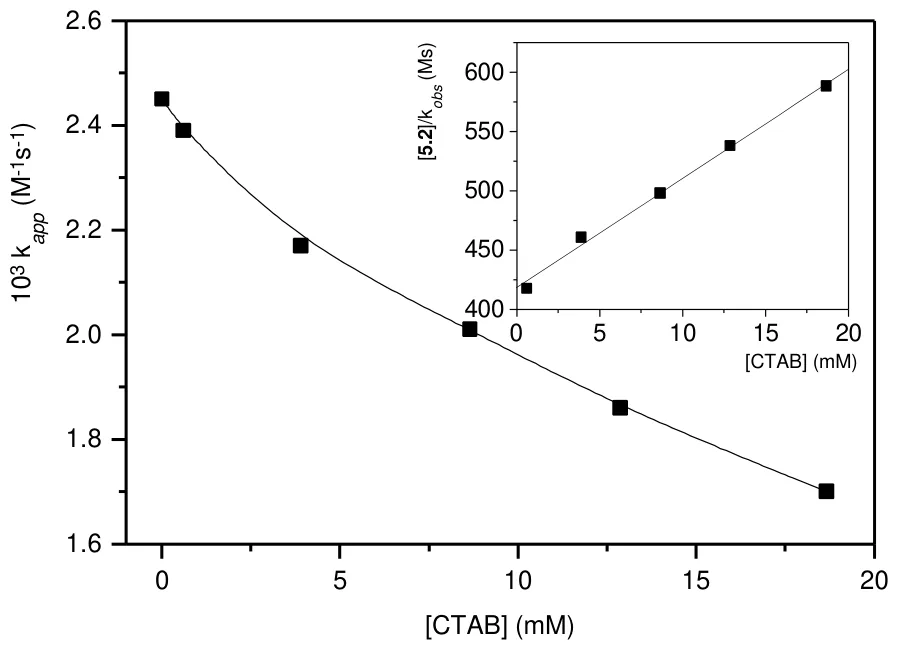
Figure 5.4. Plot of the apparent second-order rate constant, kapp (= kobs/[5.2]t) versus the concentration of surfactant for the Diels-Alder reaction of 5.1g with 5.2 in CTAB solution at 25 °C. The inset shows the treatment of these data using Equation 5.6. From slope and intercept P5.2 can be calculated (see Table 5.2).
The Diels-Alder reaction provides us with a tool to probe its local reaction environment in the form of its endo-exo product ratio. Actually, even a solvent polarity parameter has been based on endo-exo ratios of Diels-Alder reactions of methyl acrylate with cyclopentadiene61 (see also section 1.2.3). Analogously we have determined the endo-exo ratio of the reaction between 5.1c and 5.2 in surfactant solution and in a number of different organic and aqueous media. These ratios are obtained from the 1H-NMR of the product mixtures, as has been described in Chapter 2. The results are summarised in Table 5.3, and clearly point towards a water-like environment for the Diels-Alder reaction in the presence of micelles, which is in line with literature observations.
This conclusion seems in conflict with the outcome of the analysis using the pseudophase model. Here we do not speculate on the origins of this discrepancy. Instead, an extensive discussion is provided in Section 5.2.3.
Table 5.3. Endo-exo product ratios of the Diels-Alder reaction of 5.1c with 5.2 in surfactant solution compared to water and organic solvents.
| medium | %endo - %exo |
|---|---|
| 100 mM CTAB | 86 - 14 |
| 100 mM SDS | 88 - 12 |
| 100 mM C12E7 | 85 - 15 |
| water | 84 - 16 |
| ethanol | 77 - 23 |
| acetonitrile | 67 - 33 |
5.2.2 Effects of micelles in the presence of Lewis acids
Inspired by the many hydrolytically-active metallo enzymes encountered in nature, extensive studies have been performed on so-called metallo micelles. These investigations usually focus on mixed micelles of a common surfactant together with a special chelating surfactant that exhibits a high affinity for transition-metal ions. These aggregates can have remarkable catalytic effects on the hydrolysis of activated carboxylic acid esters, phosphate esters and amides. In these reactions the exact role of the metal ion is not clear and may vary from one system to another. However, there are strong indications that the major function of the metal ion is the coordination of hydroxide anion in the Stern region of the micelle where it is in the proximity of the micelle-bound substrate. The first report of catalysis of a hydrolysis reaction by metallomicelles stems from 197862. In the years that followed, particularly the groups of Scrimtin or Scrimin (in the editors’ view) and Tonellato63 as well as the groups of Tagaki64, Engbersen65 and other authors66 studied these systems in detail. Apart from catalysing hydrolysis reactions, metallomicelles have also a potential in the complexation of oxygen67 and in photochemical processes68. Surprisingly, examples of Lewis-acid catalysis by these systems were without precedent at the time we initiated the research described in this chapter.
With the aim of catalysis of the Diels-Alder reaction of 5.1 with 5.2 by metallo micelles, preliminary studies have been performed using the surfactants 5.5a-c69 and 5.6 (Scheme 5.2) . Unfortunately, the limited solubility of these surfactants in the pH region that allows Lewis-acid catalysis of the Diels-Alder reaction forced us to look for alternative surfactants.
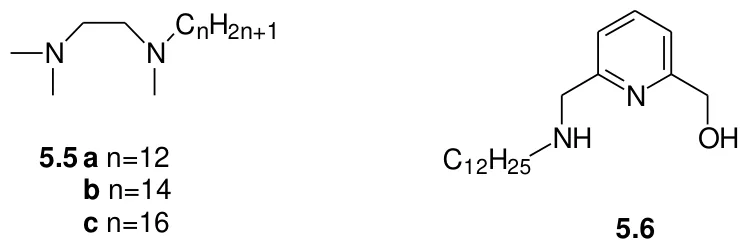
Scheme 5.2.
Table 5.4. Apparent second-order rate constants (kapp) for the reaction of 5.1c with 5.2 in micellar solutionsa of Co(DS)2, Ni(DS)2, Cu(DS)2 and Zn(DS)2 compared to the second-order rate constants (k2) of the reaction of the corresponding metal ion - 5.1c complexesb and the equilibrium constant (Ka) for the complexation of 5.1c to the corresponding metal ionb.
| metal ion | kapp (M−1s−1) | k2 (M−1s−1) | kapp / k2 | Ka (M−1) |
|---|---|---|---|---|
| Co2+ | 0.137 | 8.40·10−2 | 1.6 | 1.17·102 |
| Ni2+ | 0.152 | 9.46·10−2 | 1.6 | 6.86·102 |
| Cu2+ | 5.95 | 2.56 | 2.3 | 1.16·103 |
| Zn2+ | 0.176 | 1.18·10−1 | 1.5 | 7.28·101 |
a The concentration of surfactant was 3.89 mM above the cmc in each case. b Values taken from Chapter 2 and determined at a constant ionic strength of 2.0 M using KNO3 as background electrolyte.
It turned out that the dodecylsulfate surfactants Co(DS)2, Ni(DS)2, Cu(DS)2 and Zn(DS)2 containing catalytically active counterions are extremely potent catalysts for the Diels-Alder reaction between 5.1 and 5.2 (see Scheme 5.1). The physical properties of these micelles have been described in the literature70 and a small number of catalytic studies have been reported. The influence of Cu(DS)2 micelles on the kinetics of quenching of a photoexcited species has been investigated71. Interestingly, Kobayashi recently employed surfactants in scandium triflate catalysed aldol reactions57. Robinson et al. have demonstrated that the interaction between metal ions and ligand at the surface of dodecylsulfate micelles can be extremely efficient72.
In this section the catalytic efficiency of Co(DS)2, Ni(DS)2, Cu(DS)2 and Zn(DS)2 micelles as well as the effect of CTAB and C12E7 on the copper-ion catalysed Diels-Alder reaction between 5.1 and 5.2 is described.
The pronounced shift of the UV-vis absorption spectrum of 5.1 upon coordination to a metal ion allows investigation of the complexation behaviour of these compounds in the presence of micelles. Figure 5.5 shows the spectra of nonionic 5.1c as well as the anionic and cationic counterparts 5.1f and 5.1g in water and in surfactant solutions containing copper(II) ions. The shifts of the absorption bands primarily reflect the extent of coordination of the dienophile to the copper ions. Binding to micelles has a negligible influence on the spectrum. Addition of C12E7 to a 10 mM Cu(NO3)2 solution containing the ionic dienophiles 5.1f and 5.1g leaves the absorption spectra essentially unchanged. Apparently 5.1f and 5.1g have little affinity for C12E7 micelles. A similar picture emerges for cationic 5.1g, which resides preferentially in the aqueous phase rather than binding to cationic CTAB micelles. In contrast, 5.1c has some affinity for C12E7 and CTAB micelles, resulting in a decreased coordination to the copper ions in the presence of these surfactants. Interestingly, all three dienophiles, even anionic 5.1f, bind more efficiently to the copper ions in the presence of Cu(DS)2 micelles than in a solution containing twice the overall concentration of copper ions. This result is in line with literature observations that revealed an increased interaction between transition-metal ions and chelating organic molecules in the presence of anionic surfactants72.
Further evidence for an increased efficiency of complexation in the presence of micellar aggregates with bivalent metal counterions is presented in Table 5.4. The apparent rate constants of the reaction of 5.1c with 5.2 in the presence of micelles of Co(DS)2, Ni(DS)2, Cu(DS)2 and Zn(DS)2 are compared to the rate constants for the corresponding bivalent metal ion - dienophile complexes in the absence of micelles. The latter data are not dependent on the efficiency of the formation of the catalyst - dienophile complex whereas possible incomplete binding will certainly be reflected in the former. The good correlations between kapp and k2 and the absence of a correlation between kapp and Ka demonstrate that the equilibrium constant of binding of the dienophile to the metal ion has little influence on the apparent rate constant of the Diels-Alder reaction in the micellar solutions. Hence, we contend that binding of the dienophile to the metal ions is essentially complete in the presence of M(DS)2 micelles.
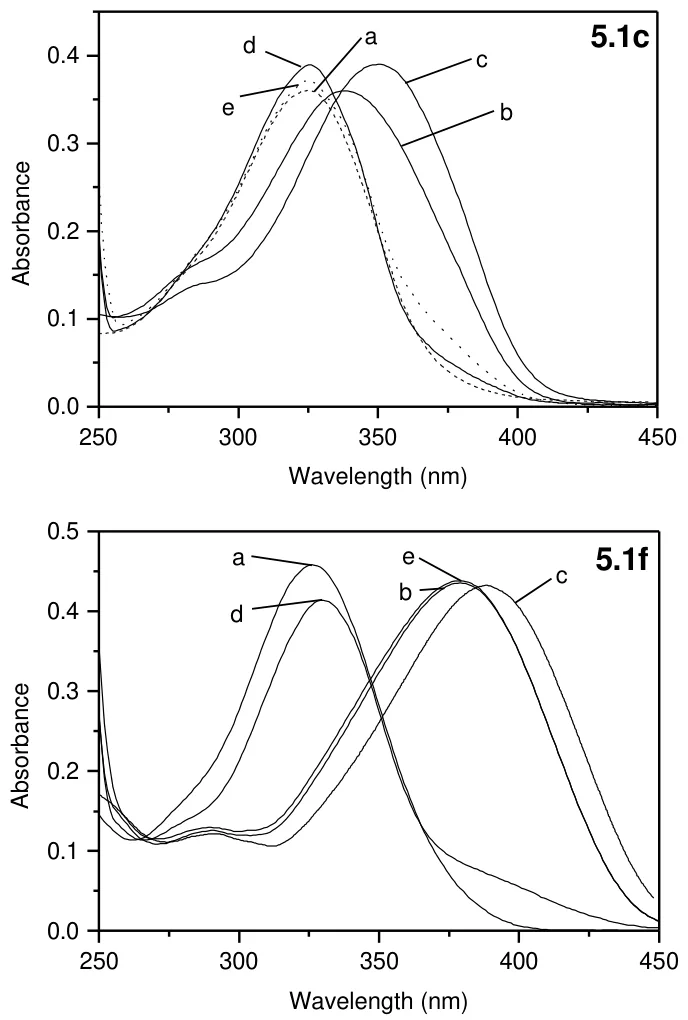
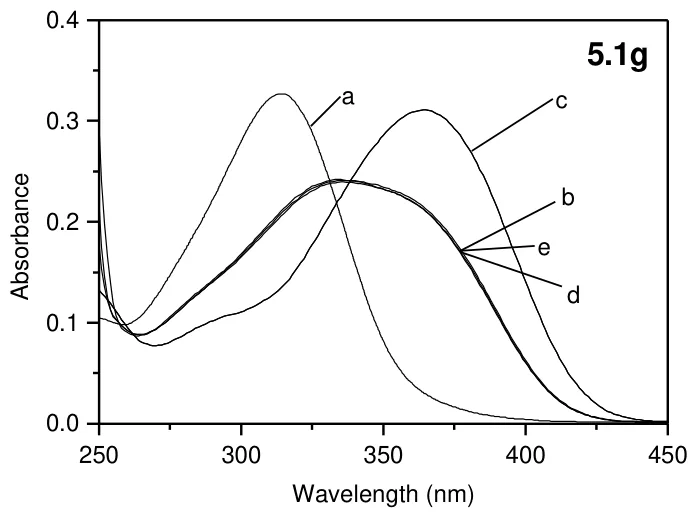
Figure 5.5. UV spectra of 5.1c, 5.1f and 5.1g in water (a) compared to those in solutions containing: 10 mM Cu(NO3)2 (b); 5 mM Cu(DS)2 (c); 10 mM CTAB plus 10 mM Cu(NO3)2 (d) and 10 mM C12E7 plus 10 mM Cu(NO3)2 (e).
The enhanced binding predicts a catalytic potential for these solutions and prompted us to investigate the influence of the different types of micelles on the rate of the copper-ion catalysed reaction. Table 5.5 summarises the results, which are in perfect agreement with the conclusions drawn from the complexation studies.
In all surfactant solutions 5.2 can be expected to prefer the nonpolar micellar environment over the aqueous phase. Consequently, those surfactant/dienophile combinations where the dienophile resides primarily in the aqueous phase show inhibition. This is the case for 5.1f and 5.1g in C12E7 solution and for 5.1g in CTAB solution. On the other hand, when diene, dienophile and copper ion simultaneously bind to the micelle, as is the case for Cu(DS)2 solutions with all three dienophiles, efficient micellar catalysis is observed. An intermediate situation exists for 5.1c in CTAB or C12E7 solutions and particularly for 5.1f in CTAB solution. Now the dienophile binds to the micelle and is shielded from the copper ions that apparently prefer the aqueous phase. This results in an overall retardation, despite the possible locally increased concentration of 5.2 in the micelle.
Clearly, very promising results were obtained for the Cu(DS)2 solutions. We have analysed this system in some detail. Figure 5.6 shows the dependence of the rate of the Diels-Alder reaction of 5.1c, 5.1f, and 5.1g with 5.2 on the concentration of Cu(DS)2. For all three dienophiles the apparent second-order rate constant for their reaction with 5.2 increases dramatically when the concentration of Cu(DS)2 reaches the cmc (1.11 mM). Beyond the cmc, the dependence of the rate on the surfactant concentration is subject to two counteractive influences. At higher surfactant concentration, a larger fraction of dienophile will be bound to the micelle, where it reacts faster than in bulk water, resulting in an increase in the rate of the reaction. At the same time, the concentration of diene in the micellar pseudophase will drop with increasing surfactant concentration, due to the increase in the volume of the micellar pseudophase. At higher surfactant concentrations the dienophile will be nearly completely bound to the micelles and the dilution effect will dominate the behaviour. Together, these two effects result in the appearance of a rate maximum at a specific concentration of surfactant that is typical for micelle-catalysed bimolecular reactions. The position of the maximum depends primarily on the micelle-water partition coefficient of the dienophile. For instance, cationic 5.1g reacts fastest almost at the cmc, because of its very high affinity for the anionic Cu(DS)2 micelles. Formation of a complex with a copper cation only further stimulates this behaviour. As a result, 5.1g is almost completely bound to the micelles, even at low concentrations of Cu(DS)2. By contrast, the reaction of 5.1f still benefits from an increasing surfactant concentration at 10 mM of Cu(DS)2. In fact, it is surprising that the reaction of this anionic compound is catalysed at all by an anionic surfactant. Probably it is the copper complex of 5.1f, being overall cationic, that binds to the micelle. Not surprisingly, the neutral substrate 5.1c shows intermediate behaviour.
Table 5.5. Influence of micelles of Cu(DS)2, CTAB and C12E7 on the apparent second-order rate constants (M−1s−1) for the copper(II) catalysed Diels-Alder reaction of 5.1c, 5.1f and 5.1g with 5.2 at 25 °Ca.
| medium | 5.1c | 5.1f | 5.1g |
|---|---|---|---|
| 10 mM Cu(NO3)2 | 1.11 | 1.38 | 2.13 |
| 5 mM Cu(DS)2 | 5.95 | 5.50 | 15.3 |
| CTABb + 10 mM Cu(NO3)2 | 0.401 | 0.150 | 1.84 |
| C12E7b + 10 mM Cu(NO3)2 | 0.630 | 1.08 | 1.71 |
a [1 or 5.1 (in the editors’ view)] ≈ 2·10−5 M; [2 or 5.2 (in the editors’ view)] = 1.0·10−3 M. b The concentration of surfactant is 3.89 mM above the cmc. c The concentration of surfactant is 7.8 mM above the cmc of the particular compound under the reaction conditions.
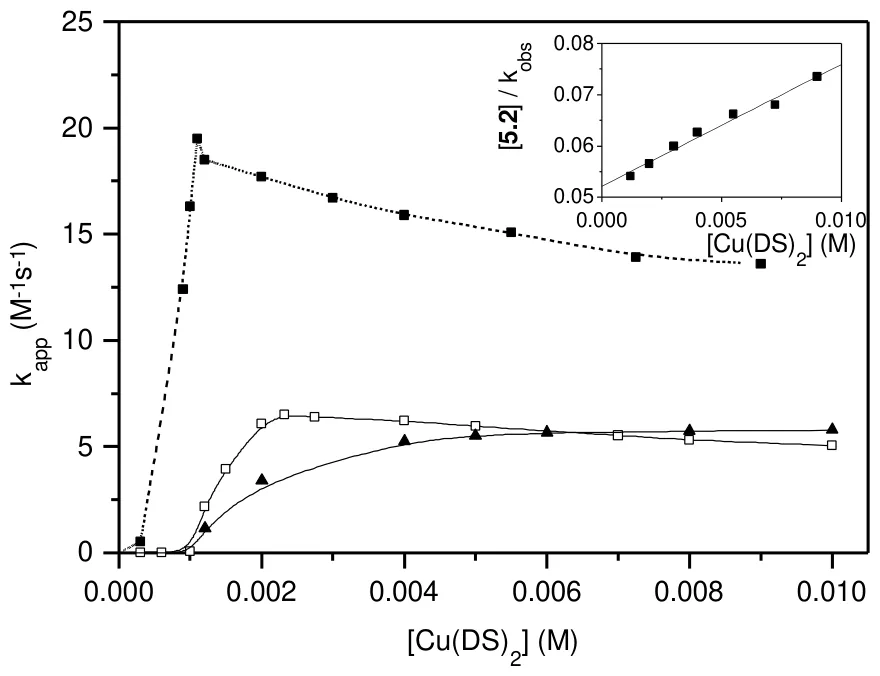
Figure 5.6. Plots of the apparent second-order rate constant (kapp) versus the concentration of Cu(DS)2 for the Diels-Alder reaction of 5.1c (□), 5.1f (▲) and 5.1g (■) with 5.2 at 25 °C. The inset shows the treatment of the data for the reaction of 5.1g according to the pseudophase model.
Interestingly, at very low concentrations of micellised Cu(DS)2, the rate of the reaction of 5.1a with 5.2 was observed to be zero-order in 5.1a and only depending on the concentration of Cu(DS)2 and 5.2. This is akin to the turn-over and saturation kinetics exhibited by enzymes. The acceleration relative to the reaction in organic media in the absence of catalyst, also approaches enzyme-like magnitudes: compared to the process in acetonitrile (Chapter 2), Cu(DS)2 micelles accelerate the Diels-Alder reaction between 5.1a and 5.2 by a factor of 1.8·106. This extremely high catalytic efficiency shows how a combination of a beneficial aqueous solvent effect, Lewis-acid catalysis and micellar catalysis can lead to tremendous accelerations.
The essentially complete binding of 5.1g to the Cu(DS)2 micelles allows treatment of the kinetic data of Figure 5.6 using the pseudophase model. Since it is very likely that 5.1g binds in the Stern region (vide infra), complete binding to the copper ions can be assumed. Using Equation 5.5, the Cu(DS)2 -water distribution coefficient of 5.2 is obtained as well as the second-order rate constant for reaction in the micellar pseudophase (see inset in Figure 5.6). Unfortunately no literature data exist for the molar volume of Cu(DS)2 that is required for the kinetic analysis. We have used an estimate of the molar volume of micellised Cu(DS)2 of 0.50 M−1, twice as large as the number that we have used previously for SDS73.
Calculations using this value afford a partition coefficient for 5.2 of 96 and a micellar second-order rate constant of 0.21 M−1s−1. This partition coefficient is higher than the corresponding values for SDS micelles and CTAB micelles given in Table 5.2. This trend is in agreement with literature data, that indicate that Cu(DS)2 micelles are able to solubilize 1.5 times as much benzene as SDS micelles70a. Most likely this enhanced solubilisation is a result of the higher counterion binding of Cu(DS)2 micelles (89% versus 60%, see Appendix 5.1), which reduces headgroup repulsion and allows a tighter packing of the headgroups resulting in decreased water penetration and an increased nonpolar character of the micellar interior as compared to SDS micelles.
Table 5.6. Hammett ρ-values for the copper(II)-catalysed Diels-Alder reaction of 5.1a-e with 5.2 in different media.
| medium | ρ |
|---|---|
| 10 mM Cu(DS)2 | 0.86 |
| 10 mM Cu(NO3)2 in acetonitrile | 0.96b |
| 10 mM Cu(NO3)2 in ethanol | 1.00b |
| 10 mM Cu(NO3)2 in watera | 0.82b |
a Ionic strength 2.00 M (KNO3). b Data taken from Chapter 2.
Comparison of the micellar second-order rate constant of 0.21 M−1s−1 with the rate constants for the reaction in acetonitrile (0.472 M−1s−1) and ethanol (0.309 M−1s−1), again points to a relatively apolar medium for the Diels-Alder reaction. This conclusion is hard to reconcile with the ionic character of two of the three reaction partners involved.
In order to obtain more insight into the local environment for the catalysed reaction, we investigated the influence of substituents on the rate of this process in micellar solution and compared this influence to the corresponding effect in different aqueous and organic solvents. Plots of the logarithms of the rate constants versus the Hammett ρ-value show good linear dependences for all media. The resulting ρ-values are shown in Table 5.6. The ρ-value in Cu(DS)2 solution resembles that in aqueous solution more than those in organic solvents.
It appears that the outcome of the analysis using the pseudophase model is not in agreement with experimental observations. Apparently, one (or more) of the assumptions of the pseudophase model is not valid for the system studied here. In particular, the treatment of the micellar pseudophase as a homogeneous “solution” might not be warranted. Therefore we contend that diene and dienophile, on average, reside in different parts of the micelle. Surely, this would impede the reaction. This arrangement would also explain the absence of a large catalytic effect in cases where diene and dienophile bind efficiently to the micelle. In order to check this hypothesis, we probed the binding sites of diene and dienophile using 1H-NMR techniques.
5.2.3 Average binding sites and their implications
NMR methods have been regularly employed in the study of micellar solutions74. The most frequently encountered technique to probe the binding location of aromatic compounds in micelles makes use of changes in the chemical shifts in the 1H-NMR spectrum of the surfactant induced by the ring current of the aromatic moiety of the solubilisate27a,34c,35a,75. In general, protons located above or below the plane of the aromatic ring are shielded and, hence, experience upfield shifts. Protons in plane with the aromatic ring, on the other hand, are deshielded and shift downfield. In the absence of any specific interactions or orientational constraints, the shielding effect of the aromatic ring of one compound on the proton chemical shifts of another is dominant and results in an upfield shift76. Note that any preference for a specific orientation is reflected in the magnitude of the ring-current induced shifts. Consequently, interpretation of shift data in terms of binding locations is somewhat hazardous.
Studies on a large number of aromatic compounds have revealed that for CTAB the largest shift occurs for the alkyl chain protons near the surfactant headgroup, whereas in SDS nearly all proton signals are shifted significantly75b-e. For SDS, the most pronounced shifts are observed for protons around the centre of the chain. This result has been interpreted in terms of deeper penetration of aromatic compounds into SDS micelles relative to CTAB micelles75b-e.
The aromatic shifts that are induced by 5.1c, 5.1f and 5.1g on the 1H-NMR spectrum of SDS, CTAB and Zn(DS)2 have been determined. Zn(DS)2 is used as a model system for Cu(DS)2, which is paramagnetic. The cmcs and counterion binding for Cu(DS)2 and Zn(DS)2 are similar and it has been demonstrated in Chapter 2 that Zn(II) ions are also capable of coordinating to 5.1, albeit somewhat less efficiently than copper ions. Figure 5.7 shows the results of the shift measurements. For comparison purposes also the data for chalcone (5.4) have been added. This compound has almost no tendency to coordinate to transition-metal ions in aqueous solutions. From Figure 5.7 a number of conclusions can be drawn. (1) The shifts induced by 5.1c on the NMR signals of SDS and CTAB show the characteristics usually observed for benzene derivatives. Comparison of the shifts induced by 5.1c on the proton resonances of CTAB with dodecyltrimethylammonium bromide (Figure 5.7j) demonstrates that the differences between SDS and CTAB with respect to the solubilisation of 5.1c are only partly due to a difference in chain length. There seems to be an intrinsic difference between the interaction of the sulfate and the ammonium headgroup with the aromatic solubilisate, in line with literature evidence for a specific cation - arene interaction (see Section 5.1.2). (2) Introduction of an ionic group in the dienophile (compare Figure 5.7e with 5.7h and 5.7f with 5.7i) causes this compound to reside on average closer to the headgroups of the surfactant. (3) Chelation of the dienophile to a zinc(II) ion has little effect on its location in the micelle (compare Figure 5.7a with 5.7d). (4) The presence of the pyridine nitrogen atom influences the binding location only to a minor extent (compare Figure 5.7b with 5.7e and 5.7c with 5.7f).
Figure 5.7k shows the shifts of the proton signals of C12E7 as induced by 5.1c. All parts of the surfactant experience an appreciable shift. The strongest shifts are observed near the interface between the alkyl chains and the ethyleneoxide part, suggesting that 5.1c prefers the interfacial region of the nonionic micelles.
Surprisingly, the shifts observed in the NMR spectrum of Zn(DS)2 as caused by 5.1g seem to point towards a relatively deep penetration of this compound into the micelle, which is extremely unlikely. 5.1g, when bound to Zn(DS)2 micelles, will coordinate to a Zn(II) ion. The resulting complex will now have three positive charges: two of the zinc ion at one end of the complex and one of the trimethylammonium group at the other end. It is hard to imagine that this very hydrophilic complex will penetrate into the micellar interior. Still the shifts indicate a short distance between the n-protons77 of the surfactant and the aromatic rings of 5.1g. The most likely explanation for this behaviour, is bending of the alkyl chain of the surfactant towards the aromatic parts of the dienophile. This demonstrates that an interpretation of shift data solely in terms of depth of penetration into the micelle is hazardous. The observed shifts of surfactant protons merely indicate a proximity of aromatic groups and, strictly, do not provide direct information about the location where this encounter occurs. Still, from the data in Figure 5.7 it may be concluded that, on average, the dienophile is not in the core of the micelle.
In a second attempt to obtain more insight into the binding location of the dienophile and now also the diene, we have made use of the influence of paramagnetic ions on the spin-lattice relaxation rates of species in their proximity. Close to these ions the spin-lattice relaxation rate is dramatically enhanced. This effect is highly distance-dependent as is expressed by Equation 5.7, describing the spin-lattice relaxation time in the absence of inner-sphere coordination78.
$$\frac{1}{T_1} = \frac{D}{d^6}\left(\frac{6\tau_s}{1 + \omega_I^2\tau_s^2} + \frac{14\tau_s}{1 + \omega_s^2\tau_s^2}\right) \qquad (5.7)$$
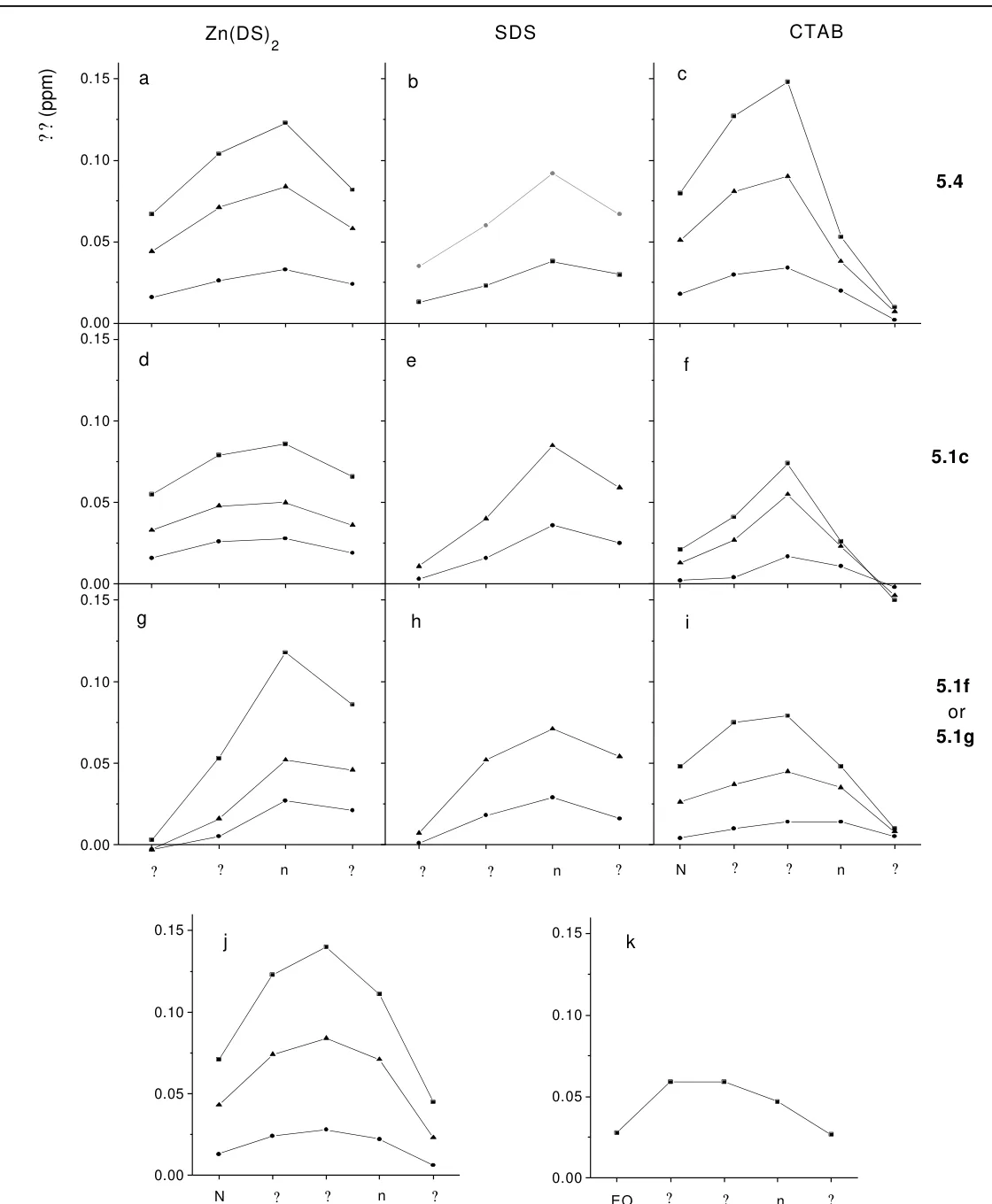
Figure 5.7. Aromatic solubilisate-induced changes in the chemical shifts (upfield) of the 1H-NMR signals of micellised surfactant. Figures a-f show the effect of 5.4 and 5.1c on the proton resonances of Zn(DS)2 (25 mM), SDS (50 mM) and CTAB (50 mM). Figure g and h show the corresponding effect of 5.1g on Zn(DS)2 (25 mM) and SDS (50 mM), respectively. Figure i depicts the effect of 5.1f on the CTAB (50 mM) resonances. Figure j shows the shifts induced by 5.1c on the DTAB (50 mM) resonances and Figure k the corresponding effect on C12E7 (50 mM). The concentrations of the solubilisate were 2.0 (●), 5.0 (▲) or 8 (■) mM. N stands for the protons at the three headgroup methyl moieties of CTAB, α and β for the methylene protons at the α and β positions relative to the headgroup. ω represents the terminal methyl group protons and n the protons between the β and ω positions.
Here T1 is the spin-lattice relaxation time due to the paramagnetic ion; d is the ion-nucleus distance; D is a constant related to the magnetic moments, ωI is the Larmor frequency of the observed nucleus and ωs is the Larmor frequency of the paramagnetic electron and τs its spin relaxation time.
Paramagnetic relaxation techniques have been employed in investigations of the hydrocarbon chain conformation of micellised surfactant78,79, in estimations of the viscosity of the micellar surface80 and of the counterion binding81 and in solubilisation studies42,75d,e,82. Generally, one can select the charge of the paramagnetic ion so that it will be a counterion to the micellar system under study, which ensures that it will be located primarily in the Stern region of the micelle. Consequently, compounds bound to the outer regions of the micelle will experience a much larger influence of these paramagnetic ions than compounds located in the interior of the micelle. The relaxation rate induced by the paramagnetic ion (rp) can be assessed by subtracting the observed relaxation rates in the absence of these ions from those obtained in the presence of the paramagnetic species. The exact magnitude of rp is strongly dependent upon the local concentration of the paramagnetic ions at the micelle. Consequently, normalisation of the rp values is required before comparisons between separately prepared solutions can be made. Hence, throughout this study the rp values will be expressed as a percentage of the rp value of the methylene group next to the surfactant headgroup.
We have used the paramagnetic relaxation technique to study the binding locations of 5.1c, 5.1f, 5.1g and 5.2 in CTAB, SDS and Zn(DS)2 solutions, employing [Cu(EDTA)]2−, Cu2+ (for 5.2) or Dy3+ (for 5.1) as paramagnetic species. Figure 5.8 shows the values of rp for 5.1c and 5.1f in CTAB solution relative to rp for the surfactant α-methylene protons. In order to provide a frame of reference, also the relative paramagnetic relaxation rates of the CTAB protons are depicted. The latter show a clear decrease upon going from the headgroup towards the end of the hydrocarbon chain. The values for both dienophiles are of a magnitude somewhere between those of the β77 and the n77 methylene protons of CTAB. Consequently, on average they are somewhat farther away from the paramagnetic ions than the β protons, but not as far as the n protons. Interestingly, the introduction of an ionic group (compare 5.1f with 5.1c) results in a modest decrease of the average distance to the paramagnetic ion. Presumably, two counteractive effects are operative. The presence of a charged group might well result in a strong shift of the average binding location towards the outer regions of the micelle, resulting in an increased influence of the paramagnetic ion on the rate of relaxation. On the other hand, the electrostatic repulsion between the charged substituent and the paramagnetic counterion will result in a decrease of the effect of this ion on the relaxation rate.
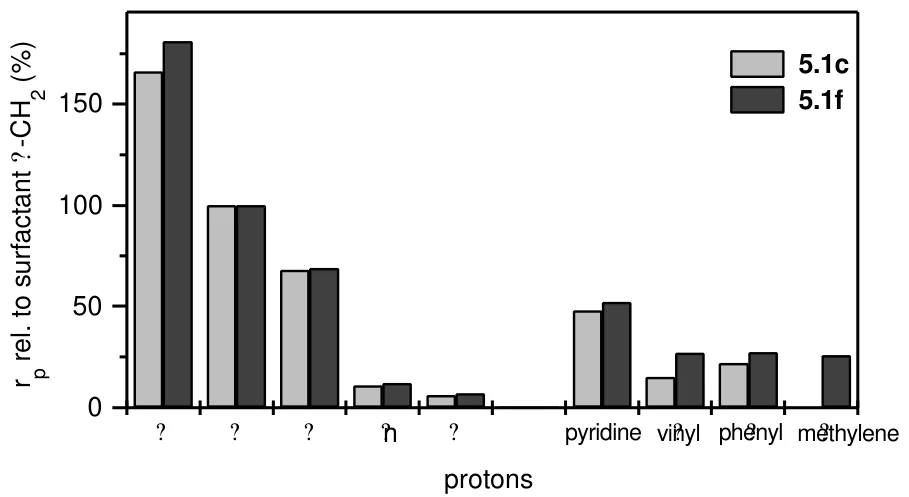
Figure 5.8. Paramagnetic ion-induced spin-lattice relaxation rates (rp) of the protons of 5.1c and 5.1f in CTAB solution and of CTAB in the presence of 5.1c or 5.1f, normalised to rp for the surfactant α-CH2. The solutions contained 50 mM of CTAB, 8 mM of 5.1c or 5.1f and 0 or 0.4 mM of [Cu(EDTA)]2−.
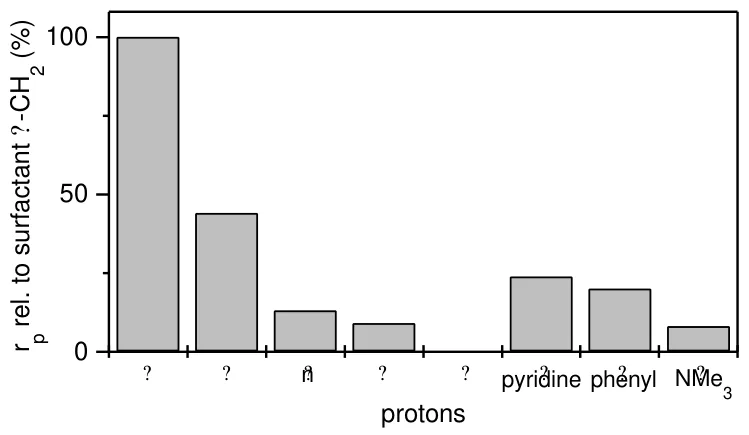
Figure 5.9. Paramagnetic ion-induced spin-lattice relaxation rates (rp) of the protons of 5.1g in Zn(DS)2 solution and of Zn(DS)2 in the presence of 5.1g, normalised to rp for the surfactant α-CH2. The solutions contained 25 mM of Zn(DS)2, 8 mM of 5.1g and 0 or 0.2 mM of DyCl3.
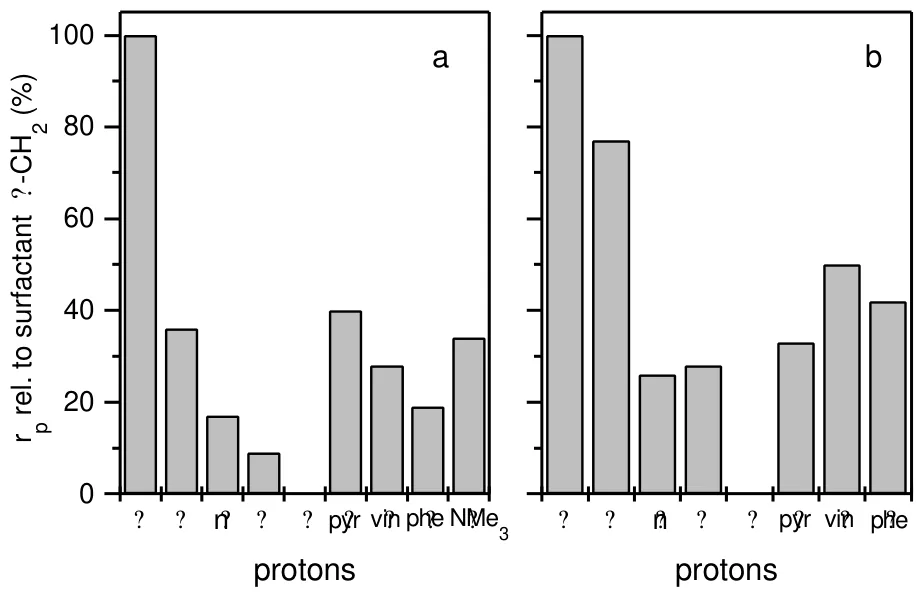
Figure 5.10. Paramagnetic ion induced spin-lattice relaxation rates (rp) of the protons of 5.1c (a) and 5.1g (b) in SDS solution and of SDS in the presence of 5.1c or 5.1g, normalised to rp for the surfactant α-CH2. The solutions contained 50 mM of SDS, 8 mM of 5.1c or 5.1g and 0 or 0.2 mM of DyCl3 and 0 or 0.6 mM of cyclen.
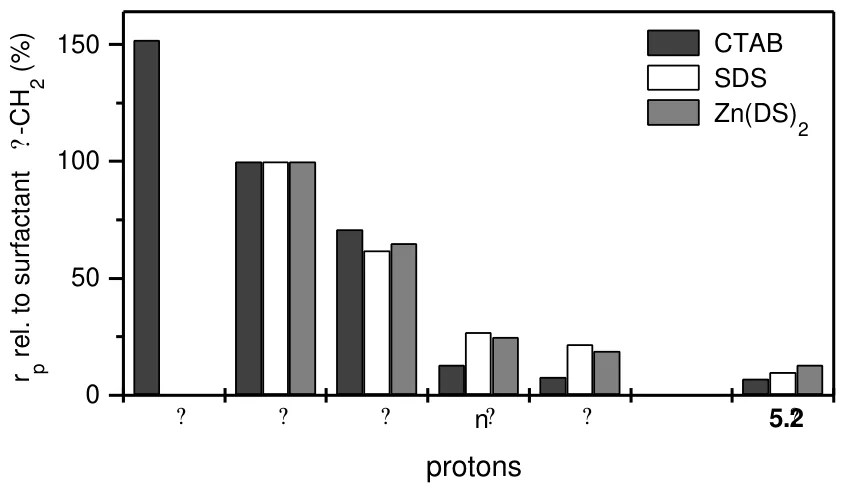
Figure 5.11. Paramagnetic ion induced spin-lattice relaxation rates (rp) of the protons of 5.2 in CTAB, SDS or Zn(DS)2 solution and of these surfactants in the presence of 5.2, normalised to rp for the surfactant α-CH2. The solutions contained 25 mM of Zn(DS)2, 50 mM of CTAB or SDS, 3 mM of 5.2 and 0 or 0.4 mM of [Cu(EDTA)]2− CTAB solutions and 0 or 0.2 mM of Cu(NO3)2 for SDS and Zn(DS)2 solutions.
Analogous studies on dienophiles 5.1c and 5.1g in SDS and Zn(DS)2 lead to essentially the same conclusions. Figure 5.9 shows the relaxation data for 5.1g in Zn(DS)2 solutions. The corresponding data for 5.1c could not be measured due to solubility problems. Analogously, Figure 5.10 shows the relaxation data of 5.1c and 5.1g in SDS solutions.
In conclusion, for all dienophile / surfactant combinations the average distance between the Diels-Alder reagent and the paramagnetic ion is intermediate between the corresponding distances of the β and the n protons of the surfactant. Hence, the dienophile resides in the outer regions of the micelle. The effects of paramagnetic ions on the relaxation rate of diene 5.2 in CTAB, SDS and Zn(DS)2 solutions are illustrated in Figure 5.11. In this case the relative value of rp is invariably smaller than the corresponding effect on the ω77 methyl protons of the surfactant. This trend clearly demonstrates that diene 5.2, in contrast to the dienophiles, is located in the interior of the micelle and spends little time at the surface.
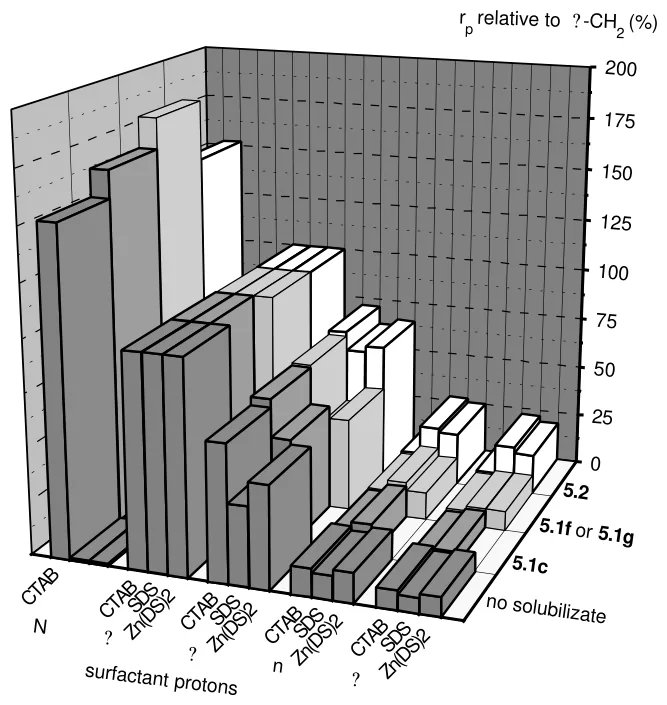
Figure 5.12. Effect of the solubilisate on the paramagnetic ion-induced spin-lattice relaxation rates (rp) of the protons of CTAB, SDS or Zn(DS)2, normalised to rp of the surfactant α-CH2. The solutions contained 25 mM of Zn(DS)2, 50 mM of CTAB or SDS, 3 mM of 5.2 and 8 mM of 5.1c, 5.1f or 5.1g and 0 or 0.4 mM of [Cu(EDTA)]2− for CTAB solutions and 0 or 0.2 mM of Cu(NO3)2 for SDS and Zn(DS)2 solutions.
Careful analysis of the influence of the character of the solubilisate on the relaxation data of the surfactant led to another interesting observation. Figure 5.12 summarises these data. The frontal row of bars represents the relative rp values of the different surfactant protons in the absence of any solubilisate. The second and third row show the corresponding effects in the presence of 8 mM of 5.1c, 5.1f or 5.1g. The relative paramagnetic relaxation rates are similar to those of the pure surfactant. Hence, the introduction of these compounds into a micellar solution does not lead to a significant perturbation of the alkyl chains of the micelle. Yet, when 5.2 is added to solutions of SDS and Zn(DS)2, significant increases in the relative paramagnetic relaxation rates of the β, the n and the ω protons are observed. Apparently, the presence of a nonpolar solute in the interior of these micelles forces the alkyl chains of the individual surfactant molecules towards the surface. Curiously, for CTAB this effect is completely absent. This might be a result of the increased length of the alkyl chain of this surfactant compared to the two anionics, ensuring an increased tolerance towards incorporation of a solubilisate. In the literature, studies comparing the solubilisation in SDS micelles with that in CTAB solutions, likewise, suggest a significantly more pronounced perturbation of the structure of SDS micelles75c.
In summary, the NMR studies indicate different average binding locations for diene and dienophile. The diene resides preferentially in the interior of the micelles, which is not surprising in view of its pronounced nonpolar character. The dienophiles, on the other hand, are located more towards the surface of the aggregates. This behaviour has important implications for the rationalisation of the kinetic data. Clearly, when the Diels-Alder reagents are not homogeneously distributed over the micellar pseudophase, analysis according to the pseudophase model will provide erroneous results. Using this model, a second-order rate constant in the micellar pseudophase will be obtained that is too low. However, the partition coefficients that are produced using this model are still useful, as long as one bears in mind that they represent the ratio of the average concentrations of solubilisate in the micellar phase and in the aqueous phase.
Another consequence of the above analysis is, that the surprising inefficiency of micellar aggregates to catalyse Diels-Alder reactions can now be rationalised. Obviously, micelles are able to bind diene and dienophile efficiently but in different parts of the micelle. The reactions seems or reaction seems (in the editors’ view) to take place at the surface of the micelle in a rather aqueous environment, where the concentration of diene is low.
The only micellar system that shows efficient catalytic behaviour is Cu(DS)2. These micelles concentrate dienophile and copper ion at their surface, thereby promoting complexation of these compounds. Since Cu(DS)2 aggregates are also capable of binding 5.2 better than CTAB and SDS micelles, the local concentration of 5.2 at the surface of the Cu(DS)2 micelles is apparently high enough to allow a modest rate enhancement compared to the situation of fully complexed dienophile in pure water. Note that at concentrations slightly higher than the cmc of Cu(DS)2, very efficient coordination of the dienophile to copper can take place, which, in the absence of the surfactant, requires copper ion concentrations which are orders of magnitude higher.
In retrospect, this study has demonstrated the limitations of two commonly accepted methods of analysing solubilisation and micellar catalysis, respectively. It has become clear that solubilisate ring-current induced shifts need to be interpreted with due caution. These data indicate a proximity of solubilisate and parts of the surfactant and, strictly, do not specify the location within the micelle where the encounter takes place. Also the use of the pseudophase model for bimolecular reactions requires precaution. When distribution of the reactants over the micelle is not comparable, erroneous results are likely to be obtained.