Sijbren Otto - Catalysis of Diels-Alder Reactions in Water
On the basis of the studies described in the preceding chapters, we anticipated that chelation is a requirement for efficient Lewis-acid catalysis. This notion was confirmed by an investigation of the coordination behaviour of dienophiles 4.11 and 4.12 (Scheme 4.4). In contrast to 4.10, these compounds failed to reveal a significant shift in the UV absorption band maxima in the presence of concentrations up to one molar of copper(II)nitrate in water. Also the rate of the reaction of these dienophiles with cyclopentadiene was not significantly increased upon addition of copper(II)nitrate or ytterbium(III)triflate.

Scheme 4.4.
Consequently, in initial attempts to extend the scope, we aimed to identify catalysis of Diels-Alder reactions of other bidentate dienophiles in water. This task turned out to be more difficult than expected. Scheme 4.5 provides a collection of potentially chelating dienophiles that all failed to exhibit Lewis-acid catalysed Diels-Alder reactions. Previous studies by Wijnen9 demonstrated that dienophile 4.13 has little affinity for the Lewis acids tested so far. Likewise, 4.14 and 4.15, which have the potential of forming six-membered ring chelates with metal ions, refrain from doing so in water (Scheme 4.5). Apparently, chelation in aqueous solution is rather demanding and a search for extending the scope of the reaction in this direction is not particularly promising. Moreover, ideally, one would want common monodentate dienophiles to undergo Lewis-acid catalysed Diels-Alder reactions in aqueous solution.
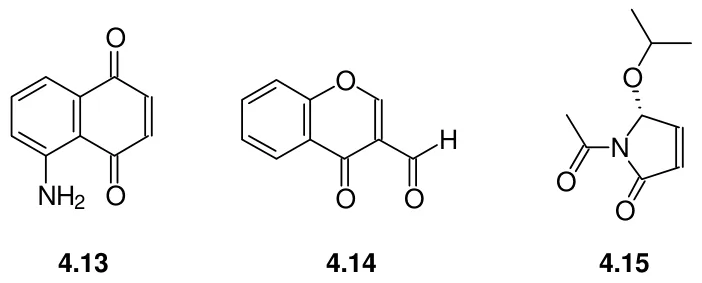
Scheme 4.5.
This goal might well be achieved by introducing an auxiliary that aids the coordination to the catalyst. After completion of the Diels-Alder reaction and removal of the auxiliary the desired adduct is obtained. This approach is summarised in Scheme 4.6. Some examples in which a temporary additional coordination site has been introduced to aid a catalytic reaction have been reported in the literature and are described in Section 4.2.1. Section 4.2.2 relates an attempt to use (2-pyridyl)hydrazone as coordinating auxiliary for the Lewis-acid catalysed Diels-Alder reaction, whereas Section 4.2.3 describes the introduction of an auxiliary via a Mannich reaction.
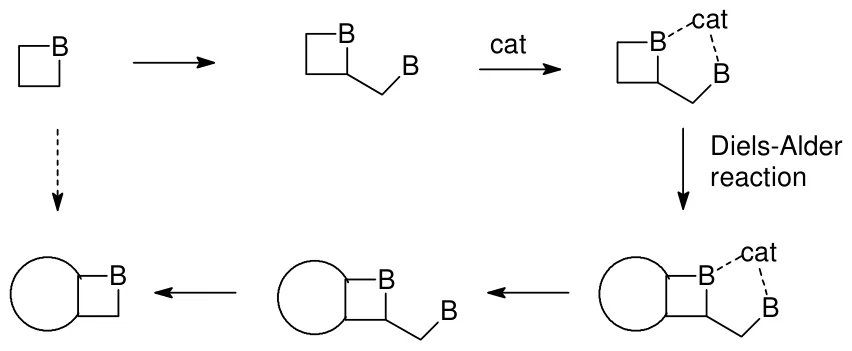
Scheme 4.6. Schematic representation of the use of a coordinating auxiliary for Lewis-acid catalysis of a Diels-Alder reaction.
4.2.1 Literature examples of auxiliary-aided catalysis
Some examples of the use of a temporary additional site of coordination have been published. Burk and Feaster10 have transformed a series of ketones into hydrazones capable of chelating to a rhodium catalyst (Scheme 4.7). Upon coordination, enantioselective hydrogenation of the hydrazone is feasible, yielding N-aroylhydrazines in up to 97% ee. Finally, the hydrazines were transformed into amines by treatment with SmI2.
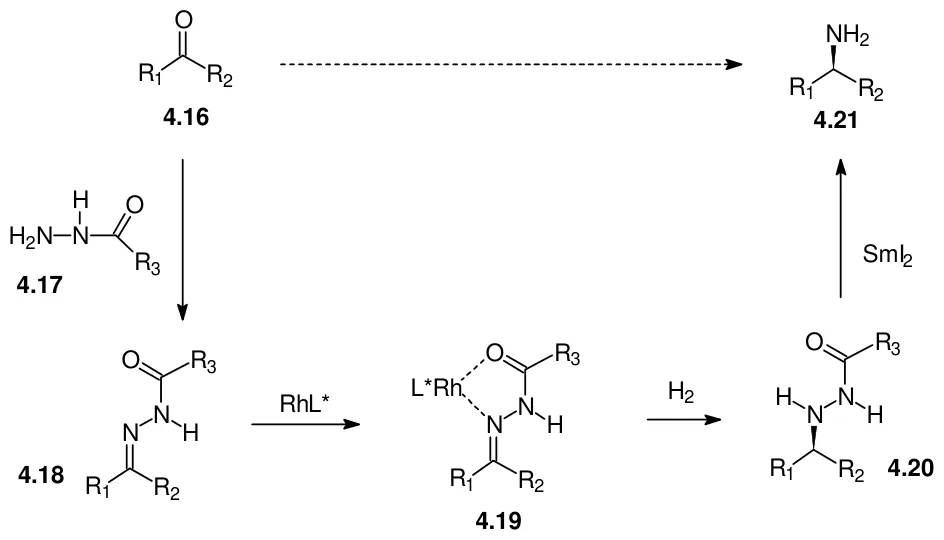
Scheme 4.7.
Czarnik et al.11 studied the auxiliary-assisted copper(II)-ion catalysed hydrolysis of acrylate esters and amides (Scheme 4.8). A chelating diamine was allowed to react in a Michael addition with either an acrylate ester or amine or amide (in the editors’ view). This reaction led to product 4.24 capable of chelating a copper(II) ion, which serves as a catalyst for the hydrolysis of the ester or amide functionality. Finally the auxiliary was removed by heating an aqueous solution of 4.26 in the presence of copper(II)triflate. Interestingly, no metal-ion promotion of the hydrolysis reactions was observed when monodentate butylmethylamine was used as auxiliary instead of bidentate N-benzyl-N’,N’-dimethylethylenediamine (4.23).
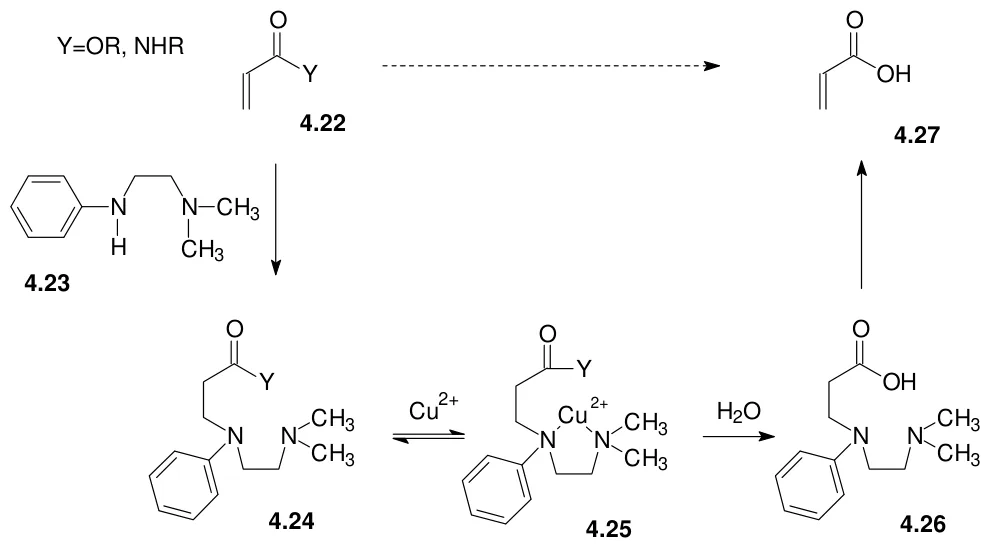
Scheme 4.8.
Westwell and Williams12 suggested an elegant approach using only a catalytic amount of auxiliary in a Lewis-acid catalysed Diels-Alder reaction (Scheme 4.9). These authors anticipated that in situ transesterification could convert a non-chelating into a chelating dienophile. Coordination to the Lewis-acid catalyst and reaction with the diene, followed by another in situ transesterification step would ultimately result in the desired Diels-Alder adduct 4.34. Unfortunately, it turned out that the cycle depicted in Scheme 4.9, although elegant, is rather inefficient. Westwell and Williams12 performed competition experiments to assess the difference in reactivity between 4.28 and 4.30. In the presence of Lewis-acid catalysts, this difference was invariably smaller than a factor of 10, whereas Lewis-acid catalysis has the potential of inducing accelerations in the order of 103 - 105. Apparently, catalysis via formation of a seven-membered chelate ring is not particularly efficient.
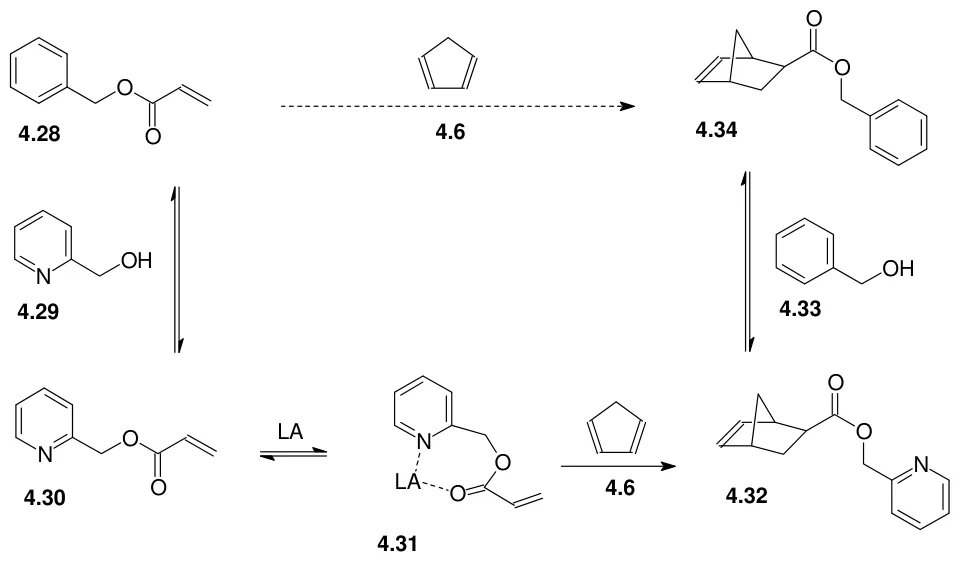
Scheme 4.9.
4.2.2 (2-Pyridyl)hydrazine as coordinating auxiliary
Inspired by the work of Burk and Feaster10, we attempted to use (2-pyridyl)hydrazine (4.36) as a coordinating auxiliary (Scheme 4.10). Hydrazines generally react efficiently with ketones and aldehydes. Hence, if satisfactory activation of the dienophile can be achieved through coordination of a Lewis acid to the (2-pyridyl)hydrazone moiety in water, Lewis-acid catalysis of a large class of ketone- and aldehyde-activated dienophiles is anticipated. Subsequent conversion of the hydrazone group into an amine functionality has been reported previously by Burk and Feaster10.
Reaction of cinnamaldehyde 4.35 with (2-pyridyl)hydrazine (4.36) yielded the desired hydrazone 4.37. As anticipated, this compound coordinates readily to copper(II)nitrate in aqueous solution as indicated by a shift of the UV absorption band by 17 nm. Unfortunately, subsequent reaction with cyclopentadiene is extremely slow. Apparently, the hydrazone moiety is less capable of transmitting the electron withdrawing influence of the coordinated Lewis-acid than a carbonyl functionality. Hence, (2-pyridyl)hydrazone is not a suitable auxiliary.
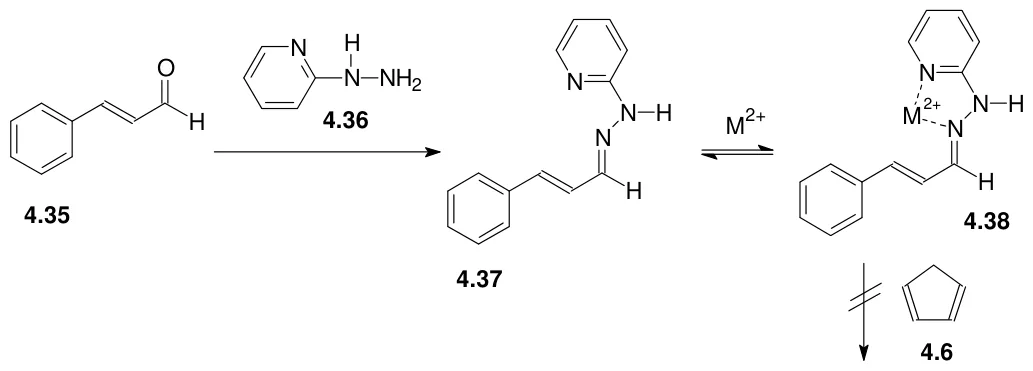
Scheme 4.10.
4.2.3. A coordinating auxiliary via a Mannich reaction
In a second attempt to extend the scope of Lewis-acid catalysis of Diels-Alder reactions in water, we have used the Mannich reaction13 to convert a ketone-activated monodentate dienophile into a potentially chelating β-amino ketone. The Mannich reaction seemed ideally suited for the purpose of introducing a second coordination site on a temporary basis. This reaction adds a strongly Lewis-basic amino functionality on a position β to the ketone. Moreover, the Mannich reaction is usually a reversible process, which should allow removal of the auxiliary after the reaction. Furthermore, the reaction is compatible with the use of an aqueous medium. Some Mannich reactions have even been reported to benefit from the use of water14. Finally, Lewis-acid catalysis of Mannich-type reactions in mixtures of organic solvents and water has been reported15. Hence, if both addition of the auxiliary and the subsequent Diels-Alder reaction benefit from Lewis-acid catalysis, the possibility arises of merging these steps into a one-pot procedure.
We chose benzylideneacetone (4.39, Scheme 4.11) as a model dienophile for our studies. The uncatalysed Diels-Alder reaction of this compound with cyclopentadiene is slow, justifying a catalytic approach. Reaction of 4.39 with paraformaldehyde and dimethylamine under acidic conditions in an aqueous ethanol solution, following a literature procedure16, produced the HCl salt of 4.42 (Scheme 4.11). The dienophile was liberated in situ by adding one equivalent of base.
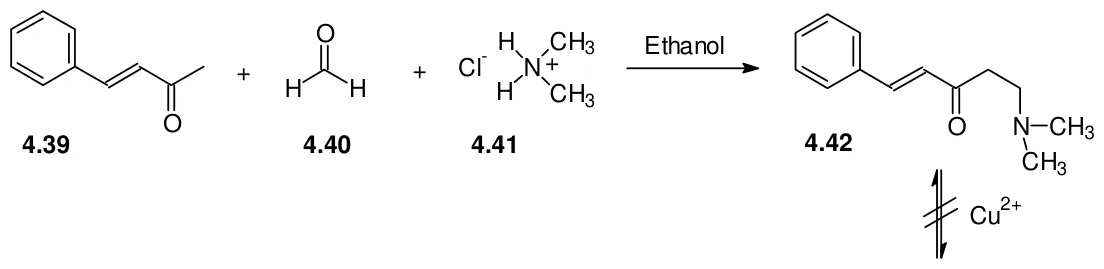
Scheme 4.11.
Unfortunately, addition of copper(II)nitrate to a solution of 4.42 in water did not result in the formation of a significant amount of complex, judging from the unchanged UV-vis absorption spectrum. Also after addition of Yb(OTf)3 or Eu(NO3)3 no indications for coordination were observed. Apparently, formation of a six-membered chelate ring containing an amine and a ketone functionality is not feasible for these metal ions. Note that 4.13 features a similar arrangement and in aqueous solutions, likewise, does not coordinate significantly to all the Lewis acids that have been tested.
As anticipated from the complexation experiments, reaction of 4.42 with cyclopentadiene in the presence of copper(II)nitrate or ytterbium triflate was extremely slow and comparable to the rate of the reaction in the absence of Lewis-acid catalyst. Apparently, Lewis-acid catalysis of Diels-Alder reactions of β-amino ketone dienophiles is not practicable.
In another attempt to achieve efficient coordination, we have used a strongly chelating diamine (4.43) in the Mannich reaction with 4.39 (Scheme 4.12). The reaction was performed in aqueous ethanol, producing 4.44·2HCl in 64% yield.
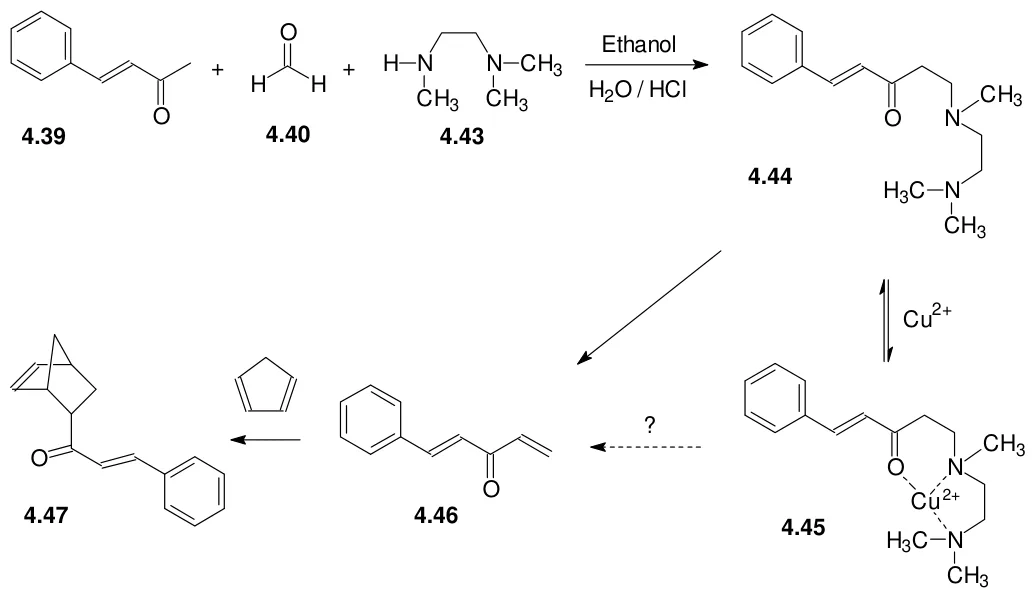
Scheme 4.12.
After in situ neutralisation, the complexation behaviour of 4.44 was studied using UV-vis spectroscopy. The absorption maximum of this compound shifted from 294 nm in pure water to 310 nm in a 10 mM solution of copper(II)nitrate in water. Apparently, 4.44, in contrast to 4.42, does coordinate to copper(II)nitrate in water.
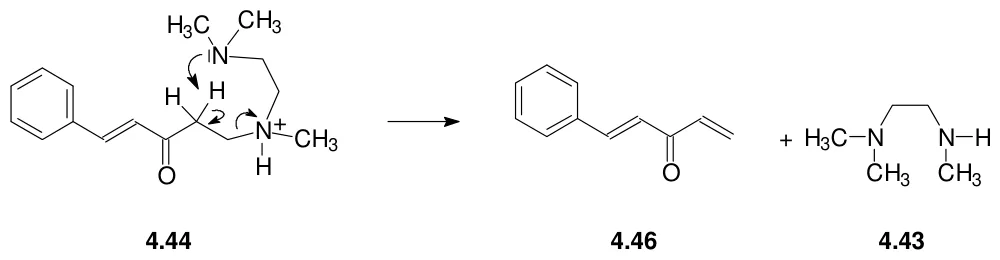
Unfortunately, 4.44 did not react with cyclopentadiene in the way that was desired. Instead, another reaction occurred, ultimately leading to an unexpected Diels-Alder adduct 4.47 that could be isolated in 68 % yield. Most likely, an intramolecular base-catalysed elimination reaction occurs, producing ketone 4.46 containing a highly reactive terminal vinyl group (Scheme 4.13). This double bond reacts rapidly with cyclopentadiene to give Diels-Alder adduct 4.47. Most likely no Lewis-acid catalysis is operative in this process.
Scheme 4.13.
Note that for 4.42, in which no intramolecular base catalysis is possible, the elimination side reaction is not observed. This result supports the mechanism suggested in Scheme 4.13. Moreover, at pH 2, where both amine groups of 4.44 are protonated, UV-vis measurements indicate that the elimination reaction is significantly retarded as compared to neutral conditions, where protonation is less extensive. Interestingly, addition of copper(II)nitrate also suppresses the elimination reaction to a significant extent. Unfortunately, elimination is still faster than the Diels-Alder reaction on the internal double bond of 4.44.
Clearly, the use of diamine 4.43 as a coordinating auxiliary is not successful. However, we anticipated that, if the basicity of the tertiary amine group of the diamine could be reduced, the elimination reaction will be less efficient. We envisaged that replacement of the tertiary amine group in 4.43 by a pyridine ring might well solve the problem.
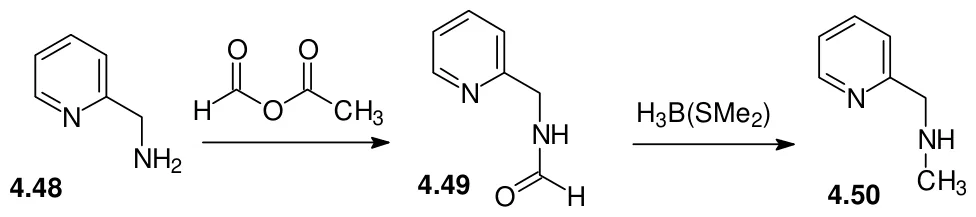
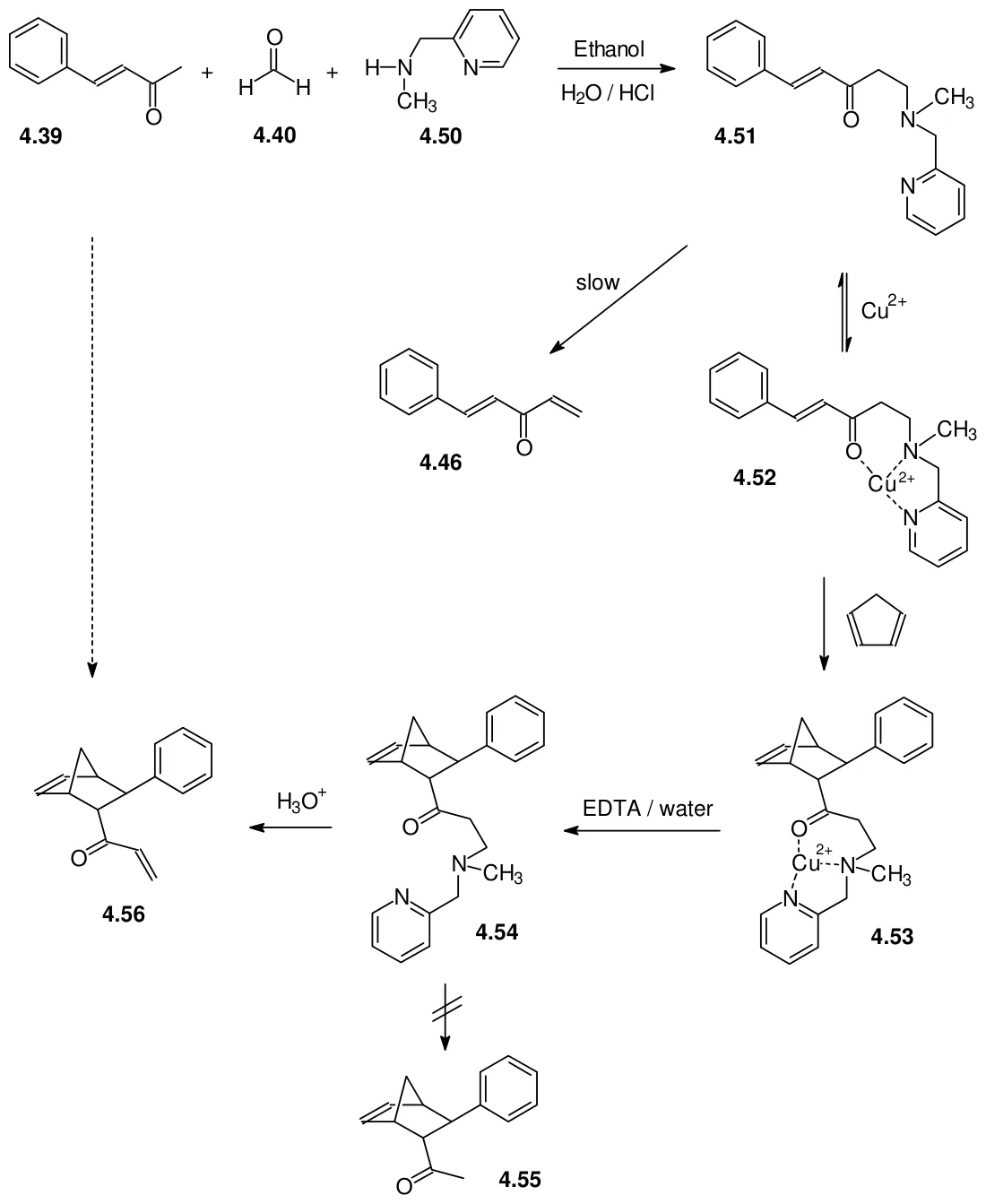
The desired pyridylamine was obtained in 69 % overall yield by monomethylation of 2-(aminomethyl)pyridine following a literature procedure17 (Scheme 4.14). First amine 4.48 was converted into formamide 4.49, through reaction with the in situ prepared mixed anhydride of acetic acid and formic acid. Reduction of 4.49 with borane dimethyl sulfide complex produced diamine 4.50. This compound could be used successfully in the Mannich reaction with 4.39, affording crude 4.51 in 92 % yield (Scheme 4.15). Analogous to 4.44, 4.51 also coordinates to copper(II) in water, as indicated by a shift of the UV-absorption maximum from 296 nm to 308 nm.
Scheme 4.14.
Most importantly, analysis using UV-spectroscopy also demonstrated that, as anticipated, the elimination reaction of 4.51 is less efficient than that of 4.44. Again, addition of copper(II)nitrate significantly suppresses this reaction.
Fortunately, in the presence of excess copper(II)nitrate, the elimination reaction is an order of magnitude slower than the desired Diels-Alder reaction with cyclopentadiene, so that upon addition of an excess of cyclopentadiene and copper(II)nitrate, 4.51 is converted smoothly into copper complex 4.53. Removal of the copper ions by treatment with an aqueous EDTA solution afforded in 71% yield crude Diels-Alder adduct 4.54. Catalysis of the Diels-Alder reaction by nickel(II)nitrate is also possible, although it is less efficient than catalysis by copper(II)nitrate. In contrast, Sc(OTf)3 did not promote this reaction significantly.
Finally, in the last step, the chelating auxiliary had to be removed. Ideally, one would like to convert 4.54 into ketone 4.55 via a retro Mannich reaction. Unfortunately, repeated attempts to accomplish this failed. These attempts included refluxing in aqueous ethanol under acidic and basic conditions and refluxing in a 1:1 acetone - water mixture in the presence of excess paraformaldehyde under acidic conditions, in order to trap any liberated diamine. These procedures were repeated under neutral conditions in the presence of copper(II)nitrate, but without success.
Scheme 4.15.
Apparently, 4.54 is extremely reluctant to undergo a retro Mannich reaction. Riviere18 demonstrated that this behaviour is not unusual for β-amino ketones. From the study of a large number of Mannich adducts, Riviere concludes that the retro Mannich reaction requires an aromatic group next to the carbonyl functionality. Clearly, 4.54 lacks this arrangement.
Fortunately, under moderately acidic conditions, in the presence of acetone and paraformaldehyde, 4.54 undergoes an elimination reaction similar to that described in Scheme 4.13, producing α,β-unsaturated ketone 4.56 in 59 % yield. Note that the highly reactive terminal double bond of this compound can be readily employed for other transformations.
The overall yield, if the intermediates are not purified, amounts to 24 %.
In summary, we have demonstrated that it is possible to extend the scope of Lewis-acid catalysis of Diels-Alder reactions in water, by employing a chelating auxiliary. We envisage that analogues of 4.39 capable of undergoing a Mannich reaction with 4.50 can be treated with reactive dienes in the presence of a Lewis-acid catalyst in water.