Sijbren Otto - Catalysis of Diels-Alder Reactions in Water
For a long time water was not a popular solvent for the Diels-Alder reaction. Before 1980 its use had been reported only incidentally. Diels and Alder themselves performed the reaction between furan and maleic acid in an aqueous medium in 1931143, an experiment which was repeated by Woodward and Baer in 1948144. These authors noticed a change in endo-exo selectivity when comparing the reaction in water with ether. Also in two patents the Diels-Alder reaction is mentioned in connection with water145. In 1973 Eggelte, de Koning and Huisman studied the reaction of maleic acid with furan in several solvents146. These authors noticed, for the first time, a beneficial effect of water on the Diels-Alder reaction. Still, it was not until the work of Breslow that it became common knowledge that water was a unique medium for Diels-Alder reactions87a.
1.4.1 The effect of water on the rate of Diels-Alder reactions
The extreme influence water can exert on the Diels-Alder reaction was rediscovered by Breslow in 1980, much by coincidence87a. While studying the effect of β-cyclodextrin on the rate of a Diels-Alder reaction in water, accidentally, the addition of the cyclodextrin was omitted, but still rate constants were observed that were one to two orders of magnitude larger than those obtained in organic solvents. The investigations that followed this remarkable observation showed that the acceleration of Diels-Alder reactions by water is a general phenomenon. Table 1.2 contains a selection from the multitude of Diels-Alder reactions in aqueous media that have been studied. Note that the rate enhancements induced by water can amount up to a factor 12,800 compared to organic solvents (entry 1 in Table 1.2).
Breslow immediately grasped the significance of his observation. He interpreted this discovery in terms of a hydrophobic effect: “Since in the Diels-Alder reaction … the transition state … brings together two nonpolar groups, one might expect that in water this reaction could be accelerated by hydrophobic interactions”87a.
Breslow supported this suggestion by demonstrating that the cycloaddition can be further accelerated by adding “anti chaotropic” salts such as lithium chloride, whereas “chaotropic” salts such as guanidium or guanidinium (in the editors’ view) chloride led to a retardation87a,c,147. On the basis of these experiments Breslow excluded all other possible explanations for the special effect of water on the Diels-Alder reaction148.
Still numerous alternative explanations have been offered. Grieco, studying compounds of obvious amphiphilic character, suggested that micellar catalysis might underlie the high efficiency of his reactions in aqueous solution compared to organic solvents149. For many of the reactions that have been studied by the Grieco group, this might well be correct149,150. This suggestion inspired some authors to claim aggregation phenomena as general explanations for the aqueous acceleration of Diels-Alder reactions87b,151. Also Breslow, through the occasional use of terms such as “hydrophobic packing”87c,147,152 and “aggregation”148 seems to suggest that hydrophobic interactions induce pre-association of the reactants. Although it is likely that the lifetime of encounter complexes of nonpolar molecules in water exceeds that in organic solvents, this pre-association is definitely not extensive enough to be held responsible for the observed rate effects. This conclusion follows from vapour pressure measurements which indicate that cyclopentadiene at concentrations up to 40 mM follows Raoult’s law. Hence, on average this compound is distributed homogeneously throughout the aqueous solution56. Also kinetic measurements on the intramolecular Diels-Alder reaction of 1.4 (entry 2 in Table 1.2) support this idea. In this reaction diene and dienophile are already associated and still water is capable of accelerating this process by a factor of 153 compared to reaction in n-hexane56.
Alternatively, authors have repeatedly invoked the internal pressure of water as an explanation of the rate enhancements of Diels-Alder reactions in this solvent69,153. They were probably inspired by the well known large effects of the external pressure26b,c on rates of cycloadditions. However, the internal pressure of water is very low61 and offers no valid explanation for its effect on the Diels-Alder reaction. The internal pressure is defined as the energy required to bring about an infinitesimal change in the volume of the solvents at constant temperature: $p_i = (\partial E / \partial V)_T$154. Due to the open and relatively flexible hydrogen-bond network of water, a small change in volume of this solvent does not require much energy. A related, but much more applicable solvent parameter is the cohesive energy density (ced). This quantity is a measure of the energy required for evaporation of the solvent per unit volume: $\mathrm{ced} = (\Delta H_{vap} - RT) / V_M$154. In contrast to the internal pressure, the ced of water is extremely high, due to the large number of hydrogen bonds per unit volume. When describing dissolution processes, the ced of the solvent is much more relevant than its internal pressure, since the creation of a cavity to accommodate the solute normally leads to the rupture of solvent-solvent interactions (related to the enthalpy of evaporation) and not to some infinitesimal change of solvent-solvent distances. The ced essentially quantifies solvophobicity, and as such, it has been successfully used by Gajewski in a multiparameter equation describing the solvent effect on a Diels-Alder reaction where one of the solvents was water67. The importance of the ced (alongside the hydrogen-bond donating capacity) in this study underlines the importance of hydrophobic interactions in rationalising the effect of water on Diels-Alder reactions. Blokzijl introduced the “enforced hydrophobic interactions” to describe the activation of Diels-Alder reactions in water. The term “enforced” is used to stress the fact that the association of the nonpolar reagents is driven by the reaction and only enhanced by water155.
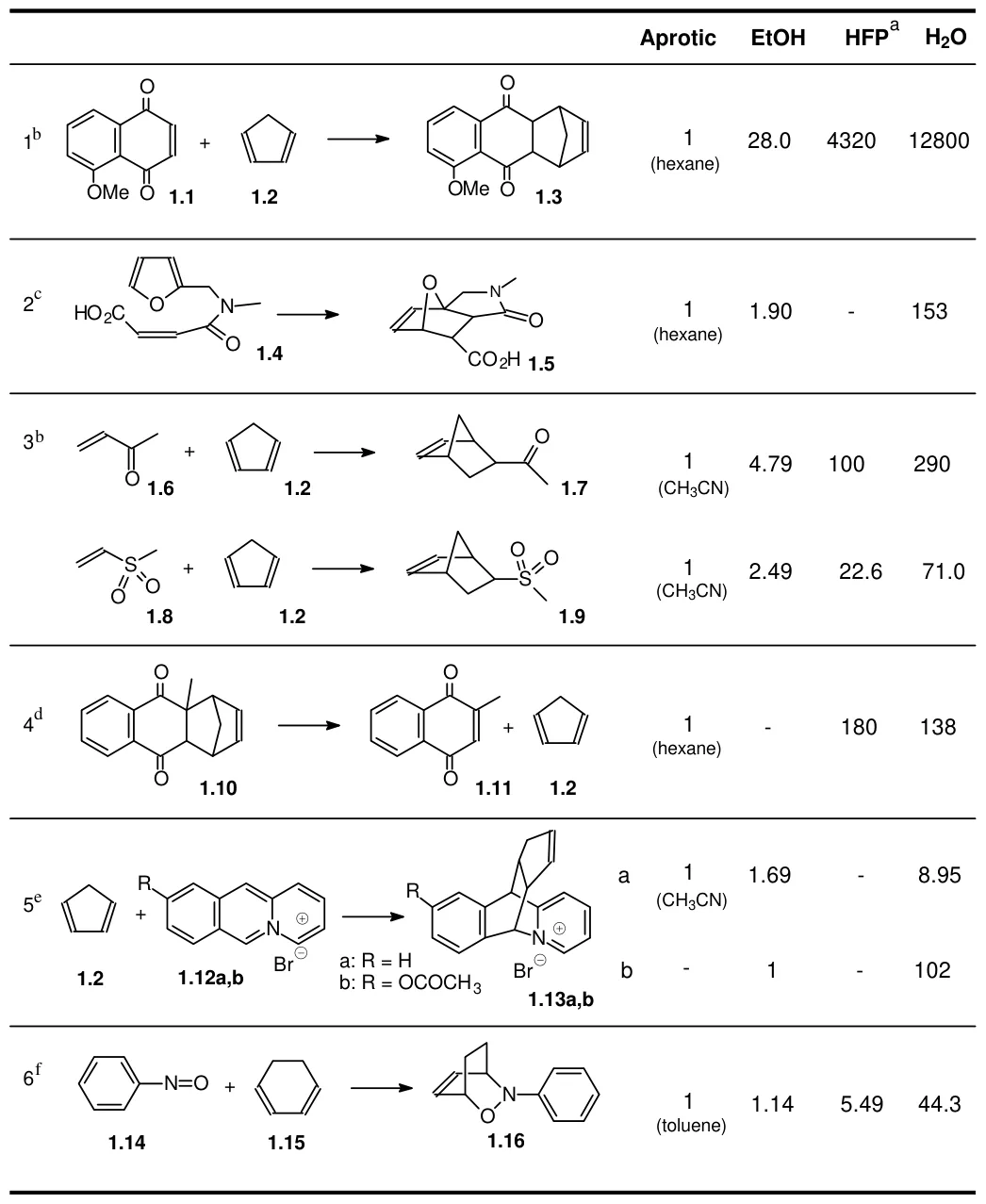
Table 1.2. Relative rate constants of some selected Diels-Alder reactions in water compared to organic solvents of different hydrogen bond donor capacities.
a 1,1,1,3,3,3-hexafluoropropanol b Taken from ref. 157 and 166b c Taken from ref. 56 d Taken from ref. 158 and 166c e Taken from ref. 159 and 166c f Taken from ref. 160 and 166c
The importance of hydrophobic interactions in the aqueous acceleration is further demonstrated by a qualitative study described by Jenner on the effect of pressure on Diels-Alder reactions in water and a number of organic solvents156. Invariably, the reactions in water were less accelerated by pressure than those in organic solvents, which is in line with the notion that pressure diminishes hydrophobic interactions.
Studies of solvent effects on type A Diels-Alder reactions by a large number of authors, as described in Section 1.2.3a, revealed that reactivity was primarily determined by two solvent parameters: the hydrogen-bond donating capacity and the solvophobicity. This pattern strongly suggests that in water, a hydrogen bond donating solvent par excellence, the Diels-Alder benefits not only from hydrophobic interactions but also from hydrogen-bonding interactions. The small size of water molecules allows efficient interaction with hydrogen-bond acceptors by forming more hydrogen bonds than protic organic solvents50. This suggestion is supported by detailed kinetic studies on a number of carefully selected Diels-Alder reactions. In entry 3 of Table 1.2 the reactions of cyclopentadiene with a carbonyl- (1.6) and a sulfonyl- (1.8) activated dienophile are compared. Due to the insulating effect of the sulfur atom in 1.8, the reactivity of this compound is much less affected by hydrogen bonding than the reactivity of 1.6157. This decreased sensitivity of 1.8 to hydrogen bonding shows up in a much less pronounced water-induced acceleration as compared to 1.6157. Further proof for the importance of hydrogen-bonding interactions came from the work of Wijnen, who showed that water also accelerated the retro Diels-Alder reaction (entry 4)158. Retro Diels-Alder reactions are characterised by much smaller activation volumes than the bimolecular reaction. Hence, it was assumed that hydrophobic interactions are of little influence in this process. Nevertheless impressive rate enhancements have been observed, which have been ascribed to hydrogen bonding interactions. The large rate constant in the strongly hydrogen-bond donating solvent 1,1,1,3,3,3-hexafluoropropanol (HFP) strongly supports this view158. In another approach, van der Wel and Wijnen selected a Diels-Alder reaction where the reactants lack hydrogen-bond accepting sites (entry 5)159. The acceleration of the reaction of 1.12a with 1.2 by water was modest, as was expected in the absence of activation by hydrogen bonds. Moreover, upon introduction of a hydrogen-bond accepting substituent (1.12b) the aqueous acceleration was significantly enhanced. Wijnen has also studied the reaction between cyclohexadiene and nitrosobenzene (entry 6)160. This reaction has been classified by Desimoni as a type C Diels-Alder reaction59a, indicating that it is insensitive to specific interactions with the solvent such as hydrogen bonding. Consequently, the aqueous rate enhancement is modest, underlining the importance of hydrogen bonding interactions for Diels-Alder reactions that experience large beneficial effects from water.
Further insights into the peculiar features of the Diels-Alder reaction in water can be obtained from the work of Blokzijl, who determined the Gibbs energies of transfer from 1-propanol to water of the starting materials and product of the Diels-Alder reaction between methyl vinyl ketone and ethyl vinyl ketone with cyclopentadiene56. When combined with the Gibbs energies of activation, these data allow a direct comparison of the chemical potentials of the initial states, the transition states and the product of this reaction in these two solvents, as shown in Figure 1.5. In water the initial state is significantly destabilised relative to 1-propanol. Hydrophobic hydration of the initial state is clearly unfavourable compared to solvation in 1-propanol. Note that this also applies to the product state. The transition state, however, has nearly equal chemical potentials in water and 1-propanol. Apparently, in aqueous solution the hydrocarbon parts of the activated complex have completely lost their nonpolar character. Recent work by Meijer has confirmed this161. Addition of methylene units or methyl groups to the diene resulted in a destabilisation of the initial state of the Diels-Alder reaction with N-alkylmaleimides in water as compared to 1-propanol. Nevertheless, the transition states in water and 1-propanol have comparable chemical potentials. Note that, if these observations can be extrapolated to other Diels-Alder reactions, the rate of the retro Diels-Alder reaction of entry 4 will benefit from a modest hydrophobic effect.
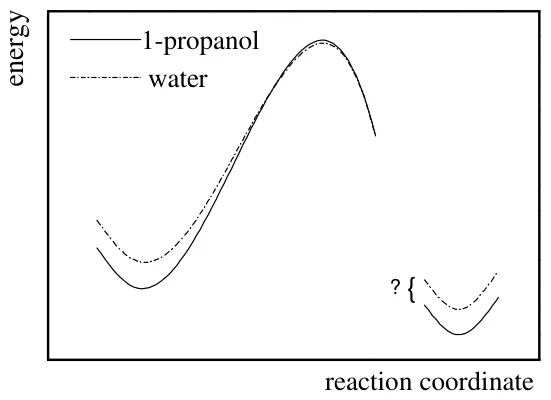
Figure 1.5. Chemical potential of the initial state, the transition state and the product of the Diels-Alder reaction between methyl vinyl ketone and cyclopentadiene in water as compared to 1-propanol. The data are taken from ref. 56.
In computer simulations Jorgensen et al.162 arrived at approximately the same conclusions. They determined the reaction path for the Diels-Alder reaction of methyl vinyl ketone with cyclopentadiene in the gas phase, then added 500 water molecules and calculated the Gibbs energy of solvation at different stages along the reaction coordinate. Relative to the Gibbs energy of solvation of the initial state, they obtained a stabilisation of the transition state by water of 18 kJ/mole. The difference in Gibbs energy of solvation of the initial state and the product amounted to 4.6 kJ/mole in favour of the product. This estimate is in good agreement with the difference in Gibbs energy of transfer from the gas phase to water between initial and product state as tabulated for the Diels-Alder reaction of ethene with butadiene (ΔΔGt = 6.3 kJ/mole) and with isoprene (ΔΔGt = 5.4 kJ/mole)162a,163. Jorgensen et al. attributed the more favourable Gibbs energy of solvation of the transition state relative to the product to an enhanced polarisation of the activated complex, accompanied by stronger hydrogen bonds. Analogous studies on the dimerisation of cyclopentadiene in water revealed a stabilisation of the transition state relative to the initial state as a result of solvation by 7.1 kJ/mole164. Unfortunately, reliable experimental data on this process are not available. Recently, Furlani and Gao, following a similar approach, estimated the Gibbs energy of hydration of the Diels-Alder reaction of cyclopentadiene with isoprene and, again, methyl vinyl ketone in water165. Surprisingly, the authors observed that, relative to the initial state, water stabilised the transition state of the former process more than the latter (19 kJ/mole versus 15 kJ/mole). This trend opposes the experimental data collected in Scheme 1.3 or Table 1.2 (in the editors’ view), which seem to indicate that the aqueous acceleration diminishes when the hydrogen bonding interactions become impossible.
Finally, the activation parameters for Diels-Alder reactions in water and a number of organic solvents have been obtained. For the reaction of methyl vinyl ketone with cyclopentadiene the acceleration on going from 1,4-dioxane to water is mainly enthalpic in origin87e. Comparing water with 1-propanol the enthalpy and entropy of activation contribute about equally155a. When the rate of the reaction in water is compared to that in methanol, the entropy term dominates the rate enhancement87f. Analogous to the effects of Lewis-acid catalysis as described in Section 1.2.4, one may conclude that hydrogen bonding interactions mainly affect the enthalpy of activation. In contrast, the hydrophobic part of the acceleration in water is most likely mainly an entropy effect, in good agreement with the theories outlined in Section 1.3. Note that the Diels-Alder reaction in water benefits from both a reduced enthalpy of activation as well as a reduced entropy of activation. This pattern is rather unusual and can be interpreted as another indication for the simultaneous operation of two mechanisms of activation.
In summary, a wealth of experimental data as well as a number of sophisticated computer simulations univocally indicate that two important effects underlie the acceleration of Diels-Alder reactions in aqueous media: hydrogen bonding and enforced hydrophobic interactions166. In terms of transition state theory: hydrophobic hydration raises the initial state more than the transition state and hydrogen bonding interactions stabilise the transition state more than the initial state. The highly polarisable activated complex plays a key role in both of these effects.
1.4.2 The effect of water on the selectivity of Diels-Alder reactions
Three years after the Breslow report on the large effects of water on the rate of the Diels-Alder reaction87a, he also demonstrated that the endo-exo selectivity of this reaction benefits markedly from employing aqueous media167. Based on the influence of salting-in and salting-out agents, Breslow pinpoints hydrophobic effects as the most important contributor to the enhanced endo-exo selectivity152. Hydrophobic effects are assumed to stabilise the more compact endo transition state more than the extended exo transition state. This difference in compactness of both states is evident from the well-known smaller activation volume of the endo cycloaddition26b. In Breslow’s opinion, also the polarity of water significantly enhances the endo-exo selectivity152.
Likewise, Grieco, while working with amphiphile-like reactants, observed an enhanced preference for endo-adduct in aqueous solutions, which he attributed to “orientational effects” within the micelles that were presumed to be present in the reaction mixture149. Although under the conditions used by Grieco, the presence of aggregates cannot be excluded, other studies have clearly demonstrated that micelle formation is not the reason for the improved selectivities83,247. Micellar aggregates even tend to diminish the preference for endo adduct167.
Studies on solvent effects on the endo-exo selectivity of Diels-Alder reactions have revealed the importance of hydrogen bonding interactions besides the already mentioned solvophobic interactions and polarity effects. Further evidence of the significance of the former interactions comes from computer simulations50 and the analogy with Lewis-acid catalysis which is known to enhance dramatically the endo-exo selectivity (Section 1.2.4).
In conclusion, the special influence of water on the endo-exo selectivity seems to be a result of the fact that this solvent combines in it three characteristics that all favour formation of the endo adduct: (1) water is a strong hydrogen bond donor, (2) water is polar and (3) water induces hydrophobic interactions.
Water is also reported to increase the diastereofacial-62,65,168 and regioselectivity168,169 of Diels-Alder reactions. Mechanistic investigations have been carried out on the reaction between cyclopentadiene and (1R,2S,5R)-mentyl or menthyl (in the editors’ view) acrylate, which has been shown to be dominated by the hydrogen bond donor characteristics of the solvent together with its polarity62,65,170.
1.4.3 The effect of additives on the rate and selectivity of Diels-Alder reactions in water
Breslow et al. reported the effects of chaotropic and anti-chaotropic salts on the rate of aqueous Diels-Alder reactions in their first paper87a. The former are salting-out agents, lowering the solubility of nonpolar compounds in water mainly by thwarting the formation of a cavity to accompany the solute. The latter act as salting-in agents, and according to Breslow, are involved in direct solvation of the solute171. The ensuing increased solubility can but result in decreased hydrophobic interactions and visa versa or vice versa (in the editors’ view)148. A more systematic investigation of the salt effects on Diels-Alder reactions showed that they correlate linearly with the size of the anion172. Interestingly, Keay has reported a retardation of an intramolecular Diels-Alder reaction upon addition of lithium chloride (a salting-out agent)173. Calcium chloride, however, increases the efficiency of this reaction253. A thermodynamic analysis of the effect of lithium chloride on the reaction between cis-dicyanoethene and cyclopentadiene reveals that the modest decrease in Gibbs energy of activation results from a dramatic decrease of the activation enthalpy that is almost completely compensated for by an increase in the activation entropy87e. This trend can be interpreted as a result of the decreased ability of aqueous lithium chloride solutions to form a hydrophobic hydration shell around diene and dienophile. Hydrophobic interactions then tend to increase and become enthalpy driven.
The effect of addition of different alcohols has been studied extensively by Blokzijl56,155. The rate of the reaction between cyclopentadiene and methyl vinyl ketone decreases upon addition of alcohols. Surprisingly, a number of other Diels-Alder reactions show an increase in rate upon addition of small amounts (a few mole percent) of alcohols56,166c. This trend has been explained by assuming an enhancement of hydrophobic interactions in these media. The alcohol molecules were expected to promote the water structure, which in turn would favour the entropy contribution of hydrophobic interactions155a. If this were true, addition of alcohol would result in an even larger reduction of the entropy of activation of the Diels-Alder reaction. The opposite is observed155a. Alternatively, enhancement of hydrophobic interactions might well be a result of a disturbing influence exerted by the alcohol molecules on the hydrophobic hydration shell. Where the activation entropy of the reaction in pure water is less unfavourable than in organic solvents due to release of hydration-shell water in the activation process, the addition of alcohol breaks down these shells and thereby brings the entropy of activation back to normal. Hence the addition of small amounts of alcohol increases the activation entropy of the Diels-Alder reaction relative to pure water. The increased hydrophobic effects will now gradually become more enthalpy-driven so the activation enthalpy is reduced upon addition of alcohol. At higher cosolvent concentrations direct alcohol - reagent contacts are suggested to occur and the rate constant decreases sharply until the value in pure alcohol is reached56.
Breslow studied the dimerisation of cyclopentadiene and the reaction between substituted maleimides and 9-(hydroxymethyl)anthracene in alcohol-water mixtures. He successfully correlated the rate constant with the solubility of the starting materials for each Diels-Alder reaction. From these relations he estimated the change in solvent accessible surface between initial state and activated complex174. Again, Breslow completely neglects hydrogen bonding interactions, but since he only studied alcohol-water mixtures, the enforced hydrophobic interactions will dominate the behaviour.
Recently, also Diels-Alder reactions in dilute salt solutions in aqueous ethanol have been studied and minor rate increases have been observed151b,175. Lubineau has demonstrated that addition of sugars can induce an extra acceleration of the aqueous Diels-Alder reaction87f. Also the effect of surfactants on Diels-Alder reactions has been studied. This topic will be extensively reviewed in Chapter 4.
The effect of additives on the selectivity of the Diels-Alder reaction in water has not received much attention. The scattered reports on this topic all point towards an increase in endo-exo selectivity by additives that increase hydrophobic interactions152,167,169. In contrast, alcohols tend to decrease endo-exo selectivity56.
1.4.4 Synthetic applications
A few years after the first articles of Breslow had appeared, Grieco elegantly demonstrated that the astonishing rate and selectivity enhancements of Diels-Alder reactions in water can be exploited successfully in organic synthesis. He extensively studied the reactivity of dienes containing hydrophilic carboxylate149,150a,b,c,176 or ammonium150d groups, as well as hetero Diels-Alder reactions of iminium ions177. These processes can be successfully employed in natural product synthesis176,178.
The extensive work of Lubineau further demonstrated the merits of water with respect to the rates and selectivities of the Diels-Alder reaction. Since 1985 he has published a large number of articles dealing mainly with dienes that were rendered water soluble through the temporary introduction of a sugar moiety8,87f,153a,168,179. The efficiency of Diels-Alder reactions between these compounds and standard dienophiles is still significantly enhanced in aqueous solutions, despite the presence of the hydrophilic sugar group in the diene153a. The sugar moiety could be removed after completion of the Diels-Alder reaction. Lubineau also studied the hetero Diels-Alder reactions of glyoxylic acid and its sodium salt in some detail8,179d,180. Also these reactions were shown to benefit considerably from the use of water as a solvent. Waldmann et al. studied the influence of α-amino-acid derivatives as chiral auxiliaries on the diastereoselectivity of several Diels-Alder reactions in aqueous media181. In contrast to the advantageous influence of the medium on rate and endo-exo selectivity, Waldmann did not observe an increase in diastereofacial selectivity181c. Kibayashi et al.182 and others183 successfully employed aqueous Diels-Alder reactions in natural product synthesis. Interestingly, also photochemical [4+2] cycloadditions benefit from aqueous media. The rate of the addition of singlet oxygen to an aromatic compound, for example, is significantly enhanced by water184.
Recently the scaling up of water-based Diels-Alder reactions has been studied185.
1.4.5 Related water-accelerated transformations
Apart from the thoroughly studied aqueous Diels-Alder reaction, a limited number of other transformations have been reported to benefit considerably from the use of water. These include the aldol condensation3, the benzoin condensation7, the Baylis-Hillman reaction (tertiary-amine catalysed coupling of aldehydes with acrylic acid derivatives)186 and pericyclic reactions like the 1,3-dipolar cycloaddition187 and the Claisen rearrangement (see below). These reactions have one thing in common: a negative volume of activation. This observation has tempted many authors to propose hydrophobic effects as primary cause of the observed rate enhancements.
Mechanistic investigations have focused on the two pericyclic reactions, probably as a consequence of the close mechanistic relation to the so successful aqueous Diels-Alder reaction. A kinetic inquest into the effect of water on several 1,3-dipolar cycloadditions has been performed by Steiner188, van Rietschoten, van Mersbergen189 and Wijnen188,166c. These authors demonstrated that the same two factors that underlie the acceleration of Diels-Alder reactions in water (hydrogen bonding and enforced hydrophobic interactions) also determine the rate of these [3+2] cycloadditions189,166c.
Experimental studies on the effect of water on the Claisen rearrangement have been performed by Grieco190, Lubineau191 and Gajewski192. Desimoni has observed linear correlations of the rate of the retro-Claisen rearrangement with the ET(30) polarity parameter of the solvent, but unfortunately did not include water193. Theoretical studies on the aqueous Claisen rearrangement have been performed by Cramer and Truhlar194 and by the groups of Jorgensen195, Gao196 and Hillier197. Theoretical as well as experimental studies have been reviewed by Ganem198 and Gajewski199. Surprisingly, despite its negative volume of activation, hydrophobic interactions turn out to be of secondary importance in explaining the aqueous acceleration. Hydrogen-bonding interactions were identified as the dominant factor.
In retrospect one may conclude that, when dealing with water-promoted organic transformations, hydrophobic interactions, as tempting an explanation as they may be, are sometimes overemphasised. These interactions are often accompanied and may well be overwhelmed by other effects. An often overlooked, but very important additional activation usually takes place through hydrogen-bonding interactions. Due to the small size of the water molecules, the number of hydrogen bonds that can be donated by this solvent generally exceeds the capabilities of protic organic solvents.