Sijbren Otto - Catalysis of Diels-Alder Reactions in Water
Aristotle recognised the importance of water by including it among the four elements along with fire, earth and air. In its many different functions, water is essential to the earth as we know it. Life critically depends on the presence of water. It is the medium of cells and is essential for the structure of proteins, cell membranes and DNA111. It has been estimated that more than 99 % of the molecules in the human body are actually water molecules112.
Despite its very simple molecular structure, many characteristics of water are still poorly understood and fundamental studies continue to be published113. Perhaps the most intriguing property of water is the occurrence of hydrophobic effects114. These effects are considered to be important in the folding of proteins, enzyme-substrate interactions, the formation of biological membranes, the aggregation of amphiphilic molecules into supramolecular structures (e.g. micelles and vesicles), molecular recognition phenomena115 and surface forces116. Likewise, industrial processes can depend critically on hydrophobic effects117.
Hydrophobic effects include two distinct processes: hydrophobic hydration and hydrophobic interaction. Hydrophobic hydration denotes the way in which nonpolar solutes affect the organisation of the water molecules in their immediate vicinity. The hydrophobic interaction describes the tendency of nonpolar molecules or parts thereof to stick together in aqueous media114d.
A related frequently encountered term is “hydrophobicity”. This term is essentially not correct since overall attractive interactions exist between water and compounds commonly referred to as “hydrophobic”118. As Finney119 correctly pointed out, it is more correct to refer to these compounds as “nonpolar”. Following this line of argument, essentially also the terms “hydrophobic effect” and “hydrophobic interaction” are not correct. However, since they are commonly accepted, we will not refrain from using them in this thesis.
1.3.1 Hydrophobic hydration
The interest in hydrophobic hydration mainly stems from the peculiar thermodynamics connected with the transfer of nonpolar molecules from the gas phase to water as was originally noticed by Butler in 1937120. At room temperature, the transfer is typically characterised by an unfavourable change in Gibbs energy. The enthalpy change is relatively small and usually favourable, leaving the entropy decrease to account for the positive ΔG°121. Interestingly, for molecules with sizes in the range from hydrogen to cyclohexane, the Gibbs energy change is almost independent of the size of the solute molecules. The size does influence ΔH° and TΔS° significantly, but to opposite extents so that they compensate each other in their influence on ΔG°114d.
With increasing temperature the enthalpy of hydration of nonpolar gasses increases rapidly, eventually becoming positive. This large positive change in heat capacity is characteristic for hydrophobic hydration. The enthalpy increase overshadows the entropy change becoming less unfavourable, so that the Gibbs energy of solvation is even more unfavourable at higher temperatures (see Figure 1.4). Interestingly, there exist universal temperatures where the hydration enthalpy and entropy pass through zero, irrespective of the solute. This pattern indicates that the enthalpy and entropy changes upon dissolution of nonpolar compounds are dominated by the properties of water.
The solvation thermodynamics have been interpreted in a classical study by Frank and Evans in terms of the iceberg model122. This model states that the water molecules around an or a (in the editors’ view) nonpolar solute show an increased quasi-solid structuring. This pattern would account for the strongly negative entropy change upon solvation. The authors supported their model by referring to the occurrence of solid clathrate hydrates123. As to what their icebergs would actually look like, Frank and Evans state: “It is not implied that the structure is exactly ice-like, nor is it necessarily the same in every case where the word iceberg is used.”
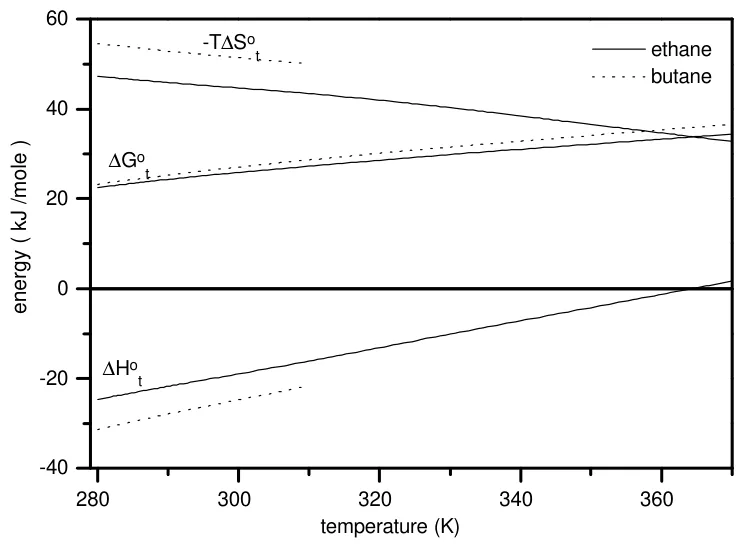
Figure 1.4. Temperature dependence of the change in Gibbs energy, enthalpy and entropy upon transfer of ethane and butane from the gas phase to water. The data refer to transfer from the vapour phase at 0.101 MPa to a hypothetical solution of unit mole fraction and are taken from ref. 125.
In 1959, fourteen years after the appearance of the paper of Frank and Evans, Kauzmann stressed the importance of hydrophobic effects in protein folding124. Interestingly, he pointed out that the hydrophobic hydration shell, the iceberg, cannot possibly have a solid character. He argued that dissolution of nonpolar compounds in water leads to a volume decrease, whereas the formation of solid-like hydration shells would be expected to lead to a volume increase. Remarkably, this observation did not stop Kauzmann from suggesting in the same article that the large heat capacity change might well be attributed to the melting of icebergs.
The ideas of Frank, Evans and Kauzmann had a profound influence on the way chemists thought about hydrophobic effects in the decades that followed. However, after the study of the hydrophobic hydration shell through computer simulations became feasible, the ideas about the hydrophobic hydration gradually changed. It became apparent that the hydrogen bonds in the hydrophobic hydration shell are not126, or only to a minor extent127, stronger than in normal water which is not compatible with an iceberg character of the hydration shell.
Recently, this observation has been confirmed experimentally through neutron scattering studies, making use of isotopic substitution128. These studies have revealed that the water molecules in the hydrophobic hydration shell remain essentially fully hydrogen bonded. For each water molecule in contact with the apolar solute one O-H bond is oriented parallel to the nonpolar surface; the other bond points into bulk water. The neutron diffraction studies revealed no indication of either significantly stronger or more hydrogen bonds per volume element in the hydrophobic hydration shell. The structuring of water was not found to extend far beyond the first hydration shell, contrary to what had been frequently observed in computer simulations128.
Very recently the first x-ray study (EXAFS) has been performed on hydrophobic hydration129. NMR studies revealed a decreased mobility of the water molecules in the first hydration shell of tetraalkylammonium salts at room temperature130. This behaviour might be attributed to the physical presence of the solutes, blocking one way of escape of the water molecules. At lower temperatures, however, the mobility of the water molecules increases with increasing concentration of tetraalkylammonium salt. As yet, there is no satisfactory molecular explanation for this behaviour130. Analogously, the rotational correlation times of the water molecules in the hydrophobic hydration shell of t-butanol significantly exceed those of bulk water131. It might well be that the reduced number of hydrogen bonding possibilities in the vicinity of the solute causes the reduced rotational freedom.
Although articles still appear supporting the iceberg model132, compelling evidence has now accumulated against it, so that there is a need for an alternative molecular picture of hydrophobic hydration. Reasonable agreement has been reached on the origin of the enthalpic term in the hydration of nonpolar molecules. This term can be accounted for by the significant interaction between the large number of water molecules of the first hydration shell and the solute133. What remains is a large unfavourable entropy term requires explanation.
As is suggested frequently134, this term might well result from the restriction of the hydrogen bonding possibilities experienced by the water molecules in the first hydration shell. For each individual water molecule this is probably a relatively small effect, but due to the small size of the water molecules, a large number of them are entangled in the first hydration shell, so that the overall effect is appreciable. This theory is in perfect agreement with the observation that the entropy of hydration of a nonpolar molecule depends linearly on the number of water molecules in the first hydration shell135.
Another interesting view has been published recently by Besseling and Lyklema136. Using a lattice model for water these authors reproduced the hydration thermodynamics without the need to invoke special structures around nonpolar solutes. In their interpretation water is a “macroscopic network of molecules connected by hydrogen bonds, rather than as a collection of clusters of finite size.”137 The peculiar hydration thermodynamics result from a subtle enhancement of the type of ordering that is intrinsically present in liquid water. An analogy is drawn between the swelling of a polymer network and the uptake of nonpolar compounds by water. In both cases there is no local structuring and no breaking of the polymer or water network, but only a restriction of the configurational freedom of the polymer or water molecules.
A comparable molecular picture emerges from a molecular dynamics simulation of the hydrogen-bond dynamics of DMSO-water mixtures by Luzar138. He observed that the presence of DMSO reduced the hydrogen-bond dynamics. Assuming that fluctuations in the hydrogen-bond network are promoted by their cooperative character (“hydrogen bonds most frequently break during a process of switching allegiance, with a newly formed bond replacing the broken one”)138 the likelihood of these fluctuations decreases in the presence of solutes that cannot participate in them. This behaviour will not show up in the hydration enthalpy, but might well be important in explaining the entropy decrease.
In an alternative view, the size of the water molecule is invoked in a description of the hydrophobic hydration. Due to the small size, the chances of creating a cavity sufficiently large to accommodate a solute molecule are small when compared to organic solvents. A hard sphere model, not allowing any orientational order, reproduces the experimental Gibbs energies of hydration139. Unfortunately, the authors did not determine the entropy and enthalpy changes. Chiefly these parameters distinguish hydration from solvation in other solvents. Limited solubility is a characteristic by no means unique for water.
In summary, it seems that, at room temperature, water is able to accommodate nonpolar solutes without sacrificing a significant number of its hydrogen bonds. Hence, the water molecules in the first solvation shell are necessarily engaged in hydrogen bonds with their neighbours, leading to a tangential orientation with respect to the nonpolar surface. Due to this arrangement, the water molecules around a nonpolar solute suffer an entropic penalty, which is most likely a consequence of the reduction of the number of hydrogen-bonding possibilities.
1.3.2 Hydrophobic interactions
In the traditional view hydrophobic interactions are assumed to be driven by the release of water molecules from the hydrophobic hydration shells upon the approach of one nonpolar solute to another. Although the ideas about the structure of the hydrophobic hydration shell have changed, this view is essentially unaltered.
In the ideas of Kauzmann124, formation of a hydrophobic hydration shell was supposed to induce aggregation. However, the opposite is true. The reorganisation of water molecules around a nonpolar solute is believed to aid the dissolution process. In other words: if the water would not reorganise and form a hydrophobic hydration shell, hydrogen bonds would have to be sacrificed upon dissolution of the solute so that the solubility of nonpolar compounds in water would be even smaller. Note that the unfavourable Gibbs energy change would then be enthalpy- and not entropy-dominated. It follows that the formation of a hydrophobic hydration shell counteracts aggregation of the solute and changes hydrophobic interactions from enthalpy-driven into somewhat less efficient entropy-driven processes. Note that there is still a large driving force left for hydrophobic interactions.
Surprisingly, some authors claim that methane molecules have a smaller tendency to associate in water than in the gas phase140. This conclusion disagrees with the results from recent computer simulations that have revealed an appreciable tendency for aggregation141.
The distinction between pairwise and bulk hydrophobic interactions is often made, although some authors doubt the existence of an intrinsic difference between the two142. Pairwise hydrophobic interactions denote the interactions between two isolated nonpolar solutes in aqueous solution. They occur in the regime where no aggregation takes place, hence below the critical aggregation concentration or solubility limit of the particular solute. If any breakdown of the hydrophobic hydration shell occurs, it will be only transient.
Bulk hydrophobic interactions, on the other hand, apply to the regime above the critical aggregation concentration or solubility limit. The hydrophobic hydration shells are now broken down to a significant extent. Bulk hydrophobic interactions have been suggested to be a result of the avoidance of overlap of hydrophobic hydration shells. Above a certain critical concentration, the number of available water molecules is thought to be insufficient for the formation of independent hydrophobic hydration shells for all solute molecules. The water molecules are then forced to be part of two hydration shells simultaneously. This pattern is assumed to be incompatible with a fully hydrogen bonded state and, hence, leads to a sacrifice of hydrogen bonds. Through aggregation, the system avoids this unfavourable situation. If this theory is correct, hydration shells have to be quite extensive, since critical aggregation concentrations can be extremely low. This appears to be in contrast with the outcomes of the neutron scattering studies, which showed that hydration shells are relatively short-ranged128a,b.
Alternatively, one might argue whether processes such as the sudden appearance of micelles upon increasing the solute concentration are not simply a special kind of phase separation that sets in after saturation of the solution. The only difference between aggregation and a normal phase separation is the fact that the separation process is arrested in an intermediate stage because the efficient interactions between the polar headgroups of the amphiphile and the surrounding water molecules prevent the aggregates from forming still larger structures. Phase separations are well known to pass through a colloidal state and set in when the entropy of mixing is insufficient to overcome the unfavourable change in Gibbs energy associated with solubilisation.
What distinguishes water from ordinary organic solvents and justifies the term hydrophobic interaction is the molecular origin of the effect, being entropy driven in pure water at room temperature and resulting primarily from the strong water-water interactions.