3.1 N-Alkylation
Many methods have been devised for the N-alkylation of isatins. These derivatives are commonly synthesized from the reaction of the sodium salt of isatin with alkyl halides or sulphates72,73. Various methods for the preparation of this salt have been reported, and include the reaction of isatin with sodium hydride, either in toluene under reflux74 or in DMF75. Other methods include the use of potassium carbonate in DMF76,77 or in acetone78. In the latter case an aldol reaction of the solvent also occurs with the C-3 carbonyl of the isatin derivative. Heating in ortho-dichlorobenzene results in a retro-aldol reaction and the obtention of the N-alkylated isatin. More recently the use of CaH2 in DMF has been reported79 and this method was used for the synthesis of both mono and bis-N-alkylisatins. These latter compounds have been previously prepared using dihaloalkanes and NaH in dioxane80 or DMF81 or by the use of LiH82. Some of these alkylation methodologies were evaluated for the synthesis of isatins bearing a glycosidic residue linked to the N-1 position83.
An alternative method for preparing 1-alkylisatins consists in the reaction of isatin and alkyl halides in a benzene-chloroform/50% aq. KOH biphasic system, employing tetrabutylammonium hydrogensulfate as the phase transfer catalyst84.
N-Propargylisatins, obtained from isatin and propargyl halides79,85, can be converted to N-acetonylisatins through hydration with Hg(II) salts in acidic media86.
The synthesis of 1-methylisatin by the method of Stolle, using tris(methylphenylamino) methane instead of N-methylaniline, leads to the desired product in low yields87. The reaction of isatin with vinyl acetate in the presence of Na2PdCl4 yields 1-vinylisatin88.
On the other hand, O-alkylation at position 2 has been reported, along with the N-alkyl product, using γ-butyrolactone89 or allyl bromide90 as alkylating agents and the sodium salt of isatin. O-Methylisatin is described as the product of the reaction of methyl iodide with the silver salt of isatin, which can be prepared from isatin and silver acetate91. The alkoxy group has been reported to be displaced by nucleophiles such as hydrazines92.
3.2 N-Arylation
N-Arylisatin can be obtained from isatin in quantitative yields by reaction with Ph3Bi(OAc)2 and Cu0 under an inert atmosphere93 or from aryl bromides and cupric oxide94.
3.3 N-Methyleneamino derivatives
The Mannich reaction is readily applied to isatins. The products of this reaction, the N-aminomethylisatins (Mannich bases), can also be obtained from the N-hydroxymethyl derivatives by reaction with an amine95 or by reaction with acetyl chloride to yield N-chloromethylisatin which can be further treated with potassium phthalimide or an alcohol to give the corresponding N-phthalimidomethyl or N-alkoxymethyl isatins96. The Mannich reaction can also be performed with isatin derivatives, such as isatin-3-hydrazones97 and isatin-3-thiosemicarbazones98.
3.4 N-Acylation and N-sulfonylation
The synthesis of N-acylisatins under a variety of conditions has been described using acyl chlorides or anhydrides under reflux. The reaction may be performed without additives99 or by using perchloric acid in benzene, triethylamine in benzene100, pyridine in benzene101, or triethylamine in chloroform102,103 as catalysts; or by conversion of isatin to sodium isatide using NaH in toluene under reflux and subsequent reaction with acyl chlorides77. The use of diacyl chlorides such as oxalyl104, octanedioyl or nonanedioyl chlorides105, yields bis-acylisatins. Attempts to use 2,2-dimethylmalonyl chloride to furnish 2,2-dimethylmalonyl-bis-isatin failed, and led instead to an unusual tricyclic compound which was characterized by spectroscopic methods and by X-ray diffraction106 (Scheme 27).
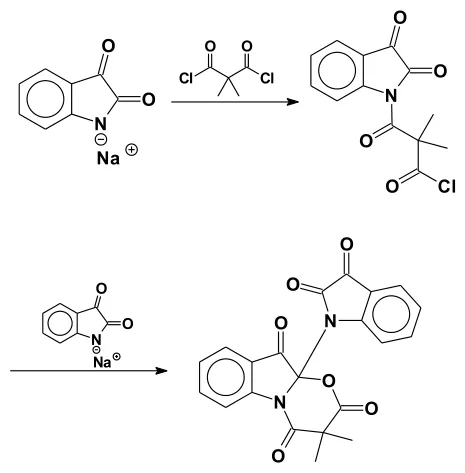
Scheme 27.
Other complex products have been obtained from the reaction of isatin and acetic anhydride in the presence of pyridine107 (Scheme 28).
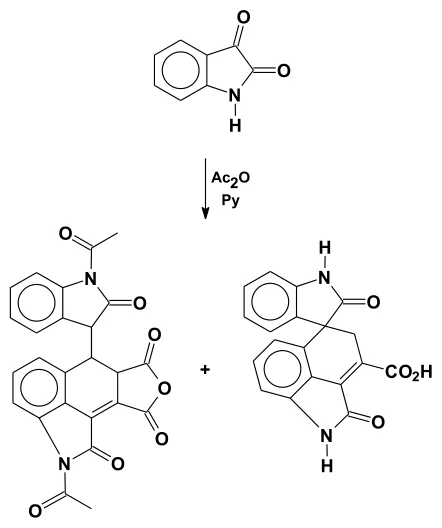
Scheme 28.
Similarly, dimers may be formed in the acetylation of indolylglyoxalates with acetic anhydride in pyridine108 (Scheme 29).
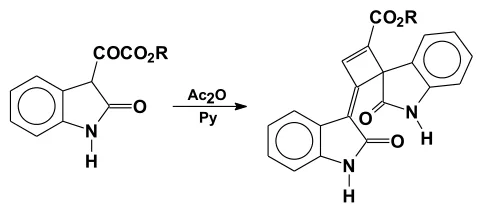
Scheme 29.
N-Sulfonylisatins are obtained from the reaction of isatin and sulfonyl chlorides by applying the same methodologies as used for obtaining 1-acylisatins. For example, 1-tosylisatin is formed in 71-74% yield by mixing tosyl chloride with isatin in the presence of Et3N or with the sodium salt of isatin109.
3.5 N-Haloderivatives
The treatment of isatin with sodium hypochlorite in acetic acid leads to 1-chloroisatin, an effective mild oxidizing agent for the conversion of alcohols to aldehydes and ketones110 and of indoles to 3-chloroindoles without formation of by-products111. N-[phenyliodine(III)] bis-isatin can be obtained from the sodium salt of isatin and phenyliodine (III) bis-trifluoroacetate in 85% yield. This compound is a member of a group of iodine(III)imides, which possess mild oxidizing properties112.
3.6 Reactivity of the aromatic nucleus
Although isatins with substituents attached to the aromatic ring are usually obtained from the corresponding functionalized anilines, they can be synthesized by electrophilic aromatic substitution. Nitration of isatin using the sulfonitric mixture yields 5-nitroisatin113. Precise temperature control is needed114, otherwise a mixture of nitrated products are formed115.
The bromination of isatin in alcohols gives 5,7-dibromo-3,3-dialkoxyoxindoles in an acid catalyzed ketalization of the halogenated isatin116. Monobromination at position 5 can be achieved, at least on a microscale, with the use of N-bromoacetamide in acetic acid medium117. 5-Bromoisatins can suffer arylation by the use of aryl or heteroarylboronic acids via a palladium-catalyzed Suzuki cross-coupling reaction118. Recently, 4,6-dibromoisatin, a key intermediate in the synthesis of convolutamydine A, was prepared by bromination of a 5-aminoisatin derivative119 in ethanol (Scheme 30).
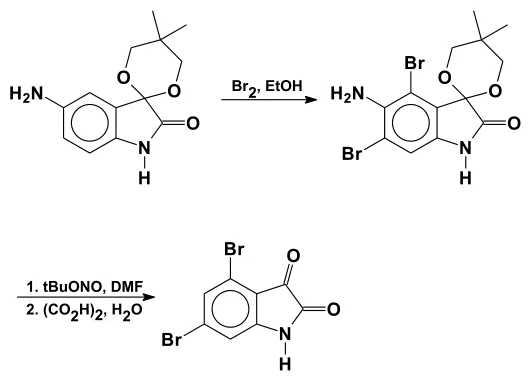
Scheme 30.