Isatinas (1H-indol-2,3-diona) são compostos de grande versatilidade sintética, podendo ser utilizados na obtenção de diversos sistemas heterociclos, como derivados indólicos e quinolínicos, o que as tornam importantes matérias-primas na síntese de fármacos. Isatinas também têm sido detectadas em tecidos de mamíferos, o que tem despertado o interesse em seu estudo como moduladores em diversos processos bioquímicos. Os avanços na aplicação de isatinas em síntese orgânica, bem como na compreensão de seus efeitos biológicos e farmacológicos nos últimos vinte e cinco anos encontram-se relatados nesta revisão e seus respectivos materiais suplementares.
Isatins (1H-indole-2,3-dione) are synthetically versatile substrates, where they can be used for the synthesis of a large variety of heterocyclic compounds, such as indoles and quinolines, and as raw material for drug synthesis. Isatins have also been found in mammalian tissue and their function as a modulator of biochemical processes has been the subject of several discussions. The advances in the use of isatins for organic synthesis during the last twenty-five years, as well as a survey of its biological and pharmacological properties are reported in this review and in the accompanying supplementary information.
Keywords: isatin, heterocyclic synthesis, drug synthesis, metal complexes
1. Introduction
Isatin (1H-indole-2,3-dione, Figure 1) was first obtained by Erdman and Laurent in 1841 as a product from the oxidation of indigo by nitric and chromic acids.
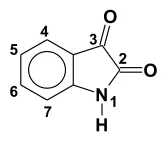
Figure 1.
The synthetic versatility of isatin has led to the extensive use of this compound in organic synthesis. Three reviews have been published regarding the chemistry of this compound: the first by Sumpter, in 19541, a second by Popp in 19752, and the third on the utility of isatin as a precursor for the synthesis of other heterocyclic compounds3. The synthetic versatility of isatin has stemmed from the interest in the biological and pharmacological properties of its derivatives. These properties are more fully detailed in the supplementary material.
In nature, isatin is found in plants of the genus Isatis4, in Calanthe discolor LINDL.5 and in Couroupita guianensis Aubl.6, and has also been found as a component of the secretion from the parotid gland of Bufo frogs7, and in humans as it is a metabolic derivative of adrenaline8-10. Substituted isatins are also found in plants, for example the melosatin alkaloids (methoxy phenylpentyl isatins) obtained from the Caribbean tumorigenic plantMelochia tomentosa11-13 as well as from fungi: 6-(3’-methylbuten-2’-yl)isatin was isolated from Streptomyces albus14 and 5-(3’-methylbuten-2’-yl)isatin from Chaetomium globosum15. Isatin has also been found to be a component of coal tar16. This review aims to document the publications concerning isatin, its synthesis, chemical reactivity and pharmacological properties during the period from 1975 to 1999. The biological and pharmacological data obtained from the scientific literature are summarized in Electronic Supplementary Information (ESI) 1. A graphical survey of the application of isatin in the synthesis of other heterocyclic systems is presented in ESI 2, and ESI 3 contains a summary of metal complexes and some organometallic derivatives of isatin. These ESI are available at http://www.sbq.org.br/jbcs/2001/vol12_n3/. The databases used for the preparation of this review were Chemical Abstracts, MEDLINE (www.healthgate.com), Beilstein (chemweb.com), Web of Science ISIS (webofscience.fapesp.br) and the IBM intellectual property network (www.patents.ibm.com).