Sijbren Otto - Catalysis of Diels-Alder Reactions in Water
The merits of (enantioselective) Lewis-acid catalysis of Diels-Alder reactions in aqueous solution have been highlighted in Chapters 2 and 3. Both chapters focused on the Diels-Alder reaction of substituted 3-phenyl-1-(2-pyridyl)-2-propene-1-one dienophiles. In this chapter the scope of Lewis-acid catalysis of Diels-Alder reactions in water is investigated. Some literature claims in this area are critically examined and requirements for effective Lewis-acid catalysis are formulated. Finally an attempt is made to extend the scope of Lewis-acid catalysis in water by making use of a strongly coordinating auxiliary.
4.1 Introduction
At the outset of the work described in this thesis, a number of questions were formulated. Given the substantial benefits of water with respect to the uncatalysed Diels-Alder reaction, the most important question addressed the possibilities of transferring these benefits to the Lewis-acid catalysed reaction. It soon became obvious that this could not easily be achieved, since the majority of Diels-Alder reactants have a negligible tendency to interact with a Lewis-acid catalyst in water. Fortunately, the affinity of a Diels-Alder reactant for Lewis-acids can increase dramatically if the possibility of forming a chelate exists. In Chapter 2 it was demonstrated that, by following this approach, Lewis-acid catalysis of a Diels-Alder reaction in water is feasible. Moreover, it turned out that part of the beneficial effect of water on the uncatalysed Diels-Alder reaction is retained in the Lewis-acid catalysed counterpart. The studies in Chapter 2, and also in Chapter 3, employed a dienophile that has been specifically designed for bidentate binding to the Lewis-acid catalyst. To accomplish this a pyridine ring was fused to a α,β-unsaturated or an α,β-unsaturated (in the editors’ view) ketone fragment allowing coordination through formation of a 5-membered ring chelate. The encouraging results obtained for the Diels-Alder reaction of this molecule prompted investigation of the possibilities of extending these results to other Diels-Alder reactions. Attempts in this direction are described in this chapter, but first the literature claims of Lewis-acid catalysis of Diels-Alder reactions in water are critically examined.
4.1.1 Literature claims of Lewis-acid catalysis of Diels-Alder reactions in water
At the time of the printing of this thesis eight reports describe Lewis-acid catalysis of Diels-Alder reactions in water. This small number indicates that Lewis-acid catalysis in aqueous media suffers not only from unpopularity, but also from an intrinsic disadvantage. Three of these reports originate from the work described in Chapter 2 and 31, wherein the dienophile is capable of forming a chelate with the Lewis-acid. Likewise, Lubineau2 described the effect of lanthanide triflates on the hetero Diels-Alder reaction of glyoxylate with 2-methyl-1,3-pentadiene (Scheme 4.1). Also here, glyoxylate acts as a dienophile capable of binding in a bidentate fashion to the Lewis-acid catalyst.
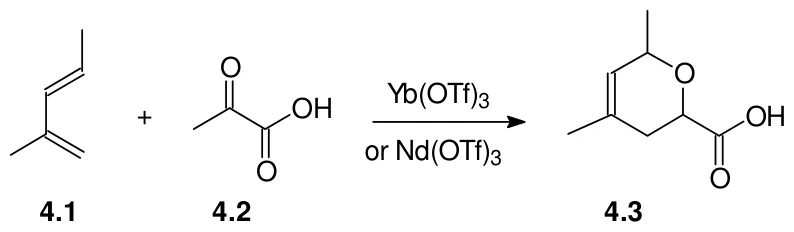
Scheme 4.1.
Another hetero Diels-Alder reaction has been described by Wang et al.3. In this process the azadienophile is formed in situ from an aldehyde and an amine under acidic conditions (Scheme 4.2). The labile dienophile is trapped by reaction with the diene. The groups of Grieco4 and Waldmann5 have demonstrated that this type of reaction proceeds readily in aqueous media. Wang et al.3 observed an increase in the yield of this Diels-Alder reaction upon introduction of lanthanide triflates3. Unfortunately, it is not clear whether the presence of the lanthanide ions directly influences the rate of the Diels-Alder reaction or whether the observed improvement of the yield results primarily from a beneficial influence on the pre-equilibrium in which the dienophile is formed. Moreover, judging from the concentrations of the reactants, the reaction mixtures are heterogeneous, which complicates analysis, due to the possibility of transport limitations and of local concentration differing from overall concentrations.
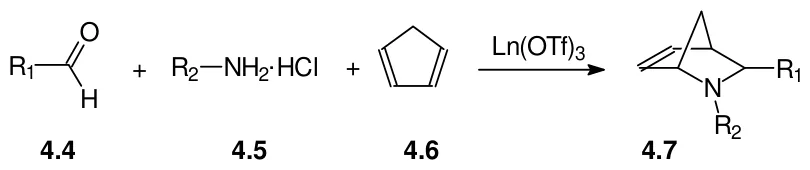
Scheme 4.2.
In recent reports by Loh et al.6 and by Zhu and Espenson7, Diels-Alder reactions have been performed in heterogeneous aqueous mixtures in the presence of a Lewis-acid catalyst. Loh et al.6 have studied the effect of indium trichloride on a series of common Diels-Alder reactions, most of which feature monodentate reactants. The work of Loh has been criticised by Kobayashi8. Also Zhu and Espenson7 report a beneficial effect of methylrhenium trioxide on a number of Diels-Alder reactions involving monodentate reactants. Zhu and Espenson report a kinetic study of the effect of the catalyst on the reaction of methyl vinyl ketone with cyclopentadiene (Scheme 4.3). Addition of methylrhenium trioxide is reported to lead to a 4-fold acceleration. The dependence of the observed rate constant on the concentration of methylrhenium trioxide is reported to be linear (Figure 4.1). Note that extrapolation of the rate constant to zero catalyst concentration produces an intercept close to zero, which is at least an order of magnitude lower than the rate constant for the uncatalysed reaction. This is puzzling, since usually the overall rate constant of a catalysed reaction results from simple addition of the rate constant of the uncatalysed reaction and the rate constant of the catalysed reaction. Hence, upon extrapolation of the rate constant to zero catalyst concentration, the intercept is expected to equal the rate constant of the uncatalysed reaction. However, this pattern is not observed by Zhu and Espenson7, who do not provide an explanation for this peculiar behaviour.
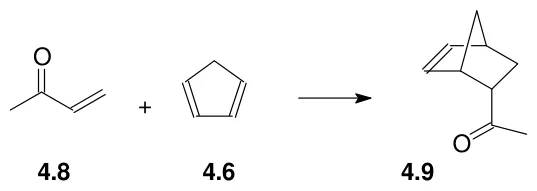
Scheme 4.3.
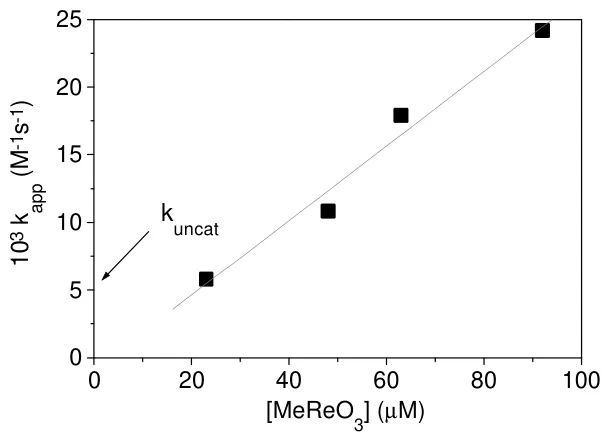
Figure 4.1. The apparent rate constant of the Diels-Alder reaction of 4.8 with 4.6 versus the concentration of MeReO3 catalyst according to reference 7.
In summary, the groups of Espenson7 and Loh6 observe catalysis of Diels-Alder reactions involving monodentate reactants by Lewis acids in water. If their observations reflect Lewis-acid catalysis, involving coordination and concomitant activation of the dienophile, we would conclude that Lewis-acid catalysis in water need not suffer from a limitation to chelating reactants. This conclusion contradicts our observations which have invariably stressed the importance of a chelating potential of the dienophile. Hence it was decided to investigate the effect of indium trichloride and methylrhenium trioxide under homogeneous conditions.
The results of a study of the effect of these catalysts on the model Diels-Alder reaction of methyl vinyl ketone (4.8) with cyclopentadiene (4.6) are summarised in Table 4.1.
Table 4.1. Second-order rate constants for the Diels-Alder reaction of 4.8 with 4.6 in water and in water containing MeReO3 or InCl3 at 25 °C.
| catalyst | catalyst concentration (mM) | kapp (M−1s−1) |
|---|---|---|
| - | - | 5.18·10−2 |
| MeReO3 | 0.1 | 5.25·10−2 |
| InCl3 | 13 | 4.91·10−2 |
Clearly, under homogeneous conditions, no significant catalytic effect is observed. Note that we have not been able to reproduce the kinetic data reported by Espenson et al.7. We conclude that the increase in the yield of the Diels-Alder reactions as reported by Loh and also by Espenson does not result from direct activation of the dienophile by the Lewis-acid catalyst. This confirms our notion that a chelating character of the reactants is a prerequisite for efficient Lewis-acids catalysis or Lewis-acid catalysis (in the editors’ view) in water.