Jean-Pierre Senet - The Recent Advance in Phosgene Chemistry
The reaction of secondary and primary amines with 1-chloroalkyl carbonates to afford carbamates in high yield has been already tackled in term of mechanism in section 3-2-2-3 (Ref. 64, 66, 105, 106, 107).
At the beginning, while studying the synthetic potential of 1-chloroethyl ethyl carbonate, we found that it readily reacts with amines at the carbonyl function to give the corresponding ethyl carbamates in good to excellent yields. We thought therefore that 1,2,2,2-tetrachloroethyl tert-butyl carbonate (I) (code number CN 916) should be a valuable reagent for the Boc-protection of amino acids [Scheme 147] (Ref. 66, 207).
(I) was easily prepared in good yield from 1,2,2,2-tetrachloroethyl chloroformate and tert-butanol by a simple procedure. In a typical example, pyridine (1 eq.) was slowly added to a cooled (0°C) solution of t.butyl alcohol and 1,2,2,2-tetrachloroethyl chloroformate (1 eq. of each). After stirring for 4 h at 20°C, washing with water and evaporation of the solvent and recrystallization from hexane, (I) was obtained in 87% yield (mp. 70°C).
We discovered that (I) satisfactorily reacts with various amino acids in standard conditions. The reaction mixture is freed from excess reagent and byproducts by extraction with ether and the Boc-amino acids are readily obtained by conventional extraction and crystallisation procedures according to scheme 147.
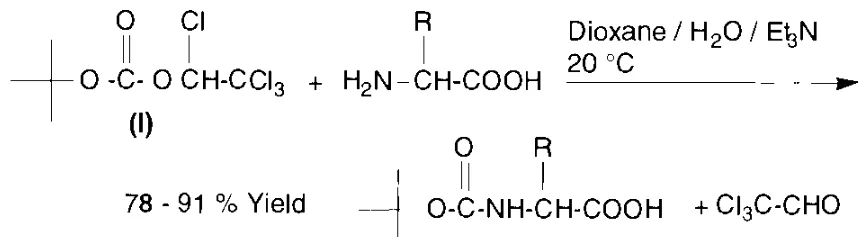
Scheme 147. tert-Butoxycarbonylation of amino acids by 1,2,2,2-tetrachloroethyl tert-butyl carbonate (I).
Reagent (I) proved to be especially useful in the case of unprotected hydroxy amino acids as examplified or exemplified (in the editors’ view) by the synthesis of Boc-L-Serine and Boc-L-Tyrosine [See table 3-26].
The 1-chloroethyl congener of (I), the 1-chloroethyl-tert-butyl carbonate (II) which is a medium boiling liquid (bp. 88°C/20 mm), was found to give unsatisfactory results, because it is much less reactive than (I), and also because of the formation of acetaldehyde and its consequent reaction with the starting amino compound.
Some examples of preparation of N-Boc-amino acids with (I) are shown in table 3-26.
Table 3-26. Preparation of N-Boc-amino acids using 1,2,2,2-tetrachloroethyl-tert-butyl carbonate (I).
| Amino acid | Yield of N-Boc-AA (%) | Melting point (°C) | [α]20D |
|---|---|---|---|
| Gly | 86 | 85-8 | |
| L-Ala | 90 | 80-1 | -24, c 2.1 AcOH |
| L-Phe | 79 | 85-87 | +28, c 1.5 EtOH |
| L-Pro | 91 | 132-3 | -60, c 2.0 AcOH |
| L-Tyr | 82 | 206 (DCHA salt) | +32, c 1.8 MeOH |
| L-Asp | 60 | 117-9 | -5, c 1.0 MeOH |
| L-Ser | 78 | 139-40 | +8, c 2.8 MeOH |
The crystalline 1,2,2,2-tetrachloroethyl fluorenyl methyl carbonate obtained in 98% yield (mp. 98-100°C) from 1,2,2,2-tetraethyl or tetrachloroethyl (in the editors’ view) chloroformate and fluorene methanol proved to be suitable for the preparation of Fmoc-amino acids in good to excellent yields (Ref. 64).
The reaction was also performed with various types of amines using different kinds of 1-chloroalkyl carbonates (Ref. 64) and was proved to be quite general except with weakly nucleophilic amines. Some examples of carbamates obtained by the reaction of 1-chloroethyl carbonates with primary and secondary amines are given in table 3-27.
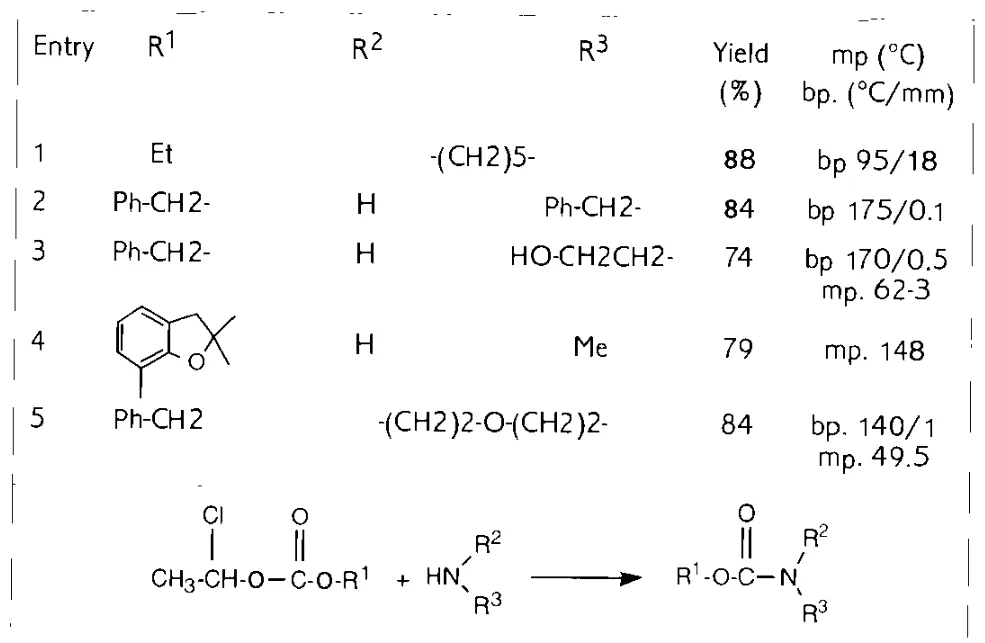
Table 3-27. Carbamates prepared from 1-chloroethyl carbonates.
Imidazole also reacts with 1,2,2,2-tetrachloroethyl-tert-butyl carbonate (I) or with 1-chloroethyl-tert-butyl carbonate (II) to give its tert-butyloxycarbonyl derivative in 50 and 86 % yield respectively as shown in scheme 148.
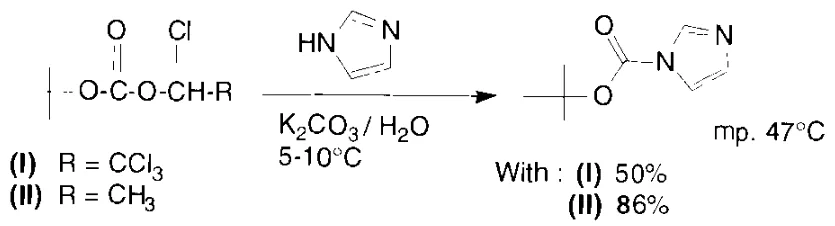
Scheme 148. Preparation of Boc-imidazole.
The application of the above method to the syntheses of insecticides carbamates Carbofuran (entry 4, table 3-27) and Aldicarbe was briefly studied. Thus, Carbofuran was readily obtained in 79% yield from 1-chloroethyl benzofuranyl carbonate which was itself obtained in 89% yield from the corresponding hydroxy benzofuran.
The method was also successfully applied to the reaction of 1-chloroethyl-S-ethyl thiocarbonate to give thiocarbamates, for example the herbicide Molinate as depicted in scheme 149.
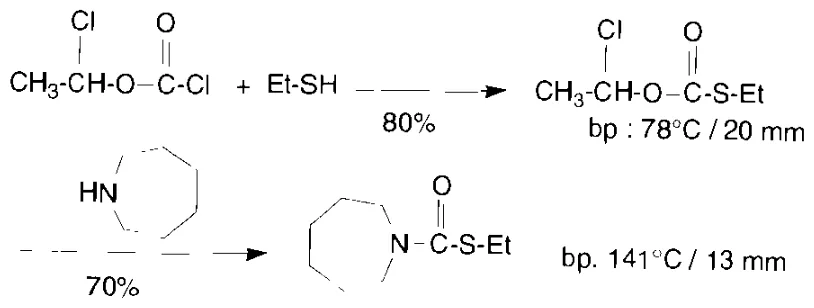
Scheme 149. New preparation of the herbicide Molinate.