Sijbren Otto - Catalysis of Diels-Alder Reactions in Water
This thesis describes a study of catalysis of Diels-Alder reactions in water. No studies in this field had been reported at the start of the research, despite the well known beneficial effects of aqueous solvents as well as of Lewis-acid catalysts on rate and endo-exo selectivity of Diels-Alder reactions in organic solvents. We envisaged that a combination of these two effects might well result in extremely large rate enhancements and improvements of the endo-exo selectivity.
In Chapter 1 mechanistic aspects of the Diels-Alder reaction are discussed. The literature on the effects of solvents and Lewis-acid catalysts on this reaction is surveyed. The special properties of water are reviewed and the effects of water on the Diels-Alder reaction is or are (in the editors’ view) discussed. Finally, the effect of water on Lewis acid - Lewis base interactions is described.
Chapter 2 describes the results of the first detailed study of Lewis-acid catalysis of a Diels-Alder reaction in water. Substituted 3-phenyl-1-(2-pyridyl)-2-propen-1-one dienophiles (1a-g in Scheme 1) were found to coordinate to Co2+, Ni2+, Cu2+ and Zn2+ ions in aqueous solution. This process forms the first step in the catalytic cycle shown in Scheme 1. The trend in the equilibrium constants for binding of 1 to these ions follows the empirical Irving-Williams series: Co2+ < Ni2+ < Cu2+ >> Zn2+. Upon binding to these Lewis acids, the dienophile is activated towards Diels-Alder reactions with cyclopentadiene (2) yielding products 3 as a mixture of racemic endo and exo adducts. The effect of Co2+, Ni2+, Cu2+ and Zn2+ ions on the second-order rate constants for the Diels-Alder reaction of 1 with 2 follows the Irving-Williams order.
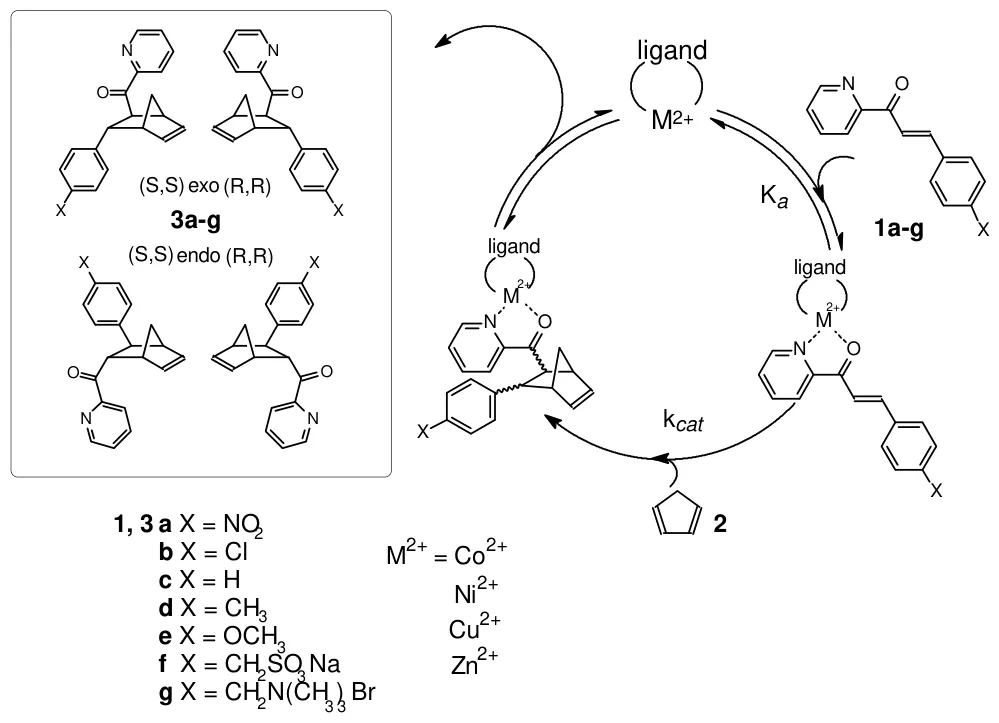
Scheme 1
The rate of the Lewis-acid catalysed Diels-Alder reaction in water has been compared to that in other solvents. The results demonstrate that the expected beneficial effect of water on the Lewis-acid catalysed reaction is indeed present. However, the water-induced acceleration of the Lewis-acid catalysed reaction is not as pronounced as the corresponding effect on the uncatalysed reaction. The two effects that underlie the beneficial influence of water on the uncatalysed Diels-Alder reaction, enforced hydrophobic interactions and enhanced hydrogen bonding of water to the carbonyl moiety of 1 in the activated complex, are likely to be diminished in the Lewis-acid catalysed process. Upon coordination of the Lewis-acid catalyst to the carbonyl group of the dienophile, the catalyst takes over from the hydrogen bonds an important part of the activating influence. Also the influence of enforced hydrophobic interactions is expected to be significantly reduced in the Lewis-acid catalysed Diels-Alder reaction. Obviously, the presence of the hydrophilic Lewis-acid diminished the nonpolar character of 1 in the initial state.
As expected, the solvent has a significant effect on the endo-exo selectivity of the uncatalysed Diels-Alder reaction between 1 and 2. In contrast, the corresponding effect on the Lewis-acid catalysed reaction is small. There is no beneficial effect of water on the endo-exo selectivity of the catalysed Diels-Alder reaction. The endo-exo selectivity in water is somewhat diminished relative to that in ethanol and acetonitrile.
We have also analysed the effect of substituents in the dienophile on: (1) the coordination behaviour to Co2+, Ni2+, Cu2+ and Zn2+ ions, (2) the rate constants of the Diels-Alder reaction with 2, catalysed by these ions and (3) the endo-exo selectivity of these reactions. The equilibrium constants for binding of 1 to Co2+, Ni2+, Cu2+ and Zn2+ increase with increasing electron donating character of the substituents, resulting in linear Hammett plots. Hence, as expected, the equilibrium constants for binding to the Lewis-acid increase with increasing Lewis-basicity of the dienophile. The Hammett ρ-values for the different metal ions follow the Irving-William or Irving-Williams (in the editors’ view) series. Satisfactory Hammett plots were obtained also for the second-order rate constants of the catalysed reaction. As expected for a normal electron demand Diels-Alder reaction, these rate constants increase with increasing electron withdrawing character of the substituents. The magnitudes of the ρ-values for the catalysed Diels-Alder reaction (0.72-0.94) are similar to those generally obtained for uncatalysed Diels-Alder reactions. This implies that the change in charge separation during the activation process of the catalysed reaction is comparable to that of the uncatalysed reaction. We conclude that the Lewis-acid catalysed Diels-Alder reaction between 1 and 2 is a concerted process. Finally, investigation of the Lewis-acid catalysed Diels-Alder reaction between 1a-e and 2 revealed that, as long as the reaction mixture is homogeneous, substituents do not affect the endo-exo selectivity significantly.
The solvent effect on the rate constants of the Diels-Alder reaction of the ionic dienophiles 1f and 1g with 2 has been studied. Interestingly, the beneficial influence of water on the rate of these reactions was comparable to that observed for the nonionic dienophiles. Apparently, a hydrophilic substituent remote from the reaction centre does not hamper the acceleration by water.
Chapter 3 describes an investigation into the effects of ligands on a Lewis-acid catalysed Diels-Alder in water. In the literature there are only a limited number of examples of systematic studies of ligand effects on Lewis-acid catalysed reactions in water. These studies mainly focus on the metal-ion catalysed decarboxylation of oxaloacetate. This reaction was observed to benefit from the presence of aromatic diamine ligands. This inspired us to investigate the influence of this class of ligands on the rate and endo-exo selectivity of the Lewis-acid catalysed Diels-Alder of 1 with 2. We have selected 2,2’-bipyridine and 1,10-phenanthroline as target ligands and have included ethylenediamine, dimethylethylenediamine and 2-(aminomethyl)pyridine for comparison purposes. Unfortunately, none of these ligands was capable of inducing a significant increase in the equilibrium constant (Ka) for binding of 1c to the Ni2+(ligand) and Cu2+(ligand) complexes. Upon addition of most ligands, the equilibrium constant Ka was reduced as compared to the value for the metal aquo ion, as expected on the basis of statistics. For most of the investigated diamine ligands, the rate constant (kcat) for the Diels-Alder reaction of the ternary ligand-metal ion-dienophile complex with 2 is comparable to kcat for the metal aquo ion. Deviations from this behaviour were observed only for Cu2+(2,2’-bipyridine) and Cu2+(1,10-phenanthroline) complexes. When compared to the copper(II) aquo ion these complexes exhibit a detrimental effect on both kcat and Ka, which is most likely a result of a steric interaction between the α-hydrogens of the pyridine rings of the ligand with the α-hydrogen of the pyridine ring of the dienophile.
Having ascertained that little was to be gained using diamine ligands, we extended the investigation to the effects of α-amino acid ligands. Since these ligands are chiral, this opens the possibility of enantioselective catalysis. To the best of our knowledge, in water no example of enantioselective Lewis-acid catalysis of a Diels-Alder reaction, nor of any other Lewis-acid catalysed organic reaction, has been published.
The influence of a large number of α-amino acids on the values of Ka and kcat have or has (in the editors’ view) been determined. These α-amino acids included: glycine, L-valine, L-leucine, L-phenylalanine, L-tyrosine, L-tryptophan, Nα-methyl-L-tryptophan (L-abrine), N-methyl-L-tyrosine, N,N-dimethyl-L-tyrosine and p-methoxy-N-methyl-L-phenylalanine.
The effects of these ligands on the second-order rate constants for the Cu2+(ligand) catalysed reaction of 1c with 2 are modest. In contrast, the effects on Ka are more pronounced. The aliphatic α-amino acids induce an approximately two-fold reduction of Ka relative to Ka for the Cu2+ aquo ion. For the square planar coordinated copper ions this effect is expected on the basis of statistics. The bidentate ligands block half the sites on the copper centre.
Interestingly, when aromatic α-amino acid ligands are employed, these compounds can induce a more than four-fold increase of Ka relative to Ka for the Cu2+ aquo ion. The enhanced stability of the ternary dienophile-Cu2+-aromatic α-amino acid complex is a result of an attractive interaction between the ligand and dienophile. Most likely an arene - arene interaction between the pyridine ring and the aromatic ring of the α-amino acid ligand is involved. This type of interaction is well-documented in aqueous coordination chemistry.
We envisaged that the arene - arene interaction may well shield one face of the dienophile from attack of the diene and consequently may induce enantioselectivity in this reaction. Indeed, in the presence of Cu2+(L-tryptophan), Diels-Alder adduct 3c was obtained in 25% enantiomeric excess (ee). The enantiomeric excess can be improved to 74% by introduction of a methyl substituents or substituent (in the editors’ view) on the α-nitrogen of L-tryptophan. The influence of the methyl substituent can be explained by considering the four different structures that can be envisaged for the ternary dienophile - Cu2+ - ligand complex (Scheme 2). These four structures result from two degrees of freedom: a cisoid - transoid equilibrium of the α,β-unsaturated ketone moiety in the dienophile and the possibilities of a cis and a trans geometry of the coordination environment around the copper(II) centre. Note that reaction of 1c through the cis-transoid and trans-cisoid complexes results in (R,R)-3c, whereas reaction through the trans-transoid and cis-cisoid complexes produces (S,S)-3c. The methyl substituent on the α-amino acid further disfavours the cis geometry around the copper ion as a result of a steric interaction with the α-hydrogen atom of the pyridine ring of the dienophile. Consequently, the reaction mainly proceeds through the trans geometry resulting in an increase of the enantioselectivity.
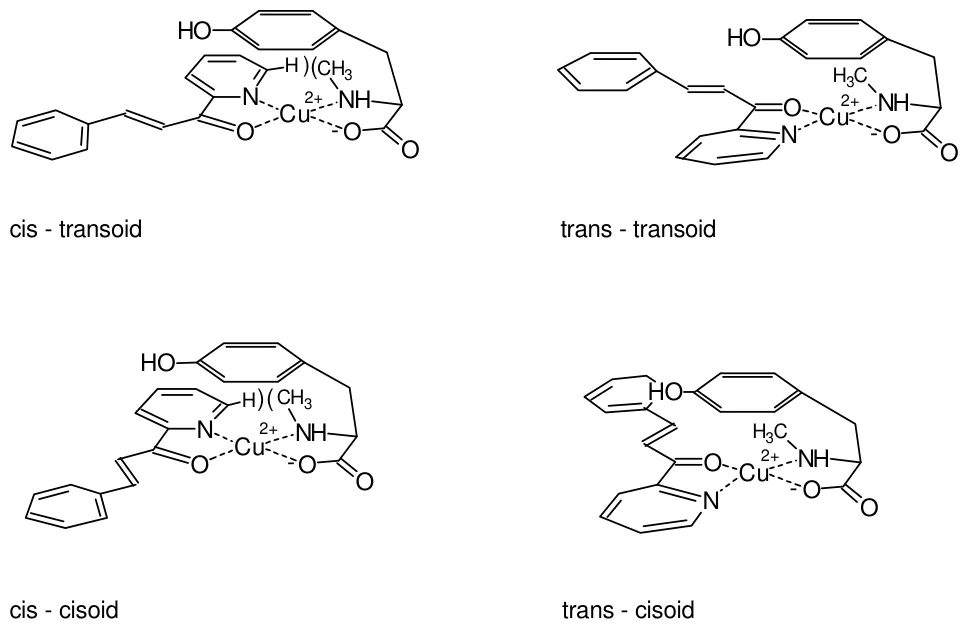
Scheme 2
We have investigated the effect of solvents on the enantioselectivity. It turned out that water (74% ee) favours the enantioselectivity of the Cu2+(L-abrine) catalysed Diels-Alder reaction between 1c and 2 as compared to chloroform (44% ee), ethanol (39% ee), THF (24% ee) and acetonitrile (17% ee). The beneficial influence of water might well be a result of a favourable influence of this solvent on the strength of the arene - arene interactions.
Finally, we have investigated the nature of the arene - arene interaction. This interaction is enthalpy driven and counteracted by entropy. This observation indicates that hydrophobic interactions are not the major driving force, although these interactions will inevitably contribute to the strength of the arene - arene interaction in water. Examination of the influence of substituents in the dienophile on Ka demonstrated that the strength of the arene - arene interaction is not significantly influenced by electron withdrawing or donating substituents. Also the enantioselectivity of the reaction is not significantly influenced by substituents. This behaviour appears to rule out an important role of donor-acceptor interactions. We contend that the arene - arene interaction is mainly governed by London-dispersion interactions and electrostatic forces.
The fact that, for the first time, enantioselectivity is observed in an organic reaction catalysed by a chiral Lewis-acid in water opens new possibilities. First of all, since the arene-arene interactions, that are underlying enantioselectivity of the particular Diels-Alder reaction described in this chapter, are also held responsible for the enantioselectivity in many other reactions involving chiral catalysts, we infer that the enhancement of enantioselectivity by water might well be a general phenomenon. Hence, future water-promoted enantioselectivity of other organic transformations is envisaged. Moreover, the use of water facilitates mechanistic studies of catalysed reactions and can be expected to contribute to a deeper understanding of the interactions underlying enantioselective catalysis. The extensive knowledge and large set of techniques of coordination chemistry in water can now be successfully employed in enantioselective catalysis.
The work that is described in Chapters 2 and 3 involves the Diels-Alder reactions of diene or dienophile (in the editors’ view) 1, that has been designed for bidentate coordination to Lewis-acid catalysts. The question arises whether the results obtained for this compound can be extended to other Diels-Alder reactions. This question is addressed in Chapter 4, in which attempts to catalyse Diels-Alder reactions of other potentially chelating dienophiles are described. Unfortunately, this approach was modestly successful. Apparently, coordination of organic molecules to Lewis acids in water is characterised by strict prerequisites. This conclusion called for an alternative approach of extending the scope of Lewis-acid catalysis of Diels-Alder reactions in water. We have made use of a strongly coordinating diamine auxiliary, which enables efficient coordination of the dienophile to the catalyst. A Mannich reaction is employed to covalently link the 2-(methylaminomethyl)pyridine auxiliary to benzylidene acetone as a model dienophile. Coordination of Cu2+ ion activated the adduct towards the Diels-Alder reaction with cyclopentadiene. Unfortunately, we did not succeed in the desired removal of the diamine auxiliary via a retro Mannich reaction. However, elimination of the diamine is possible, affording the Diels-Alder adduct which is functionalised by a vinyl group in 24 % overall yield.
Chapter 5 describes a study of the effect of micelles on the Diels-Alder reaction of 1 with 2. Literature studies on micellar catalysis of Diels-Alder reactions invariably failed to reveal significant accelerations. These results are unexpected, since most Diels-Alder reactants have a high affinity for micelles. Apparently binding of the reactants to the micelles does not lead to a significant acceleration of the reaction.
The results described in Chapter 5 provide an explanation for this intriguing behavior. This chapter describes a study of the effect of micelles of sodium dodecylsulfate (SDS), cetyltrimethyl-ammonium bromide (CTAB), dodecyl heptaoxyethylene ether (C12E7) and copper and zinc didodecylsulfate (M(DS)2) on the Diels-Alder reaction of 2 with 1a-g, containing neutral, cationic or anionic substituents. In the absence of catalytically-active transition-metal ions, micelles invariably retard the reaction. This can be rationalised on the basis of different binding locations of both reaction partners in the micelle. These binding sites have been probed using solubilisate-induced aromatic shifts on the 1H-NMR spectrum of the surfactant and paramagnetic counterion-induced relaxation enhancements of the 1H-NMR signals of the solubilisate.
These results can be extended to other Diels-Alder reactions. In view of the structures of most dienes and dienophiles a spatial separation of these compounds upon binding to micelles can be expected for the majority of Diels-Alder reactions. This arrangement most likely explains the unexpectedly small influence of micelles on the rates of Diels-Alder reactions as reported in the literature.
In contrast to SDS, CTAB and C12E7, Cu(DS)2 micelles catalyse the Diels-Alder reaction between 1 and 2 with enzyme-like efficiency, leading to rate enhancements up to 1.8·106 compared to the reaction in acetonitrile. This results primarily from the essentially complete complexation of 1 to the copper ions at the micellar surface. Comparison of the partition coefficients of 2 over the water phase and the micellar pseudophase, as derived from kinetic analysis using the pseudophase model, reveals a higher affinity of 2 for Cu(DS)2 than for SDS and CTAB. The inhibitory effect resulting from spatial separation of 1a-g and 2 is likely to be at least less pronounced for Cu(DS)2 than for the other surfactants.
We have demonstrated that due to inhomogeneous distribution of both reaction partners in the micelles, the pseudophase model leads to erroneous estimates of the second-order rate constant in the micellar pseudophase, so that conclusions regarding the medium of the reaction cannot be derived through this model. However, analysis of substituent effects and endo-exo ratios of the Diels-Alder adducts indicate that the reaction experiences a water-like medium.
In Chapter 6 we survey what has been accomplished and indicate directions for future research. Furthermore, we critically review the influence of water on Lewis acid - Lewis base interactions. This influence has severe implications for catalysis, in particular when hard Lewis acids and bases are involved. We conclude that claims of Lewis-acid catalysis should be accompanied by evidence for a direct interaction between catalyst and substrate.
Finally, we summarise our insight into hydrophobic effects that have developed during the work described in this thesis. The discussion focuses on the influence of hydrophobic effects on organic reactivity.