Sijbren Otto - Catalysis of Diels-Alder Reactions in Water
In Chapter 2 the Diels-Alder reaction between substituted 3-phenyl-1-(2-pyridyl)-2-propene-1-ones (3.8a-g) and cyclopentadiene (3.9) was described. It was demonstrated that Lewis-acid catalysis of this reaction can lead to impressive accelerations, particularly in aqueous media. In this chapter the effects of ligands attached to the catalyst are described. Ligand effects on the kinetics of the Diels-Alder reaction can be separated into influences on the equilibrium constant for binding of the dienophile to the catalyst (Ka) as well as influences on the rate constant for reaction of the complex with cyclopentadiene (kcat) (Scheme 3.5). Also the influence of ligands on the endo-exo selectivity are examined. Finally, and perhaps most interestingly, studies aimed at enantioselective catalysis are presented, resulting in the first example of enantioselective Lewis-acid catalysis of an organic transformation in water.
3.2.1 Effects of achiral ligands
At the outset of a systematic study of ligand effects on the Lewis-acid catalysed Diels-Alder reaction of 3.8 with 3.9 one can choose from an extensive set of ligands. The initial choice was inspired by the beneficial effect that had been reported for aromatic amine ligands in the transition metal ion-catalysed decarboxylation of oxaloacetate (see Section 3.1.1) and derivatives thereof. Particularly 1,10-phenanthroline (see Table 3.1) was observed to increase the catalytic efficiency. Consequently, the effect of this ligand was investigated. For comparison purposes a number of other diamines varying in the size of their aromatic system (2,2’-bipyridine, 2-aminomethylpyridine and ethylenediamine) were included. All these ligands are characterised by an extremely high affinity for the catalyst ions. The equilibrium constants for binding of these compound to the catalytically active metal ions are at least three orders of magnitude higher than those for binding of the dienophiles30.
In Chapter 2 it has been demonstrated that Co2+, Ni2+, Cu2+ and Zn2+ exhibit pronounced catalytic activity toward the Diels-Alder reaction under investigation. In aqueous solution these ions generally form octahedral complexes. Copper(II) ion occupies a special position among these catalysts. Due to the Jahn-Teller effect (see Section 2.2.4), coordination to the four equatorial sites is stronger than to the two remaining axial positions. Consequently, in the absence of special geometrical constraints in the ligands, four-coordinated copper(II) complexes are generally characterised by a square planar geometry. In contrast, there is usually no intrinsic preference for axial over equatorial coordination in Co2+, Ni2+ and Zn2+ complexes. In view of the higher catalytic activity of Ni2+ and particularly Cu2+ ions, research into the effect of ligands has focused on catalysis by these two ions.
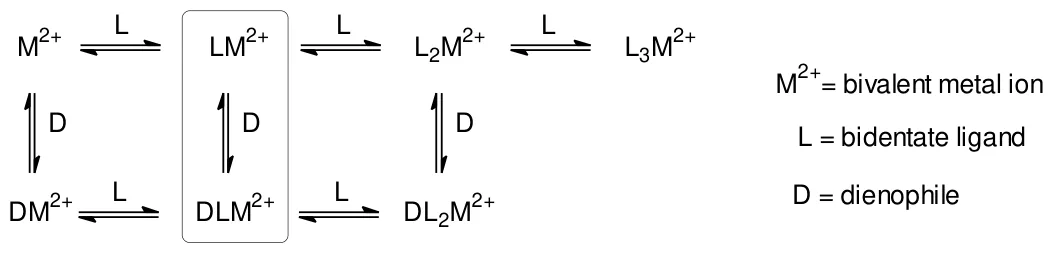
Scheme 3.6.
Measurements of rate and equilibrium constants that determine the efficiency of the catalysed Diels-Alder reaction were performed using UV-vis techniques, as described in Chapter 2. These techniques require the use of an excess of catalyst, resulting in catalyst concentrations typically in the order of several millimolar. Under these conditions it is assumed that there are only two catalyst species in solution: the ligand-metal ion complex and the ternary ligand-metal ion-dienophile complex (Scheme 3.6). This assumption greatly simplifies the analysis, but is essentially not correct. Inevitably, there is also a finite concentration of metal aquo ion as well as some metal ion coordinating two or three ligands. The relative amounts of these species are strongly pH-dependent, which even further complicates the analysis. Complete quantitative assessment of the composition of these mixtures is possible31 but, in view of the explorative character of the research, was not pursued.
Table 3.1 summarises the influence of the diamine ligands on the equilibrium constant for binding of 3.8c to the ligand-metal ion complex (Ka) and the second-order rate constant for reaction of the ternary complex (kcat) (Scheme 3.5) with diene 3.9.
Table 3.1 Influence of several diamine ligands on the equilibrium constant for binding of 3.8c to the ligand-metal ion complex (Ka) and the second-order rate constant for reaction of the ternary complex (kcat) with diene 3.9a.
| ligand | eq.b | Cu2+ | Ni2+ | ||
|---|---|---|---|---|---|
| Ka (M−1) | kcat (M−1s−1) | Ka (M−1) | kcat (M−1s−1) | ||
| “H2O” | 1.16·103 | 2.56 | 686 | 9.46·10−2 | |
| ethylenediamine | 1 | 4.58·102 | 2.91 | 437 | 9.76·10−2 |
| 2 | 136 | 8.73·10−2 | |||
| 2-(aminomethyl)pyridine | 1 | 3.74·102 | 3.12 | ||
| 2,2’-bipyridine | 1 | 1.78·102 | 0.838 | 519 | 7.43·10−2 |
| 2 | 337 | 1.02·10−1 | |||
| 1,10-phenanthroline | 1 | 1.78·102 | 0.626 | 565 | 8.20·10−2 |
| 2 | 372 | 9.03·10−2 | |||
| N,N’-dimethylethylenediamine | 1 | 4.12·102 | 2.46 | 800 | 9.75·10−2 |
| 2 | 693 | 8.19·10−2 | |||
a All measurements were performed at constant ionic strength (2.00 M using KNO3 as background electrolyte) and at pH 7-8. b Ligand-catalyst ratio.
From the data in Table 3.1 it can be concluded that binding of 3.8c to copper(II) ions is invariably hampered by the presence of the diamine ligands. On a simple statistical basis, a reduction of the equilibrium constant can be anticipated, since the ligand can be expected to block coordination sites on the metal ion. For square planar coordinated copper(II) ions, this effect will cause bidentate ligands to reduce Ka by 50%. The effects of ethylenediamine and dimethylethylenediamine can be explained on this statistical basis. 2,2’-Bipyridine and 1,10-phenanthroline, on the other hand, show a further reduction of the equilibrium constant for binding of the dienophile. An additional steric repulsion between the α-pyridine proton of the dienophile and an α-pyridine proton of the ligand might well be operative (Scheme 3.7). Note that in the ternary complex containing the 2-(aminomethyl)pyridine ligand, this interaction can be avoided by positioning the pyridine ring of the dienophile trans with respect to the ligand pyridine ring.
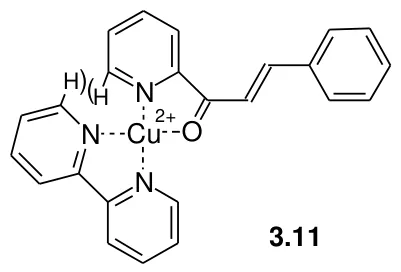
Scheme 3.7.
Interestingly, the rate constants for Diels-Alder reaction of the ternary complexes with 3.9 are remarkably similar. Only with 2,2’-bipyridine and 1,10-phenanthroline as ligands, a significant change in reactivity is observed. It might well be that the inability of these complexes to adopt a planar geometry hampers the interaction between the copper ion and the dienophile, resulting in a decrease of the rate of the catalysed Diels-Alder reaction.
When Ni2+ ion is used, a simple statistical argument predicts a bidentate ligand to reduce the equilibrium constant for binding of the dienophile by one third, if one equivalent of ligand is added, and by two thirds for two equivalents. When using ethylenediamine and 2,2’-bipyridine as ligands, this trend is observed. However, with N,N’-dimethylethylenediamine a different behaviour is encountered. One equivalent of this ligand raises Ka above the value for nickel aquo ion. It might well be that the methyl groups of the ligand hinder coordination of the water molecules in the two remaining equatorial positions of the complex, facilitating their displacement by the dienophile (Scheme 3.8). Note that the steric repulsion between the coordinated water molecules and the ligand methyl groups is likely to occur also for the corresponding copper complex. However, in that case, the pyridine ring of the dienophile, upon replacing a water molecule, will experience a similar repulsion, whereas in the nickel complex, this ring is free to occupy an axial position. The difference between the effects of 2,2’-bipyridine on the nickel and copper complexes can be explained using a similar argument. The availability of the axial positions in the nickel coordination sphere enables adoption of geometries where ligand and dienophile are in different planes, so that a steric clash of the pyridine α-hydrogens is avoided.
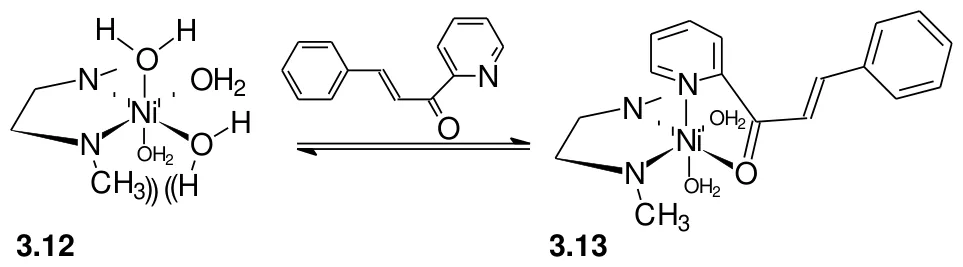
Scheme 3.8.
The rate of the Ni2+-catalysed Diels-Alder reaction is barely sensitive to the presence of ligands. Apparently no significant effect due to π-back donation is observed, in contrast to the effect of aromatic diamines on the metal-ion catalysed decarboxylation reaction of oxaloacetate (see Section 3.1.1).
In summary, for the most active of catalysts, the copper(II) ion, the diamine ligands that were investigated seriously hamper catalysis mainly by decreasing the efficiency of coordination of the dienophile. With exception of the somewhat deviant behaviour of N,N’-dimethylethylenediamine, this conclusion also applies to catalysis by Ni2+ ions. Hence, significant ligand-accelerated catalysis using the diamine ligands appears not to be feasible.
3.2.2 Effects of L-α-amino acid ligands - Stepping on the tail of enantioselectivity
The naturally occurring α-amino acids form a class of readily available strongly coordinating ligands, which exhibit broad structural variation. Moreover, their availability in enantiomerically pure form offers opportunities for enantioselective catalysis. Some derivatives of these compounds have been used successfully as chiral units in enantioselective catalysis in organic solvents (see Section 3.2.2 or Section 3.1.2 (in the editors’ view)). At neutral, or slightly acidic pH, α-amino acids tend to coordinate to transition metal ions in the deprotonated form, resulting in the formation of a five-membered ring, which is usually flat32.
The effect of a series of α-amino acids on the Diels-Alder reaction of 3.8 with 3.9 has been investigated. The results are shown in Table 3.2.
Table 3.2. Influence of several α-amino acid ligands on the equilibrium constant for binding of 3.8c to the ligand-Cu2+ complex (Ka) and the second-order rate constant for reaction of this ternary complex with diene 3.9 (kcat)a and the enantioselectivity of this reaction in waterb.
| ligand | Ka (M−1) | kcat (M−1s−1) | eec,26 (%) |
|---|---|---|---|
| “H2O” | 1.16·103 | 2.56 | - |
| glycine | 6.29·102 | 1.89 | - |
| L-valine | 5.71·102 | 1.90 | 3d |
| L-leucine | 5.14·102 | 2.01 | 3d |
| L-phenylalanine | 8.66·102 | 2.01 | 17 |
| L-tyrosine | 1.40·103 | 1.68 | 36 |
| N-methyl-L-tyrosine | 2.45·103 | 2.07 | 74 |
| N-methyl-p-methoxy-L-phenylalanine | 2.04·103 | 2.83 | 67 |
| N,N-dimethyl-L-tyrosine | 1.66·103 | 2.92 | 73 |
| L-tryptophan | 3.02·103 | 1.44 | 25d |
| 5-hydroxy-L-tryptophan | 4.89·103 | 1.15 | 29 |
| L-abrine | 5.05·103 | 1.47 | 74 |
a All measurements were performed at constant ionic strength (2.00 M using KNO3) as background electrolyte) and at pH 4.6-5.2. b 10 mol% Cu(NO3)2; 17.5 mol% ligand; conditions as outlined in the experimental section. c Only the results for the major (>90%) endo isomer of the Diels-Alder adduct are shown. d 250 mole % of catalyst was used.
The aliphatic α-amino acids induce a reduction of the equilibrium constant for binding of the dienophile to the copper ion by roughly 50 %, as anticipated on the basis of statistics. However, when L-phenylalanine is used as ligand, this reduction is significantly less pronounced. For L-tyrosine, L-tryptophan and derivatives thereof, the equilibrium constant is even larger than that of the copper aquo ion. Compared to the most bulky of the aliphatic α-amino acids, L-leucine (ΔG°compl = −15.5 kJ/mole), L-abrine (ΔG°compl = −21.1 kJ/mole) enhances the affinity of the catalyst for the dienophile by 5.6 kJ/mol. This enhancement cannot be attributed to a steric effect, since an increase of steric bulk (going from L-glycine, to L-valine, to L-leucine) leads to a modest reduction of Ka. Most likely, a specific interaction between the aromatic system of the α-amino acid ligand and that of the coordinated dienophile (arene-arene interaction33) is responsible for the enhanced stability of the ternary complex (see Scheme 3.9). This type of ligand - ligand interaction is well documented. The most relevant literature on this topic is summarised in Section 3.2.3.
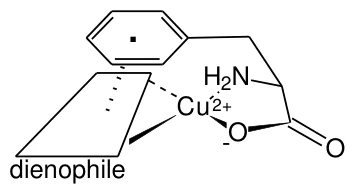
Scheme 3.9.
From the data in Table 3.2 it is apparent that almost all α-amino acid ligands induce a modest deceleration of the Diels-Alder reaction of 3.8c with 3.9. These ligands have a somewhat larger influence on the rate of the reaction than most of the diamines in Table 3.1. Most likely, this difference can be ascribed to the fact that the α-amino acids coordinate in the deprotonated form, whereas the diamine ligands are neutral. The negatively charged amino acid oxygen in the coordination sphere of the catalyst reduces its Lewis acidity. Fortunately, this effect is modest and for N-methyl-p-methoxy-L-phenylalanine and N,N-dimethyl-L-tyrosine even absent, so that under suitable conditions, ligand-accelerated catalysis by aromatic α-amino acids seems feasible.
3.2.3 Ligand - ligand interactions in ternary complexes - a literature survey
The enhanced stability of ternary complexes due to ligand - ligand interactions has been reported for an extensive set of complexes. Granot34 studied the complexes of catecholamines and divalent metal ion-coordinated ATP. From an analysis of the Gibbs energy, enthalpy and entropy changes upon complexation, he suggested the occurrence of ring stacking, predominantly driven by London dispersion interactions. Similar ligand-ligand interactions have been reported to occur in mixed ligand ATP - bivalent metal ion - 2,2’-bipyridine35, flavin mononucleotide - Cu2+ - 1,10-phenanthroline36 as well as ATP - bivalent metal ion - α-amino-acid complexes37. Kim and Martin38 investigated the interaction of the aromatic ring of phenylalanine and the aliphatic side chain of monodentate amines in square planar palladium(II) complexes. This interaction has been reported to stabilise the ternary complexes by maximally 2.3 kJ/mole. Attachment of a phenyl ring to the amine has been observed to increase the stabilisation by 0.3-1.5 kJ/mole.
Similar ligand-ligand interactions have been reported for a large number of ternary α-amino acid complexes, built up of two different amino acids. A compilation of 72 examples is presented in reference 39. The extra stabilisation due to ligand-ligand interactions in these complexes depends on the character of the amino-acid side chains and amounts to 0.34 - 0.57 kJ/mole for combinations of aromatic and aliphatic side chains and 0.11 - 6.3 kJ/mole when arene - arene interactions are possible39.
Sigel and co-workers40 investigated the interaction between the aromatic rings of phenyl carboxylates (Ph-(CH2)n-CO2−) and 1,10-phenanthroline in ternary copper(II) complexes. Variation of the number of methylene units between the aromatic ring and the carboxylate group (n=0-5) revealed that the arene - arene interaction is most pronounced for n=1. This interaction is more efficient in a 60% 1,4-dioxane-water mixture than in pure water41. Sigel et al.42 published a crystal structure of the complex with n=2, which revealed an edge-to-face orientation of the phenyl ring with respect to the 1,10-phenanthroline ring in a carboxylate bridged dinuclear complex. In the crystal, face-to-face stacking of the 1,10-phenanthroline ring with a neighbouring 1,10-phenanthroline ring was observed. Sigel et al.43 have also performed extensive structural variation of the aryl group in Ar-(CH2)n-CO2−. Ternary complexes of these ligands with copper and zinc ions and 1,10-phenanthroline, again, revealed that the most efficient arene - arene interactions occur for the carboxylate ligands containing one methylene group. Of the large set of different aryl carboxylates that has been investigated, the compounds with a naphthyl or indole ring turned out to produce the most stable ternary complexes.
Yamauchi and coworkers investigated the ternary complexes containing aromatic amines and aromatic α-amino acids. Structural variation of the amine as well as of the amino acid has been carried through43. The efficiency of the ligand - ligand interaction increased in the series phenylalanine < tyrosine < tryptophan < 5-hydroxytryptophan. Also an increase in the size of the π-system of the aromatic amine ligand enhanced the arene - arene interaction. In the extreme case of the 5-hydroxy-L-tryptophan - Cu2+ - 1,10-phenanthroline complex a stability increase of 12.7 kJ/mole was observed.
Interestingly, the magnitude of the ligand - ligand interaction in the 5-hydroxy-L-tryptophan - Cu2+ - 2-(aminomethyl)pyridine complex, can be compared with the corresponding complex of dienophile 3.8. For the former complex, Yamauchi43 obtained an interaction Gibbs energy of 4.7 kJ/mole, whereas from the data in Table 3.2, a value of 5.6 kJ/mol can be calculated. The modest difference between these two values might well result from the more extended π-system in 3.8 as compared to that of 2-(aminomethyl)pyridine.
Unfortunately, these ternary copper complexes are difficult to study using NMR techniques, due to the paramagnetic character of the copper(II) ion. However, the corresponding square planar Pd(II) complexes exhibit comparable ligand - ligand interactions and results of NMR investigations of these complexes have been published. Yamauchi et al.44 observed that, for complexes where arene - arene interactions are possible, the specific rotamer of the amino acid Cα-Cβ bond corresponding to a face-to-face orientation of the aromatic amine ligand and the aromatic ring of the amino acid is favoured. Further evidence for a specific arene - arene interaction comes from the 0.7-1.2 ppm shifts of the 1H-NMR signals of the amino acid ligand that are induced by the ring current of the diamine ligand44.
From the temperature dependence of the stability constants of a number of ternary palladium complexes involving dipeptides and aromatic amines, the arene - arene interaction enthalpies and entropies have been determined44. It turned out that the interaction is generally enthalpy-driven and counteracted by entropy. Yamauchi et al. hold a charge transfer interaction responsible for this effect. This suggestion is largely based upon the occurrence of a band at 300-350 nm in the UV spectrum45.
In their studies, Yamamauchi or Yamauchi (in the editors’ view) et al. also used dipeptides of aromatic amino acids and glycine or glutamic acid44. Ternary palladium complexes with the latter ligands exhibit reduced ligand - ligand interactions as compared to the glycine dipeptide complexes due to steric interactions between the side chains of dipeptide44. Using dipeptides containing two aromatic amino acid residues, structures have been suggested where the aromatic diamine is sandwiched between two aromatic rings46.
Recent investigation of the effect of substituents in the para position of the phenylalanine ligand on the stability of the ternary complexes has revealed the sequence Br > OH > Cl ≈ NH2 > H > F47. Interestingly, analysis of CD spectra indicates a reduction of the arene-arene interaction45 upon addition of 1,4-dioxane to aqueous solutions of the mixed-ligand complexes, in disagreement with previous observations by Sigel41.
Crystal structures of complexes of copper(II) with aromatic amine ligands and α-amino acids45,47,48 and dipeptides46 have been published. The structures of mixed ligand-copper complexes of L-tryptophan in combination with 1,10-phenanthroline and 2,2’-bipyridine and L-tyrosine in combination with 2,2’-bipyridine are shown in Figure 3.2. Note the subtle difference between the orientation of the indole ring in the two 1,10-phenanthroline complexes or L-tryptophan complexes (in the editors’ view). The distance between the two aromatic systems is comparable in both complexes: 3.67 Å in the 1,10-phenanthroline complex versus 3.51Å in the 2,2’-bipyridine complex.
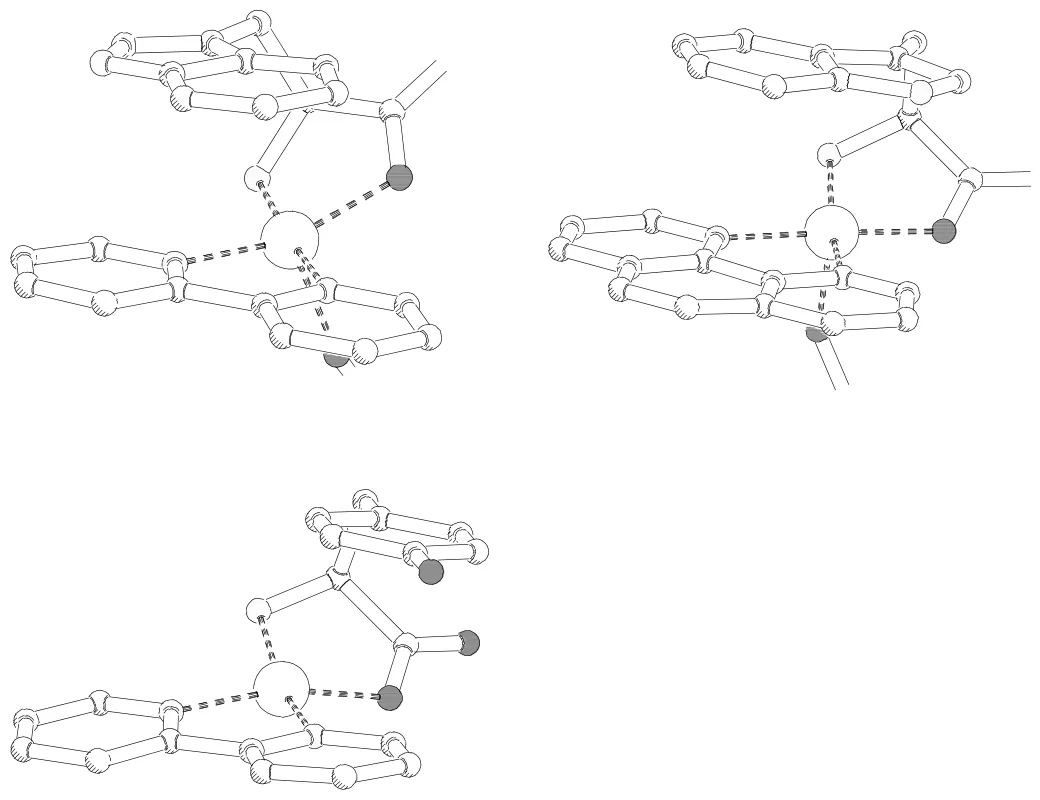
Figure 3.2. Crystal structures of (upper left) Cu(L-tryptophan)(2,2’bipyridine)ClO443; (upper right) Cu(L-Tryptophan)(1,10-phenanthroline)ClO4·2.5H2O46; and (lower) Cu(L-tyrosine)(2,2’-bipyridine)ClO4·2.5H2O45. The crystallographic data have been taken from the Cambridge Structural Database.
In summary, attractive ligand - ligand interactions in mixed ligand complexes are well documented. Compelling experimental evidence exists for this type of interaction in the solid state as well as in solution. Unfortunately, as yet no agreement exists on the nature of the interaction. However, some conclusions can be drawn which might prove to be helpful in future interpretations: (1) the arene - arene interactions are invariably enthalpy-driven and counteracted by a negative entropy change and (2) the substitution pattern on the aromatic ligands influences the interaction in a complicated fashion.
3.2.4 Effects of ligands on the endo-exo selectivity
The effect of ligands on the endo-exo selectivity of Lewis-acid catalysed Diels-Alder reactions has received little attention. Interestingly, Yamamoto et al.49 reported an aluminium catalyst that produces mainly exo Diels-Alder adduct. The endo-approach of the diene, which is normally preferred, is blocked by a bulky group in the ligand.
In contrast, investigation of the effect of ligands on the endo-exo selectivity of the Diels-Alder reaction of 3.8c with 3.9 demonstrated that this selectivity is not significantly influenced by the presence of ligands. The effects of ethylenediamine, 2,2’-bipyridine, 1,10-phenanthroline, glycine, L-tryptophan and L-abrine have been studied. The endo-exo ratio observed for the copper(II)-catalysed reaction in the presence of these ligands never deviated more than 2% from the endo-exo ratio of 93-7 obtained for catalysis by copper aquo ion.
3.2.5 Enantioselective catalysis
The attractive interaction between the aromatic ring of the dienophile and the aromatic group of the chiral α-amino acid ligands in ternary copper(II) complexes might well lead to shielding of one face of the dienophile to approach by the diene. This prompted an investigation of the effect of these ligands on the enantioselectivity of the copper(II)-catalysed Diels-Alder reaction of 3.8 with 3.9. Indeed, it turned out that the Diels-Alder products can be obtained in quantitative yield in upto or up to (in the editors’ view) 74% enantiomeric excess (see Table 3.2)50. Analogous studies of the nickel(II)-catalysed Diels-Alder reaction failed to induce significant enantioselectivity, which is not surprising in view of the large number of conceivable geometries of the ligand - nickel(II) - dienophile complex. Moreover, preliminary studies demonstrated that the arene - arene interaction is less pronounced for ternary nickel(II) complexes than for the corresponding copper(II) complexes51.
To the best of our knowledge the data in Table 3.2 constitute the first example of enantioselectivity in a chiral Lewis-acid catalysed organic transformation in aqueous solution. Note that for the majority of enantioselective Lewis-acid catalysed reactions, all traces of water have to be removed from the reaction mixture. Only in a limited number of reactions are small amounts of water tolerated29,52. In exceptional cases one or a few equivalents of water have been reported to induce modest enhancements of the enantioselectivity53.
The fact that enantioselective Lewis-acid catalysis of the Diels-Alder reaction between 3.8 and 3.9 in water is feasible has some pleasing consequences. It allows detailed investigation of the mechanism underlying enantioselectivity. In organic solvents these investigations are usually extremely complicated due to processes such as ion pairing and clustering of catalytically active species. These complications are generally not encountered in aqueous solution. The strong interactions between water and the reacting species that normally hamper catalysis by hard Lewis acids now turns into a significant benefit. For the first time a Lewis-acid catalysed reaction is available that allows easy and quantitative access to the relevant mechanistic parameters underlying enantioselective catalysis.
One example has already been encountered in the form of the binding constants in Table 3.2. These data form one of the first examples of compelling evidence for the involvement of attractive arene - arene interactions in determining the outcome of enantioselective catalysis. These attractive interactions have been frequently invoked as explanations for the observed enantioselectivities of Diels-Alder reactions25,54 and other transformations55. Unfortunately, experimental evidence for these interactions is often only indirect54a,56.
Despite the availability of relevant mechanistic parameters in the form of the rate constants and binding constants in Table 3.2, rationalisation of the observed enantioselectivities is still rather complicated and therefore some additional information has been gathered.
First, the pH-dependence of the enantioselectivity of the reaction between 3.8c and 3.9 catalysed by the copper(L-tryptophan) complex has been studied. Above pH 5 the enantioselectivity reaches a plateau value (Figure 3.3). The diminished enantioselectivities observed at lower pH most likely result from protonation of the carboxylic acid group of the α-amino acid, which decreases the affinity of this ligand for the copper(II) ion and consequently favours catalysis by the achiral copper aquo ion. Furthermore, protonation of the pyridine ring of 3.8c will result in Brønsted-acid catalysis of the reaction, leading to a racemic product mixture. Also the catalyst : dienophile ratio has been varied from 8 mM : 1 mM to 1 mM : 10 mM. Interestingly, this change did not significantly alter the enantioselectivity of the copper(L-tryptophan)-catalysed reaction, despite the fact that the former solution is homogeneous and the latter is heterogeneous. This is a strong indication that, as anticipated, the Diels-Alder reaction proceeds through the ternary dienophile - copper(II) - ligand complex and also that no displacement of the ligand by the dienophile takes place.
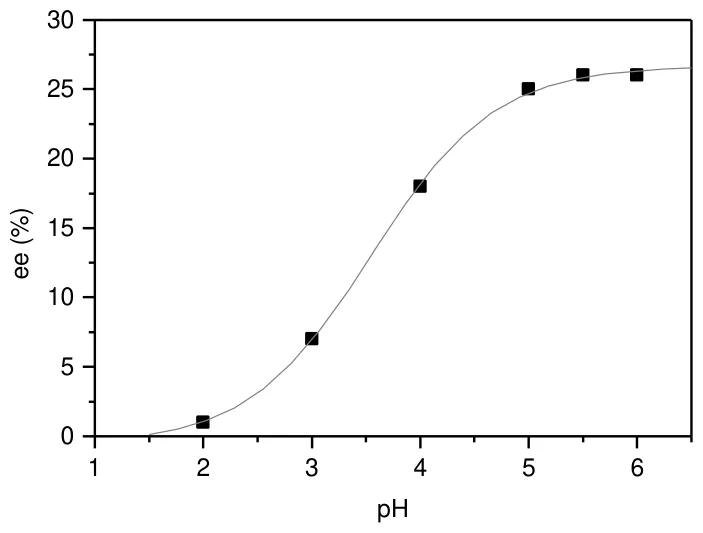
Figure 3.3. Enantiomeric excess of the Diels-Alder reaction of 3.8c with 3.9 as a function of the pH.
Likewise, the influence of the ligand : catalyst ratio has been investigated. Increase of this ratio up to 1.75 : 1 resulted in a slight improvement of the enantioselectivity of the copper(L-tryptophan)-catalysed Diels-Alder reaction. Interestingly, reducing the ligand : catalyst ratio from 1:1 to 0.5 : 1 resulted in a drop of the enantiomeric excess from 25 to 18 % instead of the expected 12.5 %. Hence, as anticipated, ligand accelerated catalysis is operative.
Finally the influence of the temperature and addition of ethanol on the enantioselectivity of the Diels-Alder reaction was studied. Table 3.3 summarises the results for different aqueous media. Apparently, changes in temperature as well as the presence of varying amounts of ethanol have only a modest influence on the selectivity of the Cu(tryptophan)-catalysed Diels-Alder reaction in aqueous solution. However, reaction times tend to increase significantly at lower temperatures. Also increasing the alcohol content induces an increase of the reaction times.
Table 3.3. Influence of temperature and ethanol content on the enantiomeric excessa of the Diels-Alder reaction between 3.8c and 3.9 catalysed by [Cu(L-tryptophan)]+ in aqueous solutionsb; ethanol / water (v/v).
| temperature (°C) | 75 / 25 | 50 / 50 | 25 / 75 | 0 / 100 | ||||
|---|---|---|---|---|---|---|---|---|
| ee(%) | time (h) | ee(%) | time (h) | ee(%) | time (h) | ee(%) | time (h) | |
| 20 | 23 | 2 | 20 | 1 | 23 | 0.7 | 25 | <0.7 |
| 0 | 28 | 1 | ||||||
| −20 | 27 | 48 | ||||||
| −40 | 30 | 72 | ||||||
a Only the results of the major (>90%) endo isomer of the Diels-Alder adduct are shown. b Conditions: [Cu(NO3)2] = 1.0 mM; [L-tryptophan] = 1.0 mM; [3.8c] = 10 mM; [3.9] = 24 mM.
In summary, when using a ligand : catalyst ratio of 1.75 : 1 at pH 5-6 the enantioselectivity of the Diels-Alder reaction between 3.8c and 3.9 is dictated by the activated complexes involving ligand, copper(II) ion, dienophile and diene. Considering that four different products are formed in this reaction (see Scheme 3.5), at least four different activated complexes are involved. However, each of these complexes has two degrees of freedom that determine the stereochemical outcome of the reaction: (1) the dienophile can coordinate in either the transoid or the cisoid conformation (3.14a,b or 3.14c,d in Scheme 3.10, respectively) and (2) the coordination environment of the copper ion is characterised by either a cis or a trans geometry (3.14a,c or 3.14b,d, respectively). Hence, the reaction can proceed through a total of 16 different activated complexes. When focusing on the major (>90%) endo isomer, still 8 different reaction pathways are conceivable, corresponding to (endo) approach of the diene on either the lower or upper face of complexes 3.14a-d. It is highly probable that enantioselectivity arises from shielding of the upper side of these complexes by the aromatic ring of the α-amino-acid ligand. Consequently, attack of the diene is likely to occur predominantly from the lower face. Hence, complexes 3.14a and d can be expected to give predominantly (R,R)-endo-3.10c, whereas 3.14b and c will yield the corresponding (S,S)-enantiomer.
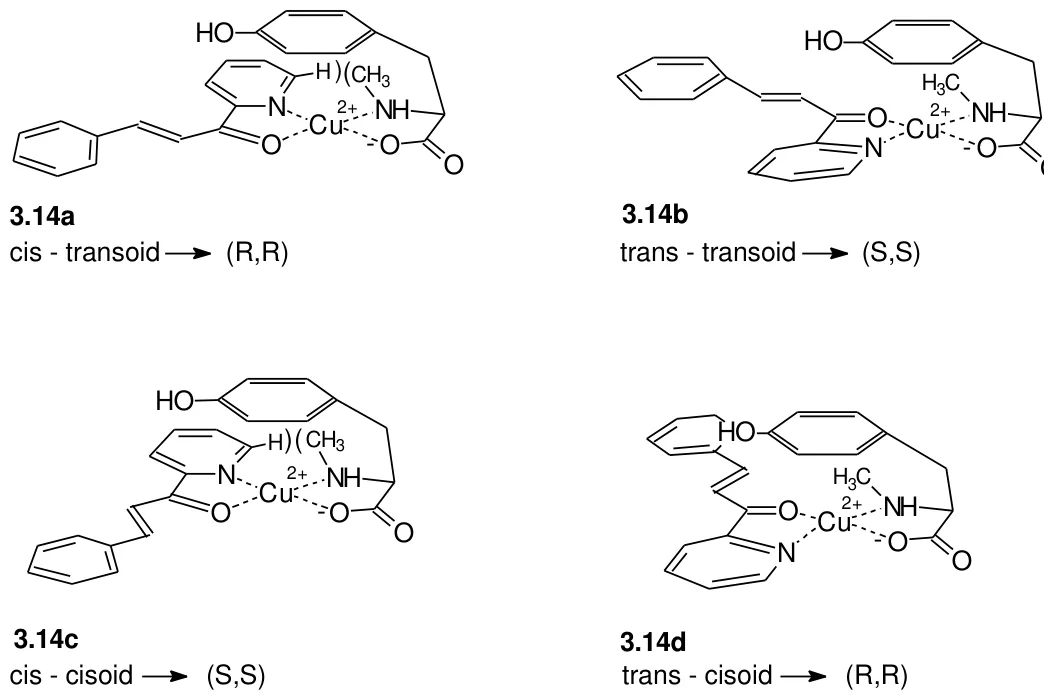
Scheme 3.10.
For elucidating the course of the reaction, insight into factors that influence the position of the cisoid - transoid conformational, and cis - trans geometric equilibria is required. The literature on enantioselective Lewis-acid catalysed Diels-Alder reactions seems to point towards a general preference for the transoid conformation in the reaction of α,β-unsaturated esters20b,57. In contrast, Evans proposed that the oxazaborolidine-catalysed or bis(oxazoline)-catalysed (in the editors’ view) Diels-Alder reaction depicted in Scheme 3.4 features the α,β-unsaturated N-acyloxazolidinone dienophile in the cisoid conformation28. Interestingly, Corey et al.54a suggested that the chiral titanium catalysed Diels-Alder reactions of a number of related oxazolidinones proceed through the transoid conformer58. In conclusion, no reliable prediction can be made concerning the cisoid - transoid conformational equilibrium of 3.8 at this stage. Experiments using the copper(II)bisoxazoline 3.6 as catalyst for the Diels-Alder reaction between 3.8c and 3.9 in anhydrous dichloromethane resulted in 16% ee of the same enantiomer as the one that is obtained in excess in the copper(II)(α-amino-acid) catalysed reaction in water. Assuming the catalyst dictates the conformation of the α,β-unsaturated ketone, this result suggests reaction of 3.8c in water via the transoid conformation.
Fortunately, the experimental and literature data allow a more definite statement concerning the cis - trans geometric equilibrium. The large influence of a methyl substituent located on the α-amino-acid amine group on the enantioselectivity of the Diels-Alder reaction of 3.8c with 3.9 forms the key to this problem. The cis complexes 3.14a and 3.14c most likely experience a steric repulsion between the pyridine α-hydrogen atom of the dienophile and the methyl group of the α-amino acid. This repulsion is absent in the trans complexes 3.14b and 3.14d. Hence, the methyl substituent in the α-amino acid ligand induces a preference for a trans geometry in the ternary complex.
This interpretation is supported by literature studies on copper(II) complexes containing two α-amino-acid ligands. For N-unsubstituted α-amino-acid ligands, deductions as to position of the cis - trans geometrical equilibrium in solution are difficult as illustrated by the fact that for some α-amino acids solid complexes have been isolated of both the cis and trans geometry32. In contrast it seems as if copper(II) complexes containing two N-alkylated α-amino-acid ligands crystallise exclusively in the trans form59.
Interestingly, the N-methylated aromatic α-amino acids increase the affinity of the catalyst for the dienophile (see Table 3.2). One might envisage three effects that could be responsible for this behaviour. Possibly, in the ternary complex the N-methyl group forces the aromatic ring of the α-amino acid more towards the pyridine ring of the dienophile. Another explanation involves a steric interaction between the N-methyl group of the α-amino acid ligand and the water molecule that is coordinated in the apical position. This interaction facilitates the displacement of this water molecule which is required in order for the arene - arene interaction to occur. Finally, there are indications that the arene - arene interactions are most favourable for the trans complex (see Figure 3.2). If the methyl groups are able to force the dienophile into a complete trans coordination, this may well result in an enhanced stability of the ternary complex.
In conclusion, the Diels-Alder reaction of 3.8c with 3.9 most likely proceeds largely through either complex 3.14b or 3.14d, which differ in the orientation of the reacting double bond with respect to the carbonyl group and, more importantly, differ in the absolute configuration of the major Diels-Alder adduct that is produced. If insight into this absolute configuration could be obtained, the reaction pathway leading to the major product could be identified. Unfortunately, despite extensive efforts, this problem has not yet been solved.
3.2.6 Solvent effect on the enantioselectivity
Having available, for the first time, a reaction that is catalysed by Lewis acids in water in an enantioselective fashion, the question rises how water influences the enantioselectivity60. Consequently, the copper(II) catalysed reaction between 3.8c and 3.9 in the presence of L-tryptophan and L-abrine has been performed in a number of organic solvents. To reduce the influence of ion pairing28b, we used the copper(II)triflate instead of copper(II)nitrate in the organic solvents. For deprotonation of the α-amino-acid ligand, triethylamine was used instead of sodium hydroxide, which is employed in aqueous media. Table 3.4 summarises the results.
Table 3.4. Enantiomeric excess and reaction times of the copper(L-abrine)-catalysed Diels-Alder reaction of 3.8c with 3.9 in different solvents at 0 °C.
| solvent | time (days) | ee(%)c |
|---|---|---|
| watera | 3 | 74 |
| ethanolb | 10 | 39 |
| acetonitrileb | 7 | 17 |
| THFb | 8 | 24 |
| chloroformb | 11 | 44 |
a Conditions: [Cu(NO3)2] = 1.0 mM; [L-abrine] = 1.75 mM; [3.8c] = 10 mM; [3.9] = 24 mM. One equivalent of NaOH was used to deprotonate the amino acid. b Conditions: [Cu(OTf)2] = 1.0 mM; [L-abrine] = 1.75 mM; [3.8c] = 10 mM; [3.9] = 80 mM. One equivalent of triethylamine was used to deprotonate the amino acid. c Only the results of the major (>90%) endo isomer of the Diels-Alder adduct are shown.
Note that the reaction time in water is considerably shorter than that in organic solvents, despite the fact that the concentration of diene used for the reaction in water was less than one third of that for the reaction in the organic solvents. Contrary to the organic solvents, the reaction mixture in water is heterogeneous. It might well be that the low solubility of the Diels-Alder product (3.10c) in this solution reduces inhibition of the reaction by this compound. Consequently, product inhibition is likely to be more pronounced in the organic media.
Due to the prolonged reaction times in organic solvents, dimerisation of the diene occurs during the reaction, resulting in contaminated product mixtures after work-up. In contrast the reactions in water yield quantitatively the 1H-NMR-pure Diels-Alder adducts.
Most importantly, enantioselectivity benefits considerably from the use of water. This effect could be a result of water exerting a favourable influence on the cisoid - transoid equilibrium. Unfortunately, little is known of the factors that affect this equilibrium. Alternatively, and more likely, water enhances the efficiency of the arene - arene interactions. There is support for this observation34,61. Since arene-arene interactions are held responsible for the enantioselectivity in many reactions involving chiral catalysts, we suggest that the enhancement of enantioselectivity by water might well be a general phenomenon.
Assuming London-dispersion and electrostatic interactions to be dominant in arene - arene interactions (see Section 3.2.7), the solvent effect on the enantioselectivity is anticipated to be influenced by the polarisability and polarity of the solvent. The arene -arene interaction is inferred to be most efficient in solvents that are characterised by weak London-dispersion interactions (low polarisability). Note that water has an exceptionally low polarisability (α = 1.44 versus 4.41 - 8.53 for the other solvents in Table 3.4)62. Unfortunately, no satisfactory correlation between solvent polarisability and the solvent effect on enantioselectivity is observed. Particularly the relatively high enantioselectivity of the Diels-Alder reaction in chloroform (α = 8.53) is in discord with an important role of the polarisability in diminishing arene - arene interactions. However, since the arene - arene interaction is accompanied by displacement of a solvent molecule from the apical position of the copper ion, it might well be that poorly coordinating solvents, such as chloroform, have an intrinsic advantage over coordinating solvents. Likewise solvent polarity can be expected to affect the electrostatic component of the arene - arene interaction, but again, no satisfactory correlation between enantioselectivity and the ET(30) solvent polarity parameter was observed. Unfortunately a two-parameter analysis using both solvent polarisability and solvent polarity also failed.
Clearly, complete understanding of solvent effects on the enantioselectivity of Lewis-acid catalysed Diels-Alder reactions has to await future studies. For a more detailed mechanistic understanding of the origins of enantioselectivity, extension of the set of solvents as well as quantitative assessment of the strength of arene - arene interactions in these solvent or solvents (in the editors’ view) will be of great help.
3.2.7 Investigations into the nature of the arene - arene interaction
Arene - arene interactions are emerging as important contributors to not only the enantioselectivity of organic reactions63, but also to molecular recognition64 and protein folding65. Likewise arene - arene interactions are involved in determining the structure of nucleic acids66. The nature of these interactions is still a matter of considerable controversy. Or, as Hunter67 puts it: “When molecular scientists obtain an unexpected result in a system which contains π-systems, they tend to invoke the mythical powers of the π-π interaction, π-stacking, charge transfer, π-acid/π-base or electron donor - acceptor interaction.”. Even the geometry in which the arene groups interact most efficiently is still under debate. For the benzene dimer, computer simulations and experimental results indicate that an edge-to-face orientation is favoured over the face-to-face, or stacked geometry68. On the basis of Monte-Carlo simulations, Jorgensen et al.68 conclude the same preference for the edge-to-face arrangement for the benzene dimer in water. Comparison of the results obtained for water with calculations for chloroform and benzene as solvents demonstrated that the formation of a dimer is more favourable in aqueous solution than in the organic solvents. Interestingly, upon increasing the size of the aromatic ring system, the stacked structures become increasingly favourable68. In contrast, recent gas-phase calculations by Jaffe and Smith69 identified the face to face geometry of the benzene dimer as the most favourable.
A number of different types of interactions have been suggested as contributing to the arene -arene interactions. London dispersion forces are likely to be of influence69,70. Also hydrophobic interactions may be important71. Finally, electrostatic interactions as well as donor acceptor interactions have been invoked67,72. The distinction between the latter is largely based upon the influence of substituents: donor - acceptor interactions are favoured by electron withdrawing substituents on one ring and electron donating substituents on the other, whereas purely electrostatic interactions are favoured by the presence of electron withdrawing substituents on both rings that reduce the repulsion between the π-electron clouds in a face-to-face arrangement.
In an elegant study, Gellman et al.73 analysed the conformation of diaryl compounds 3.15 and 3.16 (Scheme 3.11). NMR investigations revealed that 3.15 exhibits considerable stacking propensity, whereas no evidence for a naphthyl - naphthyl association could be detected for 3.16. The absence of stacking in 3.16 was interpreted as evidence against the importance of hydrophobic interactions. Gellman et al.73 ascribed the arene - arene interaction in 3.15 to electrostatic interactions between partial charges in the aromatic rings. Surprisingly, in a recent study of the conformation of 3.17, Gellman et al.74 assumed that the observed stacking in this compound is completely driven by hydrophobic interactions, despite poor correlation between Gibbs energies of hydration of the R substituent and the tendency for stacking.
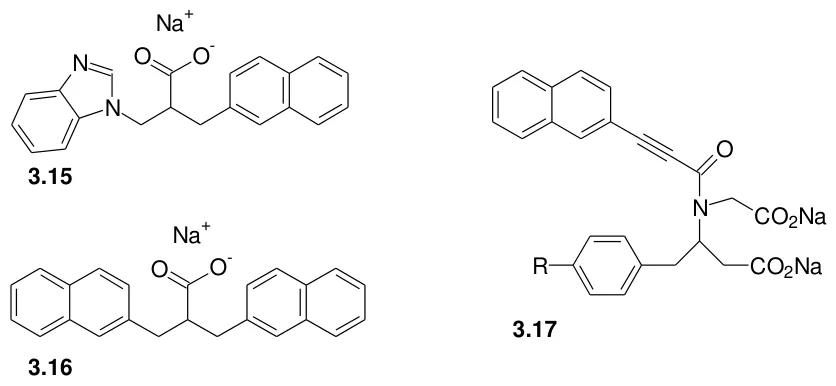
Scheme 3.11.
The literature on arene - arene interactions in ternary metal-ion complexes, as reviewed in Section 3.2.3, indicates that these interactions are generally enthalpy-driven and counteracted by a reduction of the entropy34,37a,41,44. We have determined the changes in enthalpy and entropy for the process of binding of 3.8c to a number of copper(II)-amino acid complexes from temperature dependent measurements of the equilibrium constants. The results are summarised in Table 3.5.
Table 3.5. ΔG°, ΔH° and ΔS° for the binding of 3.8c to different copper(II)-amino acid complexes in water at 25 °C at pH 5-6.
| α-amino acid | ΔG° (kJ/mole) | ΔH° (kJ/mole) | TΔS° (kJ/mole) |
|---|---|---|---|
| - | −17.7 | −18.7 | −1.0 |
| glycine | −16.0 | −14.1 | 1.9 |
| L-tryptophan | −19.9 | −25.0 | −5.1 |
| L-abrine | −21.1 | −34.0 | −12.9 |
Clearly, the same picture emerges of enthalpy-driven and entropy-counteracted arene - arene interactions. These data are hard to reconcile with a hydrophobic driving force, since at room temperature, in the absence of cosolutes, hydrophobic interactions are normally driven by the gain in entropy upon release of water molecules from hydrophobic hydration shells (see Section 1.3). Note, however, that examples are known of enthalpy-driven hydrophobic interactions75. These processes involve binding of a nonpolar solute in a nonpolar cavity. In that case an enthalpy gain upon binding is expected, since filling the cavity with water molecules is inevitably accompanied by a sacrifice of hydrogen bonds (endothermic). Hence, expelling the water molecules from the cavity into bulk solution will be exothermic.
In contrast, the hydration of the aromatic side chains of α-amino acids is characterised by a reduction of entropy, and, judging from the modest enthalpy change upon transfer from the gas phase to water, no significant breaking of hydrogen bonds takes place76. Likewise, the hydration of a pyridine rings or pyridine rings (in the editors’ view) is generally characterised by a significant decrease in entropy76b,c. At the onset of an arene - arene interaction, partial dehydration of the aromatic groups has to take place, which will inevitably be characterised by a gain in entropy. Hence, a hydrophobic contribution in the arene - arene interaction is anticipated to reveal its presence in the entropy term. Apparently, this entropy gain is overwhelmed by another effect. Hence, the hydrophobic interaction is not the major driving force for the arene - arene interactions, although it is anticipated to contribute to some extent.
An alternative driving force could involve a donor - acceptor interaction. The electron-poor pyridine ring that is coordinated to the copper cation can act as electron acceptor with respect to the aromatic ring of the α-amino acid. The fact that donating substituents on the amino acid increase the efficiency of the arene - arene interaction (Table 3.2) seems to support this view. Furthermore, a charge transfer band is observed between 300 and 400 nm for the complexes that exhibit efficient arene - arene interactions (Figure 3.4)77. This observation demonstrates that the orbitals of the dienophile and the α-amino acid ligand are sufficiently close for overlap. As correctly pointed out by Cozzi et al.78, the occurrence of a charge transfer band in itself cannot be considered as evidence for a donor - acceptor interaction. This band owes its existence to the possibility of forming a charge-separated excited state, which normally contributes little to ground-state stability.
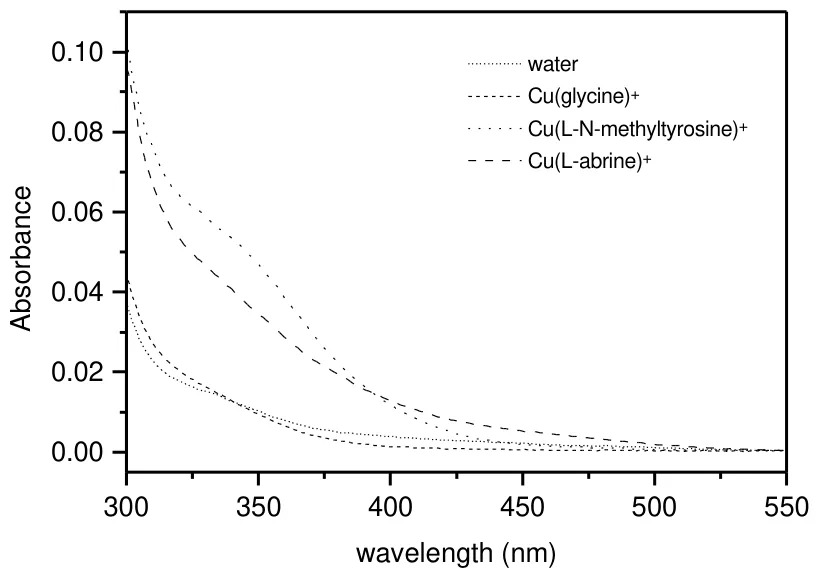
Figure 3.4. UV-vis absorption spectra of 3.10c in water and in water containing 3.0 mM of Cu(glycine) complex, 3.0 mM of Cu(N-methyl-L-tyrosine) and 3.0 mM of Cu(L-abrine).
When a donor - acceptor interaction is operative, one would expect that electronic effects of substituents on the dienophile will affect this interaction. Consequently, one might anticipate an increase of the substituent effect on the equilibrium constant for binding of the dienophile to the copper(ligand) complex for aromatic amino acids beyond the value that is obtained for binding to the copper aquo ion. Surprisingly, no indication for such behaviour is observed. A plot of the Gibbs energies of complexation of 3.8a-g to the copper(II)(L-tryptophan) complex versus those for binding to the copper aquo ion is shown in Figure 3.5. A straight line is obtained with a slope of 1.01 (r=0.999). Evidently, the Hammett ρ-values describing the substituent effect on binding of the dienophile to the copper(L-tryptophan) complex (−0.52) is, within experimental error, equal to that for binding to the copper aquo ion (−0.51). This correlation demonstrates that substituents on the phenyl ring of the dienophile do not have a significant influence on the magnitude of the arene - arene interaction. Also the enantioselectivity of the reaction of 3.8b79 and 3.8g with 3.9 catalysed by copper(L-abrine) in water is, within experimental error, equal to the enantioselectivity observed for 3.8c.
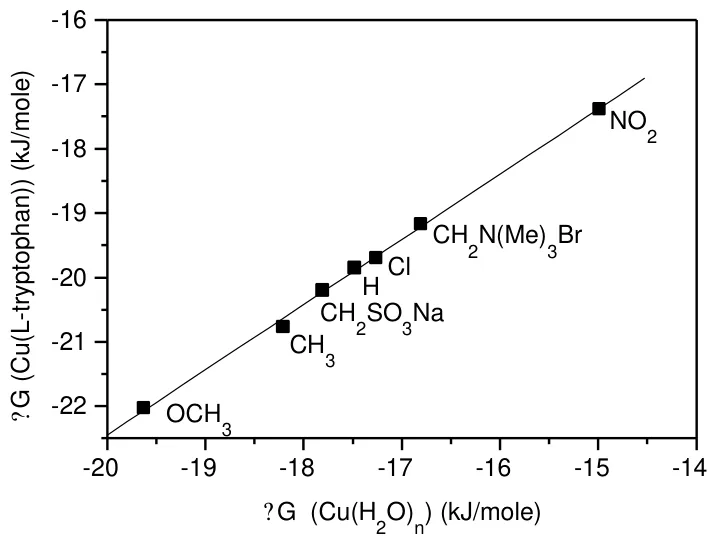
Figure 3.5. Gibbs energies of complexation of 3.8a-g to the copper(II)(L-tryptophan) complex versus those for complexation to copper aquo ion.
From the absence of a significant substituent effect on the complexation as well as the enantioselectivity, we conclude that the arene - arene interaction is not driven by a donor - acceptor interactions or a donor - acceptor interaction (in the editors’ view).
In summary, there are indications that neither hydrophobic interactions, nor donor- acceptor interactions are predominantly driving the arene - arene interaction. Consequently, we contend that these interactions are mainly governed by London - dispersion and electrostatic forces.
The beneficial effect of water in the arene - arene interaction can be explained by the fact that this solvent is characterised by a low polarisability so that interactions of the aromatic rings with water are less efficient than with most organic solvents. Also the high polarity of water might lead to a polarisation of the aromatic rings, thereby enhancing electrostatic interactions. Finally, hydrophobic interactions may be expected to play a modest role.