Sijbren Otto - Catalysis of Diels-Alder Reactions in Water
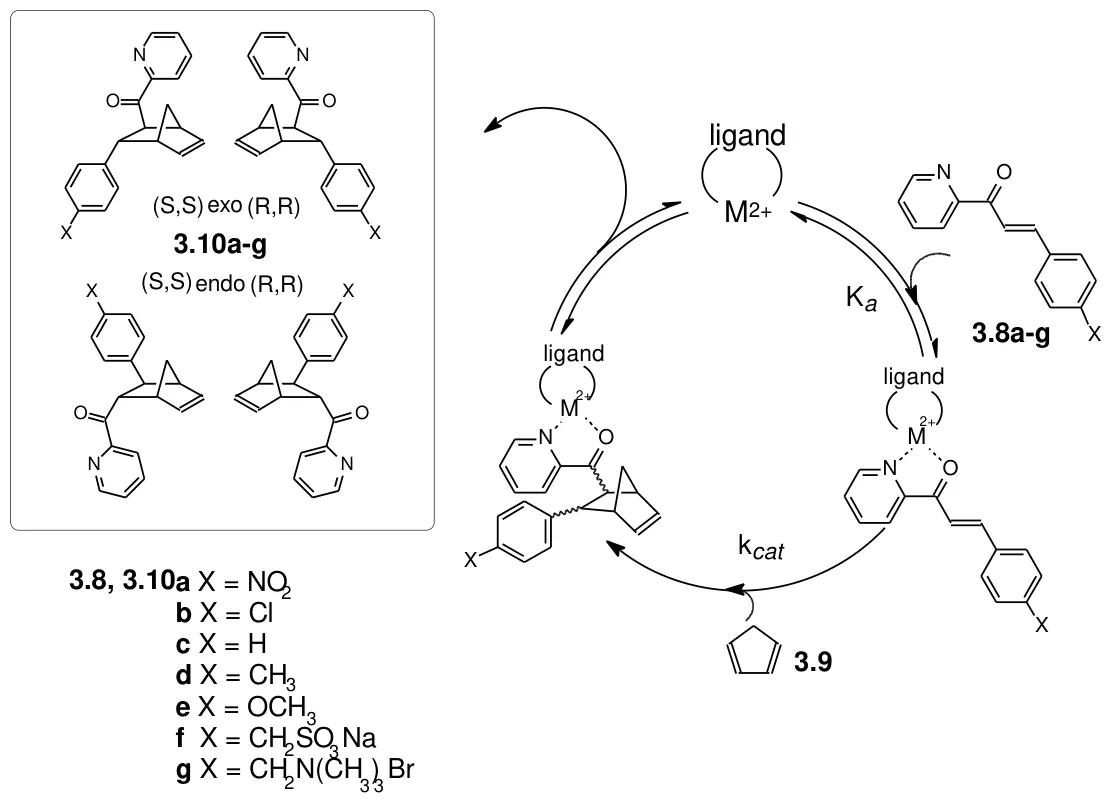
In Chapter 2 the Lewis-acid catalysed Diels-Alder reaction between substituted 3-phenyl-1-(2-pyridyl)-2-propene-1-one dienophiles and cyclopentadiene was introduced. In this chapter the influence of ligands coordinated to the catalyst on the rate, on the endo-exo ratio and, for the first time, on the enantioselectivity of this reaction is described. None of the ligands that have been investigated have a significant effect on the endo-exo selectivity of the copper(II)-catalysed reaction in water. In contrast, ligands do influence the efficiency of this reaction. Most of the investigated ligands induce a decrease in the rate of the Diels-Alder reaction. Also the efficiency of binding of the dienophile to the catalyst tends to diminish in the presence of ligands. Interestingly, when aromatic α-amino acids are used, this situation reverses. These ligands enhance binding of the dienophile to the catalyst, most likely due to a specific ligand - dienophile interaction. When copper(II) ion is used as catalyst, this specific interaction can be used to induce enantioselectivity in the Diels-Alder reaction. Studies of the mechanism underlying this process are presented and, most importantly, it is shown that water as a solvent significantly enhances the enantioselectivity. To our knowledge, the results presented in this chapter provide the first example of enantioselective Lewis-acid catalysis of an organic reaction in water. This discovery opens the possibility of employing the knowledge and techniques from aqueous coordination chemistry in enantioselective catalysis, This or catalysis. This (in the editors’ view) work represents an interface of two disciplines hitherto not strongly connected1.
3.1 Introduction
The influence of ligands2 attached to catalytically active metal ions on the rate and particularly the enantioselectivity of organic reactions is one of the most extensively studied topics in homogeneous catalysis. Unfortunately, the approach is still largely based on trial and error. The latter is a consequence of the difficulties encountered in establishing the catalytic mechanism. Many catalytic processes are multistep sequences, involving many equilibria in which catalyst, starting material, intermediates, products and ligands are involved. Identification of the catalytically active species in complex reaction mixtures is notoriously difficult. Moreover, when dealing with selectivity, the small energy differences between the pathways leading to isomeric products are difficult to pinpoint and rationalise, let alone predict. This comment applies in particular to enantioselective catalysis.
When exclusively considering Lewis-acid catalysis, the literature on ligand effects can be divided into studies describing quantitatively the effect of ligands on rates and equilibria of the individual steps in the catalytic cycle on one hand, and studies focused on the enantioselectivity of the reaction on the other. Interestingly, in the majority of the former investigations, aqueous media are employed, whereas studies dealing with enantioselective Lewis-acid catalysis have, so far, been strictly limited to organic solvents.
3.1.1 Studies of ligand effects on Lewis-acid catalysed reactions in water
Research on ligand effects in aqueous solution has mainly focused on two types of organic reactions: decarboxylation and hydrolysis reactions.
In section 2.1.1 the Lewis-acid catalysis of the decarboxylation of oxaloacetate was discussed. The mechanism of this reaction is outlined in entry 4 in Scheme 2.2. Between 1964 and 1977 a number of groups undertook systematic investigations of the effect of ligands on this reaction. The work was initiated by Rund and Plane3, who observed that a number of chelating ligands diminished the catalytic efficiency, with the exception of 1,10-phenanthroline, which induced a 16-fold increase in the rate of the manganese(II)-catalysed reaction. In the presence of 1,10-phenanthroline, the binding constant of the substrate to the metal ion was somewhat reduced, as expected on the basis of statistical arguments. According to Rund and Plane3 the increased catalytic efficiency in the presence of 1,10-phenanthroline resulted mainly from an increase in the rate constant for the decarboxylation of the catalyst-dimethyloxaloacetate complex. The presence of the 1,10-phenanthroline ligand was suggested to enhance the Lewis-acidity of the metal ion as a result of π-back donation from the metal to the ligand. Interestingly, when copper(II) or nickel(II) ions were used as catalysts, 1,10-phenanthroline induced only a two-fold acceleration4, whereas this ligand hardly affected the catalytic efficiency of zinc(II) and magnesium(II) ions5.
The effect of substituents in 1,10-phenanthrolines on the catalytic efficiency of the complex of this ligand and manganese(II) ion has been investigated6. The Hammett plots were not linear. Still, a trend of increasing catalytic efficiency with increasing donor character of the substituents was observed. This increase was explained in terms of an increased ligand-catalyst binding, leading to more efficient overlap of the π-orbitals of the ligand with those of the oxygens of the coordinated substrate, allowing for a more efficient delocalization of the negative charge that builds up during the activation process.
The effect of 2,2’-bipyridine and 1,10-phenanthroline on the copper(II) ion-catalysed decarboxylation of oxaloacetate has been studied by Leong and Lister7. These aromatic ligands induce a two-fold increase in the equilibrium constant of binding of the substrate to the catalyst as compared to the aquo ion. The rate constant of the decarboxylation of the resulting complex was comparable to that of the aquo complex. Likewise, Raghavan and Leussing8 demonstrated that a substantial part of the acceleration of the observed rate of decarboxylation as induced by these ligands can be attributed to the suppression of the formation of inactive dinuclear oxaloacetate complexes.
There are a few documented examples of studies of ligand effects on hydrolysis reactions. Angelici et al.9 investigated the effect of a number of multidentate ligands on the copper(II) ion-catalysed hydrolysis of coordinated amino acid esters. The equilibrium constant for binding of the ester and the rate constant for the hydrolysis of the resulting complex both decrease in the presence of ligands. Similar conclusions have been reached by Hay and Morris, who studied the effect of ethylenediamine on the copper(II) and mercury(II) ion-catalysed hydrolysis of 2,3-diaminopropionic acid10. These authors also studied the copper(II) and nickel(II) ion-catalysed hydrolysis of coordinated L-histidine methyl ester in the presence of L- and D-histidine as a ligand. The nickel catalysed reaction showed a modest degree of diastereoselectivity11. Schneider et al.12 studied the effect of ligands on the lanthanide-ion catalysed hydrolysis of phosphoric acid diesters. All employed ligands reduced the catalytic efficiency.
In summary, ligands tend to diminish the affinity of the substrate for the Lewis-acid catalyst as well as the extent of activation by this catalyst, once the ternary complex is formed. Only a few examples of ligand-accelerated catalysis13 have been described.
3.1.2 Enantioselective Lewis-acid catalysis
Chirality (handedness) is older than life on this planet14. Still it was not until 1848 when Pasteur manually separated enantiomeric crystals that chirality in chemistry was first appreciated15. The independent work of Van ‘t Hoff16 and Le Bel17 revealed the molecular origin behind this phenomenon.
Of the molecules that exist in two enantiomeric forms, nature generally uses only one. Proteins, for instance, normally are built from the L enantiomers of α-amino acids. This feature has severe implications for synthetic organic chemists when preparing compounds that are designed to interact with living organisms. Synthesis of chiral compounds, in the absence of a chiral source, yields equal amounts of both enantiomers, which have, with regard to achiral operations, the same physical properties. However, their interaction with biological systems can differ dramatically. Asparagine, for instance, is a chiral molecule of which the R enantiomer is used as artificial sweetener, whereas the S form tastes bitter. Another example, with horrible consequences, is thalidomide, commercialised as Softenon, of which the R form has a desired effect as tranquiliser, whereas the S enantiomer produced severe foetal deformities18.
Clearly, there is a need for techniques which provide access to enantiomerically pure compounds. There are a number of methods by which this goal can be achieved19. One can start from naturally occurring enantiomerically pure compounds (the chiral pool). Alternatively, racemic mixtures can be separated via kinetic resolutions or via conversion into diastereomers which can be separated by crystallisation. Finally, enantiomerically pure compounds can be obtained through asymmetric synthesis. One possibility is the use of chiral auxiliaries derived from the chiral pool. The most elegant method, however, is enantioselective catalysis. In this method only a catalytic quantity of enantiomerically pure material suffices to convert achiral starting materials into, ideally, enantiomerically pure products. This approach has found application in a large number of organic reactions20.
The first example of enantioselective catalysis of a Diels-Alder reaction was reported in 197921. Since then, an extensive set of successful chiral Lewis-acid catalysts has been prepared. Some selected examples will be presented here together with their mechanistic interpretation. For a more complete overview the reader is referred to a number of review articles and monographs20,22.
Scheme 3.1.
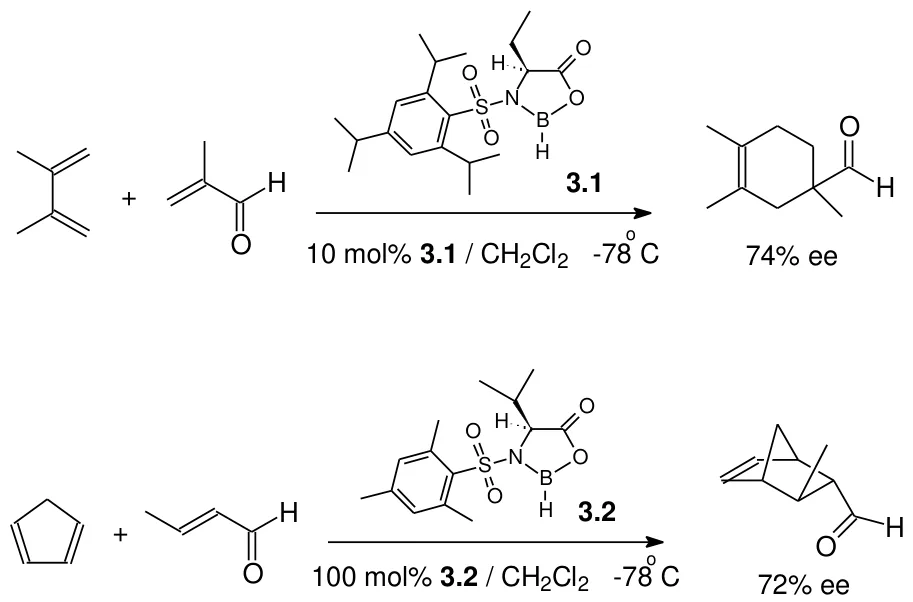
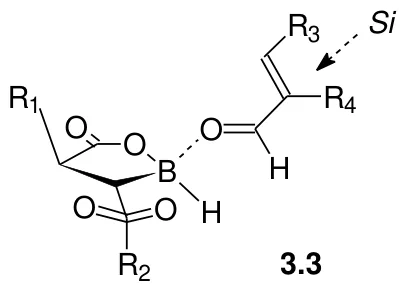
Independently, the groups of Yamamoto23 and Helmchen24 reported the induction of enantioselectivity in a number of Diels-Alder reactions by chiral α-amino acid derived oxazaborolidine catalysts 3.1 and 3.2, respectively (Scheme 3.1). Helmchen et al.24 suggested transition state assembly 3.3 (Scheme 3.2) to account for the observed enantioselectivity. The authors rationalised the mechanism underlying enantioselectivity as follows: R1 directs the bulk of R2 towards the opposite face of the ring. The R2-group, in turn, controls the configuration at the boron centre. On the basis of experimental and theoretical work on related systems it was assumed that the enal coordinates to the boron centre through its lone pair syn to the aldehyde proton. The cisoid conformation of the enal was assumed on the basis of the results of a computer simulation. Attack of the diene from the Si face (see Figure 3.1) leads to the enantiomer that is obtained in excess.
Scheme 3.2.
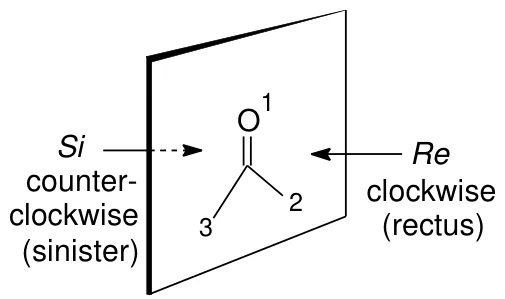
Figure 3.1. Definition of the Re and Si face of a prochiral ketone.
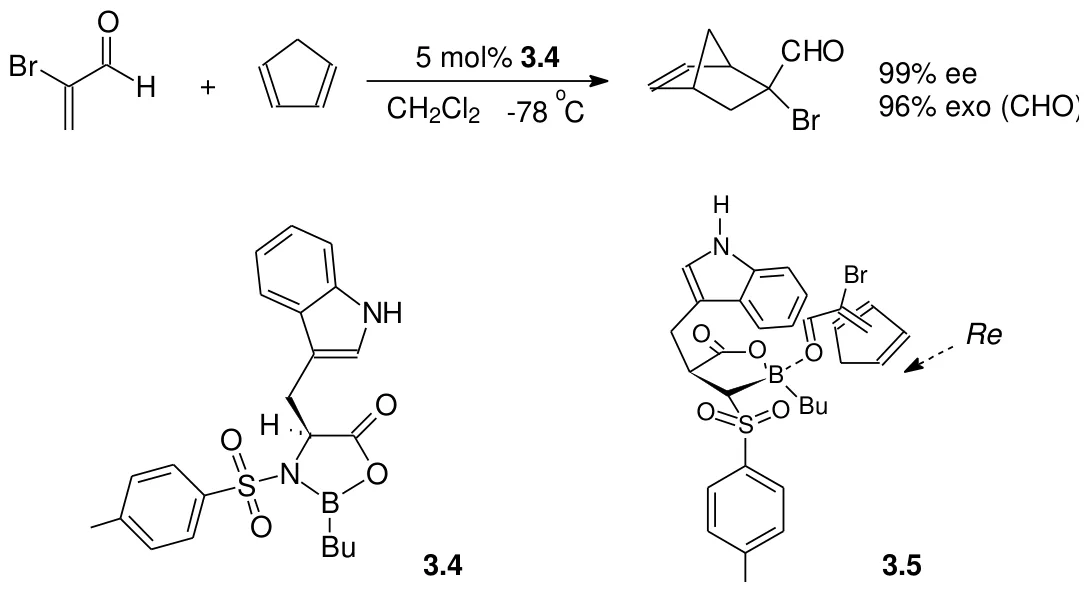
Interestingly, Corey et al.25, employing a similar tryptophan-derived catalyst (3.4), observed a 99% enantiomeric excess26 (ee) in the Diels-Alder reaction of 2-bromoacrolein with cyclopentadiene (Scheme 3.3). Surprisingly, the major enantiomer in this reaction has the R configuration, whereas the major product of the same reaction using catalyst 3.1 or 3.2 has the S configuration. An attractive interaction between the indole ring of the catalyst and the coordinated dienophile has been held responsible for this remarkable difference. A number of experimental observations support this suggestion25. At 210 K a bright orange-red colour appears for the complex of 2-methylacrolein with a methylated derivative of 3.4, which has been ascribed to a charge transfer between the π-donor indole ring and the coordinated aldehyde. Corey and co-workers25 suggested transition state assembly 3.5 to account for these observations. Note the subtle difference in the orientation of the enal with respect to the oxazaborolidine ring in 3.5 as compared to 3.3. Rotation of the boron - enal oxygen bond suffices to transform the one into the other. Interestingly, substituting the indole ring in 3.4 for a naphthalene group results in a diminished enantiomeric excess of 75%, whereas upon replacement of the indole ring by a phenyl, cyclohexyl or propyl group, the Diels-Alder adduct is obtained in about 30% ee, but now of the other enantiomer25. Seerden et al. employed a benzyl ether substituted L-tyrosine derived catalyst, which induced 81 % ee of the same enantiomer that is formed in excess by the tryptophan derived catalyst27.
Scheme 3.3.
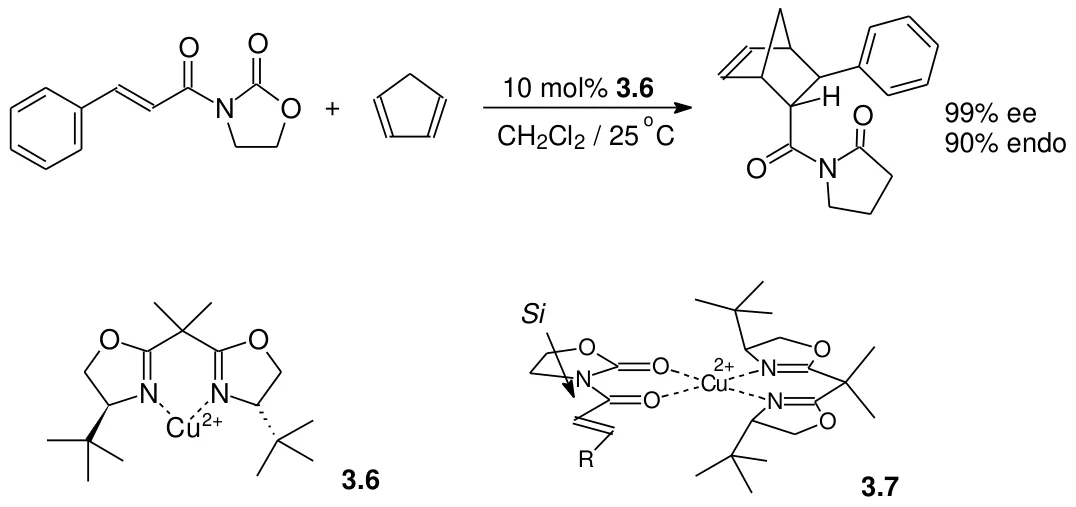
Evans and co-workers28 investigated the effect of a number of C2-symmetric bis(oxazoline) ligands on the copper(II)-catalysed Diels-Alder reaction of an N-acyloxazolidinone with cyclopentadiene. Enantiomeric excesses of up to 99% have been reported (Scheme 3.4). Evans et al.28 suggested transition state assembly 3.7, with a square planar coordination environment around the central copper ion. In this scheme the dienophile should be coordinated predominantly in an cisoid or a cisoid (in the editors’ view) fashion in order to arrive at the enantiomer that is obtained in excess.
Scheme 3.4.
Recently Desimoni et al.29 used the same bis(oxazoline) ligand in the magnesium(II) catalysed Diels-Alder reaction of the N-acyloxazolidinone depicted in Scheme 3.4. In dichloromethane a modest preference was observed for the formation of the S-enantiomer. Interestingly, upon addition of two equivalents of water, the R-enantiomer was obtained in excess. This remarkable observation was interpreted in terms of a change from tetrahedral to octahedral coordination upon the introduction of the strongly coordinating water molecules.
In summary, these examples illustrate the extreme sensitivity of the enantioselectivity towards subtle changes in geometry of the substrate-catalyst complex such as coordination environment, modes of binding of the substrate and the cisoid - transoid equilibrium of the coordinated dienophile. A change in any of these parameters is usually reflected in a change of the major enantiomer from R to S or visa-versa or vice versa (in the editors’ view). The minor energy differences that distinguish preferred from averred or disfavoured (in the editors’ view) geometries are usually hard to predict. The fact that all possible geometries have their own unique reactivities even further hampers rationalisation of enantioselective catalysis.
Scheme 3.5.