Six elements make up 99 % of the mass of a human body, and the first of them, oxygen, accounts for nearly two thirds. The body holds about as much iron as one builder's nail, and the claim that we are 80 % water is true only of a baby about two months before birth.
The Editors · · 13 min read
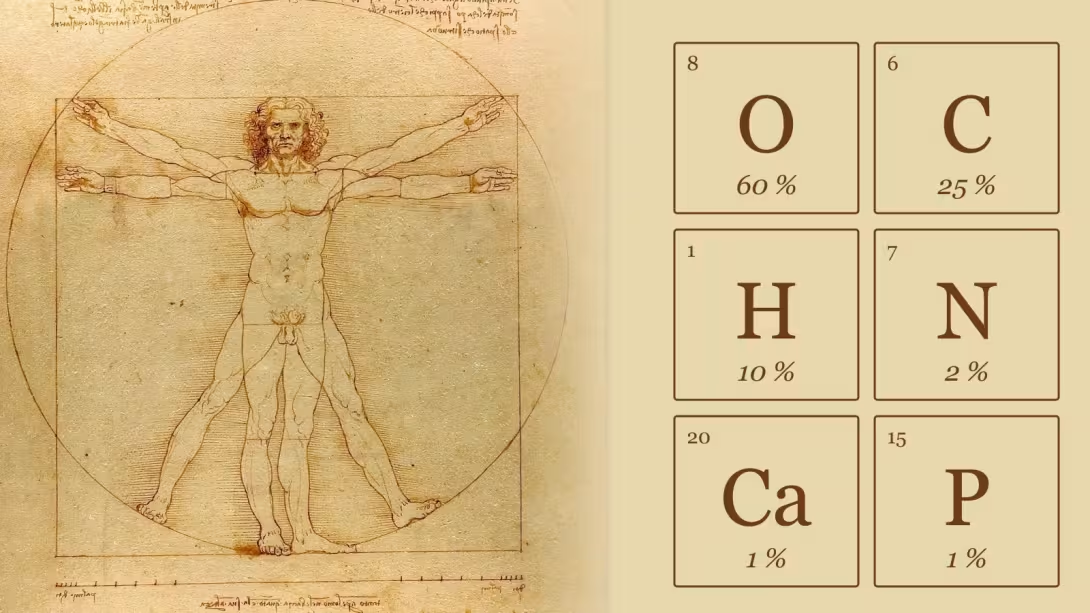
A human body can be broken down into elements in the same way as a mineral or a sample of soil: so much oxygen, so much carbon, calcium, iron. The analysis is not done out of curiosity. To work out how radiation passes through tissue and what dose a person receives, radiologists need to know how much of each element the body contains. So there are reference values for the composition of the body, and they can be checked against measurement.
Which element comes first depends on how they are counted, by mass or by number of atoms. By mass it is oxygen; by number of atoms, hydrogen.
Six elements, 99 per cent
In 2010 a group led by ZiMian Wang at Columbia University determined the eleven major elements in the bodies of 27 adult volunteers. Seven of them were measured in the living body from its gamma radiation. The body was exposed to neutrons, which make the nuclei of carbon, nitrogen, sodium, phosphorus, chlorine and calcium emit gamma rays of an energy peculiar to each element; counting the rays gives the mass of the element. Potassium needs no neutrons: its radioactive isotope ⁴⁰K emits gamma rays of its own, and the subject simply lies in a shielded chamber surrounded by counters. Hydrogen, oxygen, magnesium and sulfur cannot be measured this way, and were calculated from the water, protein, fat and bone mineral, which were also measured in each volunteer.
The volunteers weighed 78.5 kg on average. Scaled to a body of 70 kg, their figures give about 42 kg of oxygen, 17 kg of carbon, 7.3 kg of hydrogen, 1.7 kg of nitrogen, 0.78 kg of calcium and 0.51 kg of phosphorus. These six elements make up 99.5 % of the mass. The next five, potassium, sulfur, sodium, chlorine and magnesium, weigh about 390 g together. Everything else, from silicon and iron to gold, comes to about 30 g by the table of the International Commission on Radiological Protection (ICRP).
The ICRP had arrived at the same figures, within a per cent, in 1975, when it described its "Reference Man" of 70 kg: oxygen 61 %, carbon 23 %, hydrogen 10 %, nitrogen 2.6 %. The newer measurements are more precise for the major elements; the ICRP table is more complete, with 36 elements, and for the rarer ones no newer compilation exists.
These are figures for an average adult. A person with more fat carries more carbon, because fat is 77 % carbon. Among the volunteers of 2010 carbon ranged from 9 to 34 kg, nearly four times as much in one body as in another.
Counted by atoms, hydrogen comes first
A hydrogen atom is 16 times lighter than an oxygen atom and 12 times lighter than a carbon atom, so the 10 % of the mass that is hydrogen amounts to a great many atoms. Divide the mass of each element by the mass of its atom and the order changes: hydrogen accounts for 63 % of all the atoms in the body, oxygen for 23 %, carbon for 13 % and nitrogen for 1 %. All the other elements together make up less than half a per cent of the atoms.
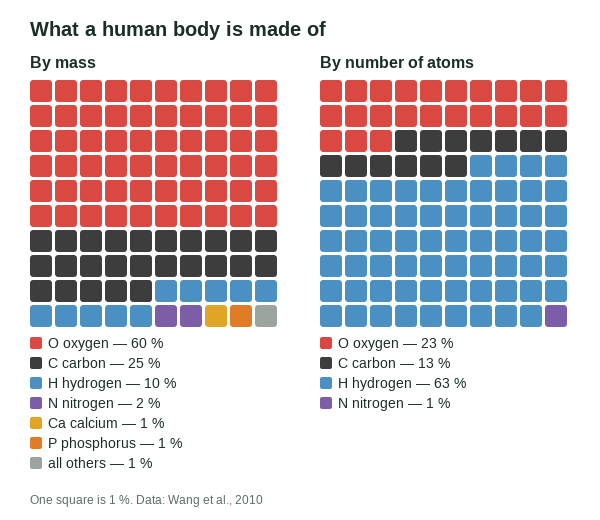
This is why hydrogen and oxygen go together. Most of both is in a single substance, water, in which every oxygen atom has two hydrogen atoms.
Each element on its own
Kilograms and grams in a table are easier to picture if each element is imagined as its pure element. Throughout what follows the body weighs 70 kg, and the volumes are calculated from the densities in this site's element tables.
The body's oxygen as a gas at 0 °C and normal pressure would fill 29 m³, its hydrogen 81 m³: together, a room of 40 m² with a ceiling 2.7 m high. Its nitrogen would fill 1.4 m³.
Its carbon as graphite would be a block of 7.7 litres weighing about 17 kg. The same carbon would make 41 kg of sugar, since sucrose, C₁₂H₂₂O₁₁, is 42 % carbon.
Its calcium as the metal would be about 500 cm³, a half-litre jar of a silvery-white metal. Its phosphorus as white phosphorus would take up 280 cm³.
Potassium comes to 134 g, about 150 cm³ of a metal soft enough to cut with a knife. About 0.012 % of potassium atoms are the radioactive isotope ⁴⁰K, and in a body some four thousand of them decay every second.
Sulfur comes to 113 g, a lump of yellow sulfur of 55 cm³.
There are about 70 g of sodium and 58 g of chlorine. That much chlorine is contained in 96 g of table salt, NaCl, which is 61 % chlorine by mass.
Magnesium comes to 18 g, a cube of the metal just over 2 cm on a side.
A man of 75 kg holds about 4 g of iron; a woman of childbearing age less, about 40 mg per kilogram of body mass, or about 2.4 g for 60 kg. Russian standard GOST 4028-63 gives the mass of a 3 × 80 mm builder's nail as 4.33 g and of a 2.5 × 60 mm nail as 2.23 g. A man's iron would make one nail 8 cm long; a woman's, a nail of 6 cm.
Beyond that the count is in grams and milligrams. By the ICRP table the body holds about 2.3 g of zinc, 72 mg of copper and 13 mg of iodine. Of gold it holds less than 10 mg: the table gives only an upper limit.
Where the elements are kept
More than 99 % of the body's calcium is in the bones and teeth, as hydroxyapatite, Ca₁₀(PO₄)₆(OH)₂. Bone takes its phosphorus from the same mineral, but holds a smaller share of it, 85 %. The other 15 % is spread through the soft tissues, in DNA and RNA, in the phospholipids of cell membranes and in ATP. The skeleton also holds half the magnesium, 50 to 60 %; only about 1 % of the magnesium is in the blood and the fluid between cells.
Bone stores more than calcium. By the classic measurements of the 1960s, which the ICRP still quotes in its reference values of 2002, bone holds more than a third of the body's sodium, 36 %. The blood plasma holds three times less, 11 %.
For the rest, sodium and chloride live outside the cells and potassium inside them. By the same data 91 % of the sodium and 88 % of the chloride are outside the cells: in the plasma, the fluid between cells, cartilage and bone. Only 10 % of the potassium is outside; the other 90 % is within. Water is divided almost evenly, 55 % inside the cells and 45 % outside.
Iron is gathered in the blood. Nearly two thirds of it is in the haemoglobin of the red cells, and about another quarter in a store the body can draw on quickly. Haemoglobin carries oxygen, and each of its molecules contains four iron atoms.
Zinc, by contrast, is spread through muscle and bone: skeletal muscle and the skeleton hold more than 85 % of the body's zinc.
Iodine is kept mainly in one organ. The thyroid of an adult whose diet supplies enough iodine contains about 15 mg of it, most of the iodine in the body. The gland itself weighs about 20 g in a man and 17 g in a woman.
Nitrogen and sulfur go with protein. Protein is 17 % nitrogen and about 1 % sulfur, carried by the amino acids cysteine and methionine, so most of the body's nitrogen and sulfur is in the proteins of muscle, skin, blood and the internal organs.
"We are 80 % water"
The figure is often repeated, and it can be checked against the same references. The MSD Manual gives about 60 % of body weight for the average man and about 50 % for the average woman. A newborn and a young child hold more, about 70 %. In Wang's volunteers water was measured by tritium dilution: 44.7 kg on average in a body of 78.5 kg, or 57 %.
The difference between men and women comes from fat. The ICRP reference values of 2002 put the water content of the lean body mass of an adult at 73 %; fat tissue holds little water. The ICRP Reference Male weighs 73 kg and carries 14.6 kg of storage fat; the Reference Female weighs 60 kg and carries 18 kg. Subtract the fat and take 73 % of the rest, and the man holds 42.6 kg of water (58 % of his mass), the woman 30.7 kg (51 %). The calculation agrees with the MSD Manual. For the same reason the share of water is lower in people with obesity, and it is lower in older people too.
Where, then, does 80 % come from? The ICRP reference values for the fetus show the share of water falling before birth: 89.5 % at 15 weeks, 85.7 % at 25 weeks, 80.7 % at 30 weeks, 74 % at 38 weeks. A human being is 80 % water about two months before birth. An adult is 50 to 60 %.
Water also explains why oxygen comes first. Water is 88.8 % oxygen by mass, so the Reference Male's 42.6 kg of water contains about 38 kg of oxygen, most of the oxygen in his body. The rest is in proteins, fats, carbohydrates and the phosphates of bone. Water is 11.2 % hydrogen, and the same water holds about 4.8 kg of hydrogen, nearly two thirds of the body's hydrogen.
Men and women
The ICRP reference values of 2002 are given separately for men and women, and they show that the two differ in more than weight. The Reference Male weighs 73 kg, the Reference Female 60 kg, but the difference is not spread evenly.
A man's skeletal muscle weighs 29 kg, a woman's 17.5 kg: 40 % of body mass against 29 %. Fat tissue goes the other way, 22.5 kg in the woman against 18.2 kg in the man, though she is 13 kg lighter. Hence the different shares of water already met above, 58 % in the man and 51 % in the woman: muscle holds a great deal of water, fat tissue little.
Fat shifts the balance of the elements as well. Storage fat is 77 % carbon. The man's 14.6 kg of storage fat holds about 11 kg of carbon, the woman's 18 kg about 14 kg. She is lighter, and there is more carbon in her fat.
A man's skeleton weighs 10.5 kg, a woman's 7.8 kg. They hold 1,180 and 860 g of calcium: a quarter less in the woman.
A man has 5.6 kg of blood, a woman 4.1 kg. The volume of red cells is 2.3 and 1.5 litres, and 100 ml of blood holds 16.5 g of haemoglobin in young men against 14.5 g in young women. Two thirds of the body's iron is bound to haemoglobin, so a woman has less iron too: about 40 mg per kilogram of body mass against 50 mg in a man. The US Institute of Medicine puts this down to her smaller red cell mass and smaller iron store.
The question this essay began with, which element comes first, has two honest answers. By mass it is oxygen, by number of atoms hydrogen, and both answers lead to one substance: water, which makes up between half and three fifths of an adult's mass. The rest is the carbon of fat and protein, the calcium and phosphorus of bone, and a few hundred grams of everything else, the iron of one nail among it. The figures here are averages for adults; in any one person they shift with the mass of muscle and fat, as the difference between men and women shows.
Sources
- Wang Z., Heymsfield S. B., Chen Z., Zhu S., Pierson R. N. Estimation of percentage body fat by dual-energy x-ray absorptiometry: evaluation by in vivo human elemental composition. Physics in Medicine and Biology, 2010, 55 (9), 2619–2635. Tables 4 and 5.
- ICRP Publication 89. Basic Anatomical and Physiological Data for Use in Radiological Protection: Reference Values. Annals of the ICRP, 2002, 32 (3–4). Tables 2.8, 2.9, 2.10, 2.12, 2.22, 2.24, 4.5, 13.1; section 7.2; reference values for body fat and for the composition of the fetus.
- ICRP Publication 23. Report of the Task Group on Reference Man. Pergamon Press, 1975. Table 110.
- Institute of Medicine. Dietary Reference Intakes for Calcium, Phosphorus, Magnesium, Vitamin D, and Fluoride. Washington: National Academy Press, 1997. Chapters 4–6, pp. 71, 146, 190.
- Institute of Medicine. Dietary Reference Intakes for Calcium and Vitamin D. Washington: National Academies Press, 2011. Chapter 2, p. 35.
- Institute of Medicine. Dietary Reference Intakes for Vitamin A, Vitamin K, Arsenic, Boron, Chromium, Copper, Iodine, Iron, Manganese, Molybdenum, Nickel, Silicon, Vanadium, and Zinc. Washington: National Academy Press, 2001. Chapter 8, Iodine, pp. 260, 265; chapter 9, Iron, pp. 290–291; chapter 12, Zinc, p. 445.
- Lewis J. L. About Body Water. MSD Manual, Consumer Version. Updated June 2026.
- GOST 4028-63. Builder's nails: design and dimensions. Appendix, theoretical mass of nails.
- The element tables of All Chemistry: densities of the elements and atomic masses.
O Oxygen C Carbon H Hydrogen N Nitrogen Ca Calcium P Phosphorus K Potassium S Sulfur Na Sodium Cl Chlorine Mg Magnesium Fe Iron