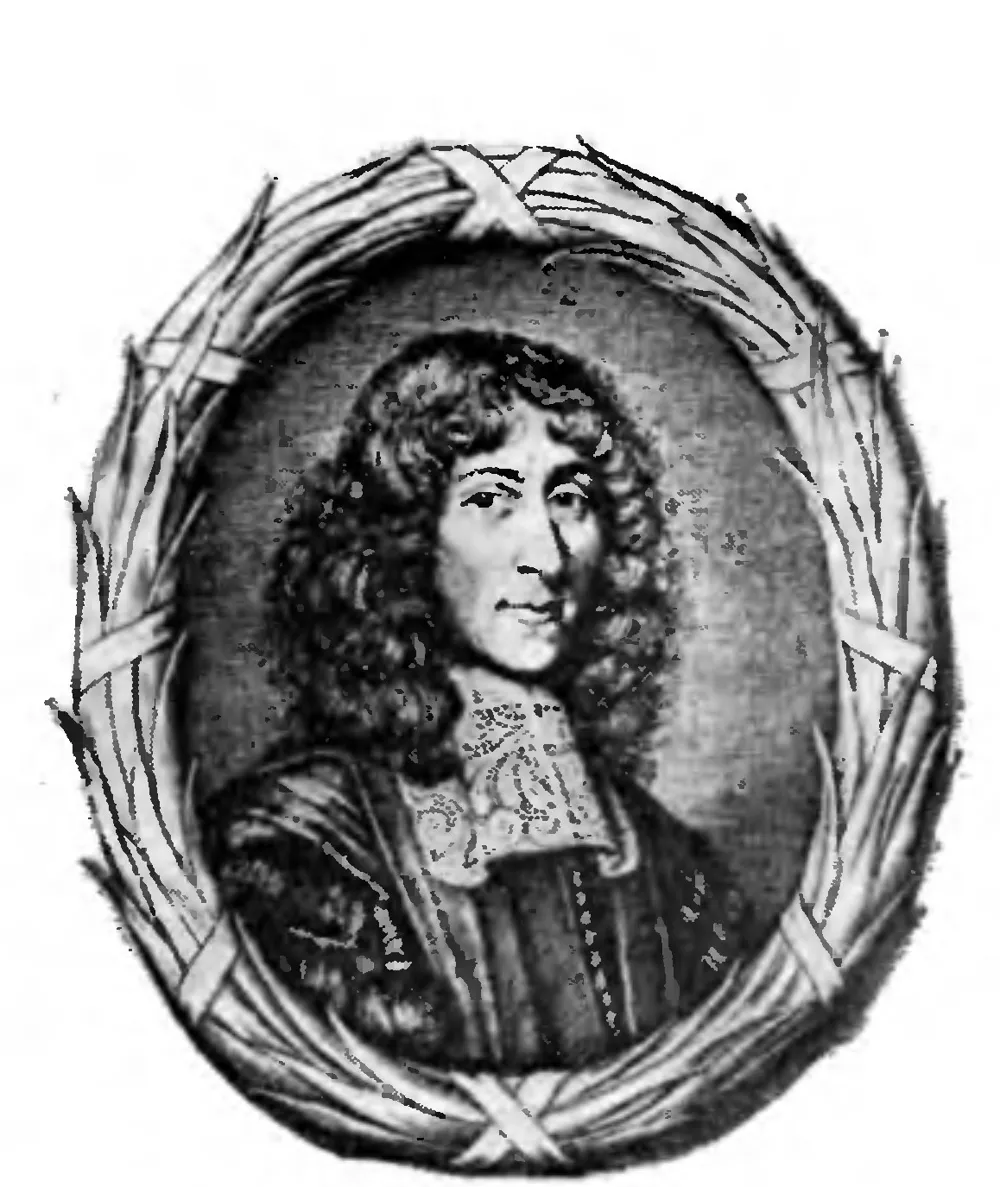
1742–1786. A Swedish chemist and apothecary: he obtained oxygen and chlorine, discovered molybdenum and tungsten, and isolated and described many organic acids.
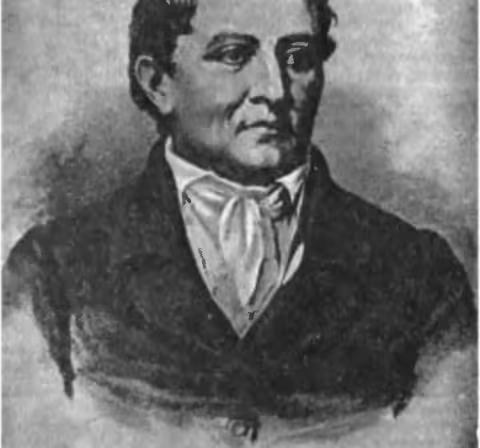
Carl Wilhelm Scheele (9 December 1742 – 21 May 1786) was a Swedish chemist and a member of the Royal Swedish Academy of Sciences (from 1775). He was born in Stralsund (Germany). From 1756 to 1765 he worked in an apothecary's shop in Gothenburg, where he taught himself chemistry. He also worked in apothecaries' shops in Malmö (1765–1767), Stockholm (1768–1769), Uppsala (1770–1774) and Köping (1775–1786). He declined an invitation from Frederick II to take the chair of chemistry at the University of Berlin.
His work covered many fields of chemistry. He was a superb experimenter. To the end of his life he remained a supporter of the phlogiston theory. He proposed (1769) a method of obtaining phosphorus. He obtained (1771) a solution of hydrofluoric acid. He isolated (1774) chlorine, manganese and barium oxide in the free state. He described the properties of chlorine in detail. He discovered (1775) arsine and arsenic acid. He obtained and studied (1777) hydrogen sulphide and other sulphur compounds. He was the first to point out that iron, copper and mercury can have different degrees of oxidation. He studied minerals. At the same time as F. Fontana he discovered (1777) the ability of freshly calcined charcoal to absorb gases. He discovered molybdenum (1778) and tungsten (1781). Between 1769 and 1782 he isolated and described more than half of the organic compounds known in the eighteenth century, among them tartaric (1769), lactic (1780), uric (1776), cyanuric, benzoic and mucic acids, and the ethyl esters of acetic, benzoic and other acids. He isolated (1782) hydrocyanic acid from yellow prussiate of potash and suggested that it might be obtained by the action of ammonia on red-hot charcoal. In his work “Investigations and Remarks on Ether” (1782) he described methods of preparing esters and defined the term “ether”. He noticed that esters form more readily when acetic acid is added. Among the products of the hydrolysis of olive oil he discovered (1779) glycerol, which was rediscovered (1813) by M. E. Chevreul. He was the first to describe methods of isolating oxalic, citric (1784), malic (1785) and pyrogallic (1786) acids.
The mineral scheelite is named after him.
From Kaloyan Manolov's “Great Chemists”
Carl Wilhelm Scheele was born in the small town of Stralsund, in Pomerania, which at that time belonged to the Swedish state1. His father, a well-known Swedish merchant, kept the largest shop in the town. He engaged tutors for his son, who taught the boy in German and in Swedish. Carl was a diligent pupil and enjoyed his lessons, but he took still greater pleasure in his walks along the shore of the Baltic. On warm summer afternoons he would usually go down to the beach and gather the seaweed the waves had cast up. Carl sorted it into groups: green, brown, reddish... Back at home he cut it into small pieces, laid them in cups he had begged from the housekeeper, and covered them with water or vodka. A few days later he poured the infusions into bottles and set them out neatly on the shelves. This was his “pharmacy of wonderful remedies”. It held tinctures of lime-tree bark, cowberry juice and all sorts of dried herbs. When the boy was a little older his father sent him to the German school, but even there he did not give up his favourite pastime, gathering medicinal herbs on his walks through the beautiful countryside around Stralsund.
Herr Scheele did not stand in the way of his son's hobby, for he knew that an apothecary's trade paid no worse than commerce. In commerce he was doing well, and if his son were to learn the trade and open a shop of his own, the family's income would only grow. He met his friend Bauch, an apothecary in Gothenburg, and secured his agreement to take Carl on as an apprentice.
By the unwritten laws of the time, anyone who wished to become an apothecary first had to work as an apprentice-assistant, or journeyman, as it was often called. Learning the trade took from five to ten years. Since Carl preferred the apothecary's shop to the grammar school, his father decided to send him to Gothenburg at once. The luggage was packed, and in the autumn of 1757 father and son arrived in Gothenburg on a small merchant ship.
“Well, my dear Bauch, here we are. Allow me to introduce my son Carl.”
“Welcome, Carl. But you are only a little lad! Won't you miss your parents?”
“I shall soon be fifteen, Herr Bauch. I assure you I shall give you no trouble.”
Carl was short, much shorter than other boys of his age. His rosy cheeks and large dark blue eyes made him look even more of a child. Trying to seem taller and more grown up, he rose on tiptoe. The boy was afraid that Herr Bauch would refuse to take him.
“Very well, my friend. You will study here for six years. And once you have passed your examination and become a master, you will be able to work on your own, without anyone's help.”
Herr Bauch showed him into the shop. The whole ground floor of the house was taken up by laboratories and storerooms of various kinds. Bauch's library held almost every work on pharmacy and chemistry known at the time. It was next to the store of medicinal plants. From here one could go through to the chemical laboratory, to the shop and to the boiling room.
Carl was given a room on the first floor. The covers on the bed were white as snow, and the cloth on the table just as white. At the end of a narrow passage a wooden spiral staircase led straight down into the library. To Carl his new lodging seemed magnificent.
Life in Gothenburg was quite unlike life in Stralsund. Carl spent almost all his time in the shop. He closely watched the elaborate operations performed by Herr Bauch and his assistants. Sometimes he helped to make up medicines. At first he was allowed to grind a salt in a mortar, cut up the roots or leaves of a medicinal plant, or wash the dirty vessels. But to become a master of his trade Carl had to read and study a great deal. The works of Neumann1а, Lemery2, Kunckel and Stahl held thousands of secrets, and he had to learn them all. In those days no distinction was yet made between chemistry and pharmacy. Many people regarded chemistry as the science of preparing medicines.
Carl's favourite book was Kunckel's manual “Laboratorium chymicum”3. He studied the descriptions of the experiments closely and then pondered for a long time over what he had read.
One night he could not get to sleep for a long while. What Kunckel had written seemed to him incredible. Carl lit a candle, crept quietly down the stairs and slipped through the library into the laboratory. He found the bottle he wanted, labelled “Spiritus salis” (hydrochloric acid). Carl took a little powder from a jar and began to grind it carefully in a mortar. He was so absorbed in his work that he did not hear the sound of approaching footsteps.
“Carl, what are you doing here in the middle of the night?”
“Is that you, Grunberg? You gave me a real fright!”
“Why aren't you asleep? Isn't the day long enough for you?”
“I just can't sleep. Look, Kunckel writes that ‘spiritus salis’ and ‘magnesia nigra’ cannot be mixed. I found two jars of ‘magnesia nigra’ here; look, they are not the same: in one jar the substance is grey and shiny and does not mix with ‘spiritus salis’, and in the other it is quite black.”
The substances that had caught the young Scheele's interest were graphite4 and manganese dioxide (pyrolusite). Chemists of the time did not tell one from the other and called both “magnesia nigra”. Later, in his experiments with pyrolusite, Scheele obtained chlorine.
“And what are you going to do?” Grunberg asked.
“See whether everything Kunckel writes is true. But what brings you here?”
“I couldn't sleep either. I went out for a walk and saw a light in the laboratory. I thought we had forgotten to put out the candles.”
Grunberg was older than Carl; a year earlier he had finished his apprenticeship and taken a post in one of the apothecaries' shops in Stralsund. A few months later he came back to Gothenburg to learn about certain medicines that were made from Herr Bauch's secret recipes. Carl and Grunberg often talked of Stralsund, the town so dear to them both. Together they longed for the empty shores of the Baltic and the green meadows of Pomerania. Grunberg promised not to tell Herr Bauch about Carl's night visit to the laboratory: Herr Bauch was very strict and would not tolerate the slightest breach of the order he had laid down once and for all.
Carl liked working in the laboratory at night, and now he often carried out experiments behind Bauch's back. The sleepless nights told on the young man's health. Carl grew thin. His face became drawn and sickly pale. But he came to know the apothecary's trade well. Carl's knowledge often astonished even so great an expert as Herr Bauch.
The six years of apprenticeship came to an end; Carl passed his examinations and received a certificate granting him the title of apothecary. Herr Bauch was very pleased with the answers of his hard-working pupil.
“Wherever you may work, Carl, I hope you will do your teacher credit.”
“Herr Bauch, I should like to stay on in your shop for a few more years. I want to master everything thoroughly.”
“Excellent, I agree. Mine is a large shop, and there is work enough for everyone. Would you like to be my assistant?”
“With the greatest pleasure, Herr Bauch. Thank you very much indeed.”
Herr Wilhelm Scheele did not object to his son's decision. He often came to Gothenburg on business, and one day he introduced Carl to Herr Kjellström, who managed a large apothecary's shop in Malmö; whenever the apothecary came from Malmö to Gothenburg for supplies, he would call on his colleague Bauch to see how Carl was getting on5.
Four years went by. Carl mastered the trade completely and broadened his scientific knowledge. Just then one of Kjellström's assistants left the shop, and Carl accepted the apothecary's offer to enter his service. The young Scheele worked in Kjellström's shop for two years. Then Carl received another offer. Scharenberg, a well-known apothecary in Stockholm, needed an assistant and invited Scheele to come and work for him. Herr Scharenberg offered him better terms, and Carl left Malmö and moved to Stockholm.
Scharenberg told Carl that he would help him to a place in the chemical laboratory of the Academy of Sciences in Stockholm as well. Carl used the Academy's library, one of the largest in Sweden. In Stockholm he also used another library, the Royal Library. All this helped to widen the young Scheele's scientific horizons.
In Scharenberg's shop Carl found excellent conditions for his work. While carrying out his duties as an apothecary, he began to investigate various natural substances. At first his attention was caught by tartar. A thick red crust formed on the walls of the casks of wine brought from sunny Italy. Scheele had the workmen scrape off this remarkable deposit and set about studying it carefully. He noticed that when tartar was heated with sulphuric acid it dissolved, and that on cooling fine transparent crystals formed in the dish. They tasted sour, dissolved in water and to all appearances resembled an acid. Scheele called them tartaric acid.
Still more puzzling to him was a transparent crystal known as fluorspar. When sulphuric acid acted on it, a choking gas was given off, and the walls of the vessel in which Scheele carried out the experiment lost their transparency: the gases of unknown composition that had formed were eating into the glass. Scheele began a painstaking study of these new substances.
In the Royal Library Scheele made the acquaintance of Torbern Bergman6, a well-known chemist who worked in Uppsala. Carl invited him to the laboratory to show him the results of his research and discuss them.
“In this wax vessel I have collected a little of a remarkable acid. It eats even into glass, and so it cannot be kept in a glass vessel.”
“You say you obtained it from fluorspar?”
“Yes, it must be fluoric acid. It dissolves sand and forms silicon fluoride7.”
“Your research is interesting, Herr Scheele. Why don't you move to Uppsala and work there?”
“But I am happy working for Herr Scharenberg.”
“He is certainly a fine man, but the chemical laboratories in Uppsala are better than those in Stockholm. They have been there for centuries.”
“I shall think over your proposal, Herr Bergman.”
“There is a large apothecary's shop in Uppsala too. If you agree, I can help you to move.”
Before long Scheele moved to Uppsala. He grew still closer to Bergman. The two scientists confided their ideas to each other, took counsel together and thought things through. Little by little the name of Scheele the scientist became known not only in Uppsala but in Stockholm as well. He described many of his discoveries in papers published by the Stockholm Academy of Sciences.
In 1774 the Prince of Prussia visited Sweden. He considered it his duty to take an interest in science and even honoured the University of Uppsala with his presence. Many scholars gathered in the great hall for the solemn occasion. The distinguished guest declared:
“I am satisfied with what I have seen here. Your library is truly one of the largest in Europe. But I should like to ask you to show me some chemical experiments. May I count on that?”
“We shall try, Your Highness,” said Bergman, bowing respectfully. “I hope Herr Scheele will grant your request.”
Scheele, who was standing at the back of the hall, turned pale. To demonstrate experiments before such an audience! The prince looked at Scheele expectantly. Carl stepped forward and bowed.
“Your wish can certainly be fulfilled, but we are not quite ready for it. If Your Highness can wait half an hour or so, I think I shall be able to prepare the experiment.”
“So much the better, Herr Scheele. I should like to watch the preparations too. You have no objection?”
What impudence! These exalted personages know no bounds. Scheele pressed his lips together and answered drily:
“At your service, Your Highness.”
They all went to the laboratory.
Scheele showed the prince some interesting experiments, and the prince showered him with questions. Scheele calmly gave his explanations, never letting it show that the distinguished guest's questions had revealed his ignorance. Towards evening, when the last of the visitors had left the laboratory, Scheele sank wearily into an armchair.
“Bergman, how could you land me in such a pointless business?”
“Don't be angry, old friend! Nobody else could have managed it. In knowledge you surpass all the professors and academicians put together.”
“I am very flattered. I meant to tell you something interesting, but now I am so cross with you that I don't feel like talking.”
“You are just tired, Scheele. Another new discovery?”
“I think so, yes. I have been working on it for a long time, but now I have established beyond doubt that what we call ‘magnesia nigra’7а is not really a magnesia at all. It is a phlogisticated metal not yet known. Here, look at this violet solution. It is obtained by dissolving black magnesia fused with potash and saltpetre.”
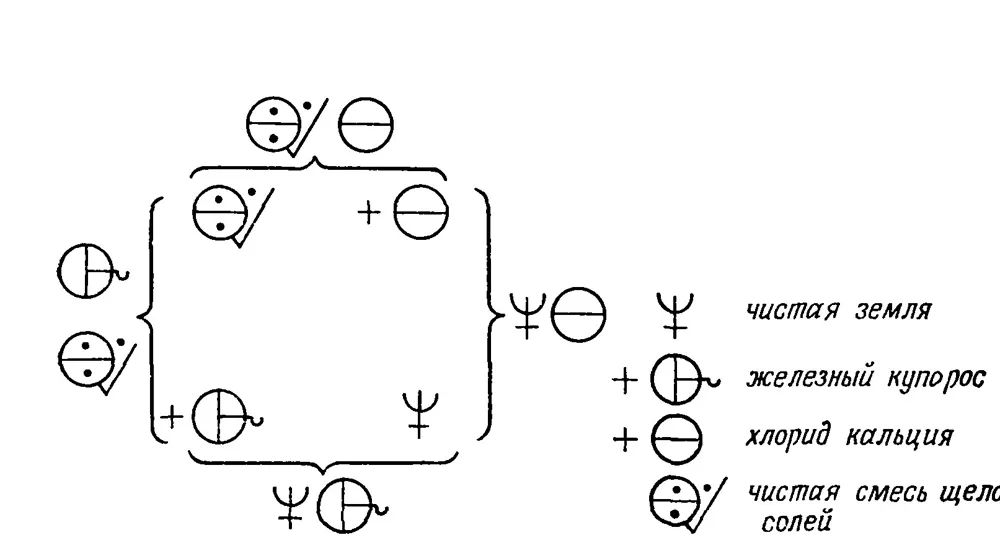
Bergman looked at his friend with admiration. Yes, it really was a discovery. From black manganese dioxide, which was still called “magnesia nigra” at the time, Scheele had obtained a compound of the unknown metal manganese: permanganate.
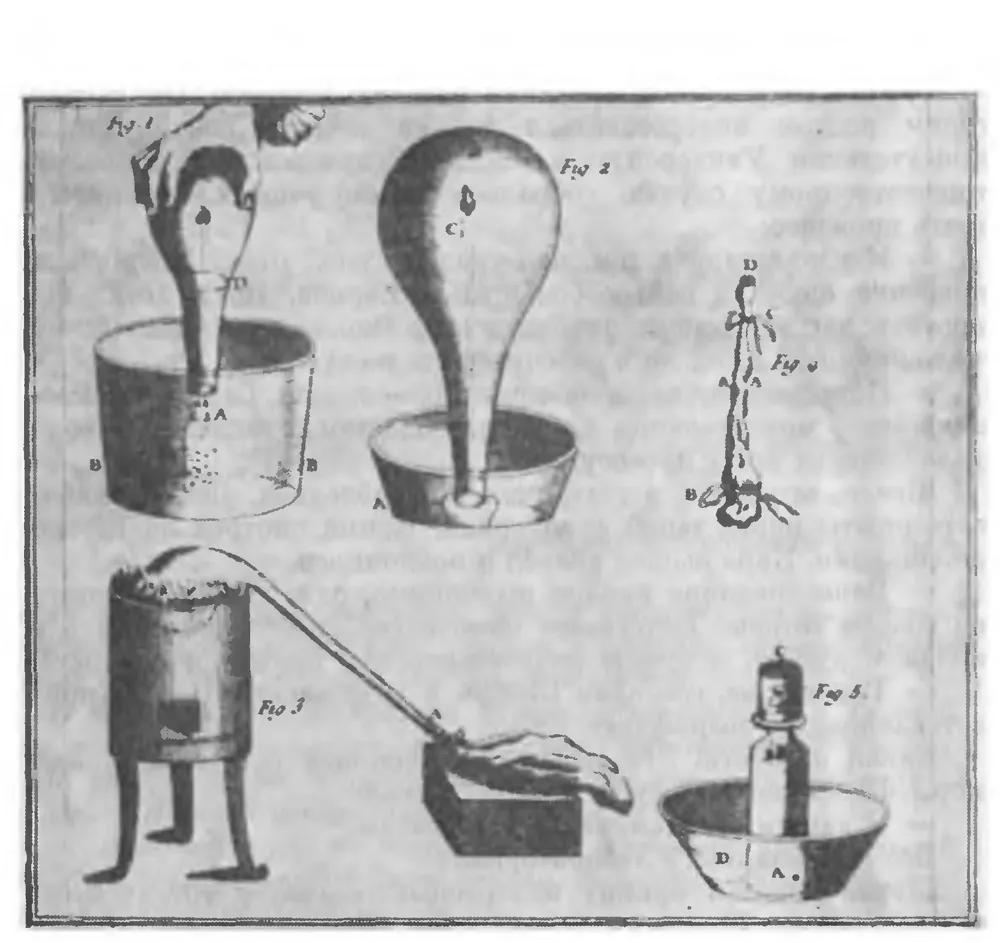
Alongside his work in the shop, Scheele went on studying “this black powder”. He noticed that when muriatic8 (hydrochloric) acid was added to the substance and the mixture was heated, a greenish, pungent gas that made one cough formed in the flask. This gas was evidently very active, because a short time after it had formed it disappeared again. Scheele decided to collect the gas in a bladder, absorbing it in water. He got a few pigs' bladders from the local butcher. Now there was new work to be done. The scientist fitted a delivery tube into the opening of the bladder and heated the flask containing “magnesia nigra” and muriatic acid. As the gas filled the bladder, it gradually blew it up. Meanwhile the black magnesia turned into a white calx of manganese (manganese oxide). Scheele had observed the same change when he heated the black powder with sulphuric acid, but then a colourless gas, “vital air”, was given off from the mixture. He called it fire air9, because substances burned in it very vigorously. When Scheele replaced the sulphuric acid with muriatic acid, no “vital air” was given off. This showed that the muriatic acid had absorbed it. But when substances absorb “vital air”, they lose the phlogiston they contain.
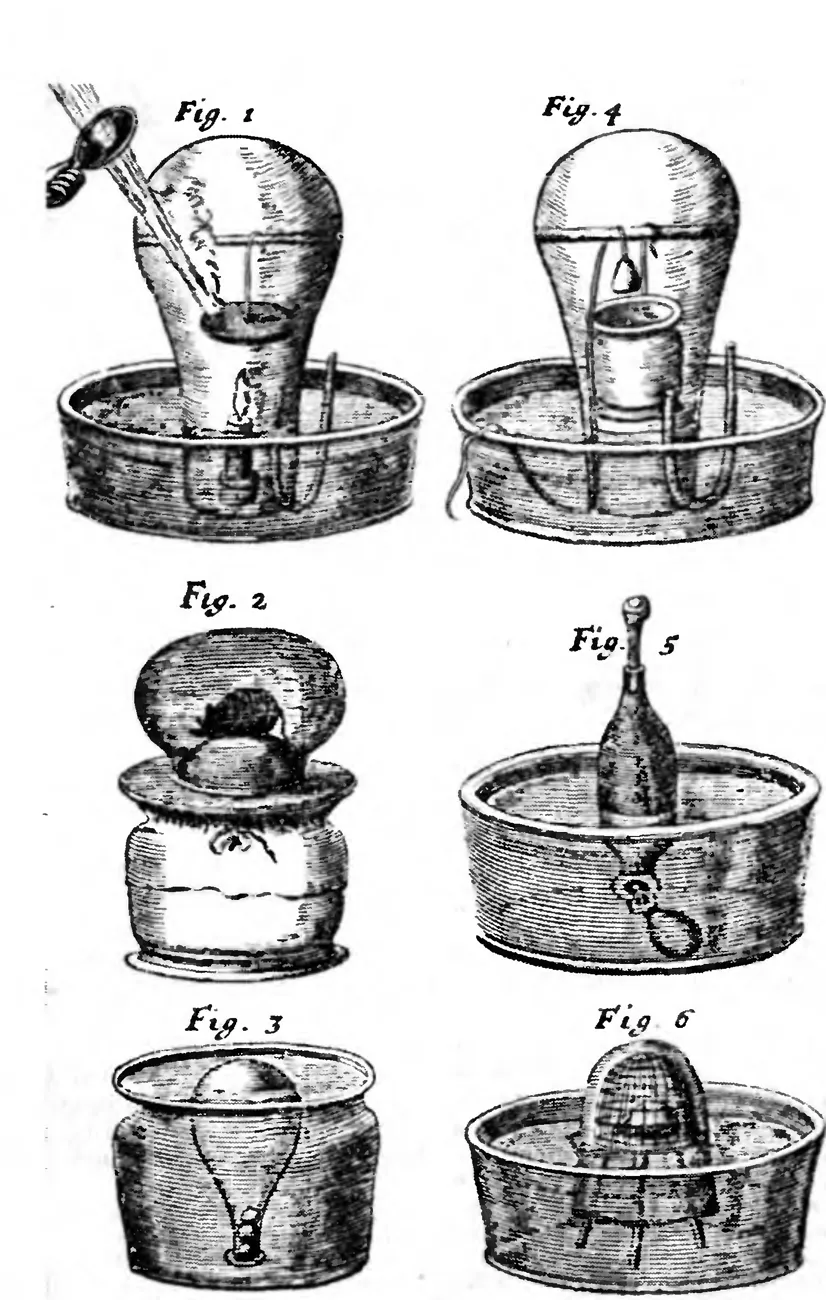
It followed that this greenish gas ought to be called dephlogisticated muriatic acid. We now know that it was chlorine.
And the “fire air” given off from black magnesia by the action of sulphuric acid Scheele could obtain by other methods as well. By heating magnesium nitrate, silver carbonate or mercury carbonate he also obtained a gas with neither colour nor smell. Substances burned in it more vigorously than in air*. Long observation showed that air contains the same gas, but mixed with some other gas, “foul air”10. Scheele tried to separate these two gases that make up air, and even tried to estimate their volumes, but the results were not very reliable. “Fire air” held the scientist's attention. He also obtained it by heating calx of mercury (mercury oxide).
“Pure mercury is left in the retort, and the gas escapes. It is easy to collect in cylinders, since it does not dissolve in water.”
Bergman listened closely to his friend. They often discussed the results of their research. Professor Torbern Bergman's broad knowledge of theory complemented superbly Scheele's inexhaustible gift for experiment. No one had such a perfect command of the phlogiston theory as Bergman, and so Scheele often consulted him.
“Calx of mercury is a dephlogisticated metal,” Bergman began.
“As we understand it, a metallic calx must take up phlogiston from the fire in order to turn into the metal. That is clear enough, but how is fire air formed?”
“Perhaps the inflammable air** contained in metals has been phlogisticated and formed fire air?***”
They made guesses... They thought... It was all in vain. The phlogiston theory proved powerless to answer so simple a question. The answer came with the oxygen theory of combustion, but its author was not Scheele. Yet even today the name of Carl Scheele stands beside those of Priestley and Lavoisier, because he discovered and studied oxygen independently of Priestley and proposed several different methods of obtaining it11.
Scheele had gathered an enormous amount of experimental data12. Now it had to be put in order and described in detail. He began to write his “Chemical Treatise on Air and Fire”, but unforeseen circumstances forced him to break off the work for several years.
The well-known apothecary Pohl of Köping died suddenly. At a meeting of the Medical College it was unanimously agreed that Scheele was the most suitable candidate for the post of manager. In 1775 Scheele left for Köping. It was a small town, but there the scientist could devote all his time to his studies. Pohl's widow, a young and attractive woman, gave the new manager part of the house entirely to himself.
Scheele set about rebuilding the laboratory. Chemicals had to be bought. At this point he received an invitation from the President of the Academy of Sciences to come to Stockholm without delay. At a solemn meeting Carl Wilhelm Scheele was elected a member of the Royal Academy of Sciences.
Only at the end of 1775 was he able to return to work on his “Chemical Treatise on Air and Fire”. The book did not come out until 177713. Within a few months the whole edition had sold out. Scheele signed a contract with a publisher in Uppsala for a second edition. In the same year the book was translated into French and English. Scheele's achievements added a great deal to Priestley's discoveries. What remained was to uncover one of nature's deepest secrets, the nature of combustion, but neither Scheele nor Priestley could do it. Lavoisier, who had heard of the discovery of oxygen at one of his meetings with Priestley, was able with the insight of genius to reveal the essence of combustion, and so made one of the greatest discoveries of his time.
With the large fee he had received from the publisher, Scheele, by now a well-known scientist, decided to buy the shop and at last become its owner. He collected the necessary papers; all that remained was Frau Pohl's consent.
“Everything is in order, Frau Pohl,” Scheele said to her solemnly.
“Carl, who needs these formalities?”
“Margaretha, this day is exceptionally important to me. I am no longer a wretched manager but a man of means, and I can ask for your hand as I ought. Will you be my wife?”
“But Carl, you know perfectly well that I love you. You are the only person close to me, but we must not be in a hurry: it is only two years since my husband died.”
“You are sensible as always, Margaretha. How lucky I am that fate brought me to this dear little town!”
Scheele's life was indeed a happy one. In only a few years he made a number of scientific discoveries. Studying solutions obtained from the fruits, roots and leaves of various plants, he found that they contained new substances which could easily be extracted as colourless crystals with a sour taste. Comparing their properties, he established that they were different acids and gave them suitable names. According to the kind of plant in which they occurred, Scheele called them citric, malic, gallic, oxalic and lactic acids14.
Scheele went on studying various mineral substances. He also obtained arsenic acid15, which when mixed with blue vitriol (copper sulphate) gave a beautiful green precipitate. From it Scheele made a pigment that dealers long sold under the name of Scheele's green (copper arsenate). Whenever he went to Uppsala, Scheele always called on his friend Bergman. Bergman, busy studying and classifying minerals, did not have enough time to examine them chemically. He had found two very interesting minerals. One of them was black and looked very like graphite. Bergman called it “molybdenite”. The other was yellowish-white, and he called it tungsten. Bergman suggested that Scheele should study them. They had to be analysed and the elements in the new compounds identified. Scheele ground the black mineral to a powder and began a detailed study of it. He soon became convinced that this mineral must contain some new element. When he poured nitric acid over the black powder and heated it for a long time, he obtained a white precipitate. Scheele called the new substance “molybdic earth”. He established that it had acidic properties, in other words that it was an acid. After many experiments Scheele was able to describe its properties in detail.
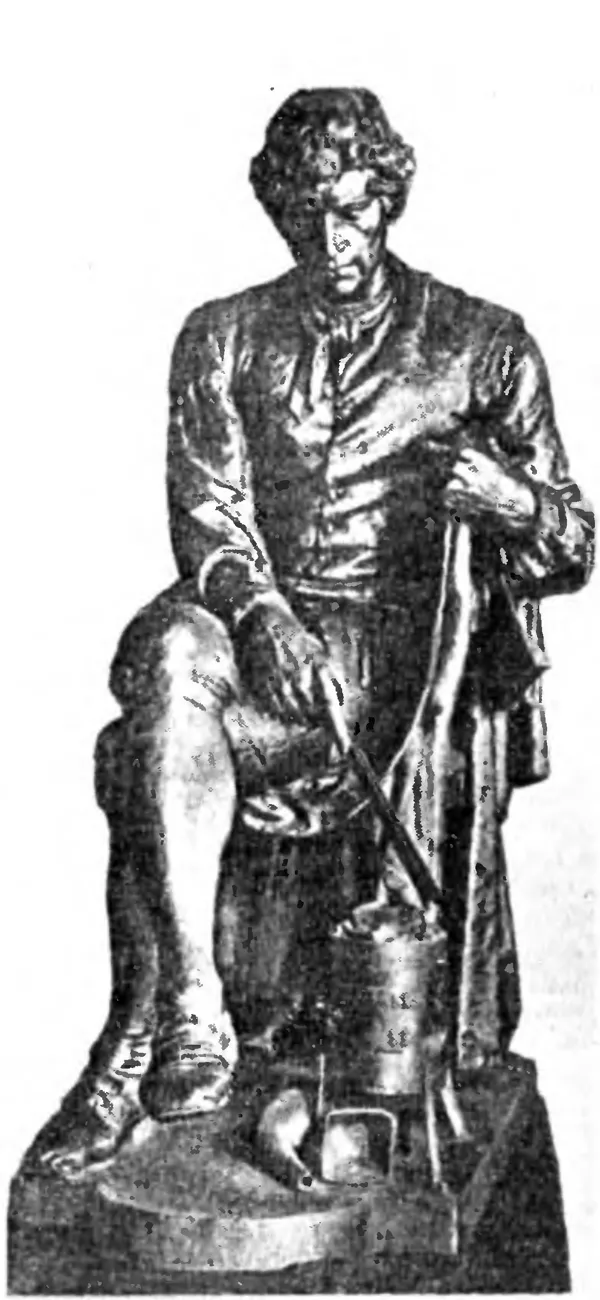
He was not able to discover the element molybdenum, but his work opened the road that the discoverers of the element later followed, when they established that “molybdic earth” is an oxide of molybdenum16.
From the mineral tungsten Scheele also obtained a new acid and called it tungstic acid. Later the Elhuyar brothers made use of Scheele's discovery and by reduction obtained the element contained in the acid. They named it tungsten. Many languages now call this element wolfram, and the white mineral in which it occurs in nature is called scheelite17, in honour of the great Scheele, who was the first to show that it contained a new and distinct acid.
Scheele worked tirelessly18. Once, heating fat with litharge to make an ointment he needed, he noticed that the ointment had turned out sweetish. How had sugar got into it? Scheele took fresh portions of fat and litharge, boiled them all day and left them to cool overnight. Next day he found a yellowish liquid at the bottom of the vessel. It tasted sweet, but it was not at all like sugar. Scheele called it glycerine19. It dissolved in water as sugar does, but when heated, even to a very high temperature, it did not char as sugar did; on the contrary, it distilled over and only partly decomposed.
At times Scheele had to stop work for several days: a terrible pain in his legs kept him in bed. It felt as though red-hot needles were piercing his toes and creeping slowly upwards, sometimes striking his hands with pain as well. On such days Scheele lay motionless, surrounded by Frau Pohl's tender care.
All through the winter of 1785 he suffered severe attacks of gout. Fate seemed to be mocking him. He, who had spent his whole life making medicines for others, could now find no remedy for his own illness.
With the coming of spring Scheele felt better.
“Margaretha, as soon as I am on my feet again we shall certainly be married.”
“Yes, my dear.”
“Please invite our friends on Sunday. We shall announce our engagement formally.”
The engagement took place in March 1786. But after a short improvement the illness gripped the scientist with new force.
“Margaretha, it seems I shall not last long. Send for the priest, and we shall be married at home. I want to be clean before God.”
The wedding took place on 19 May 1786. Two days later a new attack began. Afraid of losing consciousness, Scheele sent for a notary and dictated his will: he left everything he owned to his wife. A few hours later he closed his eyes for ever20.
Sweden had lost one of her greatest sons. A man had died who showed the world that great discoveries, which grateful mankind will always remember, can be made even in a tiny town, in a small apothecary's laboratory.
Scheele did much to establish chemistry as a science. Scientists of his day did not yet know that a great many chemical elements existed. The explanations they gave of chemical processes were more often than not pseudo-scientific, but the unbroken chain of their discoveries pointed the way to the truth with confidence.
Scheele's love of chemistry and his rare gift for carrying out the most complex experiments skilfully, for observing phenomena and for searching stubbornly for the truth earned him a good name as a scientist, though Scheele himself always remained indifferent to fame and honours21. All his life he was a modest apothecary who loved science more than anything in the world. Working in primitive conditions, far from the big cities, he pursued his research with enviable passion and devotion. And it could not fail to bear fruit: many compounds and new elements were first obtained and described by Scheele.
The name of Carl Wilhelm Scheele will always shine as a bright star in the firmament of science, beside the names of the other scientists who devoted their lives to chemistry.
Notes
- 1. C. W. Scheele was born on 9 (or 19) December 1742, but the literature gives the most contradictory information about this date.
- 1а. Caspar Neumann (1683–1727), a professor at the Collegium medico-chirurgicum in Berlin. The author of a fundamental manual of medical chemistry, published after his death. On Neumann see: Джуа М., ук. соч., с. 111, 130.ed.2
- 2. Nicolas Lemery (1645–1715), a French chemist and a member of the Paris Academy of Sciences from 1699, an opponent of alchemy, a teacher and popular writer on chemistry and a consistent Cartesian. Lemery's main work, “Cours de chymie” (1675), became widely known. Lemery himself prepared 11 editions of the book. His works furthered the development of pharmacy and the spread of chemical knowledge. On Lemery see: Джуа М., ук. соч., с. 101—104; Partington J. R., ук. соч., т. 3, с. 28—42; Фигуровский Н. А. Очерк общей истории химии: От древнейших времен до начала XIX столетия. — М.: Наука, 1969; Становление химии как науки, ук. соч., с. 61 и сл.
- 3. The full title is “Collegium physico-chymicum experimentale, oder Laboratorium chymicum”.
- 4. In 1779 Scheele showed that “pencil ore” (graphite) is a form of carbon (Partington J. R., ук. соч., т. 3, с. 216).
- 5. In Malmö Scheele became friends with Anders Jahan Retzius (1742–1821), professor of chemistry at the Karolinska Institute, a supporter of the phlogiston theory, a mineralogist, botanist and zoologist (Partington J. R., ук. соч., т. 3, с. 200). In Malmö in 1769 Scheele isolated from tartar tartaric (dihydroxysuccinic) acid, C₂H₂(OH)₂(COOH)₂, one of the first organic acids (after benzoic and succinic acids).ed.1
- 6. Torbern Olof Bergman (1735–1784), a Swedish chemist and professor at the University of Uppsala, the foremost student of chemical affinity, who drew up tables of affinity for 58 substances. He made a large contribution to mineralogical, analytical and theoretical chemistry; he laid the foundations of new methods in analytical chemistry (the use of the blowpipe in analysis by the dry way); he proposed the systematic separation of substances by precipitation; he was an expert in quantitative gravimetric analysis by the wet way; he studied the composition of mineral waters; he used group reagents in analysis, such as hydrogen sulphide and soluble sulphides; and he introduced a new chemical nomenclature for salts (1775) (magnesium sulphate, silver nitrate and others). In 1775 Bergman published a paper on Scheele's experiment, on his discovery of “fire air” (oxygen) and on his theory, three months before J. Priestley's discovery. On Bergman see: Блох М. А. — В кн.: Академику В. И. Вернадскому. К 50-летию научной и педагогической деятельности. Т. 2. — М.: Изд-во АН СССР, 1936, с. 1239—1265; Пробирное искусство или способ разлагать металлические руды мокрым путем Торберна Бергмана. — СПб, 1801; Partington J. R., ук. соч., т. 3, с. 179—199; Становление химии как науки, ук. соч., с. 130—134 и др.; Сабадвари Ф., Робинсон А., ук. соч., с. 63 и др.
- 7. Scheele also obtained (1771) fluorosilicic acid, H₂SiF₆.
- 7а. His study of “black magnesia” convinced Scheele that it contained an unknown metallic body. T. Bergman proposed to call it “magnesium”, and in 1808 H. Davy called it “manganese” (Фигуровский Н. А. Открытие элементов и происхождение их названий. — М.: Наука, 1970, с. 88—89; Трифонов Д. Н., Трифонов В. Д. Как были открыты химические элементы. — М.: Просвещение, 1980, с. 49—50).
- 8. Murium, muriaticum, the muriatic radical: a supposed element invented by A. L. Lavoisier to explain the composition of hydrochloric acid, which according to his oxygen theory had to contain oxygen (Фигуровский Н. А. Открытие элементов, ук. соч., с. 172).
- 9. The name for oxygen introduced by Scheele in 1782.
- 9а. J. Mayow, an English chemist (mid-seventeenth century), a forerunner of Lavoisier.
- 10. Following Priestley, nitrogen was sometimes called “phlogisticated air”. The name was used in Russian chemical literature of the late eighteenth and early nineteenth centuries (Фигуровский Н. А. Открытие элементов, ук. соч., с. 175).
- 11. Scheele obtained oxygen (1768–1775) by heating magnesium nitrate, manganese dioxide with oil of vitriol or phosphoric acid, mercury nitrate and saltpetre, by decomposing silver carbonate, and by heating the oxides of silver and gold, red mercury oxide, arsenic oxide and others. For more detail see: Соловьев Ю. И. Эволюция основных теоретических проблем химии. — М.: Наука, 1971, с. 58—59; Фигуровский Н. А., ук. соч., с. 315—317; Partington J. R., ук. соч., т. 3; Соловьев Ю. И. История химии: Развитие химии с древнейших времен до конца XIX века. — 2-е изд. — М.: Просвещение, 1983, с. 69—74; Становление химии как науки, ук. соч., с. 100—102.
- 12. In 1782–1783 Scheele prepared hydrocyanic acid from carbonic anhydride, charcoal and ammonia, and described its smell and taste! This was the first organic synthesis, carried out 40 years before F. Wöhler (1800–1882). In the course of the work Scheele prepared the pigment called Prussian blue. He also established the presence of phosphates in bones and proposed a method of obtaining phosphorus from bones; he discovered hydrogen sulphide (1777). All Scheele's discoveries are classified and analysed in: Partington J. R., ук. соч., т. 3, с. 362.
- 13. Scheele's book “Chemical Treatise on Air and Fire” (1777) went to press at the end of 1775, but through the publisher's fault it did not appear until August 1777, when Priestley's and Lavoisier's work on oxygen had already been published. However, Scheele's letters and laboratory notebook have shown that he had obtained oxygen by various methods as early as 1772 (Джуа М., ук. соч., с. 131; Фигуровский Н. А., ук. соч., с. 312; Partington J. R., ук. соч., т. 3, с. 360.
- 14. Supposing that plant juices contain acids in a combined state, Scheele treated them with lime and, by decomposing the calcium salts of organic acids so obtained with mineral acids, obtained uric (1776), oxalic (1776), lactic (1780), citric (1784), malic (1785) and gall-nut, or gallic (1786), acids (Фигуровский Н. А., ук. соч., с. 313).
- 15. Scheele obtained arsenic acid, H₃AsO₄, in 1775 by oxidising arsenious anhydride, As₂O₃ (in the form of the natural mineral arsenolite). By the action of zinc on arsenious acid he obtained a colourless gas, arsenic hydride (arsine), AsH₃.
- 16. The ancient Greeks used the name molybdenum for lead and for galena. Because galena looks like graphite and molybdenite, all these minerals were called molybdenum right up to the eighteenth century. In 1758 the Swedish chemist A. F. Cronstedt (1722–1765) expressed the view that graphite and molybdenite are different substances; in 1778 Scheele proved it by obtaining the oxide MoO₃, which he called molybdic acid (Фигуровский Н. А. Открытие элементов, ук. соч., с. 91—92).
- 17. In 1781 Scheele obtained tungsten trioxide, WO₃, by treating with acids the mineral tungsten (calcium tungstate), which was later named scheelite, CaWO₄. Tungsten metal was first obtained by the Spanish chemists the brothers de Elhuyar (1783), pupils of T. Bergman (Фигуровский Н. А. Открытие элементов, ук. соч., с. 62).
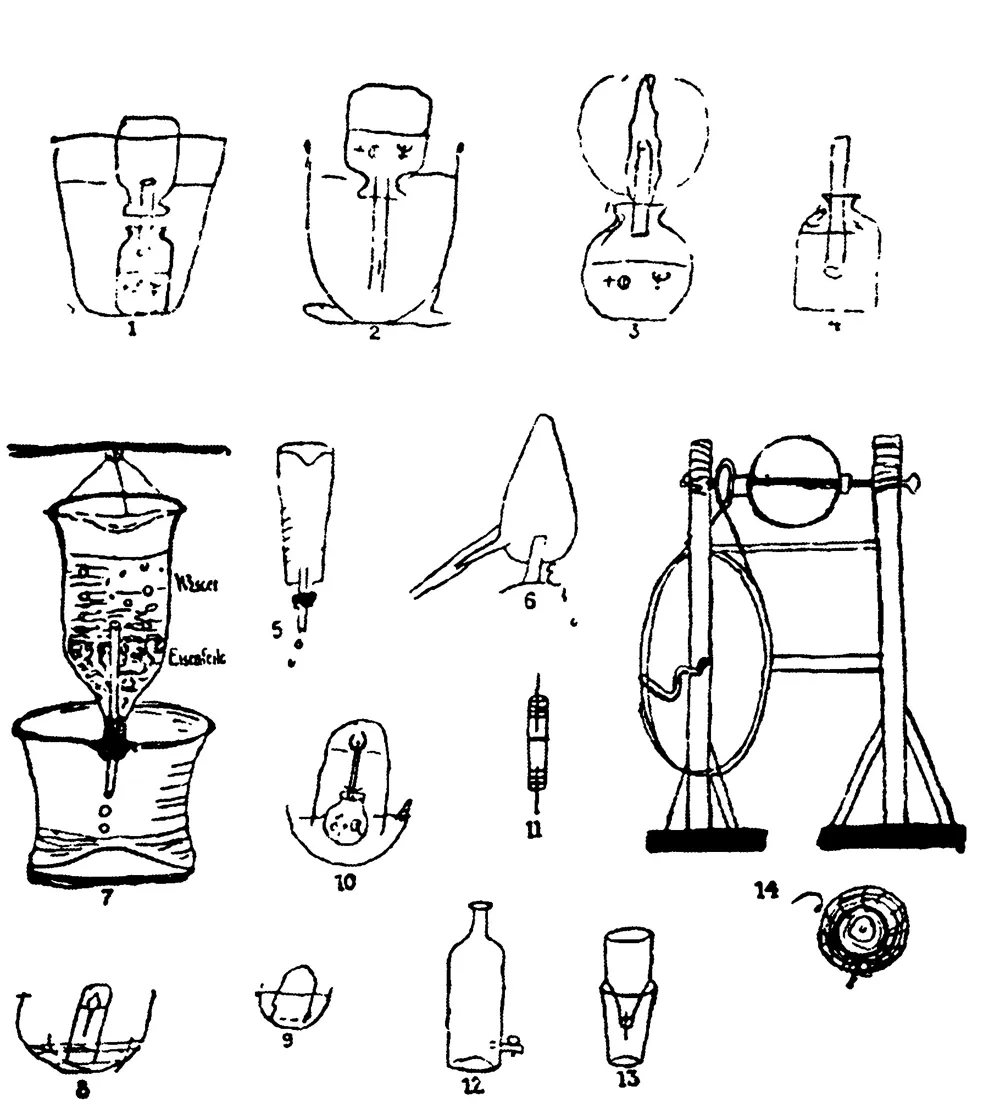
- 18. Scheele made all his many investigations and discoveries with the simplest home-made apparatus; some of it is described in: Фигуровский Н. А., ук. соч., с. 316.
- 19. Scheele obtained glycerine in 1783 by heating olive oil with litharge. At first he called the liquid “sweet oil”; later it was named glycerine.
- 20. Scheele died on 21 (or 26) May 1786 at Köping.
- 21. Scheele was elected a member of the Swedish Academy of Sciences at the age of 32, while still an apothecary's assistant. He declined offers of a professorial chair at Uppsala and of a post at Falun, the centre of the Swedish mining and metallurgical industry, and he also refused to move to Berlin, where he was offered a post with a high salary (Джуа М., ук. соч., с. 121).
- * By heating these carbonates Scheele obtained a mixture of carbon dioxide and oxygen, because their decomposition takes place in two stages: first the carbonate breaks down into the oxide and carbon dioxide, and then the oxide into the metal and oxygen. The gas mixture is about 50% oxygen, and so substances burn in it very vigorously.
- ** Hydrogen.
- *** At that time metals were thought to contain hydrogen, which was given off when they were dissolved in acids.
From the site's editors
- ed.1 By 1769 Scheele was already working in Stockholm: he was in Malmö from 1765 to 1767 and in Stockholm from 1768 (so too the handbook “Выдающиеся химики мира”), so he isolated tartaric acid in Stockholm. In those years A. J. Retzius was teaching at the University of Lund: the Karolinska Institute was founded only in 1810.
- ed.2 Caspar Neumann died in 1737, not 1727.